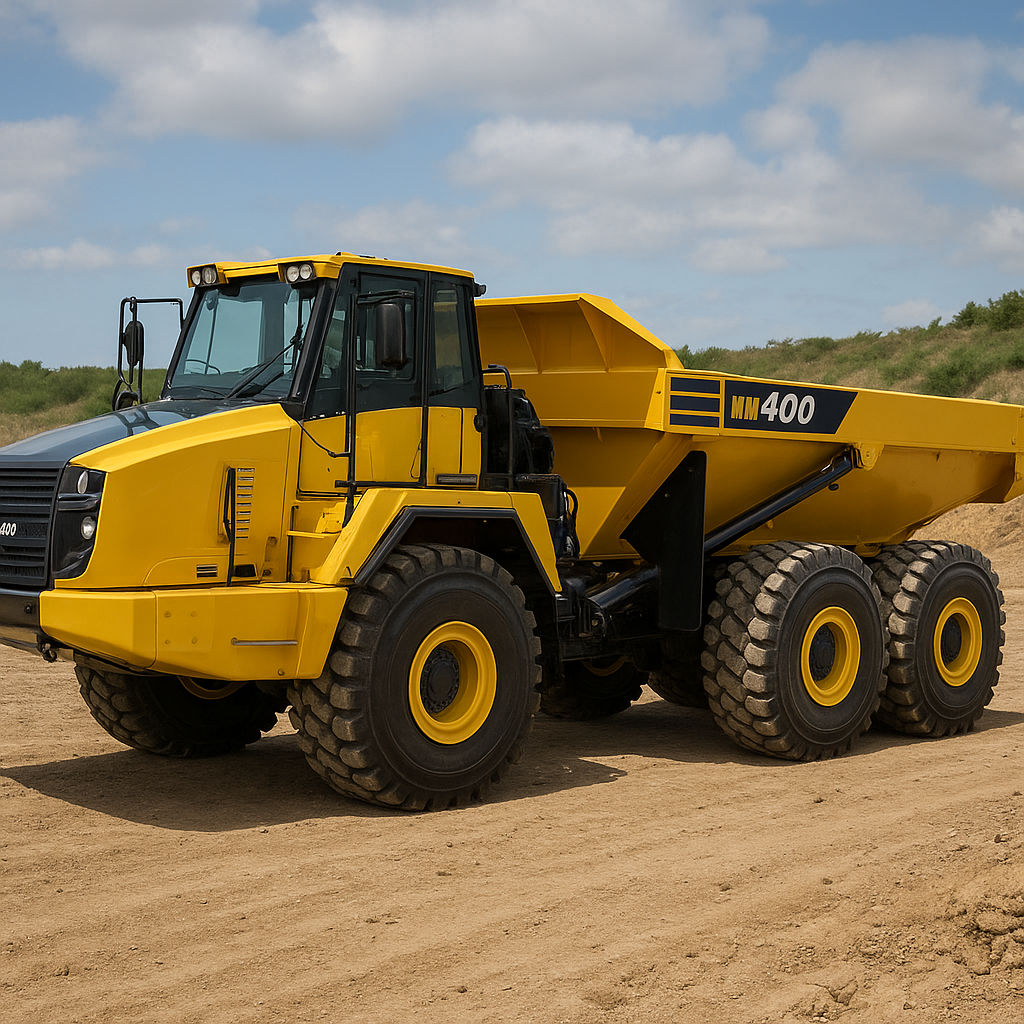
The Komatsu HM400-5 is a heavy-duty articulated dump truck designed for demanding off‑road hauling tasks. In this article you will find an overview of its design and technical characteristics, practical applications on construction sites and in mining, operational and maintenance considerations, safety features, and comparative observations that can help buyers and operators make informed decisions. The sections below include practical statistics, typical performance figures, and suggestions for maximizing the machine’s lifecycle value.
Design and key features
The Komatsu HM400-5 is an example of an articulated hauler built to move large volumes of material across rough terrain with high reliability and operator comfort. The vehicle’s architecture combines a robust front frame and powertrain with a separate rear bogie and dump body connected by an articulated joint. This articulation provides excellent maneuverability and traction on slopes, in wet conditions, and on soft ground where rigid-frame trucks would struggle.
Key design elements include:
- Articulated chassis that delivers superior off-road mobility and reduced ground pressure compared with conventional rigid dump trucks.
- A heavy-duty dump body with optimized geometry for quick and complete material discharge, often featuring high-strength steel for extended durability.
- An advanced driveline that typically includes a torque converter and automatic transmission, designed for smooth power delivery and reduced operator fatigue.
- All-wheel drive with automatic traction control and differential locks that help maintain momentum in challenging conditions.
- A reinforced suspension system — often hydro-pneumatic or spring-based depending on configuration — to protect the chassis and payload from excessive shock loads.
Technical specifications (typical values)
Specifications for the Komatsu HM400-5 vary slightly depending on configuration, regional regulatory packages, and optional equipment. The figures below represent commonly published values or typical industry expectations for a machine in this class. For exact numbers consult the manufacturer’s specification sheet for the exact serial/model configuration.
- Payload: approximately 36–40 tonnes (metric)
- Operating weight: typically in the range of 28,000–32,000 kg depending on options
- Engine: a turbocharged diesel engine meeting regional emissions standards (for example EU Stage or EPA Tier equivalents), with displacement and tuning optimized for low-end torque
- Rated power (horsepower): commonly between 300–370 kW (400–500 hp) depending on tuning and emission control hardware
- Top speed: around 55–60 km/h on road/level surface (limited by gear ratio and safety settings)
- Fuel capacity: typically 600–900 liters, designed for full-shift operation in remote sites
- Transmission: automatic or automated powershift with multiple gears forward/reverse
- Brakes: service and parking brakes with hydraulic or hydraulic-retardation assist plus multiple safety redundancies
- Body volume: usually between 18–24 m3 depending on load material and body design
Note: The ranges above are intended to give prospective users a realistic expectation. Exact figures will depend on equipment packages, local emissions hardware, and specific market offerings.
Applications and typical use cases
The HM400-5 is commonly used where large volumes of material must be transported quickly over unpaved, uneven ground. Typical industries and use cases include:
- Construction and civil engineering: earthmoving for roadworks, dam building, large-scale excavation, and site preparation.
- Mining and quarrying: transporting blasted rock, overburden, and mill feed between extraction points and processing or stockpile areas.
- Infrastructure projects: pipeline trench backfill, bridge approach construction, and bulk material relocation for airports or ports.
- Forestry and land reclamation: hauling biomass, soil, and fill material in remote or soft-ground environments.
Articulated haulers like the Komatsu HM400-5 are favored in projects requiring a balance between payload capacity and off-road agility, where rigid haulers or large rigid dump trucks cannot operate efficiently or safely.
Performance and productivity
Productivity for the Komatsu HM400-5 is a function of payload, cycle time, fuel consumption, and site logistics. Key performance factors include:
- Short cycle times achieved through responsive powertrains and efficient body dump geometry.
- High tractive effort in poor traction conditions thanks to articulated steering and automatic traction control systems.
- Optimized fuel consumption using engine management systems that match power output to load and terrain, plus options like eco-modes for non-critical moves.
- Reduced downtime due to robust components and easy-access service points.
Sample productivity estimate (illustrative): with a 38-tonne payload and an average cycle time of 15 minutes, a single HM400-5 could theoretically move close to 3,000 tonnes per 10-hour shift under favorable conditions. Actual productivity will vary with haul distance, loading efficiency, terrain, and operator proficiency.
Operator comfort, ergonomics and safety
Modern articulated haulers emphasize operator cab comfort and safety as important contributors to productivity. The HM400-5 typically offers:
- A spacious, climate-controlled cab with adjustable seating and controls positioned for reduced operator fatigue.
- High-visibility glazing and mirrored camera options to improve sightlines to the dump body and rear bogie.
- Advanced instrumentation showing fuel usage, payload monitoring, diagnostic codes, and service reminders.
- Integrated safety systems such as ROPS/FOPS certified cabs, automatic park brake engagement, and hill-hold functions.
- Optional telematics and fleet monitoring systems that provide real-time alerts, machine health data, and location tracking.
Safety is enhanced through training, on-board alarms, and designs that reduce risk during maintenance (e.g., ground-level service points and lockout procedures). Many fleets use camera systems and proximity detection to further reduce collision risks at busy sites.
Maintenance, uptime and lifecycle considerations
Reliable uptime is critical for machines like the HM400-5. Owners and fleet managers focus on maintenance strategies that maximize availability and minimize total cost of ownership. Important maintenance topics include:
- Preventive maintenance schedules for engine, transmission, driveline and hydraulic systems.
- Use of genuine parts and recommended lubricants to preserve warranty and performance.
- Condition monitoring through oil analysis, vibration checks, and telematics-based fault logging.
- Wear-item management for tires, brake components, bucket/dump body liners, and suspension parts.
- Operator training programs to ensure correct loading practices and reduce stress on the machine.
Because articulated haulers are often used in remote sites, planning for fuel logistics and spare parts availability is essential. Many operators choose service contracts or extended warranties to stabilize maintenance costs and ensure rapid response times when problems occur.
Environmental performance and emissions
Emissions regulations and fuel efficiency are increasingly important. The Komatsu HM400-5 is typically offered with engines that comply with contemporary regional emissions standards (e.g., EU Stage, EPA Tier). Strategies to reduce environmental impact include:
- Selective catalytic reduction (SCR) and diesel particulate filters (DPFs) where required to meet NOx and particulate limits.
- Engine-management systems that optimize combustion for lower fuel consumption and reduced CO2 emissions.
- Idle-reduction features and automatic shutdown options to lower unnecessary fuel use.
- Use of low-emission hydraulic oils and recyclable components where possible.
Fleet managers can further reduce environmental impact by operating machines in eco-mode during non-critical tasks, implementing tire pressure monitoring to reduce rolling resistance, and planning logistics to minimize empty runs.
Comparisons with competitors and market position
In the articulated hauler market, Komatsu competes with other major manufacturers offering similar payload classes. Comparative considerations often focus on:
- Reliability and service network: Komatsu’s global dealer network and parts availability can be decisive for international operations.
- Total cost of ownership: initial purchase price versus lifecycle fuel consumption, maintenance costs, and resale value.
- Operator comfort and technology: telematics, operator-assist features, and cab ergonomics.
- Specific configuration options: body types, tire choices, and emission packages that suit region-specific needs.
Buyers typically conduct site trials to compare cycle times, fuel use, and operator preference before committing to a fleet purchase. The HM400-5 is usually positioned as a premium, durable option in its class.
Purchasing, financing and resale considerations
When evaluating a purchase of a Komatsu HM400-5, consider the following financial and logistical factors:
- Financing and leasing options that match project timelines and cash flow constraints.
- Availability of local dealer support and service contracts for maintenance and repairs.
- Projected resale value based on hours, maintenance history, and market demand for used articulated haulers.
- Warranty coverage and optional extended-care packages for critical components.
- Training and operator certification programs often included in purchase bundles.
Good record-keeping of service history and operating hours is crucial to preserve resale value. Well-maintained HM400-5 units often retain a strong portion of their value in secondary markets due to the robustness of articulated-hauler designs.
Operational tips and best practices
Maximizing uptime and productivity for a machine like the HM400-5 often depends as much on operator behavior and site practices as on machine design. Best practices include:
- Matching payload to recommended limits to avoid overstressing the drivetrain and suspension.
- Planning haul routes to minimize sharp turns, steep grades and unnecessary empty runs.
- Using telematics and on-board payload monitoring to prevent overloading and optimize cycle efficiency.
- Maintaining correct tire pressure and monitoring wear to keep rolling resistance low.
- Training operators in efficient loading patterns and safe dumping procedures to speed cycles and reduce downtime.
Regular pre-start checks and post-shift inspections help catch developing issues early and reduce the likelihood of catastrophic component failures.
Summary and final notes
The Komatsu HM400-5 is a versatile, heavy-duty articulated hauler designed for high productivity in challenging off-road environments. With robust design, comfortable operator accommodations, and modern emissions and telematics options, it serves a wide spectrum of industries from construction to mining. While exact specifications vary with configuration and regional offerings, typical machines in this class offer payloads in the high 30-tonne range, engines producing several hundred kilowatts of power, and long operating ranges supported by large fuel tanks.
Prospective users should examine exact manufacturer specifications, conduct site-specific trials, and plan maintenance and logistics carefully to realize the best value from a Komatsu HM400-5. Proper operator training, preventive maintenance, and use of telematics will significantly improve productivity and lower lifecycle costs.
)
)