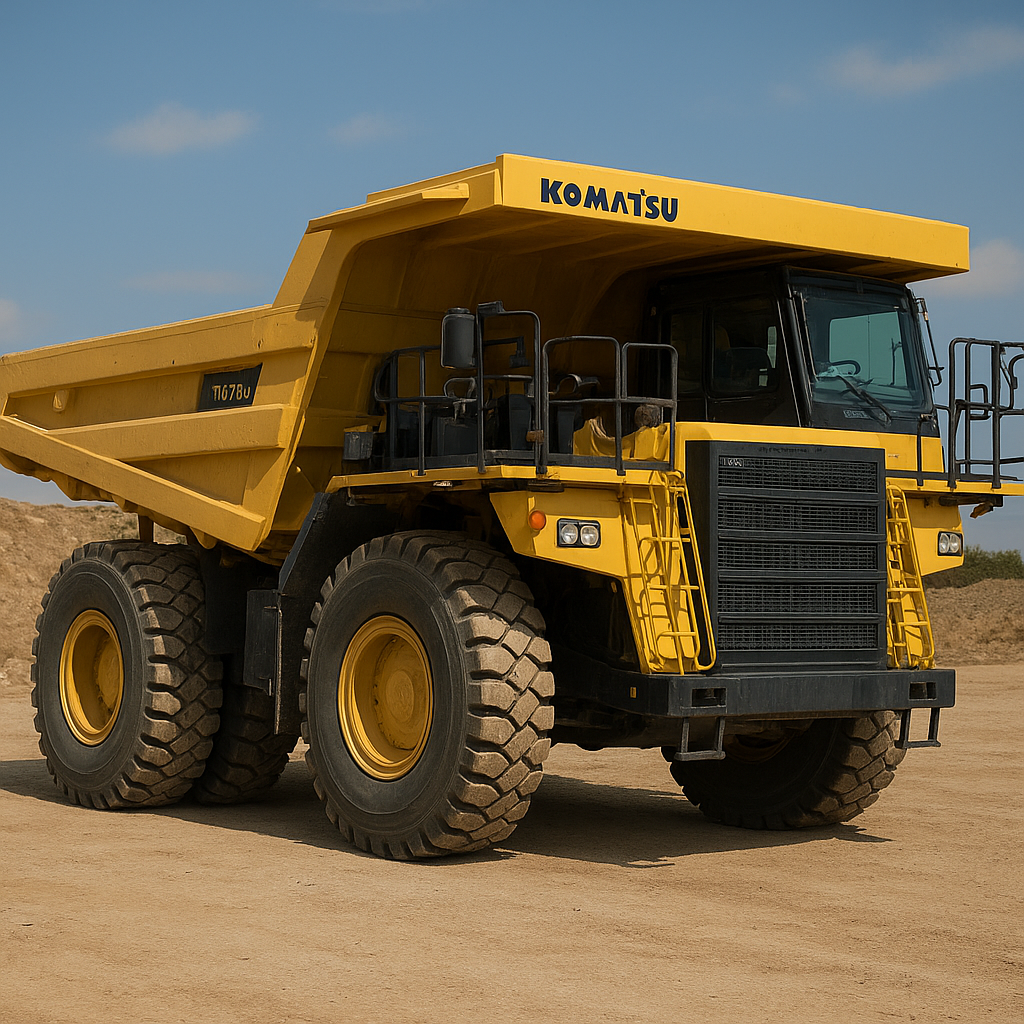
The Komatsu HD785-8 is a heavy-duty rigid haul truck designed for large-scale mining and quarry operations. Combining robust mechanical systems, operator-focused cab ergonomics, and digital monitoring capabilities, the HD785-8 is built to transfer large volumes of material reliably and efficiently in harsh environments. This article explores the machine’s design, typical applications, technical characteristics, operational performance, maintenance and safety considerations, and the economic and environmental factors that affect its deployment in modern mining and bulk-earthmoving operations.
Design and Technical Overview
The Komatsu HD785-8 follows the lineage of Komatsu’s HD series of rigid dump trucks, optimized for high payloads, structural durability, and straightforward serviceability. The machine is engineered to be a workhorse: a heavy frame and robust suspension handle the dynamic loads of continuous material transport, while drivetrain components are sized for long life under heavy strain.
Powertrain and Drive System
The HD785-8 is driven by a high-output diesel engine mated to a heavy-duty transmission and final drives designed for hauling. Depending on the specification and regional emissions requirements, the truck typically features an engine tuned to deliver high torque at low RPMs to manage steep grades and heavy loads. The powertrain generally includes a torque converter and an automatic transmission optimized for smooth, repeatable cycle times and long component life. A powerful retarder and service braking system ensure safe descent control in open-pit applications.
Body and Chassis
The load body is engineered for heavy wear and impact; high-strength steel and wear-resistant liners are common options. The chassis uses massive box-section frames and reinforced axles to resist bending and fatigue. The HD785-8’s body geometry is designed to allow efficient loading and reliable material discharge, minimizing carryback and helping keep cycle times consistent.
Operator Environment
Komatsu places emphasis on operator comfort and visibility in the cab. The HD785-8 typically offers a climate-controlled, ergonomically arranged ROPS/FOPS-certified cab with intuitive controls, a comfortable seat with multi-axis adjustments, and ample sightlines to loading points. Onboard displays provide machine diagnostics, fuel and payload data, and telematics integration.
Electronics and Telematics
Modern HD785-8 trucks are commonly equipped with Komatsu’s telematics and monitoring systems (such as Komtrax), which give fleet managers remote access to hours-of-use, fuel consumption, maintenance alerts, and machine health diagnostics. These systems enable predictive maintenance and more efficient fleet scheduling.
Typical Specifications and Performance (approximate)
Specifications may vary by market and configuration; the figures below are typical ranges used in industry references and serve as general guidance:
- Payload: typically around 60–65 tonnes (metric)
- Body capacity (heaped): approximately 30–40 m³ depending on material density and body design
- Operating weight: commonly in the range of 45,000–60,000 kg (varies with payload components and optional equipment)
- Engine power: broadly in the region of 400–700 kW depending on the tuning and emissions package
- Top speed: limited by gearing and safety systems; typical maximum travel speeds range from 50–60 km/h on level ground (actual safe operating speed depends on load, grade and site rules)
- Fuel tank: large capacity (several hundred liters) to support long shifts without frequent refuelling
- Turning radius and dimensions: engineered for stability and maneuverability within open-pit roadways; precise dimensions vary by spec
These nominal values are influenced by site-specific choices: tyre size and type, body configuration (e.g., rock body vs. general-purpose), optional equipment such as automatic lubrication, and local emission-control hardware (aftertreatment and DEF/AdBlue systems). Komatsu also offers factory and dealer-installed options to tailor the truck to particular duty cycles.
Applications and Use Cases
The Komatsu HD785-8 is primarily intended for high-production mining and quarry operations that require the movement of large volumes of material per shift. Key application areas include:
- Open-pit mining: Hauling ore, waste rock and overburden between dig faces, crushers, and stockpiles. The truck’s robust construction and high payload capability make it suitable for sustained cycle operations on graded haul roads.
- Quarrying and dimension stone operations: Transport of blasted rock and aggregate to crushing and screening plants. The HD785-8’s stable body design and durable liners are advantageous where sharp, abrasive material is common.
- Major earthworks and infrastructure: Large-scale civil projects—such as dam construction, road building, and port development—benefit from the truck’s ability to transfer substantial material volumes over short to medium distances.
- Stockpile management and bulk handling: Movement between excavation points, primary crushers and load-out facilities where predictable cycle times and payload repeatability are crucial.
Within these environments, the HD785-8 is often integrated into a fleet with loaders, excavators and crushers sized to match the truck’s capacity so that loading cycles and material flow are optimized. Fleet planners commonly pair the truck with large hydraulic excavators or wheel loaders capable of matching the truck’s payload in one pass to maximize productivity.
Operational Performance and Productivity
Productivity for a haul truck like the HD785-8 is primarily a function of payload, cycle time and machine availability. Typical metrics used to assess performance include tonnes moved per hour (tph), fuel consumption per tonne, and effective payload per shift.
Estimating Throughput
A straightforward example: at a nominal payload of 60 tonnes and an average cycle time of 10 minutes (including loading, haul, dump, and return), a single truck could theoretically move 360 tonnes per hour (60 t × 6 cycles). In higher-productivity scenarios—shorter cycle times due to nearby loading and dumping points—throughput rises proportionally. Fleet planners therefore evaluate haul road design and loading equipment to minimize cycle times and maximize each truck’s hourly output.
Fuel Efficiency and Operating Cost
Fuel consumption is one of the largest variable costs in trucking operations. Modern HD785-8 trucks are designed with driveline efficiency and engine management systems to reduce fuel burn per tonne moved. Typical measures for improving fuel efficiency include matched engine tuning, intelligent shift strategies, controlled idle management, operator training and payload optimization to avoid underloading or overloading.
Because fuel consumption varies with payload, terrain and operator behavior, fleet managers often measure litres-per-tonne as a key performance indicator and set baselines for improvement through telematics and driver coaching.
Maintenance, Serviceability and Lifecycle Considerations
Reliability and serviceability are critical for heavy haul trucks because downtime directly reduces production. The HD785-8 is built with common-sense access for routine maintenance tasks and with monitoring systems that enable condition-based servicing.
- Daily service points: Easy access to daily checks for engine oil, coolant, hydraulic fluid and tyre inspections helps keep machines in service.
- Scheduled maintenance: Major service intervals for filters, fluids and components are typically aligned with hours of operation. Using OEM-recommended parts and following prescribed lubrication programs extends component life.
- Predictive diagnostics: Telematics and onboard diagnostics allow remote monitoring of oil analysis results, temperature trends, vibration and other indicators that can predict pending issues before catastrophic failure occurs.
- Replacement components and rebuilds: High-wear parts such as driveline components, brakes, tyres and suspension elements are typically maintained by scheduled overhaul or refurbishing to extend the machine’s operational lifespan.
Effective workshops, trained technicians and an inventory of critical spare parts are essential to keep a fleet of HD785-8 trucks producing at high availability rates.
Safety Features and Operator Aids
Safety is integral to the HD785-8 design. The truck’s cab is usually ROPS/FOPS certified and equipped with seat belts, reliable braking systems, and visibility aids. Modern safety and assistance features include:
- Rear and side cameras and proximity sensors to detect personnel or obstacles in blind zones
- Collision avoidance systems and automated alerts (depending on optional equipment)
- Speed limiters and retarder control to maintain safe descent speeds on declines
- Fire suppression systems as an option for high-risk operations
- Operator training programs focused on safe loading/dumping practices, hill management, and emergency procedures
On many sites, the truck is part of a broader safety ecosystem that includes vehicle access controls, designated haul roads, tyre management programs, and regular safety briefings.
Environmental and Regulatory Considerations
Emissions regulations vary by region, and modern Komatsu trucks including the HD785-8 are configured to meet applicable standards. Typical strategies to address environmental concerns include:
- Tier/Stage-compliant engines or equivalent emissions-control packages (such as diesel particulate filters and selective catalytic reduction using DEF/AdBlue)
- Fuel-efficiency improvements through drivetrain optimization and operator-focused programs
- Noise-reduction measures including cab insulation and muffler packages to mitigate community and worker exposure to high-decibel environments
- Recycling and remanufacturing programs for major components to reduce lifecycle environmental impact
Beyond regulatory compliance, many operators track fuel use and emissions as part of corporate sustainability goals, using telematics to report and reduce the fleet’s carbon intensity per tonne moved.
Economic Considerations and Fleet Integration
Purchasing and operating a Komatsu HD785-8 involves assessing lifecycle costs rather than only upfront acquisition cost. Key economic factors include:
- Acquisition vs. lease: Many operations evaluate the total cost of ownership (TCO), including purchase price, financing, insurance, and resale value. Leasing or rental can provide flexibility for short-term projects.
- Fuel and maintenance: As variable costs, these are closely monitored. Fuel-efficient operation and low unscheduled downtime reduce cost per tonne.
- Matching equipment: Aligning loaders and excavators to the truck’s payload ensures efficient loading cycles and minimizes underutilization.
- Resale and remanufacture: When properly maintained, these trucks retain substantial residual value and can be rebuilt or remanufactured to extend service lives.
Fleet managers often run scenario models to determine the optimal number of trucks, shift patterns and auxiliary equipment to hit production targets while keeping unit costs acceptable.
Real-World Considerations and Best Practices
Implementing HD785-8 trucks effectively requires more than good machines; it demands systems that optimize their performance:
- Haul road design: Proper gradients, bench widths and drainage are essential to maintain cycle time and tyre life.
- Matching excavator and loader fleet: Properly matched loading equipment ensures single-pass fills and consistent payloads.
- Operator training and incentives: Skilled operators reduce fuel burn, machine stress and incident rates. Incentive programs tied to litres-per-tonne or uptime can improve behavior.
- Integrated telematics: Real-time monitoring enables quick response to mechanical issues, reduces idling and helps load-and-haul scheduling.
- Tyre management: Selecting the correct tyre compound and maintaining correct pressures lengthens tyre life and improves fuel economy.
Conclusion
The Komatsu HD785-8 is a purpose-built haul truck for high-production mining, quarrying and large earthmoving operations. Its strengths lie in its heavy-duty construction, operator-focused cab design, and the availability of modern telematics and support systems that help operators maximize uptime and productivity. While exact specifications vary by configuration and emissions requirements, the truck commonly serves in the 60–65 tonne payload class and is intended to be paired with appropriately sized loading equipment and properly designed haul roads to reach its full potential. Attention to maintenance, operator training and fleet integration practices is essential to achieve attractive life-cycle economics and reliable production performance.
)
)