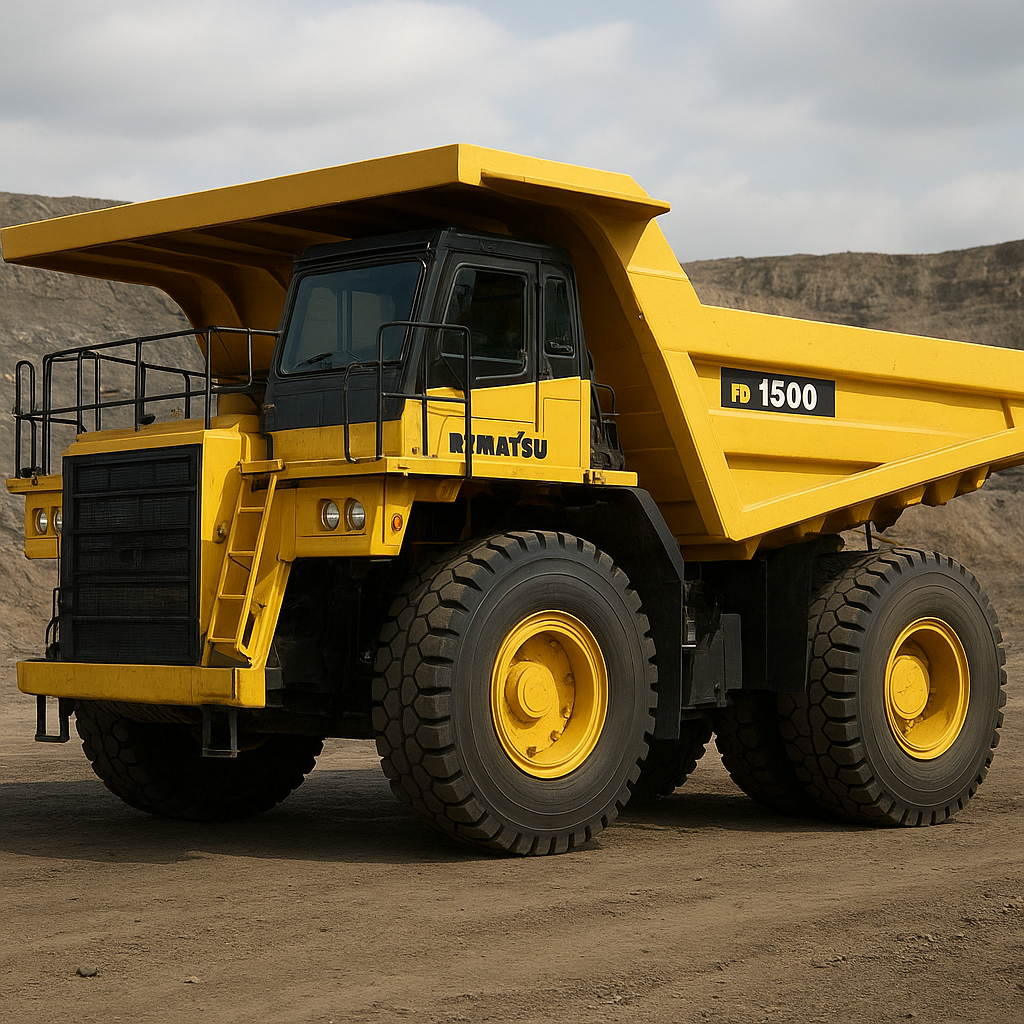
The Komatsu HD1500-8 represents a class of ultra-large rigid-frame dump trucks designed for the most demanding surface mining and heavy earthmoving operations. Combining robust structural design, high-capacity hauling, and operator-focused innovations, this model is aimed at maximizing productivity in operations where moving massive volumes of material quickly and reliably is paramount. Below you will find a detailed look at its design, typical applications, performance characteristics, operational considerations, and lifecycle management.
Overview and design philosophy
The HD1500-8 is part of Komatsu’s line of large-capacity trucks intended to serve high-production open-pit mines, large quarry operations, and major infrastructure earthworks. As with many modern ultra-class machines, the HD1500-8 emphasizes a balance of structural durability, efficient powertrain integration, and operator comfort. Key priorities in the design include maximizing payload per cycle, minimizing unplanned downtime, and enabling straightforward serviceability in remote and harsh environments.
Structural and drivetrain features
- The frame and body are engineered to resist high-cycle fatigue from repeated heavy loads, with reinforcements in high-stress zones to extend component life and reduce crack propagation.
- Power is delivered through a driveline tuned for the truck’s nominal load. The arrangement typically pairs a high-displacement diesel prime mover with heavy-duty transmission gearing and axles designed for large torque loads.
- Braking systems on machines of this class often include both service brakes and auxiliary retardation systems (engine brake, retarder) to manage descent speeds safely when loaded.
The core intent is to provide a platform that can sustain long shifts under heavy duty without compromising safety or efficiency.
Primary applications and industry fit
Designed mainly for surface mining, the HD1500-8 finds its strongest fit in high-tonnage material handling scenarios. Typical applications include:
- Mining — transporting overburden, ore, and waste material from pit faces to crushers, stockpiles, or haul roads.
- Large-scale quarry operations — moving blasted rock and aggregate where high cycle productivity is needed.
- Major infrastructure and civil engineering projects — bulk earthworks for dams, ports, and highways requiring high daily moved volumes.
- Heavy industrial stockpile management — seasonal or project-based tasks that require reliable, high-capacity hauling.
In these contexts, the HD1500-8 is selected where a combination of high payload and reliable uptime translates directly into reduced per-ton haul costs.
Technical specifications and performance indicators
Specifications for large mining trucks can vary with optional configurations, market region, and regulatory/operational choices. The following values are indicative typical figures for an ultra-class truck in the 150-ton payload segment and reflect the performance characteristics users expect from a Komatsu HD1500-8 class machine:
- Nominal payload: approximately 150 metric tonnes (150 t).
- Gross vehicle weight (loaded): dependent on configuration but typically in the range that supports the stated payload with structural and ballast considerations.
- Powertrain: high-output diesel engine matched to a heavy-duty mechanical or torque converter transmission; power and torque are tuned to ensure strong startability and adequate speed retention on grades.
- Top operating speeds: designed for efficient haul cycles rather than high speed; loaded and unloaded speed profiles are optimized for cycle time rather than highway performance.
- Fuel consumption: varies with duty cycle, haul road grades, and load, but fuel efficiency strategies (such as engine management and transmission tuning) seek to minimize liters per ton moved.
Because actual numbers change with options (different tires, gearing, climate and altitude adaptations), fleet managers usually benchmark machines in real operating conditions to establish reliable productivity and fuel metrics.
Performance metrics and how they matter
- Cycle time reduction — the single most impactful lever for productivity: improving cycle time by a few percentage points can produce significant tonnage gains per shift.
- Fuel consumption per ton — used to compare operational efficiency across different truck models and powertrains.
- Availability and mean time between failures (MTBF) — maintenance reliability drives utilization; high availability is crucial for meeting production targets.
- Payload accuracy and load distribution — ensuring each trip approaches nominal payload without overloading protects structural components and axles.
Operational considerations and productivity optimization
Maximizing the potential of a Komatsu HD1500-8 requires attention to a number of operational areas, from road design to operator training. Practical steps proven in the field include:
- Optimizing quarry and pit road geometry to reduce sharp turns and steep grades, which lowers cycle times and fuel burn.
- Implementing effective load/haul/dump sequencing to minimize idle time and queuing at benches and crushers.
- Using payload management systems to ensure consistent loading that approaches but does not exceed rated capacity.
- Applying tire management practices — correct pressure, regular inspections, and scheduled rotations extend tire life and improve fuel economy.
- Training operators in eco-driving techniques specific to large haul trucks: proper use of throttle and retardation systems, anticipating road grade changes, and minimizing unnecessary braking or acceleration.
Fleet telematics and mine fleet-management software are typically used to monitor all of these factors in real time, producing dashboards for supervisors and automated alerts for maintenance or safety events.
Maintenance, safety, and lifecycle cost management
Large haul trucks like the HD1500-8 are capital-intensive assets where lifecycle cost management is essential. Maintenance regimes are established to maximize availability while controlling costs. Common practices include:
- Scheduled preventive maintenance (greasing, fluid and filter changes, inspection of structural welds and suspension components).
- Condition-based monitoring (oil analysis, vibration monitoring, thermography) to detect early signs of wear or failure.
- Use of OEM replacement parts and rebuild programs for major components (engine, transmission, axles) to balance cost and reliability.
- Comprehensive safety systems, including collision avoidance aids, camera packages, and robust operator protection structures.
Because downtime in a high-production mine can be extremely costly, many operators maintain a spare parts inventory and rapid repair capability either in-house or through OEM service agreements to restore machines to service quickly.
Safety systems and operator environment
- Cab ergonomics are designed to reduce operator fatigue: climate control, vibration isolation, good visibility and intuitive controls are standard priorities.
- Safety interlocks, access ladders with handrails, fall-protection anchor points, and non-slip walking surfaces reduce incident risk during service and daily operation.
- Advanced monitoring systems provide alerts for over-speed, overheat, and other hazardous operating conditions, enabling early intervention.
Economic and environmental considerations
Operators increasingly evaluate trucks not only on initial acquisition cost and uptime but on per-ton operating cost and environmental footprint. For a machine like the HD1500-8, key points are:
- Cost per ton moved — integrates fuel, maintenance, tire, and operator costs distributed across the expected service life and annual utilization.
- Fuel efficiency strategies — modern engine controls, route optimization, and reduced idling reduce diesel consumption and emissions.
- Emission control options — depending on regulatory environment and customer specification, trucks can be equipped with after-treatment systems to meet regional emissions standards.
- Potential for future hybridization or electrification — while large haul trucks present challenges for full electrification, there is growing adoption of trolley-assist systems, battery-hybrid architectures, and mine-wide electrification strategies to reduce diesel use on long downhill hauls.
Companies often build total-cost-of-ownership models that incorporate resale value, expected component rebuilds, and projected fuel price changes to make procurement decisions.
Technological trends and future directions
The ultra-class haul truck segment is experiencing evolutionary changes driven by automation, electrification, and connectivity. Trends relevant to machines in the HD1500-8 category include:
- Autonomous haulage systems (AHS): many large mines are deploying driverless fleets for efficiency and safety — trucks are integrated into central control systems allowing continuous operation and optimized dispatching.
- Electrified systems: trolley assist and in-pit charging can reduce fuel consumption and increase truck productivity on long, repetitive routes.
- Advanced diagnostics: AI-driven analytics applied to sensor data improve predictive maintenance and help avoid catastrophic failures.
- Operator augmentation: enhanced displays, augmented reality maintenance guides, and remote assistance tools help reduce errors and downtime.
These trends reduce unit operating cost and improve environmental performance, and fleets that adopt them early can gain competitive advantages in productivity and compliance.
Case examples and fleet integration
In a typical open-pit copper mine scenario, an HD1500-8-class truck is paired with high-capacity excavators or wheel loaders. The economics for such pairings often look at:
- Matching shovel bucket size and cycle time to truck capacity to avoid under- or over-utilization of either asset.
- Route optimization to minimize empty weights during climbs and stabilize loaded descent speeds for safety and fuel economy.
- Scheduling maintenance in off-peak production periods and using telematics to predict the optimal service window.
Well-integrated fleets manage truck allocation to match ore/overburden production plans, keeping the truck utilization high and minimizing loading wait times.
Specifications snapshot (indicative)
Below is an indicative snapshot of specification areas commonly used to evaluate ultra-class haul trucks like the HD1500-8. Exact numbers are model- and configuration-dependent and should be verified with the manufacturer or equipment datasheets for procurement decisions.
- Payload capacity: ~150 metric tonnes (nominal).
- Powertrain: high-displacement diesel engine; transmission sized for heavy torque and frequent starts under load.
- Braking: service and auxiliary retardation systems with robust cooling for continuous downhill application.
- Operator environment: climate-controlled, vibration-isolated cab with monitoring systems and ergonomic layout.
- Serviceability: ground-level service points where possible, modular components for faster replacement of major assemblies.
Summary: strengths and selection considerations
The Komatsu HD1500-8 class haul truck is focused on delivering reliable, high-volume hauling in demanding environments where each trip contributes significantly to mine throughput. When evaluating whether a truck of this class is the right fit, decision-makers consider:
- Daily tonnage targets and whether the payload aligns with shovel/loader capacity.
- Road profiles and whether the truck’s powertrain and braking systems are optimized for local terrain.
- Availability of maintenance infrastructure and spare parts to sustain high utilization.
- Opportunities to integrate advanced technologies (telematics, autonomous operation, electrification) to reduce operating cost per ton.
In essence, the right deployment of an HD1500-8-class machine can significantly lower the per-ton movement cost in large mining and earthmoving projects, provided the fleet is managed with attention to matching equipment capabilities to site requirements, enforcing rigorous maintenance practices, and leveraging modern operational technologies.
)
)