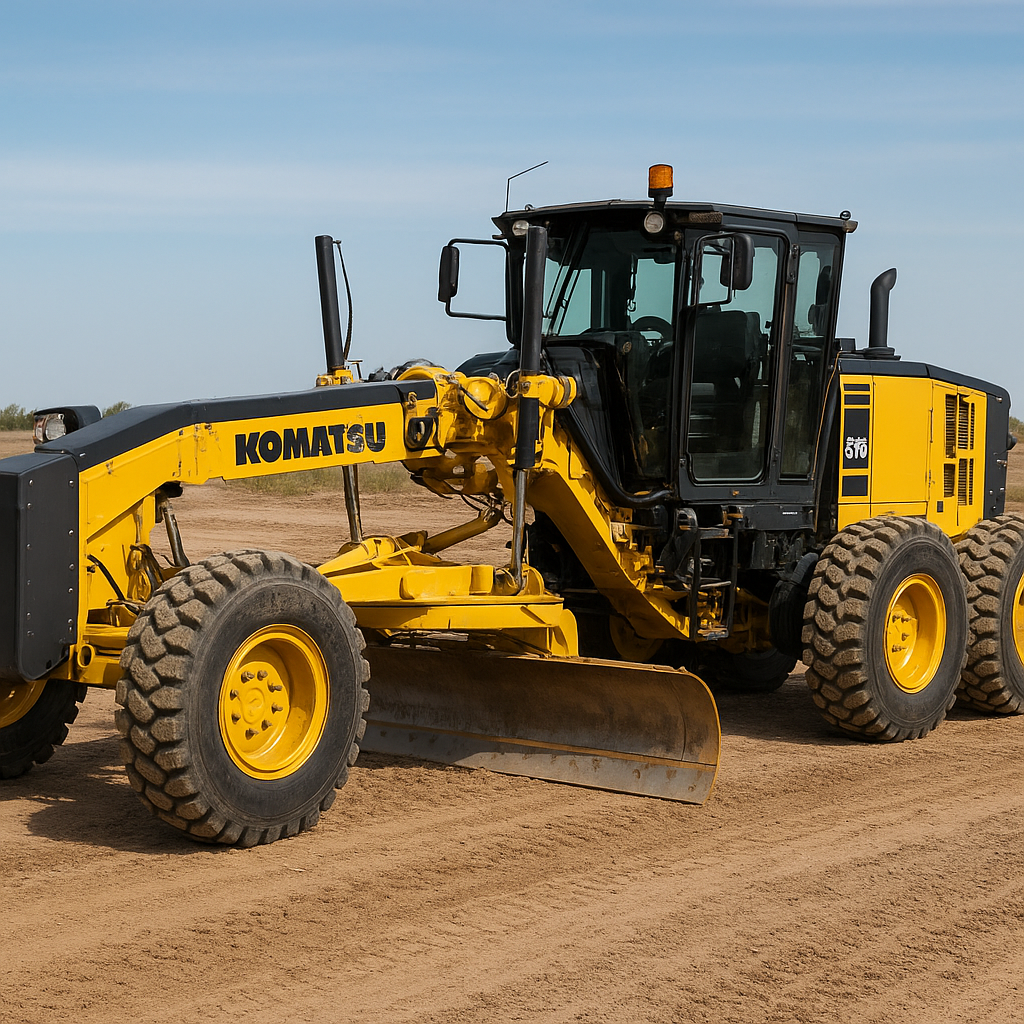
The Komatsu GD675-6 is a robust and versatile motor grader designed for heavy civil construction and road maintenance tasks. Combining proven mechanical systems with modern hydraulic controls and operator-oriented ergonomics, this model represents a solid choice for contractors who need reliable grading performance in a wide variety of site conditions. In the following sections, we will explore the machine’s design features, typical applications, technical characteristics, operator environment, maintenance considerations, available attachments, and buying/operating tips that help owners get the most value from a GD675-6.
Overview and design philosophy
Komatsu has long focused on engineering heavy equipment that balances durability, ease of operation and lifecycle cost. The GD675-6 reflects that approach: it is built for continuous grading work while minimizing downtime and simplifying service. At its core, the machine emphasizes a rigid frame and a powerful, responsive powertrain matched to an efficient hydraulic system that controls blade positioning, articulation and ancillary implements.
Key structural and mechanical elements
- Frame and circle: The grader’s frame and circle assembly are engineered for high stiffness to deliver consistent cutting geometry over extended cycles and reduce blade chatter.
- Articulation and steering: Hydraulically actuated articulation combined with precise steering gives the GD675-6 strong maneuverability on narrow corridors and curved alignments.
- Powertrain: Designed to provide linear power delivery during both high-load grading and travel, the powertrain balances torque and fuel consumption for productive on-site performance.
- Hydraulics: A load-sensing hydraulic system (typical on modern graders) ensures smooth blade shifts and implements control while optimizing pump output to reduce unnecessary fuel use.
These core systems work together to deliver repeatable cross-slope and longitudinal grading with the stability to resist twisting under load. The design aims to reduce operator fatigue and enable long production runs with predictable finish quality.
Applications and typical uses
The GD675-6 finds its place in a wide range of tasks where a reliable and capable grader is required. Typical applications include:
- Road construction and maintenance: creating base courses, shaping gravel roads, final surfacing preparation before paving, and maintaining rural road surfaces.
- Site preparation: creating level building pads, grading for utilities corridors, and establishing design grades for earthworks.
- Snow removal and shoulder work: with suitable blade configurations and optional wings or scarifiers, graders are used for clearing snow, shaping shoulders and ditching.
- Mining and quarry work: maintaining haul roads, establishing ramps and controlling drainage patterns on benches.
- Airport and runway maintenance: precise grading for shoulders and subgrades when extreme flatness and drainage are required.
Because of its combination of power and controllability, the GD675-6 is a good choice wherever consistent longitudinal grade and crossfall control are priorities. It can also serve as a versatile multi-task platform by adding rippers, front blades or GPS-controlled grading systems.
Technical specifications and performance (typical figures)
Exact specifications for the GD675-6 can vary by market, emission standard and optional equipment. The figures below are representative for a machine in this class and intended to give a realistic sense of capability rather than a factory-certified data sheet. Always consult the manufacturer or an official spec sheet for final numbers when planning work or purchasing.
Representative performance data
- Operating weight: approximately 16,000–20,000 kg (varies with options such as ripper or winch).
- Engine output: gross/net power typically in the range of 170–260 kW (230–350 hp) depending on the market configuration and emission stage.
- Blade length: standard moldboard length typically 3.7–4.2 m; cutting depth and height ranges support versatile grading profiles.
- Maximum travel speed: up to 40–50 km/h on road travel configurations, depending on gearing.
- Fuel capacity: commonly in the 300–500 L range, sized to support a full working shift in many field conditions.
- Hydraulic flow: designed to supply sufficient flow for precise blade control and rapid implement response; exact pump rates depend on configuration.
- Breakout and tearout forces: adequate for scarifying and ripping in medium-hard soils when equipped with factory rippers or scarifiers.
Fuel consumption will vary widely with duty cycle, terrain and operator technique. Typical working consumption on heavy grading could range from around 15 to 30 liters per hour, with lighter transport and trimming work on the lower end. These figures are indicative; real-world measurement on the specific machine and site is the best predictor of fuel use.
Operator environment and controls
Komatsu places a premium on operator productivity and comfort, and the GD675-6 is configured to reduce fatigue during long shifts. The cab is designed for good visibility to the blade, circle and immediate working area, and ergonomics prioritize intuitive control placement.
Cab features and ergonomics
- Visibility: large glazed areas and angled pillars to maximize sightlines to the moldboard and the machine’s working envelope.
- Controls: ergonomic joysticks or levers, depending on spec, that integrate blade, articulation and circle functions for seamless operation.
- Comfort: climate control, adjustable air-suspended seating and vibration-mitigating features keep operators productive for longer.
- Instrument cluster: clear displays for engine parameters, hydraulics and optional telematics readouts help operators manage performance and fuel use.
Many GD675-6 units are offered with factory preps for grade control systems and telematics, meaning that GPS or laser-guided grading solutions can be integrated to boost accuracy and reduce rework.
Technology and monitoring
Modern graders increasingly come with electronic monitoring and assist systems to streamline maintenance and improve uptime. On Komatsu machines, users often have access to the KOMTRAX telematics platform (or equivalent), which provides remote data on:
- Machine location and hours
- Fuel consumption and operational profiles
- Service alerts and diagnostic codes
- Utilization reports to inform fleet planning
Integration with grade control systems, either factory-installed or dealer-fitted, allows contractors to adopt 2D/3D guidance for higher accuracy in finish grading and to reduce dependence on manual stringline work. These technologies typically improve productivity and reduce material and rework costs.
Maintenance, serviceability and lifecycle costs
Serviceability is a major consideration for graders that operate in remote or demanding conditions. The GD675-6’s design focuses on simplified daily checks, long service intervals for major components where possible, and straightforward access to filters and fluids.
Routine maintenance highlights
- Easy-to-access engine and hydraulic filter locations to reduce downtime during routine servicing.
- Centralized lubrication points or optional automatic lubricators for circle and articulation pins.
- Modular component replacement reduces repair time for major items like pumps or valves.
- Service intervals and extended-life fluid options can be selected to match operating conditions and reduce overall lifecycle cost.
Planned maintenance and a robust parts supply chain are key to keeping operating costs predictable. Komatsu dealer networks typically provide diagnostic support, parts availability and refurbishment options to extend machine life in a cost-effective way.
Attachments and optional equipment
One of the GD675-6’s strengths is its ability to be configured for specific tasks with a selection of attachments and optional equipment. Common options include:
- Rippers and scarifiers for loosening compacted material before grading.
- Front push blades for multifunction snow removal or heavy pushing tasks.
- Rear winches for recovery, logging or specialized earthworks.
- Wireless or cab-mounted control kits for integrating 2D/3D grade control systems.
- LED lighting packages for night work and improved safety.
- Tire and wheel options to optimize traction and flotation for specific ground conditions.
Matching the right attachments to the intended work can significantly expand machine utility and deliver better return on investment.
Safety and environmental considerations
Safety features for the GD675-6 include ROPS/FOPS cab protections, good all-around visibility, and optional camera systems for blind-spot monitoring. On environmental fronts, engine configurations comply with regional emissions standards (Stage/ Tier levels), and fuel-efficient operating modes help reduce greenhouse gas emissions per unit of work.
Operators and fleet managers should prioritize:
- Regular safety audits including lighting, brakes and visibility systems.
- Proper training on grading best practices to prevent machine misuse and reduce wear.
- Use of OEM-approved consumables to maintain emissions compliance and engine health.
Buying considerations and total cost of ownership
When evaluating a GD675-6 for purchase or rental, consider both upfront cost and the total cost of ownership. Important variables include:
- Intended duty cycle: heavy continuous grading calls for a different spec (and possibly heavier attachments) than intermittent maintenance work.
- Fuel economy: look for machines with efficient engine maps and enablement for economy modes if available.
- Service network: proximity to dealer support for parts and diagnostics reduces downtime risk.
- Resale value: machines with factory-installed telematics and well-documented service histories typically command higher resale prices.
- Option packages: factory-installed grade control, extended warranties and maintenance contracts can be cost-justified for high-utilization fleets.
Leasing or rental can be an effective strategy for owners who need seasonal capacity or want to avoid the capital expenditure of ownership while retaining access to a modern machine.
Comparisons and fleet integration
Within a mixed fleet, the GD675-6 generally occupies the mid-to-large grader category. It competes with similar models from other major manufacturers on the basis of durability, hydraulic control sophistication and dealer support. For fleet managers, consider:
- Standardization of controls to reduce operator retraining when machines from different brands are used.
- Commonality of parts across fleet models to simplify inventory.
- Telematics platforms and whether they can be integrated into a single fleet management dashboard.
Optimizing the grader’s role—whether primary finishing grader, road maintenance machine or multipurpose site machine—helps make procurement and operational planning more effective.
Final thoughts
The Komatsu GD675-6 is a capable and adaptable motor grader suited to contractors who need dependable grading performance across construction, roadwork and maintenance tasks. With an emphasis on durability, operator productivity and serviceability, the model is well positioned for owners who value predictable performance and long service life. By considering the right configuration, attachments and maintenance plan, purchasers can ensure the GD675-6 delivers efficient production and a competitive total cost of ownership.
Highlighted keywords for quick reference: Komatsu GD675-6, motor grader, blade, hydraulics, operator comfort, fuel efficiency, KOMTRAX, durability, versatility, maintenance.
)
)