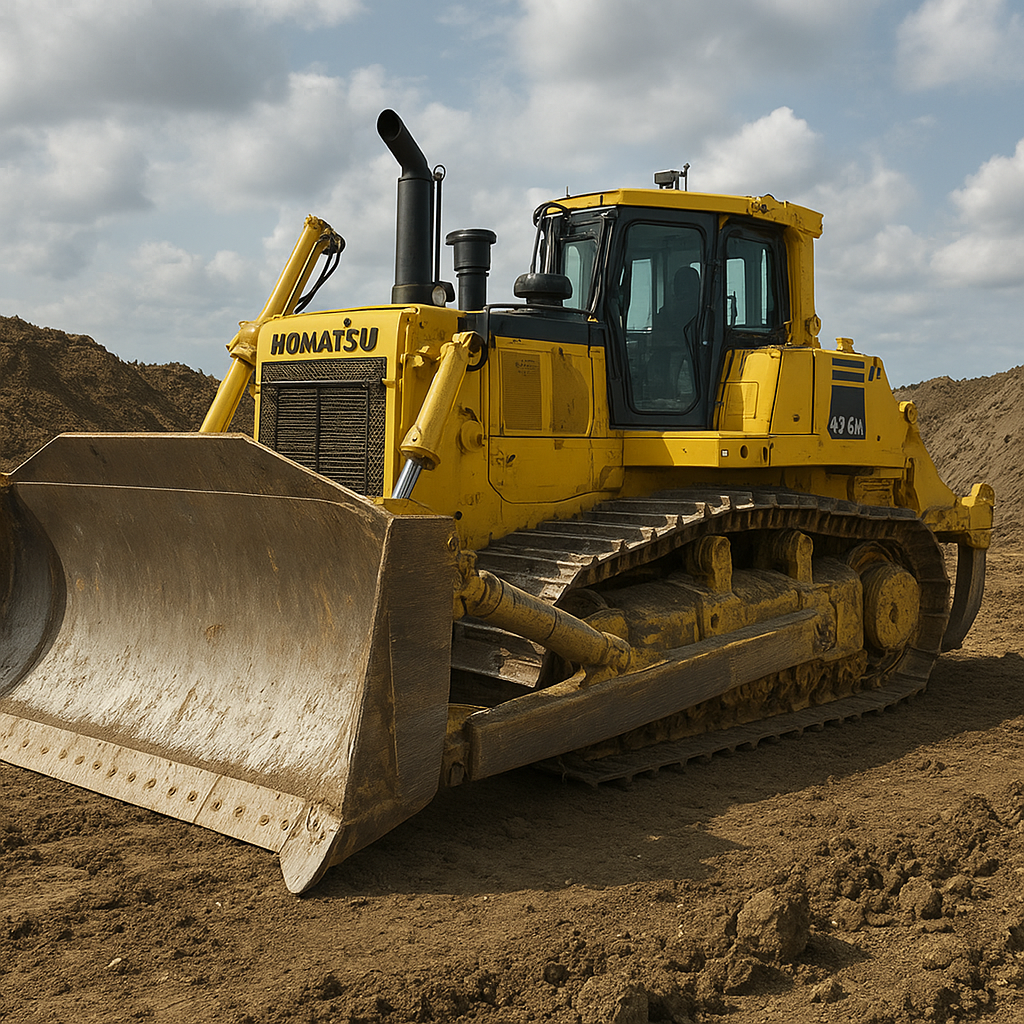
The Komatsu D475A stands among the most powerful and heavy-duty crawler dozers ever produced for large-scale earthmoving and mining operations. Designed to move enormous volumes of material efficiently while offering durability in the harshest environments, this machine combines robust mechanical design with features aimed at improving operator comfort and site productivity. In the following sections we will explore the machine’s design principles, typical applications, technical characteristics (presented as commonly reported ranges), operational economics, maintenance aspects, and the technological innovations that make the D475A a preferred tool on major projects worldwide.
Design and engineering overview
The Komatsu D475A is a large track-type tractor developed to address the needs of heavy civil construction, quarrying, and surface mining. Its platform emphasizes strength, stability, and ease of serviceability. The undercarriage is engineered to withstand continuous high loads, while the frame and final drives are sized to resist the shock and torsional stresses found in quarry and mine environments. Critical components are laid out to facilitate quick maintenance and reduce downtime on site.
Key aspects of the platform include an emphasis on cooling capacity to sustain long operating cycles in hot environments, a reinforced blade-mounting structure for pushing and spreading large material loads, and modular component design to simplify replacement of major assemblies. Many versions of the D475A have been offered with specialized options such as multi-shank rippers, winches, and various blade configurations adapted to application needs.
Typical applications and use cases
The versatility and size of the D475A make it particularly effective in several sectors:
- Open-pit and surface mining: managing overburden removal, reclaiming benches, and assisting in haul-road construction.
- Large civil works: moving bulk earth for dam construction, major highway grading, and foundation earthworks for large infrastructure projects.
- Quarrying and aggregate production: clearing blasted rock, building benches, and stockpile management.
- Land reclamation and heavy forestry work: clearing and windrowing in large-scale land-preparation tasks.
Because of its scale, the D475A is rarely used for fine grading; instead it excels where power and brute-force displacement of mass are primary requirements. The addition of a heavy-duty ripper enables it to loosen compacted rock or frozen ground before pushing or loading operations.
Technical characteristics and typical performance figures
Technical specifications vary across model years, variants, and optional equipment packages. Below are commonly reported, broadly representative figures that illustrate the machine’s class and capabilities. These should be regarded as typical ranges rather than precise values for every serial configuration.
Engine and power
The D475A series uses large displacement diesel engines designed for continuous heavy duty cycles. Gross engine power for machines in this class generally lies in the upper hundreds of kilowatts, making them among the most powerful production dozers. Typical reported power figures fall in the range of several hundred to just under a thousand kilowatts, depending on the exact subtype and rating, providing the torque needed for sustained pushing and ripping operations.
Weight and dimensions
Operating weight for the D475A family is substantial, reflecting reinforced frames and heavy undercarriage components. Typical operating weights are commonly cited in the range of tens of tonnes (often approximating 50–60 metric tonnes or more for many configurations), though specific values vary with blade, ripper, fuel load, and optional attachments.
Blade capacity and attachments
Blade designs offered include universal (U), semi-universal (S/U), and straight (S) types tailored for pushing large volumes or spreading material. Blade capacities for machines of this size typically cover a broad span—commonly multiple cubic meters up to several tens of cubic meters—depending on blade type and lift angle. The machine supports heavy multi-shank rippers and can be fitted with winches for specialized haul-road and reclamation tasks.
Fuel consumption and operating economy
Fuel burn for very large dozers varies widely with load factor, duty cycle, ground conditions, and operator technique. In heavy continuous dozing and ripping, average fuel consumption can be significant; reported operational ranges for comparable class machines often fall into dozens to low hundreds of liters per hour under severe load. Effective fleet management, grade control, and targeted preventive maintenance are essential to optimize fuel efficiency and reduce total cost of ownership.
Operational performance: productivity and site integration
On-site productivity for a D475A is driven by its ability to move large volumes of material quickly. Factors that influence productivity include blade selection, ground conditions, operator skill, and integration with the support fleet (dozers working with loaders, haul trucks, and graders). Use of the correct blade and ripper configuration can substantially improve cycle rates and reduce truck-loading times in mining operations.
Modern D475A units or retrofitted machines may be equipped with sensor packages, telematics, and GPS-based grade control systems. These technologies enhance efficiency by providing accurate cut/fill guidance, monitoring machine health remotely, and enabling better dispatch decisions. Telematics also supports predictive maintenance by tracking operating hours, load factors, and fault codes, which helps maintain high reliability and uptime.
Maintenance, serviceability, and lifecycle considerations
Robust maintenance practices are critical for maximizing productive life and controlling costs. The D475A’s service points are designed with accessibility in mind: wide service doors, modular cooling package, and centralized grease points reduce time spent on routine checks. Common maintenance tasks include track and shoe inspection, final drive service, engine oil and filter changes, cooling-system checks, and hydraulic system monitoring.
Wear parts—such as track shoes, idlers, sprockets, and ripper shank tips—are subject to heavy abrasion and cyclical stresses; planned replacement intervals depend on environment and usage intensity. Component rebuild programs and parts remanufacturing can extend service life and improve sustainability. Furthermore, thorough operator training reduces misuse and early component failure.
Operator environment and safety features
Although focused on heavy duty performance, the D475A platform recognizes the importance of the operator cabin as a productivity factor. Cab designs on recent versions emphasize ergonomics, visibility, noise reduction, and climate control to keep operators effective during long shifts. Safety features typically include robust ROPS/FOPS structures, improved sightlines to blade and ripper, rear and side cameras, and integrated alarms for reversing or system faults.
Operator comfort often correlates with reduced fatigue and fewer operational errors, contributing directly to improved site productivity and lower incident rates. Well-maintained handrails, anti-slip steps, and clear service access also help maintain safe working environments around the machine.
Variants, aftermarket options, and customization
Over its production history the D475A platform was offered in multiple variants tailored to specific markets and uses. Typical permutations include different blade styles, ripper configurations (single- or multi-shank), and heavy-duty undercarriage packages for abrasive ground. Some units were produced with simplified control packages for high-availability mines, while others received advanced electronic controls and telematics for precision earthmoving.
Aftermarket support commonly includes heavy-duty track components, reinforced blades, specialized rippers, and retrofit kits for emissions or telematics upgrades. Owners often customize machines for their site needs, balancing initial capital outlay against long-term operating savings and performance improvements.
Environmental considerations and efficiency improvements
Large dozers such as the D475A operate with significant fuel consumption and emissions compared to smaller earthmoving equipment. Modern approaches to mitigate environmental impact include:
- Engine tuning and emissions systems that meet regional standards, reducing particulate and NOx output.
- Operator training and site planning to minimize idle time and unnecessary travel, improving fuel efficiency.
- Use of telematics to identify inefficient operating patterns and optimize task allocation across the fleet.
- Retrofitting with improved hydraulic controls and variable engine management for load-matching during operations.
Additionally, lifecycle strategies—such as remanufactured components and extended service intervals through condition-based monitoring—contribute to lower environmental footprints by extending usable life and reducing waste.
Case studies and real-world examples
In large open-pit mines and major infrastructure projects, machines of the D475A class are typically deployed where maximal pushing force and consistent earthmoving are required. For example, in overburden stripping operations, a D475A fitted with a heavy U-blade and multi-shank ripper can loosen and transport bench material to haul roads, enabling high daily moved volumes. In quarry settings, the same machine might be used to level blast spoil, push benches, and assist in primary rock handling.
Key performance indicators in such cases often emphasize tons moved per hour, fuel liters consumed per ton moved, and equipment availability percentage. Operators and site managers routinely monitor these KPIs to justify machine selection and to track improvements following service or operator training initiatives.
Longevity, resale value, and fleet strategy
Heavy dozers like the D475A are capital-intensive assets. Long-term value depends on utilization rate, maintenance practices, and the availability of parts and service. Many owners plan for multi-decade service lives, using mid-life overhauls and component rebuilds to sustain performance. Resale values depend heavily on documented service history and the condition of tracks, final drives, engine, and blade/ripper assemblies.
Efficient fleet strategies pair the D475A with appropriately sized support equipment—excavators and wheel loaders for loading, haul trucks for transport, and graders for finish grading—to ensure that the dozer is used where it provides the highest marginal benefit.
Concluding remarks
The Komatsu D475A is an example of a heavy-duty dozer engineered for demanding environments where reliability, sheer power, and durability are paramount. While specific specifications vary by model year and configuration, the machine’s principal advantages lie in its ability to move huge volumes of material, withstand abrasive conditions, and integrate into large-scale operations through telematics and aftermarket customizations. For mine operators, contractors, and site planners facing large earthmoving challenges, the D475A remains a workhorse option—provided that organization-level attention is paid to maintenance regimes, operator training, and efficiency monitoring to control operating costs such as fuel consumption and parts wear.
For those evaluating heavy dozer options, considerations should include the desired blade and ripper configuration, the balance of initial acquisition cost versus lifecycle maintenance, and the availability of service support in the operating region. Properly matched to application and well-maintained, a D475A-class dozer can deliver substantial production advantages over its operational life while serving as a centerpiece of a productive heavy equipment fleet.
)
)