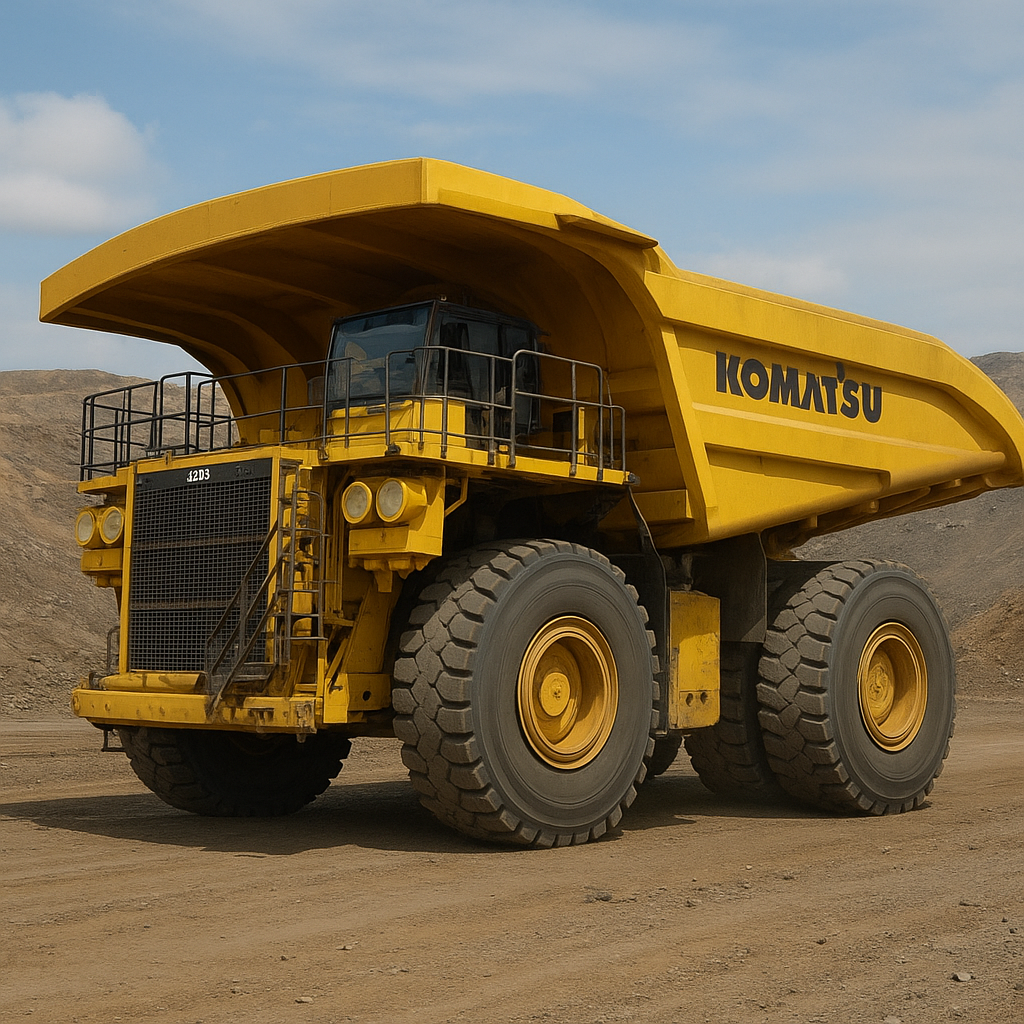
The Komatsu 980E-4 is one of the most recognizable machines in large-scale surface mining. Designed as a high-capacity, long-haul truck, it plays a central role in modern open-pit operations where the efficient movement of massive volumes of ore and waste rock determines the economic success of a mine. In the following sections we describe the machine’s design philosophy, typical applications, technical and operational characteristics, and important considerations for owners and operators. The article also highlights the broader context — from productivity and costs to environmental and safety aspects — that shapes how the Komatsu 980E-4 is deployed in the field.
Overview and Design Philosophy
The Komatsu 980E-4 belongs to the family of ultra-class haul trucks built to meet the demands of the world’s largest mines. These machines are engineered around a few core principles: maximum payload capacity, robust durability under constant heavy loading, and optimized energy transfer to minimize losses. Komatsu’s approach with the 980E line emphasizes a diesel-electric drive system, large-capacity dump bodies, and a modular design that simplifies major service tasks. The result is a truck capable of sustaining long production cycles while offering predictable maintenance windows and a long structural life.
Key design elements
- Diesel-electric drive: The engine drives a generator, which powers electric traction motors on the axles. This arrangement provides high torque at low speeds and reduces mechanical complexity in the drivetrain compared with purely mechanical transmissions.
- Rigid frame and heavy-duty suspension: Built to resist fatigue under repeated heavy cycles, the frame geometry and suspension components are designed for long-term reliability.
- Large-capacity body: Bodies are optimized for material retention, dump dynamics, and quick loading and dumping cycles to keep shovels and excavators productive.
- Serviceability: Components such as the electrical cabinets, cooling systems, and hydraulic units are arranged for accessible maintenance.
- Operator-focused cab: The cab integrates ergonomic controls, climate control, and integrated monitoring systems to support long shifts and improve operator efficiency.
Applications and Operational Roles
The Komatsu 980E-4 is used primarily in large open-pit mining operations where bulk material movement is a central activity. Its role is straightforward: move the greatest possible mass of ore or waste as efficiently and safely as possible. Typical applications include:
- High-tonnage iron ore operations, where very large daily outputs are typical and fleet productivity scales directly with dump truck capacity.
- Copper and gold mines with large open pits and significant waste stripping requirements where haul distances and cycle times make large trucks advantageous.
- Coal operations where large volumes must be moved from the pit to stockpiles or processing plants.
- Infrastructure projects requiring bulk earthmoving on a massive scale (less common but feasible where mobility and capacity are priorities).
In a modern mine fleet, the 980E-4 is commonly paired with large electric rope shovels, hydraulic shovels, and large-wheel loaders. Fleet planners evaluate the truck’s payload in relation to shovel bucket size and cycle time to achieve optimum truck-shovel matching — a critical determinant of fleet efficiency and capital utilization.
Technical Characteristics and Typical Performance
Specifications for ultra-class trucks vary with configuration and market, but some typical technical characteristics and performance indicators for the Komatsu 980E-4 are:
- Rated payload: approximately in the range of several hundred tonnes — a class-leading capacity used to match the biggest shovels on the market. In practical fleet planning, payload is expressed in metric tonnes and matched to material density and shovel bucket volume.
- Diesel engine and electrical system: the truck employs a high-displacement diesel engine coupled to a generator and AC traction motors. Electrical drive allows for high starting torque and precise traction control.
- Operating weight: substantial, reflecting the heavy-duty frame and components necessary for ultra-class loads.
- Top speed and cycle speed: travel speeds vary by load condition and gearing; operators optimize speed profiles to balance fuel use, tire wear, and cycle time.
- Tires: large, purpose-built mining tires (commonly in the 59/80R63 size class or equivalent) that represent a major running cost and critical maintenance item.
Precise numeric specifications depend on configuration choices (body type, tires, optional equipment) and evolving model updates. Mine operators generally evaluate metrics such as tonnes moved per hour, fuel consumption per tonne, tire life, and mean time between failures (MTBF) to assess a truck’s in-service performance.
Operational performance drivers
- Loading performance: matched to shovel or loader bucket size; proper matching reduces over- or underloading and improves cycle consistency.
- Haul road design: gradient, curvature, and surface conditions strongly affect cycle times and fuel use.
- Driver behavior and fleet control: training, fatigue management, and fleet management systems influence average cycle time and incident rates.
- Maintenance philosophy: preventive vs condition-based maintenance strategies determine downtime, component life, and overall cost per tonne.
Economics: Cost per Tonne and Lifecycle Considerations
Investment in a Komatsu 980E-4 (or any ultra-class truck) is a balance between capital cost, operating cost, and productivity. Owners model total cost of ownership (TCO) over the expected service life (often measured in operating hours and years), considering:
- Capital expenditure — purchase or lease cost of the truck.
- Fuel consumption — one of the largest variable costs; influenced by engine efficiency, haulage profiles, and idle time.
- Tire costs — particularly significant for ultra-class trucks due to tire size and replacement frequency.
- Maintenance and parts — scheduled servicing, major component rebuilds (e.g., traction motors, inverters, body replacements), and downtime costs.
- Resale value and salvage — residual value after multi-year service can offset initial cost.
Large mines quantify cost per tonne moved as a fundamental KPI. A single ultra-class truck can have a pronounced effect on fleet-wide performance: by increasing payload per cycle, the 980E-4 can reduce the number of trucks required to meet throughput targets, thereby reducing collective fuel use, maintenance overhead, and operator hours per tonne — provided that supporting shovels and haul roads are sized appropriately.
Maintenance, Reliability and Serviceability
Reliability and predictable maintenance are essential in environments where delays can translate to millions in lost production. The 980E-4’s design reflects an emphasis on heavy-duty components and accessibility:
- Modular components make it possible to replace or repair major assemblies with minimal disassembly.
- Advanced monitoring and telematics systems provide real-time data on engine health, electrical system performance, and operational parameters to support predictive maintenance.
- Condition-based maintenance driven by sensor data allows service teams to intervene before failures occur, extending component life and reducing unplanned downtime.
- Consumables management — spare parts logistics, tire management programs, and planned rebuild schedules — underpin high fleet availability.
Key maintenance focuses include the electrical traction system (inverters, motors, and cables), brake systems, steer and suspension components, and the structural integrity of the dump body and frame. Tire life is heavily dependent on haul road condition, loading practice, and operator habits. Well-managed fleets typically see longer tire life and lower cost per tonne.
Safety Systems and Operator Environment
Safety is a top priority in modern mining equipment. Komatsu equips the 980E-4 with multiple systems to protect operators and other site personnel:
- Rollover protection and reinforced cabs that meet or exceed international safety standards.
- Advanced braking and retardation systems designed to control descent on steep haul roads and minimize brake wear.
- Collision avoidance and proximity detection systems that integrate with mine-site fleet management to reduce vehicle-to-vehicle and vehicle-to-pedestrian incidents.
- Visibility enhancements including camera systems, radar, and structured mirrors to mitigate blind spots around the machine.
- Operator aids such as load monitors, stability warnings, and integrated diagnostics to support safer and more efficient operation.
Ergonomic cab design and improved HVAC systems also contribute to operator alertness and comfort, which indirectly supports safer, more consistent operation over long shifts.
Environmental and Energy Considerations
Large haul trucks have a substantial environmental footprint due to fuel use and associated emissions. Two themes dominate current thinking around the Komatsu 980E-4 and similar machines: reducing carbon intensity and improving energy efficiency.
- Diesel-electric efficiency: Electric drive systems often deliver better energy transfer from engine to wheels compared with purely mechanical drivetrains, improving fuel economy on heavy starts and stops.
- Alternative fuel pathways: Mine operators are evaluating blends (biofuels), renewable diesel, and electrified haulage (wirelessly powered or battery-electric trucks) as pathways to reduce Scope 1 emissions. The 980E platform’s electrical components can ease adaptation in hybridization strategies.
- Idle reduction and fleet optimization: Telematics-driven scheduling reduces idle time and improves route planning to cut fuel burn.
- Emissions control: Modern engines include after-treatment to meet emissions standards for particulates and NOx, and operators employ best practices to reduce the environmental footprint of the fleet.
Fleet Integration and Technology
The Komatsu 980E-4 is often part of a technologically advanced fleet. Key integrations include:
- Fleet management systems for real-time dispatch, cycle time tracking, and KPI dashboards.
- Autonomous or semi-autonomous capabilities in some operations where OEMs and mines pursue driverless haulage systems to improve consistency and reduce human-related variability.
- Predictive analytics using machine learning to forecast component life based on telematics data and to recommend proactive maintenance actions.
- Integration with pit design and scheduling tools so that dispatching is aligned with mine planning and shovel availability.
Automation and autonomy are particularly attractive because they can raise utilization, lower the variability of cycle times, and reduce exposure of personnel to hazardous operating environments.
Global Use and Case Examples
The Komatsu 980E-4 is deployed worldwide in large-scale mining operations, including major iron ore, copper, coal, and gold mines. Typical geographic hotspots include Australia, North and South America (notably Chile and the United States), and parts of Africa — regions where large open-pit mines and high-volume extraction are economically viable.
Case examples often emphasize the following outcomes:
- Higher fleet productivity per truck compared with smaller classes of haul trucks, allowing mines to meet output targets with fewer units.
- Reduced per-tonne operating costs when matched properly to shovel capacity and haul road design.
- Improvements in predictability and availability after implementing advanced telematics and condition-based maintenance programs.
Key Advantages and Limitations
Advantages of the Komatsu 980E-4 include:
- High payload capacity — supporting economies of scale in high-throughput mines.
- Diesel-electric drive — improved torque characteristics and potential efficiency advantages.
- Robust construction — designed for long service life in abrasive environments.
- Advanced monitoring — enabling proactive maintenance and operational optimization.
Limitations and challenges include:
- High capital cost and significant supporting infrastructure (maintenance facilities, parts inventory, trained personnel).
- Tire and consumable costs — large tires and heavy-duty consumables are expensive and often a major portion of operating expenses.
- Requirement for matched fleet elements — overly large trucks in a fleet without appropriately sized shovels or well-designed haul roads can reduce overall efficiency.
Practical Recommendations for Operators
For mining operations considering or operating Komatsu 980E-4 trucks, practical recommendations include:
- Conduct thorough shovel-to-truck matching to ensure the truck’s payload complements the loading equipment.
- Invest in haul road design and maintenance: good roads lower tire wear, improve fuel efficiency, and reduce cycle time variance.
- Implement telematics and predictive maintenance systems from day one to build a dataset for optimizing intervals and reducing unscheduled downtime.
- Train operators on fuel-efficient driving techniques and loading discipline to extend component life and minimize overloading risks.
- Plan parts logistics and rebuild cycles to avoid extended outages for major components.
Statistics and Performance Metrics (Typical Ranges)
While exact numbers depend on configuration and operating conditions, typical performance metrics for ultra-class haul trucks like the Komatsu 980E-4 fall into the following ranges. These should be treated as indicative rather than definitive for any specific machine.
- Rated payload: in the general range used by ultra-class trucks — indicative payloads often range from a few hundred to several hundred metric tonnes depending on model and configuration.
- Engine power (equivalent output): often in the multi-thousand horsepower range when considering the diesel generator and electrical drive outputs combined.
- Fuel consumption: highly variable — from tens to several hundreds of liters per hour depending on cycle, load, and road profile; expressed per tonne typically improves with optimized operations.
- Tire life: hundreds to over a thousand operating hours depending on haul-road conditions and loading practices; tire costs per hour are a significant operational expense.
- Availability: well-managed fleets target high availability figures (often above 85–90%) through preventive and predictive maintenance.
Future Trends and Evolution
The trajectory for ultra-class haul trucks like the Komatsu 980E-4 reflects broader trends in mining equipment: increasing electrification, greater reliance on data and autonomy, and heightened focus on lowering emissions. Anticipated developments include:
- Hybrid and fully electric variants, or integration into site electrification strategies where grid power or battery swapping can reduce diesel use.
- Wider use of autonomy for predictable, 24/7 operations that maximize truck and shovel utilization.
- Improved materials and designs to reduce mass without compromising strength, improving fuel economy and payload efficiency.
- Enhanced digital twins and simulation tools to optimize truck-shovel matching and route planning before major capital deployment.
Conclusion
The Komatsu 980E-4 represents a class of heavy-duty haul trucks that are central to modern high-tonnage, open-pit mining. Its combination of diesel-electric drive, high payload capacity, and service-focused design supports efficient bulk material movement when integrated into a well-designed fleet and pit operation. Success with this machine depends not only on the truck itself but on proper shovel matching, haul road engineering, maintenance strategy, and the application of modern fleet management and analytics. For mines aiming at high throughput with controlled operating costs, the Komatsu 980E-4 delivers a platform around which robust and efficient haulage systems can be built.
)
)