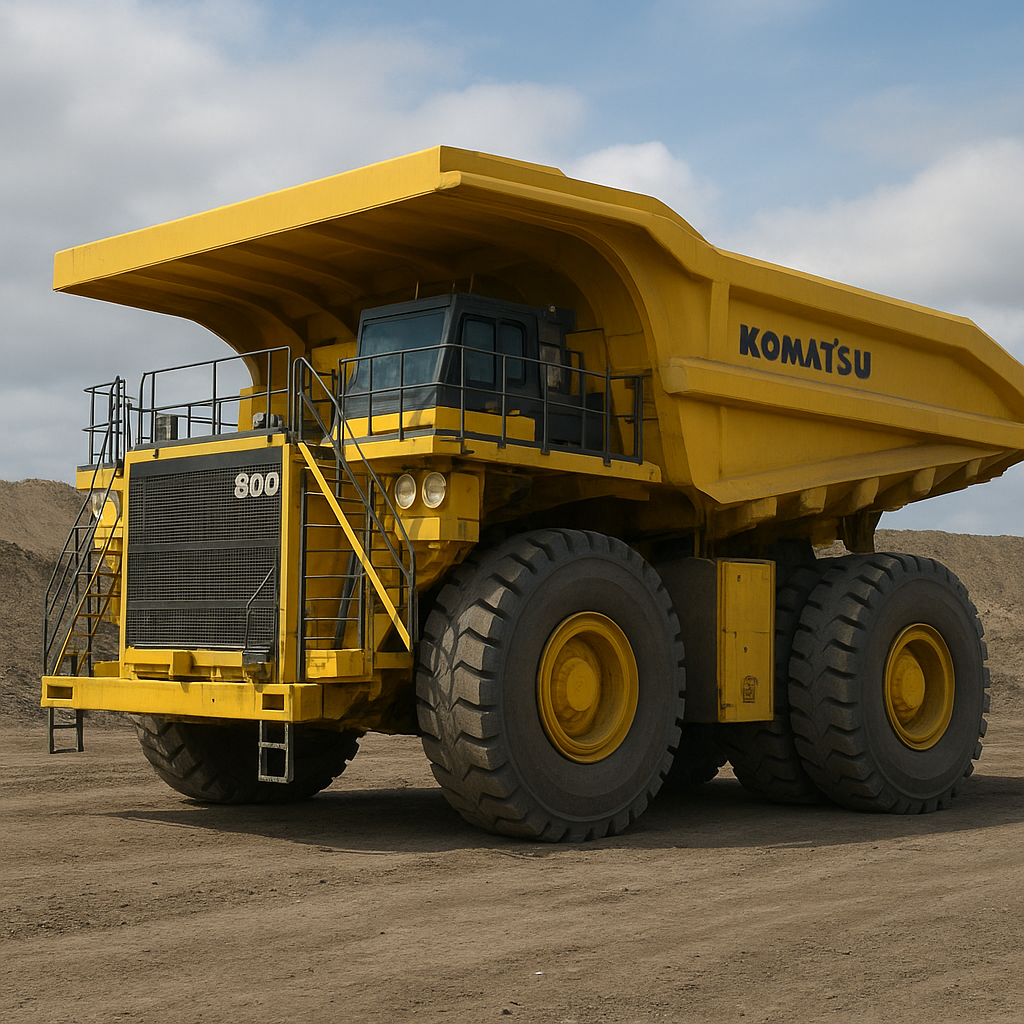
The Komatsu 860E is a heavy-duty haul truck designed for large-scale surface mining operations and heavy earthmoving applications. As part of Komatsu’s E-series of electric-drive mining trucks, the 860E combines robust structural design, an electric powertrain concept, and features aimed at maximizing productivity while reducing operating costs. This article explores the machine’s design, typical areas of application, operational characteristics, and other notable information that mine operators, engineers, and enthusiasts may find valuable.
Overview and role in mining operations
The Komatsu 860E is engineered primarily for use in open-pit mining, where large volumes of overburden and ore must be transported from excavation faces to crushers, stockpiles, or processing facilities. These trucks are part of a class of ultra-class haul trucks that emphasize high payload capacity, reliability, and long-term operational uptime.
In a typical mine fleet, machines like the 860E operate in concert with shovels, draglines, loaders, and primary crushers. Their role is to move material cost-effectively over designated haul roads, often in cycles lasting several minutes per load. Because haul trucks directly affect throughput and unit cost of material movement, the choice and deployment of a truck such as the 860E have significant implications for mine economics.
Design and technical characteristics
The 860E follows the general architecture common to modern ultra-class haul trucks: a heavy structural frame, a high-capacity dump body, a robust suspension/axle arrangement, and a powertrain tailored for long-term heavy-duty use. A defining technical trait of the E-series (including the 860E) is the use of an electrically driven final propulsion system. Rather than a traditional mechanical drivetrain transferring power directly from the diesel engine to the wheels through a transmission and axles, the diesel engine powers an onboard generator which supplies electricity to traction motors driving the axles.
Powertrain and propulsion
- The 860E typically employs a high-horsepower diesel engine coupled to an alternator or generator. This setup drives large traction motors, providing strong tractive effort at low speeds and efficient power distribution.
- An electric drive offers advantages including reduced mechanical complexity in the transmitted power path, improved torque control, and generally simpler long-term maintenance of moving mechanical gear sets compared with some mechanical transmissions.
- Regenerative technologies or dynamic braking systems are often incorporated to manage braking energy and dissipate heat generated during downhill runs.
Structural design and payload handling
- The chassis and dump body are built using thick, wear-resistant steels and are engineered for repetitive heavy loading cycles. Key structural nodes (such as the frame rails and dump body hinge) are reinforced for durability.
- Suspension and axle systems are designed to spread heavy loads safely across large tyres. The truck’s design accommodates standard mining tyre sizes and configurations used across ultra-class fleets.
Operator station and controls
- Cab design emphasises visibility, operator comfort, and ergonomics to reduce fatigue over long shifts. Modern variants include climate control, adjustable seating, and intuitive control layouts.
- Advanced instrument clusters and onboard diagnostics provide operators with real-time information about fuel consumption, vehicle status, and alerts to support preventive maintenance.
Typical applications and operational contexts
The Komatsu 860E is optimized for large-scale material haulage in a variety of mining conditions:
- Coal mining — moving overburden and coal from pit faces to processing or stockpile areas.
- Hard-rock mining — hauling blasted ore to crushers or primary crushers for further processing.
- Bulk earthworks — infrastructure projects where large volumes of material need fast, repetitive hauling.
These trucks are most advantageous where haul distances and material tonnages justify the use of ultra-class equipment. In short-haul operations with lower payload requirements, smaller rigid trucks or articulated haulers may be more economical.
Performance, capacity and statistics (typical ranges)
Specifications for haul trucks can vary between model years and optional configurations. The following figures represent typical ranges and general expectations for a machine in the 860-class of Komatsu haul trucks:
- Payload capacity: often in the range of several tens to a few hundred metric tonnes per load depending on configuration; operators should consult the vehicle’s data plate or factory literature for exact rated payload for a specific model and configuration.
- Engine power: diesel prime movers for trucks of this class commonly deliver in the high hundreds to low thousands of horsepower equivalent, driving generators for the electric traction system.
- Operating weight: gross vehicle weight, including payload when loaded, is typically measured in the hundreds of tonnes for ultra-class machines.
- Top speed: road or haul-road speeds are modest and designed to prioritize torque and safety; in loaded conditions speeds are constrained by gradient, braking capacity, tyre wear and operator procedures.
- Fuel consumption: depends heavily on duty cycle, material density, haul-road profile, and operator behavior. Electric drive trucks may show operational fuel advantages through efficient torque delivery and fewer mechanical losses.
Because manufacturers periodically update engines, control systems, and structural details, specific numeric values should be verified in the technical specifications for the exact model year and variant of the Komatsu 860E in question.
Maintenance, lifecycle and operational economics
Maintaining a large haul truck like the 860E requires a structured program focusing on preventive maintenance, condition monitoring, and timely component replacement to preserve uptime. Key areas of attention include:
- Tyre management — tyres represent a significant operating cost; proper selection, rotation, and maintaining correct tyre pressures extend tyre life and reduce fuel consumption.
- Electric drive components — traction motors, power electronics, and cooling systems require specific diagnostics and regular inspections to detect early signs of wear or electrical faults.
- Structural inspections — welds, pivot points, and stress-critical members must be checked periodically for fatigue or cracking, particularly in highly abrasive or impact-prone environments.
- Lubrication and filters — regular replacement of engine and hydraulic oils, filters, and coolant helps extend component life and maintain efficiency.
From an economic standpoint, haul trucks like the 860E are capital-intensive assets whose value is realized over long service lives through low cost-per-tonne moved. Fleet managers track metrics such as tonnes hauled per day, fuel burn per tonne, hours between failures, and total cost of ownership to inform replacement and expansion decisions.
Safety, telematics and automation
Safety is a paramount design and operational consideration. Haul trucks incorporate multiple systems to protect operators and ground personnel:
- Advanced braking systems and redundant controls to manage downhill speed and emergency stops.
- Enhanced visibility features, including cameras and proximity detection to reduce collision risks in busy pit environments.
- Operator restraint systems and ergonomic cabs to reduce injury risk in the event of rollover or sudden maneuvers.
Modern Komatsu trucks are often fitted with telematics suites that capture operational data, enabling remote monitoring of vehicle health, fuel usage, and location. This data allows fleet managers to optimize cycles, schedule maintenance proactively, and reduce unplanned downtime.
In recent years, automation and semi-autonomous operation have become increasingly important. While full autonomy depends on mine infrastructure and regulatory frameworks, many fleets use automation for:
- Repeatable haul cycles with precision routing to reduce tyre wear and fuel use.
- Hands-off operation in constrained or hazardous zones to improve safety.
- Integration with mine control centers for coordinated shovel-truck assignment.
Environmental considerations
Haul trucks are major consumers of diesel fuel and contributors to a mine’s greenhouse gas and particulate emissions budget. Manufacturers and operators pursue improvements through:
- Engine efficiency gains and cleaner aftertreatment systems to reduce NOx and particulates.
- Optimized haul-road design and operational strategies to minimize fuel burn per tonne moved.
- Use of biodiesel blends or alternative fuels where feasible to lower lifecycle emissions.
- Research into hybridization or battery-electric alternatives for reduced on-site emissions; electric-drive trucks like those in Komatsu’s E-series can be more efficient in converting fuel energy into tractive effort than some mechanical drivetrains.
Advantages, limitations and considerations for fleet planners
Advantages of the Komatsu 860E type include:
- High payload potential that reduces the number of cycles and vehicles needed for a given production target.
- Electric drive characteristics that can offer improved reliability of the traction system versus some complex mechanical transmissions.
- Operator-friendly cabins and integrated diagnostic systems that help maintain productivity and reduce human error.
Limitations and considerations include:
- High initial purchase price and significant capital commitment, which must be justified by throughput and lifecycle efficiency.
- Requirement for skilled maintenance personnel and appropriate workshop facilities to handle large components and electrical systems.
- Infrastructure constraints such as haul-road width, bridge capacities, and pit geometry that must be compatible with ultra-class truck dimensions and axle loads.
Notable operational examples and industry context
Trucks of the Komatsu E-series, including models like the 860E, have been used in a wide range of mining contexts globally, including large copper, iron ore, and coal operations where productivity and efficiency are critical. Operators often pair such trucks with high-capacity shovels and integrated mine planning systems to maximize throughput.
When planning to deploy an 860E-type truck in a fleet, companies typically undertake an analysis including:
- Cycle time modelling (shovel-dump-shovel) to confirm that the truck’s payload and speed characteristics align with shovel productivity.
- Cost-per-tonne modelling considering fuel, tyres, maintenance, and capital depreciation.
- Risk assessments for safety, environmental compliance, and spare parts logistics.
Future outlook and technological trends
Industry trends affecting machines like the Komatsu 860E include electrification, increased automation, and greater use of data analytics. Specific areas to watch:
- Integration of advanced telematics and predictive maintenance algorithms to reduce unscheduled downtime and optimize parts inventory.
- Greater adoption of autonomous haulage systems (AHS) in large, predictable mining operations, enabling continuous operation and potential reductions in operating cost per tonne.
- Improvements in power electronics and battery technology that may lead to hybrid or fully electric haul trucks with lower on-site emissions and different maintenance profiles.
As mines seek to lower costs and environmental footprints while increasing productivity, large haul trucks such as the 860E will continue to evolve through incremental technical improvements and deeper integration with digital mine management platforms.
Concluding remarks
The Komatsu 860E represents a class of robust, high-capacity haul trucks engineered to handle the demanding cycles of modern surface mining. With its combination of electric drive characteristics, durable construction, and compatibility with modern telematics and automation, the 860E-style haul truck remains a critical asset for mines seeking to move large volumes of material efficiently. Operators considering such machines should evaluate fleet-level economics, operational conditions, and maintenance capability to ensure the asset delivers the expected productivity and lifecycle value.
)
)