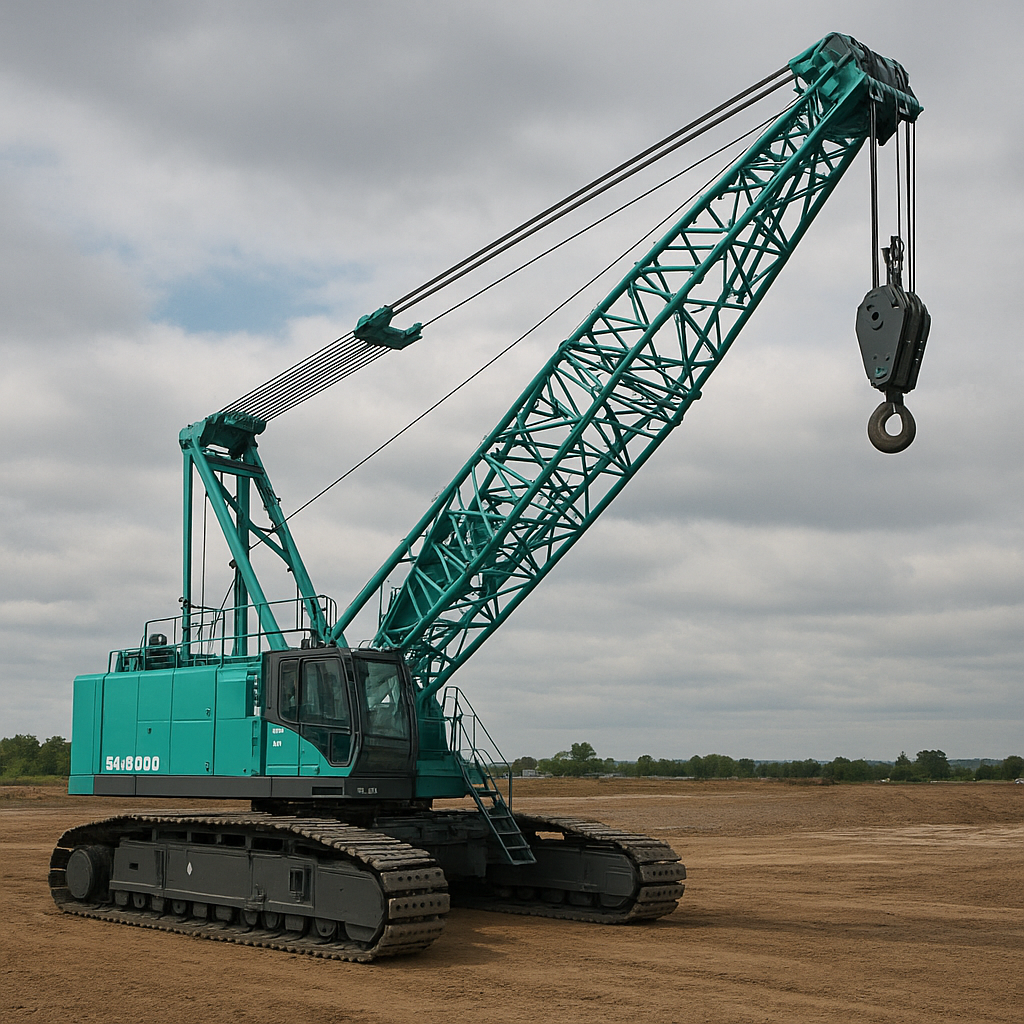
The Kobelco SL6000 is a heavy-duty crawler crane designed for high-capacity lifting tasks in demanding construction, energy, and industrial projects. Combining robust structural engineering with modern control and safety systems, the SL6000 is built to handle large lifts, long boom configurations, and challenging site conditions where mobility, stability, and precision are essential. This article explores the machine’s design, typical applications, operational features, safety aspects, maintenance considerations, and market positioning, providing both technical insight and practical guidance for owners and operators.
Design and technical characteristics
The SL6000 is a member of Kobelco’s lineup of lattice-boom crawler cranes, engineered for heavy lifting and extended reach. While exact specifications depend on configuration, counterweight, boom and jib combinations, and optional equipment, the model is commonly described as a high-capacity crane in the heavy-lift category. Key components and design considerations include:
- Chassis and undercarriage: The crawler undercarriage provides exceptional stability and ground pressure distribution, allowing the crane to travel on-site and position loads without the need for immediate auxiliary support. Tracks are engineered to tolerate heavy counterweight and boom loads while maintaining mobility on prepared surfaces.
- Lattice boom: A modular lattice boom system enables very long reach and high tip heights. Sections can be added or removed to match job requirements; lattice construction reduces overall weight for a given reach compared with a comparable telescopic boom.
- Counterweight system: A modular counterweight design allows the SL6000 to adapt lifting charts for different configurations. Ballast blocks are stacked and secured to achieve desired stability and safe lifting capacities.
- Hoist and winch systems: Heavy-duty winches with multiple layers of drum capacity and redundant braking provide the pulling power for main and auxiliary hoists. Winch gearing, wire rope diameters, and drum capacities are matched to rated loads and recommended reeving patterns.
- Powertrain: Typically diesel-powered engines provide the prime mover for hoist, swing and travel systems through hydraulic or hydrostatic transmission modules. Engine outputs and emission controls vary by region and model year.
- Operator’s cabin and controls: Ergonomically designed cabin with climate control, advanced joysticks, load-moment indicators, and display panels that present real-time load charts and diagnostics for safe operation.
- Safety & monitoring systems: Modern load moment indicators (LMI), anti-two-block protection, overload alarm/warning systems, and optional remote-monitoring telematics are commonly integrated.
Performance parameters (typical ranges)
Manufacturers publish multiple lifting charts for each configuration; therefore the SL6000’s performance is best understood as a range. Typical characteristics for a machine in this class include:
- Lifting capacity: Configurations for the SL6000 are intended to deliver very high lifting capability. Depending on the setup, the rated capacity may reach into the several-hundred-ton class; in practical field configurations, cranes of this type are used for lifts ranging from medium-high to ultra-heavy jobs.
- Boom length: Lattice booms and jibs can commonly be configured to reach tens of meters to over one hundred meters of tip height, depending on section selection and jib combinations.
- Operating weight: The complete machine with counterweights and boom fitted typically weighs many tens of tonnes, and in heavy configurations the total transport weight (split into truckable sections) is a substantial logistic consideration.
- Travel & positioning: Low-speed travel for site repositioning is supported by the crawler undercarriage, while transport between sites usually requires disassembly and multi-axle transport.
Note: Exact numerical figures vary by model year, country-specific versions, and optional packages. For precise lifting charts and machine weights, consult the manufacturer’s technical documentation and certified load charts for the specific machine configuration.
Typical applications and industries
The SL6000’s combination of power, reach and stability makes it suitable for a wide variety of heavy construction and industrial uses. The most common application areas include:
- Power generation — installation of heavy turbines, generators, heat-recovery units, and major components in thermal, hydro and wind power plants. The ability to position heavy components at height and with precision is a critical advantage.
- Wind farm construction — erection of towers and installation of nacelles and blades on onshore projects where large lifting radius and boom reach are required. Special jibs and dedicated attachments are often used to achieve required hub heights.
- Petrochemical and refinery work — lifting large vessels, heat exchangers, columns and piping modules during maintenance turnarounds or new construction. Corrosion-resistant finishes and explosion-proof options may be specified for hazardous environments.
- Marine and port operations — shipyard lifts, heavy module loads, and offshore platform component assembly and load-out operations where large lifting capacity and precise load control are essential.
- Infrastructure and bridge construction — placing pre-cast concrete segments, bridge girders and heavy structural elements where reach and capacity reduce the number of lifts or temporary supports needed.
- Industrial plant installation — erection of heavy machinery, press units, and structural elements in steelworks or heavy manufacturing facilities.
Across these industries the SL6000 is valued for its predictability on complex lifts and its capacity to be configured for specialty attachments such as spreader bars, hydraulic jibs, and tandem or multi-crane lifts.
Operational features and safety systems
Modern crawler cranes such as the SL6000 integrate numerous systems aimed at improving operational efficiency and safety. Below are the important operational features and common safety measures:
- Load moment indicator (LMI) — continuously monitors boom length, angle, load radius, and weight to display allowable capacities and trigger alarms or cutouts when approaching unsafe conditions.
- Anti-two-block protection — prevents the hook block from contacting the boom tip, which could cause line damage or catastrophic structural failure.
- Automatic swing and slew control — assists in smooth rotation of heavy loads, allowing precise placement and reducing dynamic load effects.
- Redundant braking and holding systems — ensure load security in the event of hydraulic or power loss.
- Operator aids — camera systems, proximity sensors, and load-positioning displays that reduce blind spots and improve situational awareness.
- Telematics and remote monitoring — optional modules report machine hours, fuel consumption, alarms, and geolocation to fleet managers for improved maintenance planning and asset utilization.
- Environmental controls — emission packages, particulate and NOx treatment options to meet regional regulations; sound attenuation to reduce noise footprint on urban jobsites.
Training of operators and rigging crews, combined with certified lifting plans and site-specific risk assessments, are essential complements to the SL6000’s built-in safety features. Proper selection of ground mats, cribbing, and outrigger or leveling accessories is also critical to ensure stable and safe lifting conditions.
Maintenance, serviceability and lifecycle considerations
Owning and operating a machine like the SL6000 involves significant lifecycle planning. Regular maintenance and prompt repairs maximize uptime and protect resale value. Key maintenance topics include:
- Routine inspections — daily pre-shift checks for wire rope wear, hook and block integrity, hydraulic lines, and track condition.
- Scheduled servicing — engine oil and filter changes, hydraulic fluid analysis and replacement, gearbox inspections and winch drum maintenance as per the OEM schedule.
- Wire rope management — frequent monitoring and replacement of hoist ropes and reeving components to prevent fatigue failures; rope lubrication and correct spooling procedures prolong service life.
- Structural inspections — non-destructive testing (NDT) for boom sections, pins, and critical welds, especially after exposure to shock loads or near-miss events.
- Parts availability — ensuring supply of critical spares such as hydraulic pumps, valves, slewing bearings, and electronic modules reduces downtime. Using genuine OEM parts maintains warranty and performance.
- Refurbishment and rebuilds — large crawler cranes are often refurbished multiple times across decades of service; component rebuilds (engines, winches, turntables) can be cost-effective compared to replacement.
Planned maintenance programs and technical training for in-house mechanics can dramatically lower lifecycle costs. Many owners deploy telematics and condition-monitoring tools to predict component failures and schedule proactive repairs.
Logistics, transport and site preparation
Deploying an SL6000 requires careful logistical planning. The machine’s heavy components are generally transported as multiple truckable loads. Factors to manage include:
- Disassembly and transport — main components such as crawler frames, counterweight blocks, boom sections, and superstructure are removed and transported on multi-axle trailers. Transport permits and route planning are often required for oversized loads.
- Assembly and rigging — site cranes or mobile cranes and specialist crews assemble the unit. Assembly sequences follow strict safety protocols to manage heavy parts and minimize risk.
- Ground bearing capacity — soil investigation and ground improvement may be necessary. Use of crane pads, timber mats or engineered slabs ensures safe load distribution under the tracks and outriggers.
- Permitting and regulations — local authorities may require special permits for heavy lifts, temporary traffic management, and environmental or noise controls.
Efficient logistics and thorough site preparation reduce downtime and cost overruns. For remote or constrained sites, modular assembly and component sizing become essential considerations.
Market, availability and resale value
High-capacity crawler cranes like the SL6000 occupy a niche market. Buyers include large contractors, rental companies specializing in heavy lifts, energy firms, and plant owners. Market factors that influence purchase and resale value include:
- Demand cycles — infrastructure investment, energy projects and major industrial maintenance drives periodic increases in demand for heavy crawlers.
- Fleet utilization — rental businesses measure return on investment by utilization rates; an SL6000 with consistent bookings can recover higher capital costs faster.
- Specification and service history — machines with upgraded safety packages, low hours, and documented maintenance command premium resale prices.
- Global availability — geography affects prices; regions with concentrated heavy-lift demand often have a more active secondary market and better parts service networks.
Because these cranes are long-lived assets, refurbished older models frequently change hands. Availability of certified lifting charts and manufacturer support for older machines is an important consideration when acquiring a used unit.
Practical considerations for buyers and operators
When selecting or planning to operate an SL6000, owners should evaluate the following practical aspects:
- Match crane capacity to task — avoid overspecifying or underspecifying. A crane sized appropriately for the majority of anticipated lifts optimizes operational cost.
- Certification and operator training — ensure operators hold appropriate heavy-lift certifications and undergo type-specific training on the SL6000’s control systems and safety features.
- Insurance and liability — heavy lifts carry high financial exposure. Lift-specific insurance, thorough lift plans and certified rigging inspections reduce financial risk.
- Attachment selection — choose hoist lines, spreader bars, and jibs rated for the loads and rigging geometries intended. Specialized attachments (e.g., pick-and-carry skidding systems) should be validated for use with the machine.
- Environmental and community impact — noise mitigation, dust control and traffic management plans are especially important in urban deployments.
Case studies and notable project types
Large crawler cranes in the SL6000 class are often deployed in projects that attract attention because of scale or complexity. Examples of project types where similar machines have been used include:
- Turbine installs — placement of heavy steam turbine casings and wind turbine nacelles in constrained plant layouts.
- Bridge girder launches — lifting and placing superstructure elements in long-span bridge projects where precision and reach minimize temporary works.
- Offshore platform module assembly — load-outs and lift installations of topside modules where crane capacity and reach support safe handling at quayside.
- Refinery turnaround lifts — removal and installation of heavy process units during scheduled maintenance outages, where time and reliability are critical.
In these contexts, the SL6000 class crane’s ability to tailor configurations and its predictable performance under heavy loads contribute directly to project schedule adherence and risk reduction.
Environmental and regulatory considerations
Modern heavy cranes must comply with a range of environmental and safety regulations. Owners should consider:
- Emissions standards — regional engine emissions rules (Stage V in Europe, EPA tiers in the U.S.) can affect engine selection and after-treatment packages.
- Noise restrictions — urban sites may impose noise curfews; using low-noise diesel packages and scheduling noisy work during permitted hours helps compliance.
- Spill prevention — hydraulic fluid containment measures, secondary drip pans, and service-area controls reduce environmental risk.
- Waste management — responsible disposal or recycling of lubricants, filters and worn components is often required and recommended for sustainable operations.
Integrating environmental management into the lifecycle of the machine preserves community relations and mitigates regulatory risk.
Summary and final observations
The Kobelco SL6000 represents a class of large, versatile crawler cranes engineered for heavy industries where capacity, reach and reliability are essential. Its combination of lattice-boom flexibility, modular counterweights, and advanced safety and monitoring systems make it suitable for demanding projects in power generation, wind energy, petrochemical facilities, ports, and large infrastructure ventures. Effective use of the SL6000 requires careful planning around logistics, certified rigging, operator training, and a disciplined maintenance program to protect reliability and resale value. While exact technical data and lifting charts vary by configuration, the machine’s reputation rests on robust engineering and adaptability to specialty lifting challenges.
Key words emphasized throughout this article: Kobelco, crawler crane, lifting capacity, lattice boom, counterweight, operator, safety, maintenance, hydraulics, fuel efficiency.
)
)