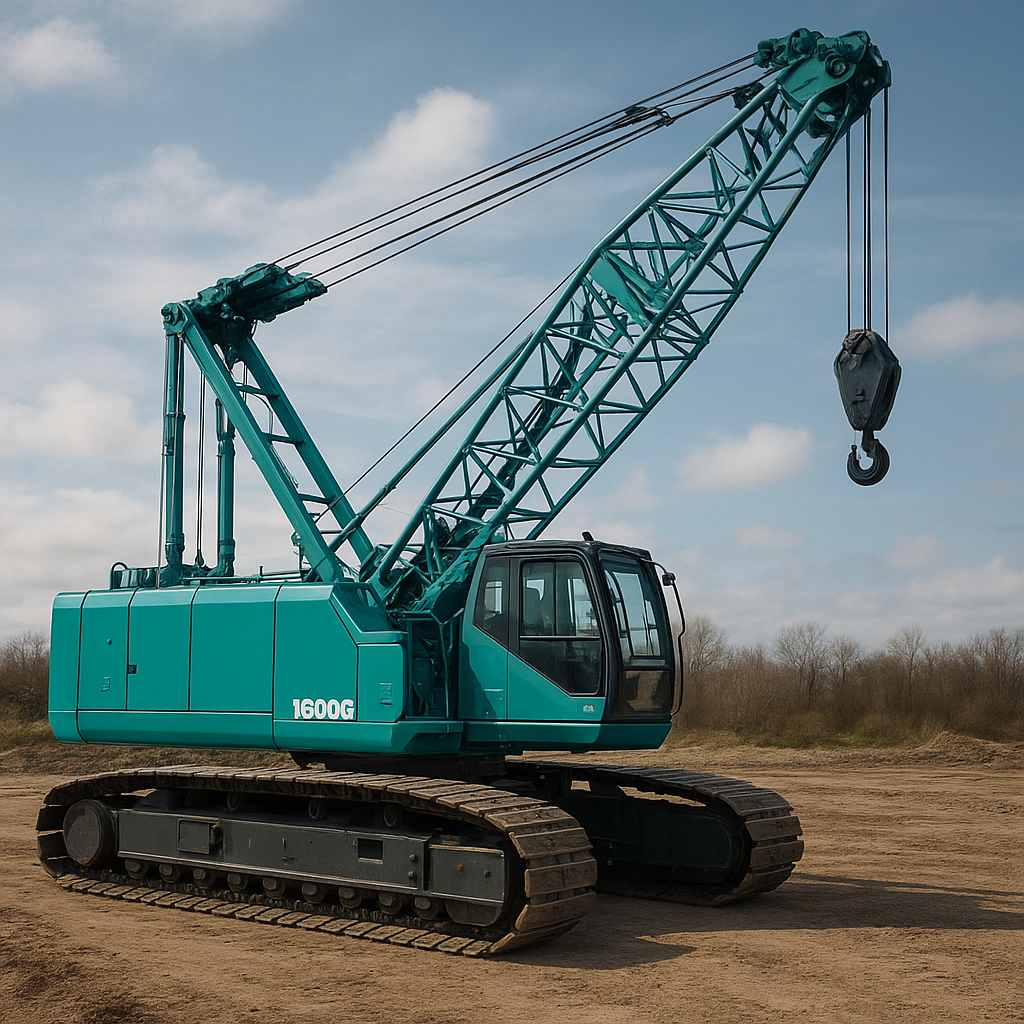
The Kobelco 1600G is a heavy-duty crawler crane designed for demanding lifting tasks in construction, infrastructure, and industrial projects. Combining robust engineering with versatile configurations, this model aims to deliver reliable performance across a variety of applications. In the following sections we will explore where the machine is used, its main technical characteristics and typical statistics, operational considerations such as safety and maintenance, and practical information about transport, assembly and market positioning. The text highlights practical insights that are useful for fleet managers, site supervisors and contractors considering the Kobelco 1600G for their projects.
Applications and typical use cases
The Kobelco 1600G, as a crawler crane, is primarily intended for heavy lifting where mobility on rough ground and high load capacity are required. Crawler cranes are chosen when site conditions, load sizes or lift heights make them the most efficient and safe option. Typical applications include:
- Large-scale building construction — placing pre-cast concrete elements, steel beams and facade modules.
- Infrastructure projects — bridge girder erection, viaduct components, and segmental bridge construction.
- Energy sector — installation and maintenance of wind turbine components (nacelles, hubs and towers), and plant equipment erection in power plants.
- Heavy industry and petrochemical plants — moving reactors, heat exchangers, pressure vessels and pipe racks.
- Port operations and heavy logistics — loading/unloading oversized cargo, and assembling large offshore components for transport.
Because it is mounted on crawlers rather than wheels, the machine offers excellent stability on soft or uneven terrain, and can often perform lifts without the need for substantial ground preparation. This makes it well-suited to remote or temporary sites where building a large crane pad would be costly or time-consuming.
Technical characteristics and typical specifications
Specifications vary with configuration and market, but the Kobelco 1600G typically fits the 160-ton class of crawler cranes. Below is an overview of common technical characteristics to help understand what to expect from a crane in this category:
- Lifting capacity: roughly 160 metric tons (rated capacity in the basic configuration). The actual load chart depends on boom length, counterweight and working radius.
- Main boom: modular telescopic or lattice sections allowing main boom lengths commonly ranging from about 12 m up to 60 m or more in some configurations.
- Jib: fixed or swing jibs available, often in ranges such as 12–30 m or more, enabling increased hook height and longer radius lifts.
- Operating weight: varies by counterweight and attachments but commonly in the tens of tonnes; assembled operating weight often exceeds the nominal lifting capacity by design to ensure stability.
- Engine and power: diesel engines sized to the crane’s hydraulic and winch systems; exact HP varies by configuration and emissions standards, but typically in the mid-to-high horsepower range suitable for heavy-duty continuous lifting.
- Winches and hoist line: multiple winches (main hoist, auxiliary hoist, and boom hoist) with capacities and line speeds tailored to heavy lifts and precise placement.
- Counterweight: modular counterweight systems allow tailoring the crane’s ballast to the lift requirements while optimizing transport loads.
- Undercarriage: heavy-duty crawler tracks with wide shoes for ground pressure distribution and improved mobility on rough or soft surfaces.
Important technical parameters such as maximum tip height, maximum radius at which rated capacity is achieved, and detailed load charts are dependent on the exact boom/jib configuration and counterweight. For accurate planning, it is essential to consult the manufacturer’s load charts for the selected configuration.
Performance, efficiency and environmental considerations
Modern crawler cranes like the Kobelco 1600G emphasize a combination of raw lifting power and operational efficiency. Key areas of performance include:
- Fuel efficiency: Engine and hydraulic system optimizations reduce fuel consumption during idle and lifting cycles. Many manufacturers include eco modes and optimized pump systems to lower operating costs.
- Hydraulic control and precision: Advanced hydraulic control gives smooth hoisting and slewing, which is crucial for accurate placement of heavy loads and safer operations in confined work zones.
- Cycle times: Efficient winches and powertrain design shorten load handling cycles, increasing productivity on repetitive lifts.
- Durability and uptime: Robust components and accessible maintenance points help maintain high uptime on long projects.
Environmental concerns have led manufacturers to improve emissions compliance and offer engine packages meeting regional standards (e.g., Stage V / Tier 4 final in applicable markets). In some cases, auxiliary systems like electrically driven pumps or hybrid assistance can further reduce fuel consumption and emissions during low-load operations.
Safety systems and operator assistance
Safety is paramount when operating heavy cranes. The Kobelco 1600G class cranes typically incorporate multiple systems to protect personnel and equipment:
- Load moment indicators (LMI): real-time monitoring of load, radius and boom configuration to warn or prevent overload conditions.
- Anti-two block and over-hoist protection: mechanical and electronic systems to prevent hazardous line-on-hook contact during lifts.
- Wind and environmental monitoring interfaces: integration options for sensors that limit operations in unsafe environmental conditions.
- Operator ergonomics and visibility: well-designed cabs with HVAC, adjustable seats and large windows. Cameras and proximity sensors are often available to augment visibility.
- Emergency and fail-safe systems: redundant controls and emergency stop features to allow the operator to secure the load safely.
Proper operator training and adherence to lift planning procedures remain essential, even with advanced safety systems. A thorough job-specific lift plan, including ground bearing pressure checks and rigging procedures, is always required for lifts involving heavy components.
Transport, assembly and site logistics
One advantage of crawler cranes is their ability to move on site without assembly, but larger configurations and long booms still require transport and assembly logistics. Key points:
- Modular design: main boom sections, jibs and counterweights are often modular to allow road transport within legal dimensions and staged assembly on site.
- Transport planning: trailers, heavy haulers and cranes for assembly may be necessary depending on the chosen configuration. The weight and dimensions of counterweight packs are important for logistics planning.
- Crawler mobilization: on-site movement typically uses the undercarriage, but for long-distance relocation on public roads the crawler is often disassembled or transported on trailers.
- Site preparation: while crawler cranes can operate on softer ground, a stable working pad or crane mats are often used for heavy lifts to distribute loads and reduce settlement risk.
Assembly time and crew requirements depend on how modular the crane is and the availability of support equipment. Experienced crews can assemble mid-sized crawler cranes quickly, but large lattice boom and heavy counterweight setups may take multiple days.
Maintenance, serviceability and lifecycle costs
Routine maintenance is critical to ensure reliability and minimize downtime. For the Kobelco 1600G class, focus areas include:
- Regular inspections: structural inspections for boom sections, pins and welds; periodic crawler drive and track inspections.
- Hydraulics and hoist systems: hose checks, oil analysis and scheduled replacements of filters and seals.
- Engine maintenance: scheduled servicing according to hours of operation and local emissions-related service items.
- Electrical and control systems: software updates, calibration of safety systems and battery/alternator checks.
Lifecycle cost planning should include not only original equipment cost but also fuel consumption, scheduled maintenance, spare parts availability, and resale value. Crawler cranes from established manufacturers such as Kobelco tend to have robust global support networks, which can reduce total cost of ownership by improving parts availability and technical support.
Market position, alternatives and economic factors
In the 160-ton class, the Kobelco 1600G competes with models from other major manufacturers offering similar capacities and features. Decisions between models often hinge on:
- Local dealer support and parts availability — critical for minimizing downtime.
- Specific site requirements — transport constraints, assembly resources and ground conditions.
- Total cost of ownership over the expected work cycle — fuel efficiency and service intervals play strong roles.
- Operator preference and cab ergonomics, which affect productivity on long-term projects.
Fleet owners evaluating purchase vs rental also weigh utilization rates and project timelines. For occasional lifts, renting a specialist crane may be more economical than purchasing; for long-term, continuous use the purchase of a crane like the Kobelco 1600G can be justified by consistent productivity and quicker mobilization.
Comparisons and complementary equipment
When planning heavy lifts, the crane is just one element in a broader lift ecosystem. Complementary equipment and considerations include:
- Rigging gear: slings, shackles, spreader bars and custom lifting frames sized to the load.
- Support cranes: lattice-boom or mobile cranes used to place boom sections or counterweights during assembly.
- Ground support: crane mats, timber sleepers or engineered pads to reduce ground pressure and protect the site.
- Transport vehicles: heavy haulers and multi-axle trailers for moving components between sites.
Comparing the lifting capacity and reach of competing cranes helps teams select the most efficient machine for a given job. Often a crane with slightly higher capacity but simpler assembly can outperform a theoretically larger crane that requires extensive support logistics.
Interesting facts and practical tips
Versatility of boom configurations
One of the strengths of the 160-ton class is flexible boom configuration. Operators can adapt between a compact counterweight scheme for tight urban jobs or a heavy counterweight and long boom/jib for tall structures and long-radius lifts. This versatility reduces the need to switch cranes for differing tasks on the same project.
Site planning and ground bearing
Even though crawlers distribute loads well, it is essential to calculate ground bearing pressure, especially for heavy lifts. Using crane mats or engineered pads can mitigate settlement and protect sensitive surfaces like asphalt or turf.
Operator training and certification
Given the complex systems onboard, operators should be certified and familiar with electronic LMI systems and the specific behavior of crawler cranes versus hydraulic truck cranes. Familiarity with slewing dynamics and boom flex behaviors improves safe and efficient operations.
Typical specifications (for reference)
The following are representative reference figures for a 160-ton class crawler crane. These are indicative only — always consult the manufacturer’s official datasheets for precise values for a particular configuration.
- Rated capacity: approximately 160 metric tons (standard configuration).
- Main boom length range: approx. 12 m to 60 m (configurable).
- Jib lengths: common options 12 m to 30 m, sometimes longer with lattice extensions.
- Maximum tip height (with jib): potentially 70–90 m depending on configuration.
- Engine power: variable by region and emissions spec, typically in the several hundred horsepower range.
- Operating/installed counterweight: modular system up to several tens of tonnes depending on lift demands.
Conclusion
The Kobelco 1600G represents a capable and flexible choice in the mid-to-upper range of crawler cranes. Its combination of stability, configurable boom and jib options, and robust safety systems make it suitable for demanding construction, energy and industrial projects. When selecting a machine, pay close attention to site logistics, transport and assembly needs, operator training and support from the manufacturer or dealer network. Proper maintenance practices and lift planning will maximize uptime and safety, while careful selection of configuration and complementary equipment will optimize performance and lifecycle costs for your projects.
)
)