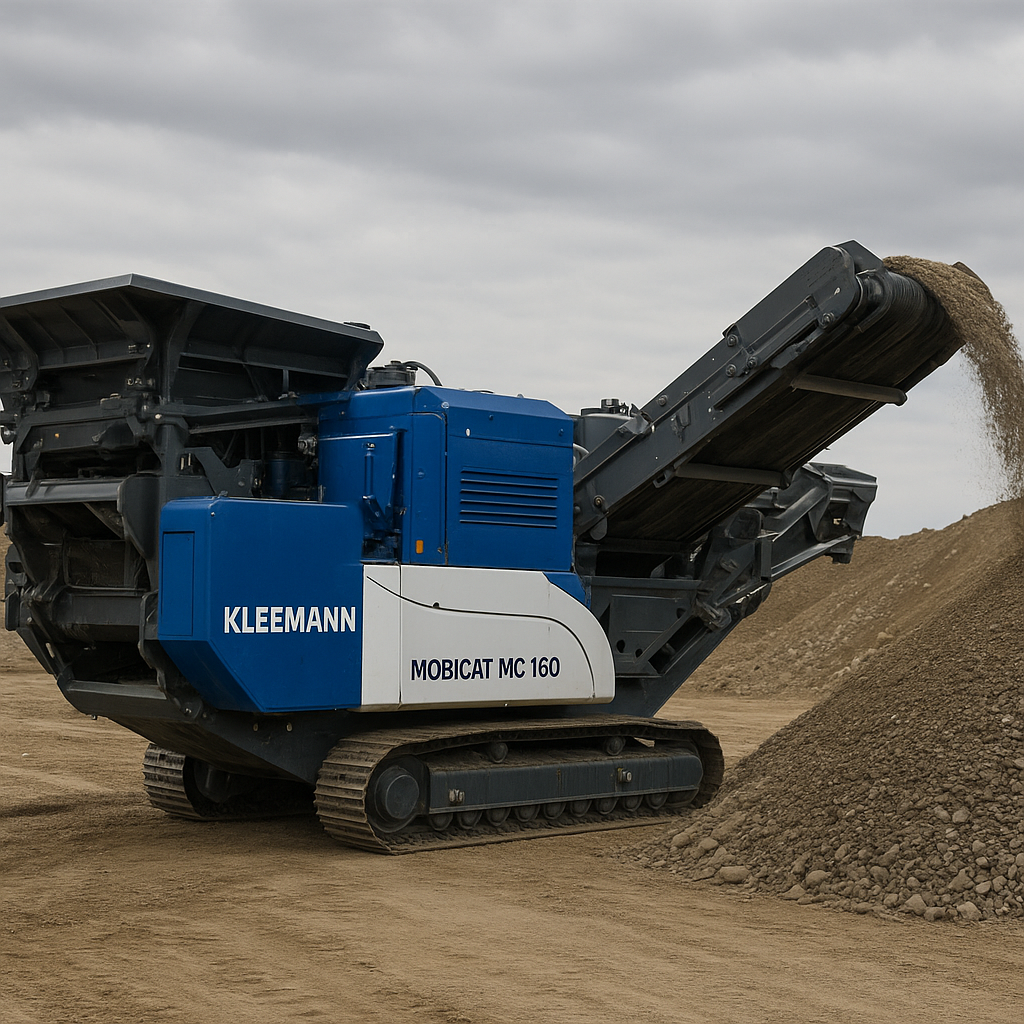
The Kleemann MOBICAT MC 160 is a powerful and versatile mobile crusher designed for demanding crushing tasks in quarrying, construction and demolition recycling, and infrastructure projects. Combining robust engineering with modern drive and control systems, the MC 160 delivers high productivity with flexibility on site. The following article examines the machine’s main features, typical applications, operational considerations, environmental and economic aspects, and practical tips for getting the most from this class of mobile jaw crusher.
Overview and key features
The MOBICAT MC 160 belongs to Kleemann’s family of tracked jaw crushers engineered for mobile primary crushing. Its design emphasizes rapid on-site deployment, simple transportability between jobs, and reliable crushing performance across a wide range of materials. Kleemann, part of the Wirtgen Group, has focused on combining high crushing performance with user-friendly maintenance and advanced control systems.
- Robust frame and crusher unit: The machine’s chassis and jaw unit are designed for heavy-duty operation and long service life. The jaw crusher is built to tolerate abrasive materials and high feed rates.
- Mobility: Tracked undercarriage allows the unit to move around large sites under its own power, minimizing setup time and site preparation.
- Flexible drive systems: Modern variants typically offer diesel direct drives or diesel-electric combinations and often include energy recovery or economy modes.
- Advanced control and automation: Integrated control panels and remote-control options facilitate adjustment of feed, speed, and crusher settings to optimize throughput and particle size distribution.
- Quick maintenance features: Easy access to wear parts, hydraulic adjustments for the crusher gap, and modular components reduce downtime.
Where it is used — primary applications
The MOBICAT MC 160 is primarily used as a primary crusher where large pieces of raw or demolished material must be reduced to a size suitable for secondary processing or direct use. Typical application areas include:
- Quarrying: Crushing blasted rock or quarried limestone, granite, basalt, and other aggregates to produce base material for construction and asphalt plants.
- Construction and demolition recycling: Processing concrete, brick, asphalt and masonry from demolition sites so inert fractions can be reused as recycled aggregate, reducing disposal costs and raw material demand.
- Road building and civil engineering: Producing sub-base and base layers directly on site, enabling faster project cycles and lower material transport costs.
- Mining: Preliminary crushing of overburden or ore ahead of secondary crushers and screens in smaller operations or remote sites.
- Special projects: Infrastructure refurbishments, pipeline projects, and other applications where a mobile, robust primary crusher speeds up the workflow.
Technical characteristics and typical performance
Specific performance and dimensions depend on the MC 160’s configuration, options, and the hardness and size distribution of input material. Below are representative characteristics and typical performance ranges to provide context for planning and procurement:
- Feed opening: Mobile jaw crushers of this class are designed to accept large feed sizes; typical feed openings can accommodate material up to several hundred millimetres in diameter. Exact feed opening depends on the chosen jaw plate geometry and configuration.
- Throughput (capacity): Typical throughput for a robust primary mobile crusher like the MC 160 can vary widely — from roughly 150 to 500 tonnes per hour — depending on material density, required product size, crusher gap settings, and plant configuration (pre-screening, conveyor speeds, etc.).
- Drive power: Units in this segment are usually powered by diesel engines rated in the mid-hundreds of kilowatts (or equivalent diesel-electric systems), with options for lower or higher power based on expected workload.
- Crusher type: Jaw crushers with hydraulic adjustment systems are common, enabling quick setting changes and protection against uncrushable objects. Kleemann typically offers efficient, single-toggle jaw designs optimized for a balance of throughput and wear life.
- Mobility and weight: Transport weight often ranges from tens to several tens of tonnes depending on equipment fit (e.g., additional screens, conveyors, magnetics). Track drive and foldable conveyors allow road transport on low-loaders in many configurations, but exact transport dimensions must be checked against local regulations.
Note: The figures above are indicative. Exact numbers should be obtained from the machine’s technical datasheet based on the selected model and equipment package.
Design and component highlights
The MC 160 integrates components and design elements developed to improve uptime and efficiency:
- Hydraulic gap adjustment and overload protection: Hydraulic systems permit fast changes to the crusher setting and provide protection when uncrushable objects enter the crusher, preventing serious damage.
- High-performance jaw profiles: Optimized jaw plate geometry balances crushing efficiency and wear life, and different material-specific profiles are available to tailor performance.
- Feed hopper and vibrating feeder: Large-capacity hoppers combined with robust feeders ensure continuous, even feed to the crusher. Optional pre-screening modules separate fines before the jaw, improving throughput.
- Integrated conveyors and stockpiling: Foldable, height-adjustable conveyors allow efficient product transport and stockpile creation without additional handling equipment.
- Control and diagnostics: Modern electrical systems provide onboard diagnostics, automated start/stop sequences, and CAN-bus based component monitoring for predictive maintenance.
Operation, set-up and best practices
To achieve optimal performance from a machine like the MOBICAT MC 160, operators should follow several practical guidelines:
- Material preparation: Remove oversized or problematic pieces when possible and use pre-screening to bypass fines that will not require primary crushing. This reduces wear and improves throughput.
- Feed uniformity: Consistent feed distribution across the crusher inlet prevents uneven wear and maximizes crushing efficiency. Use feeders and distribution devices where necessary.
- Crusher setting and product control: Adjust the crusher gap and jaw profile to achieve the desired product gradation while avoiding chokepoints. Regularly inspect jaw plates for wear and change settings as wear progresses.
- Routine maintenance: Lubrication and wear part inspections should follow manufacturer schedules. Quick access panels and modular components reduce maintenance downtime.
- Operator training: Well-trained operators and maintenance personnel significantly increase machine productivity and reduce wear-related costs. Make use of manufacturer training and digital support tools.
Safety and regulatory considerations
Safety is paramount when operating heavy mobile crushing equipment. Key measures include:
- Lock-out/tag-out procedures: Ensuring power sources are isolated before performing maintenance or clearing blockages.
- Guarding and access platforms: Secure enclosures, emergency stops, and safe access points for inspections and maintenance.
- Dust control: Dust suppression systems, water sprays, and encloses where necessary to meet workplace air quality limits.
- Noise mitigation: Using acoustic enclosures or scheduling noisy activities to comply with local noise ordinances and protect personnel.
- Compliance: Ensuring the machine meets local emissions and operational regulations (engine emissions, transport permits, etc.). Many modern machines are offered with engines that comply with EU Stage V or similar standards.
Environmental and economic aspects
Mobile crushing with equipment such as the MC 160 can deliver both environmental and economic benefits:
- Reduced transport emissions: Crushing reusable material on site reduces the need to transport heavy aggregates over long distances, lowering fuel consumption and CO2 emissions.
- Recycling and waste reduction: Processing demolition material into reusable aggregates reduces landfill use and the demand for virgin resources.
- Operational cost efficiency: Integrated plant layouts reduce handling stages and costs. Fuel-efficient engines and intelligent control systems further lower operating expenses.
- Lifecycle and resale value: Robust machines with documented maintenance histories tend to retain higher resale value; choosing the right wear parts and operating practices extends service life.
Typical configurations and optional equipment
Manufacturers like Kleemann offer a range of optional equipment and configurations to tailor the crusher to specific tasks and site conditions:
- Pre-screening and bypass conveyors: Separate fines prior to crushing to increase capacity and reduce wear.
- Magnetic separators: For removing ferrous contaminants in recycling applications.
- Dust suppression packages: Water sprays, full enclosures, or baghouse integration for sensitive sites.
- Remote control and telematics: Systems for remote monitoring of performance, fuel consumption, and maintenance alerts, aiding fleet management.
- Special jaw liners: Material-specific liners to maximize output and wear life depending on the feed material’s abrasiveness and crushing requirements.
Practical examples and use-case scenarios
Below are illustrative scenarios where a mobile jaw crusher similar to the MC 160 can create value:
- Urban demolition: A contractor demolishes a 10,000 m2 industrial hall and uses an on-site mobile crusher to convert concrete rubble into base material for a new parking area, saving on disposal fees and aggregate purchases.
- Road rehabilitation: In-place crushing of asphalt and sub-base materials provides reprocessed aggregate for the roadbed, reducing project time and transport costs.
- Quarry supplement: A small quarry uses a mobile primary crusher to bridge peaks in demand without installing a fixed plant; the unit can be relocated as the quarry face progresses.
Maintenance tips and common issues
To keep an MC 160-class crusher operating at peak performance, focus on:
- Wear part monitoring: Track jaw plate wear rates and rotate or replace liners before performance drops significantly.
- Hydraulic system care: Maintain clean hydraulic fluid and replace filters per schedule to prevent pressure loss and component wear.
- Feeding practice: Avoid overfeeding or uneven loading; both lead to blockages, excessive wear, and reduced throughput.
- Electrical diagnostics: Use onboard diagnostics to detect motor, sensor, or control issues early. Addressing small electrical faults early avoids expensive downtime.
Market context and selection considerations
When selecting a mobile primary crusher, buyers should consider:
- Capacity needs: Match the crusher’s throughput range to your project’s peak and average volumes.
- Material characteristics: Hardness, abrasiveness, and maximum feed size influence liner choice, speed, and expected wear costs.
- Mobility and transport: Consider travel distances between sites, transport permits, and the machine’s setup time.
- Total cost of ownership: Factor in fuel consumption, wear parts, serviceability, and resale value in addition to purchase price.
- Support and spare parts: Reliable dealer support and availability of wear parts shorten downtime and protect productivity.
Summary and final remarks
The Kleemann MOBICAT MC 160 class of mobile jaw crushers offers a combination of robustness, mobility, and operational flexibility that makes it well suited to quarrying, demolition recycling, road construction, and other heavy-duty applications. While exact performance figures depend on configuration and material, the machine’s strengths lie in rapid deployment, straightforward maintenance, and the ability to reduce material handling stages on site. Choosing the appropriate options and following best-practice operation and maintenance routines will maximize uptime and return on investment for contractors and operators working in demanding environments.
)
)