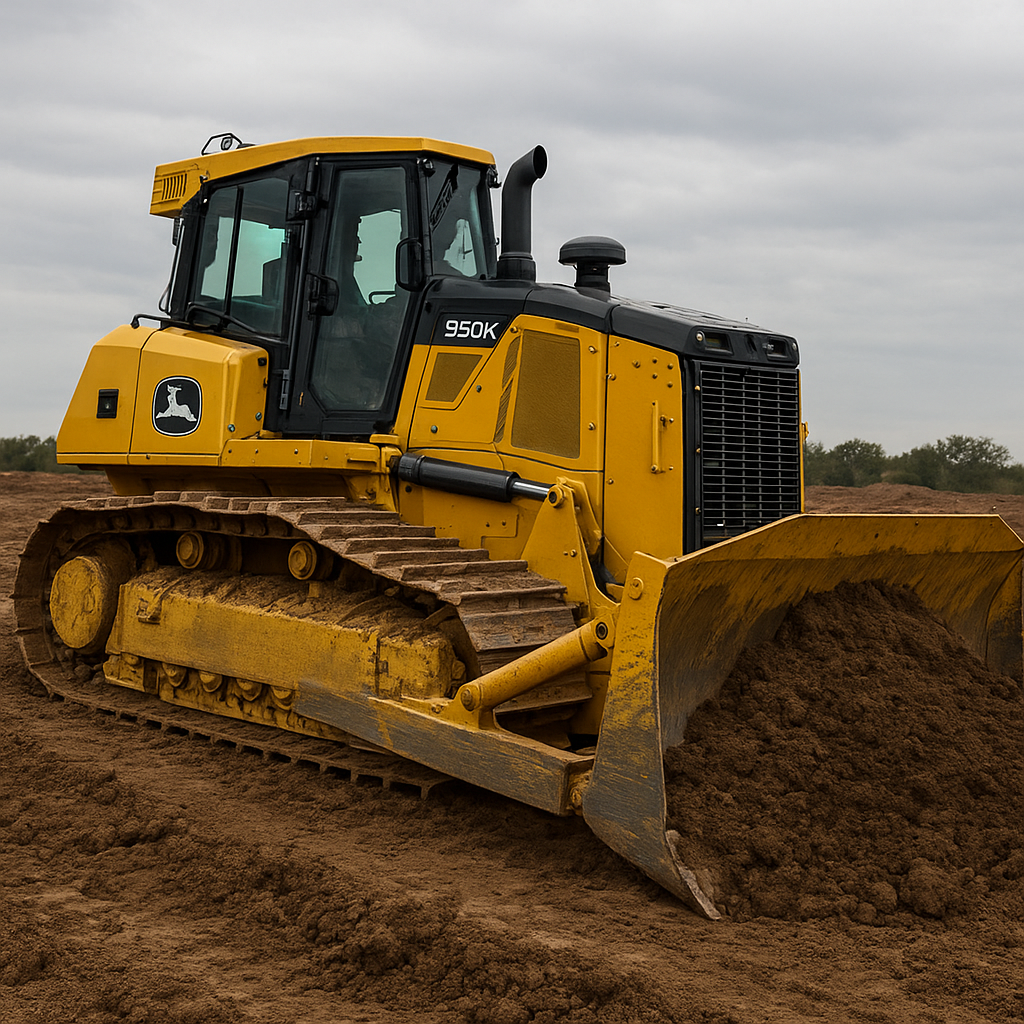
The John Deere 950K is a versatile medium-class tracked bulldozer designed for a wide range of earthmoving tasks across construction, mining support, forestry, and agricultural applications. Combining proven mechanical systems with operator-focused features, the 950K aims to deliver balanced performance, durability, and ease of service. This article explores the machine’s design, typical applications, technical characteristics, operational strengths, and considerations for buyers and fleet managers.
Overview and design philosophy
The John Deere 950K represents John Deere’s approach to producing a machine that blends robust mechanical components with modern operator conveniences. As a dozer positioned in the medium-size class, it is intended to offer a compromise between the maneuverability of smaller models and the sheer pushing capacity of larger crawler dozers. The platform emphasizes modular serviceability, simplified hydraulic and electrical systems, and a track-underframe designed for long life in abrasive conditions.
Key design highlights
- Engine layout: A compact, efficient diesel powerplant with emission control systems configured to meet regional regulations while preserving torque for heavy dozing work.
- Transmission and final drives: Robust transmission components and planetary final drives are selected to withstand shock loads common in heavy push operations.
- Blade options: Multiple blade types (straight, universal, semi-universal) and sizes are available to suit varying material conditions and job requirements.
- Undercarriage: A heavy-duty track frame and undercarriage components in various track-width and shoe configurations to optimize ground pressure and traction.
- Serviceability: Grouped service points, accessible filters, and straightforward diagnostics help reduce downtime and simplify maintenance.
Applications and operating roles
The 950K is used across a broad spectrum of industries where reliable earthmoving is required. Its size and balance of features make it especially popular for jobs that demand both mobility and respectable pushing power without the operating footprint of larger dozers.
Common applications
- Construction site preparation: clearing, rough grading, ramp building, and stockpile management.
- Road building and maintenance: embankment shaping, subgrade compaction aid, and roadside clearing.
- Mining and quarry support: push-loading, bench cleanup, and haul-road maintenance in small to medium mines or quarries.
- Land reclamation and landscaping: contouring large areas, building terraces, and preparing seedbeds.
- Forestry site prep: skid-to-skid clearing, loading paths, and firebreak preparation when fitted with protective guarding.
Because of its adaptability, the 950K is frequently chosen by rental fleets and contractors who need a machine that can be redeployed across diverse tasks. Its blade and undercarriage configurations can be optimized for either low ground pressure (sensitive terrain) or increased traction and capacity (heavy pushing).
Technical specifications and performance
Exact specifications for the John Deere 950K vary by model year, country, and optional equipment. The values below represent typical ranges and configurations commonly encountered in dealer literature and spec sheets; final figures should always be confirmed for the specific machine and market.
Typical technical data (approximate)
- Engine: John Deere PowerTech series, 6-cylinder diesel; displacement commonly in the 6.8–7.2 L range; emission control via aftertreatment where required.
- Net power: roughly 160–200 kW (215–270 hp) depending on rating and market.
- Operating weight: typically in the neighborhood of 18,000–24,000 kg (40,000–53,000 lb), depending on blade, ripper, and undercarriage choices.
- Blade capacities: selected blades yield volumes from approximately 2.5 to 6.0 m3 (3.3–7.8 yd3) depending on blade type and machine configuration.
- Track gauge and shoe width: multiple options (e.g., shoes from ~450 mm to 915 mm) to tune ground pressure and flotation.
- Travel speed: low-range speeds geared for heavy push; top speeds in transport gear commonly 10–12 km/h (6–8 mph), with creep modes for fine dozing.
- Fuel capacity: tanks typically sized to support a full workday under normal loads — often in the 250–400 L range depending on options and market.
- Hydraulics: load-sensing or pressure-compensated systems with electronic controls to manage blade and ripper functions; auxiliary hydraulic circuits for attachments where applicable.
Performance in field conditions depends heavily on configuration: wider tracks and larger blades increase productivity in bulk material movement but raise operating weight and may reduce maneuverability. Conversely, narrow shoes and smaller blades reduce ground disturbance and fuel consumption on soft or environmentally sensitive sites.
Productivity and fuel efficiency
Productivity metrics for a dozer like the 950K are influenced by blade type, soil conditions, operator skill, and machine setup. Typical production rates for general dozing tasks range widely — for instance, bulk pushing in loose material might yield several thousand cubic meters per day, whereas fine grading will be much lower but deliver higher quality results.
Fuel efficiency has been a focus of recent engine and hydraulic improvements. Electronic engine control, optimized torque curves, and improved hydraulic flow management help reduce fuel burn per cubic meter moved compared with older-generation machines. Many operators report operational fuel savings in the range of 5–15% when upgrading from a much older model to a modern 950K, though exact savings depend on duty cycle and machine settings.
Operator environment and safety
John Deere emphasizes ergonomics and safety in its cab design for the 950K. Comfortable operators can be more productive and make fewer mistakes, so cab features aim to reduce fatigue and improve visibility.
Cab and controls
- Comfort: climate-controlled cab with adjustable suspension seat, low noise levels, and thoughtful control layout to reduce strain during long shifts.
- Visibility: large glazed areas and optimized blade sightlines help with precise grading and obstacle awareness.
- Controls and displays: intuitive joystick or lever controls combined with digital displays provide engine, hydraulic, and diagnostic information; optional camera systems enhance rear and blind-spot visibility.
- Safety: ROPS/FOPS-certified cabs, emergency shutoffs, and well-marked access points for safe ingress/egress.
Operator-assist features such as grade-control-ready electrical systems, automated throttle responses, and variable response hydraulics may be available or dealer-fit. These can increase productivity, particularly in fine grading and repetitive tasks.
Maintenance, durability and lifecycle costs
A key part of the 950K’s value proposition is its maintainability and component durability. Major service items are designed to be accessed without complex disassembly, and John Deere’s dealer network provides parts, diagnostics, and field support in many regions.
Serviceability features
- Grouped service points: filters, fluid fill points, and daily checks are collocated to minimize time spent on routine maintenance.
- Modular components: major components such as radiators, fans, and pumps are designed for easier replacement when necessary.
- Diagnostics and telematics: on-board diagnostics and optional telematics packages allow remote monitoring of machine health, usage, and fuel consumption, which supports preventive maintenance.
Lifecycle cost considerations should include not only fuel and scheduled maintenance, but also undercarriage wear (often the largest single expense on tracked machines), blade and cutting-edge replacements, and the resale market. Undercarriage life varies with ground conditions and operator technique, but thoughtful selection of track shoe width and grouser pattern can extend component life significantly.
Attachments and versatility
The 950K can be equipped with various attachments to expand its usefulness beyond primary dozing tasks. Ripper options (single-shank or multi-shank), angle blades, winches, and specialized protective guarding for forestry operations are commonly used to adapt the machine to specific job demands.
Common attachments
- Ripper: for breaking hardpan or compacted layers prior to ripping and loading.
- Winch: useful in salvage, steep-slope work, and certain forestry or utility applications.
- Rear counterweights and guarding: to balance heavy blade loads and protect vital components in abrasive environments.
- GPS and grade-control systems: for precision dozing and to reduce rework.
When outfitted appropriately, the 950K can serve as a multi-role machine, decreasing the need for multiple specialized pieces of equipment on many job sites.
Purchasing considerations and resale
Fleet managers considering the 950K should look beyond sticker price to total cost of ownership. Factors such as fuel consumption under expected load cycles, warranty and dealer support, parts availability, and expected residual value all influence long-term costs.
What to evaluate before purchase
- Expected duty cycle: choose blade and undercarriage options to match the primary tasks.
- Dealer support: local availability of parts and skilled technicians reduces downtime.
- Warranty and service agreements: extended coverage or scheduled maintenance contracts can stabilize operating expenses.
- Resale value: machines with documented maintenance histories and telematics logs typically fetch higher resale prices.
Used 950K machines are common in secondary markets. Machines with well-maintained undercarriages and minimal structural repairs usually command higher resale values. Telematics and service logs add value by demonstrating consistent maintenance and sensible utilization.
Environmental and regulatory considerations
Modern 950K models are equipped to meet emissions standards in major markets via engine calibrations and exhaust aftertreatment. Responsible operation and maintenance also help minimize environmental impacts: maintaining proper track tension reduces fuel use and undercarriage wear, and correct engine servicing preserves emission-control performance.
Where noise, dust, or soil disturbance are concerns (urban development, protected lands), operators should consider low-ground-pressure configurations, protective blade skirts, dust suppression, and muffler or sound-reduction options to reduce the machine’s footprint.
Summary and final assessment
The John Deere 950K is a balanced medium-class dozer that provides a blend of power, durability, and operator comfort. With configurable blade, undercarriage, and attachment options, it can be tailored to a wide set of roles across construction, mining support, forestry, and agricultural tasks. Its design emphasizes serviceability and uptime, and many operators report favorable results in fuel economy and component life when machines are properly specified and maintained.
While final selection should be based on the specific job demands and local support network, the 950K stands as a practical choice for contractors seeking a reliable, mid-sized crawler dozer that balances productivity, fuel efficiency, and reliability. For precise, model-year-specific figures such as exact engine model, rated net horsepower, or blade dimensions, consult an authorized dealer or the official John Deere specification sheet for the exact configuration you are considering.
)
)