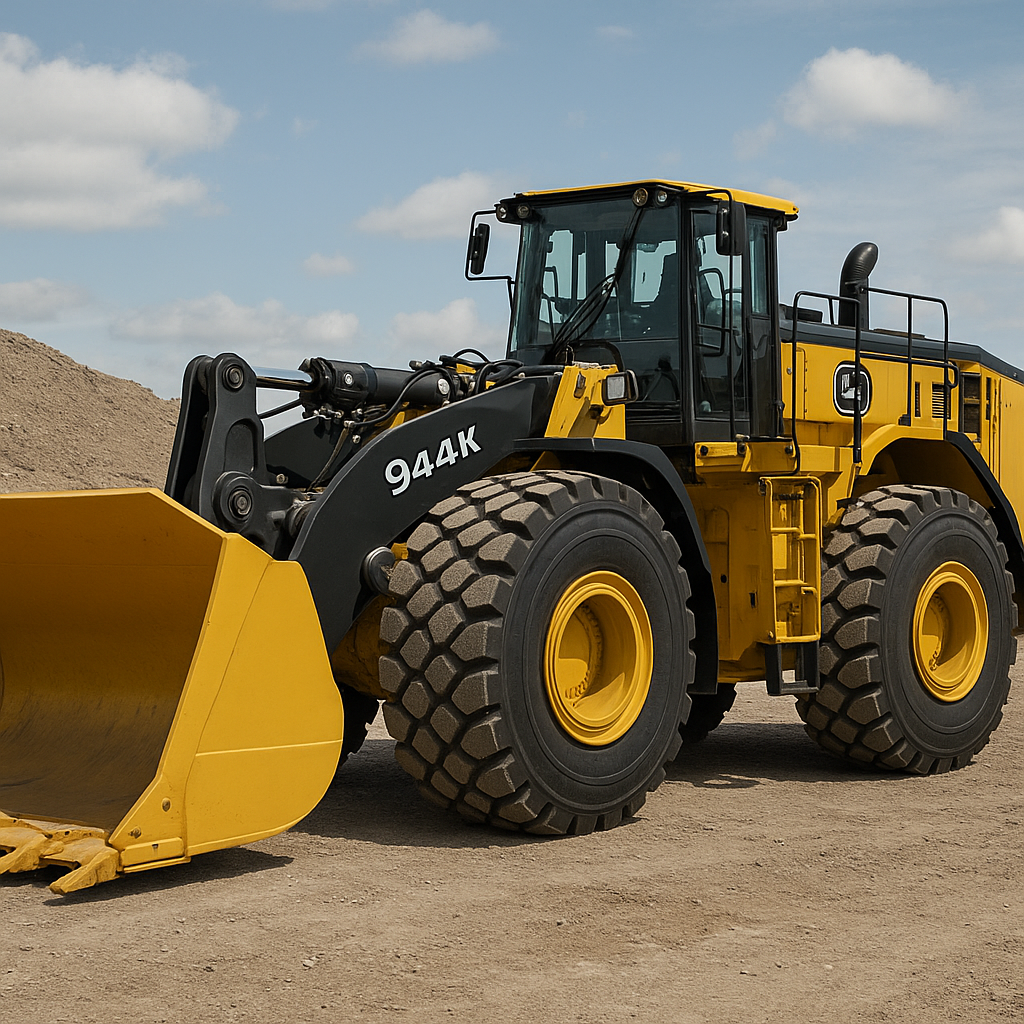
The John Deere 944K wheel loader is a heavy-duty machine designed to meet demanding tasks across construction, quarrying, mining, and materials handling. Combining proven mechanical principles with modern electronics and operator-focused design, the 944K aims to deliver balanced performance, fuel efficiency, and long-term durability. This article explores the machine’s design, typical specifications, common applications, maintenance considerations, safety features, and real-world use cases to provide a comprehensive view of what the 944K offers to fleet managers, contractors, and rental companies.
Design and engineering philosophy
John Deere built the 944K within a lineage of wheel loaders that emphasize a robust frame, dependable driveline, and serviceability. The model is intended to be a mid-to-large-sized loader in Deere’s lineup, optimized for a mix of pushing, loading and material transport tasks. Key elements of the design include a rigid structural underframe, articulated steering for maneuverability, and an integrated hydraulic system that balances speed and control.
Powertrain and drivetrain
The 944K is typically equipped with a turbocharged diesel engine from the John Deere PowerTech family or equivalent OEM-sourced engines, chosen for torque-rich performance at lower RPMs and for meeting emissions regulations. The engine works with a power-shift or torque-converter transmission tuned for smooth acceleration under load. Drive axles are engineered for high capacity, with planetary final drives and heavy-duty differentials to withstand shock loads. The combination of engine, transmission and axles is carefully matched to provide consistent work cycles on loading and hauling tasks.
Hydraulics and implement control
A responsive hydraulic system allows the 944K to operate with speed and precision. Priority flow to steering and implement circuits ensures effective control during heavy digging or lifting. Hydraulic components are selected for reliability and ease of replacement. Boom and bucket geometry are optimized to deliver strong breakout forces while maintaining good rollback and dump angles, improving fill factors and reducing cycle times.
Performance and typical specifications
Exact specifications for the John Deere 944K can vary by year, market and optional configurations. Below are commonly reported ranges and values that reflect the machine’s capabilities in many standard configurations.
- Engine power: approximately 200–260 kW (270–350 hp) depending on tuning and emissions package.
- Operating weight: typically in the range of 20,000–28,000 kg (44,000–62,000 lb) depending on bucket, counterweights and attachments.
- Bucket capacity: common options range from about 2.8 to 5.0 m³ (3.6–6.5 yd³) for general-purpose buckets; heavier-duty and specialty buckets can alter this range.
- Breakout force: often in the ballpark of 180–240 kN (40,000–54,000 lbf) for front-end attachment configurations focused on digging and loading.
- Rated payload: varies with configuration but generally supports heavy loads consistent with large articulated wheel loaders.
- Fuel tank capacity: typically 300–500 liters, enabling extended operating cycles between refueling (exact capacities depend on model year and region).
- Hydraulic flow and pressure: designed to support fast implement cycles—typical implement flow rates may range from 200–300 L/min at working pressure compatible with heavy-duty attachments.
- Speed: travel speeds are optimized for jobsite mobility — low-range crawl and higher highway-equivalent speeds for short-distance transport.
These figures should be treated as representative. For purchase or specification work, consult machine serial-specific datasheets from the dealer or John Deere’s official documentation to confirm exact numbers for a given unit.
Applications and industries
The John Deere 944K finds application across a variety of industries, where its balance of size, power, and versatility is most advantageous. Typical sectors include:
- Construction: site preparation, backfilling, stockpile handling, loading haul trucks and feeding crushers.
- Quarrying and mining: loading hard rock, aggregate and coarse materials into haul units or processing equipment.
- Materials handling and ports: moving bulk commodities, managing stockpiles, and loading/unloading rail cars or trucks.
- Agriculture and bulk feed operations: handling silage, manure, and bulk commodities at agricultural processing facilities or large farms.
- Demolition and recycling: moving demolition debris, sorting recyclable material with specialized attachments.
Within each of these sectors the 944K’s strengths—such as solid breakout force and bucket fillability—help operators maintain high productivity. When equipped with specialty attachments (grapples, forks, high-capacity buckets), the machine adapts to niche tasks while still offering the core benefits of a wheel loader platform.
Attachments, options and adaptability
One of the most important aspects of the 944K’s value is its ability to accept a wide range of attachments, expanding its utility beyond generic loading. Typical attachment categories include:
- General-purpose and heavy-duty buckets
- Light-material buckets for low-density products
- Rock buckets and reinforced designs for abrasive environments
- Forks and pallet-handling equipment
- Grapples for demolition or forestry applications
- Snow blades and pushers for winter operations
- Quick-coupler systems to expedite attachment changes
Options available from the factory or aftermarket—such as ride-control systems for smoother bucket transport, advanced lighting packages for night work, and telematics—allow fleet owners to tailor machines to specific jobsite demands. Telemetry and remote monitoring systems enable managers to track hours, fuel use, and maintenance needs, improving uptime.
Operator environment and ergonomics
John Deere places emphasis on the operator’s experience, recognizing that comfort and visibility translate directly into productivity. The cab is typically designed to offer a high seating position for improved sightlines to the bucket and front corners, wide glass areas, and robust HVAC systems for year-round comfort. Controls are logically arranged, and many machines include adjustable seats, joysticks or single-lever pilot controls for intuitive handling.
Noise and vibration mitigation is addressed through engine mounts and cab isolation, enhancing operator endurance during long shifts. Visibility aids such as rearview cameras, side mirrors and optional camera systems reduce blind spots and help on-site safety.
Maintenance, serviceability and lifecycle costs
Serviceability is a major factor in total cost of ownership. The 944K is engineered to provide accessible service points, grouped filters, and long service intervals for major items where feasible. Key maintenance considerations include:
- Regular engine oil and filter changes per the OEM schedule
- Hydraulic system monitoring and timely replacement of hoses and filters
- Cooling system maintenance to prevent overheating in heavy-duty applications
- Drivetrain inspections—axles, differentials and final drives—especially after shock events
- Undercarriage and structural inspections for cracks and wear at pivot points
Effective maintenance reduces unplanned downtime and extends component life. Many owners use a mix of manufacturer-recommended parts and strategic aftermarket components to balance initial cost and longevity. Telematics and onboard diagnostics can highlight emerging issues before they become critical, enabling predictive maintenance strategies.
Safety features and compliance
Safety is addressed through both passive and active systems. The cab structure often meets rollover protection standards (ROPS) and falling-object protection (FOPS). Standard or optional features may include:
- Rearview and 360-degree camera systems
- Proximity detection systems for busy yards
- Automatic engine shutdown or derate on critical faults
- Emergency exits and ergonomic handholds for ingress/egress
- Operator presence sensors and seatbelt reminders
Meeting regional emissions and safety regulations is a key part of machine specification. For many buyers, compliance with Tier/Stage emissions standards and adherence to safety codes is a minimum requirement.
Environmental and economic considerations
Fuel efficiency is a major operating cost driver. While the 944K is a large machine consuming significant fuel under heavy cyclical loads, design choices such as engine calibration, hydraulic efficiency and smart idle features help improve fuel economy. Using the proper size bucket and matching cycles to material characteristics also reduces wasted cycles and fuel burn.
Lifecycle economics also consider resale value. John Deere machines typically retain resale value well in markets that value service networks and parts availability, although resale depends on machine condition, hours, and maintenance history.
Real-world examples and case studies
In quarry operations, a 944K configured with a rock bucket and heavy-duty tires often becomes the primary loader for feeding secondary crushers and loading on-road trucks. Its breakout force and bucket geometry can significantly reduce cycle time compared to smaller machines, enabling higher throughput in crushing circuits.
On large construction sites, the 944K commonly operates as a multipurpose machine—moving raw soils, stockpiling materials, and loading dump trucks. When fitted with a high-capacity bucket it can move more material per cycle, reducing truck queuing and improving overall site logistics.
In recycling and demolition yards, units equipped with grapples and reinforced buckets can pick, sort and transport mixed demolition debris. Operators benefit from durable front-end frames and reinforced attachment points that resist fatigue in abrasive applications.
Buying considerations and fleet integration
When evaluating the 944K for purchase or rental, consider the following:
- Match bucket size and operating weight to the intended task to avoid over- or under-sizing the machine.
- Factor in local dealer support for parts, service and warranty—a strong dealer network reduces downtime.
- Evaluate telematics and service contracts to manage fleet uptime and maintenance costs.
- Assess total cost of ownership including fuel, maintenance, tires, attachments and resale projections.
- Consider operator training programs to maximize productivity and reduce wear from improper operation.
Summary
The John Deere 944K wheel loader is a versatile, heavy-duty machine designed to deliver strong performance across a wide range of industries. With a focus on power, reliability, and productivity, combined with adaptable hydraulics and a comfortable operator environment, it provides fleet owners with a capable tool for demanding material handling tasks. Careful selection of bucket size and attachments, disciplined maintenance, and effective operator training will maximize the value of the machine in day-to-day operations. For exact specifications and configuration options, consult authorized John Deere documentation or your local dealer to match the 944K to your specific application needs.
)
)