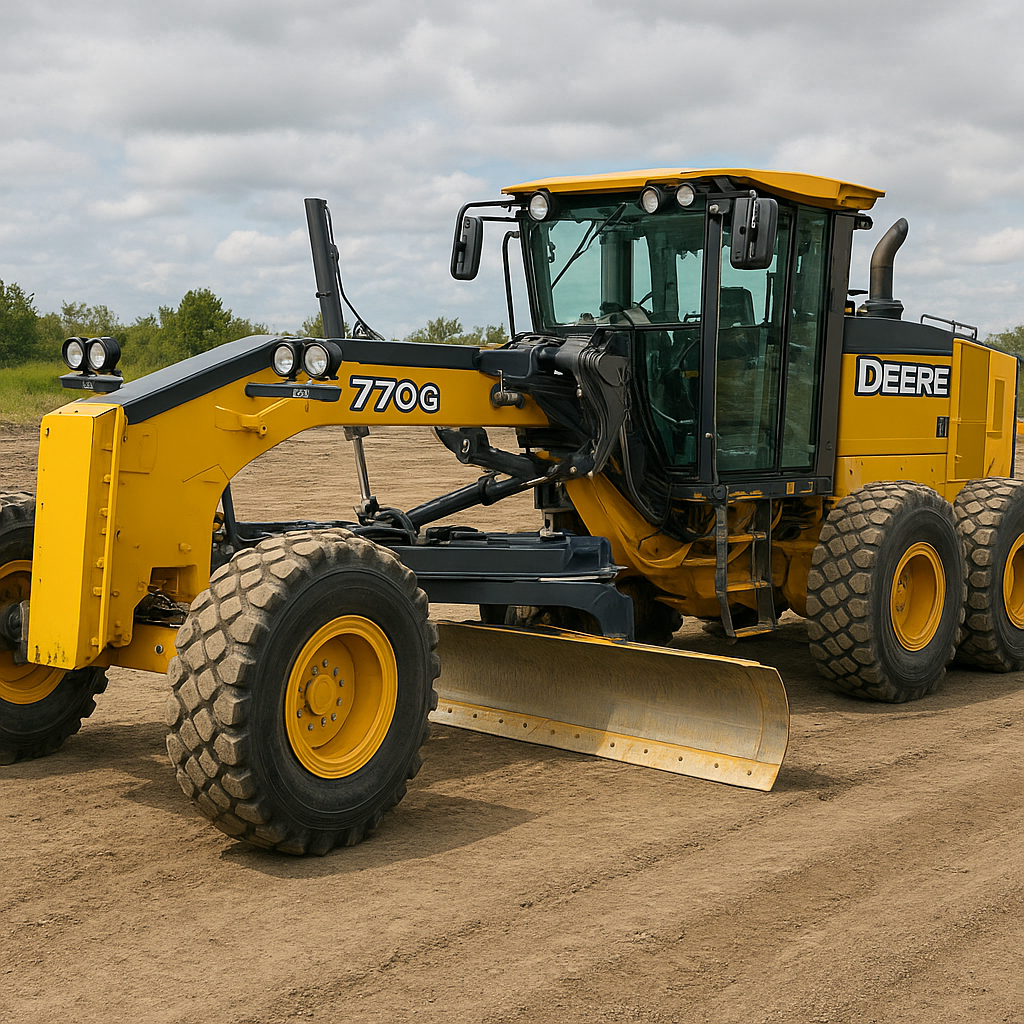
The John Deere 770G is a versatile mid-size construction machine designed to perform a wide range of road-grading and surface-shaping tasks. Built with robust mechanical systems and operator-focused ergonomics, this motor grader combines reliable power delivery with precise blade control to handle applications from roadway construction and maintenance to site preparation and snow removal. Below you will find an in-depth look at the machine’s capabilities, typical uses, technical highlights, and practical considerations for ownership and operation.
Overview and key characteristics
The 770G occupies a position in the mid-range segment of John Deere’s grader lineup, offering a balance of maneuverability and working capacity suited to contractors, municipal fleets, and large private estates. As a classic example of a wheeled grading machine, the 770G is engineered around a long moldboard, hydraulic circle and blade controls, and an articulated frame that improves turning and alignment on varying terrain.
Design philosophy and target users
John Deere designed the 770G to serve operators who need reliable performance without stepping up to the largest, heavy-duty graders used in major highway construction. Typical owners include small-to-medium civil contractors, road-maintenance departments, aggregate and mining operations for haul road correction, and municipal organizations responsible for unpaved road networks. The model emphasizes proven mechanical simplicity, serviceability, and the option to integrate modern control systems for increased precision.
First-time buyers and long-time grader users alike appreciate the 770G’s combination of field-proven hydraulics, an operator-friendly cab layout, and a chassis that can accept a variety of attachments. The machine provides a work envelope large enough for fast progress on moderately sized jobs while remaining compact enough to work in constrained environments, such as urban streets or confined construction sites.
Technical specifications and performance (typical figures)
Exact specifications can vary by year, build options, and regional configurations. The figures below are representative ranges based on common configurations of the John Deere 770G motor grader and should be verified against the specific serial number and equipment plate of any machine you consider.
- Engine power: approximately 160–210 kW (215–280 horsepower), net output depending on tuning and emissions spec.
- Operating weight: roughly 12,000–15,500 kg (26,500–34,200 lb), depending on attachments and ripper/tandem options.
- Moldboard (blade) length: commonly in the range of 3.7–4.3 m (12–14 ft); cutting height and tilt capacities vary by configuration.
- Articulation angle: ±15–20 degrees typically, improving turning radius and lateral positioning.
- Transmission: power-shift or torque-converter automatic transmissions with multiple forward and reverse gears for grading and travel.
- Top travel speed: around 30–40 km/h (19–25 mph), enabling rapid repositioning between work sites.
- Fuel capacity: usually between 200–350 liters (53–92 gallons), supporting extended operating shifts.
- Hydraulic system: high-flow closed-center or load-sensing systems to operate blade circle, ripper, and steering circuits.
- Implement options: front scarifier, rear ripper (typically 3–5 shanks), winch and quick-coupler mountings are common.
Performance characteristics important to contractors include blade penetration force, steering responsiveness, and the grader’s ability to hold grade under load. The 770G’s frame and hydraulic layout are designed to provide consistent moldboard control, allowing operators to achieve fine tolerances on crown and crossfall profiles.
Typical applications and industries
The John Deere 770G is used across many sectors where long, flat grades and rolling surfaces are required. The machine’s adaptability makes it a standard piece of equipment in the following categories:
- Road construction and leveling on paved and unpaved surfaces — final grading, base preparation, and shaping drainage slopes.
- Routine maintenance of gravel and dirt roads — redistributing fines, re-establishing crown, and restoring proper drainage.
- Snow removal — using a front-mounted or blade arrangement to push or windrow snow on streets, parking lots, and airfield taxiways.
- Site preparation for building pads and utility corridors — cutting, filling, and blending materials to create uniform surfaces.
- Facility and campus maintenance — leveling shoulders, parking areas, and athletic fields where precision grade control is not heavy earthmoving.
- Mining and quarry haul-road maintenance — keeping hard-packed haul roads smooth for heavy truck traffic, reducing tire wear and improving safety.
Because of its balance between power and maneuverability, the 770G is especially popular where a contractor needs more capability than lighter graders but does not require the footprint and fuel consumption of the largest models.
Operator environment, controls and ergonomics
A significant selling point of the 770G is its operator-focused cab and control layout, which can directly impact productivity and fatigue on long shifts. Design highlights typically include:
- Spacious cab with clear sightlines to the moldboard, scarifier and rear ripper, facilitating precise blade placement.
- Ergonomically placed levers and joysticks for blade lift, circle rotation, articulation and scarifier operation — reducing operator movement and strain.
- Adjustable seating, climate control and sound insulation to enhance operator comfort and reduce fatigue hours.
- Optional ride-control hydraulics and suspension seats that smooth out bumps while maintaining grading accuracy.
- Visibility aids such as rearview cameras and optional LED lighting packages for low-light operation.
When graders are operated for long shifts or in variable weather conditions, these cab-level comforts and controls materially affect overall productivity. Modern retrofits and later production models can include multi-function displays and telematics to monitor machine health and usage.
Technology, attachments and modern upgrades
While the 770G is fundamentally a mechanical grader, it can be equipped with technologies and attachments that broaden its capabilities:
- Grade-control systems: The machine can accept aftermarket or factory-integrated systems such as John Deere grade control, Trimble, or Topcon solutions that provide GPS-guided blade control to maintain precise slopes and elevations.
- Auto blade control: Automated sections and height control improve repeatability and reduce the need for stringlines on long profiles.
- Telematics: Remote monitoring of fuel use, operating hours, fault codes and location helps fleets reduce downtime and plan service intervals more efficiently.
- Attachments: front-mounted scarifiers, variable-angle dozer blades, rear rippers, and winches expand the machine’s usefulness across job types.
- Lighting and camera packages: enhance safety and situational awareness during night or low-visibility operations.
Integration of a modern GPS-based grade control system can dramatically enhance the 770G’s output by enabling the operator to maintain accurate cross slopes and elevations without constant line-of-sight staking. This translates into fewer passes, reduced material rework, and lower labor costs.
Fuel consumption, efficiency and operating costs
Operating cost is a major factor for owners. Typical working fuel consumption for machines in this power class can range from roughly 15 to 30 liters per hour (4–8 gallons per hour) depending on load, ground conditions, and operator technique. Idle time, frequent engine lugging, or heavy ripping work will push consumption toward the higher end of that range.
Key ways to optimize fuel efficiency and lifecycle costs include:
- Keeping the engine and powertrain tuned to manufacturer specs and replacing air and fuel filters on schedule.
- Training operators in efficient grading techniques — minimizing unnecessary passes and avoiding excessive engine rpm when not needed.
- Using appropriate tire pressures and wheel configurations to reduce rolling resistance.
- Implementing telematics to identify wasteful idle time or inefficient working patterns.
When evaluating total cost of ownership, factor in resale values, average annual hours (common ranges for graders vary between 500 and 2,000 hours/year depending on use), and major service intervals such as hydraulic pump or transmission overhauls. Well-maintained 770G units can remain productive for many years; regular service and component rebuilds often extend life well beyond a decade in mixed-use fleets.
Maintenance, common service items and longevity
Routine maintenance practices are critical to keep a grader like the 770G performing reliably. Common service items and maintenance tips include:
- Frequent inspection of the moldboard cutting edge and end bits — replace or rotate edges to ensure consistent cutting performance.
- Monitoring hydraulic hoses, fittings and fluid quality — contaminants and worn seals are frequent causes of hydraulic inefficiency.
- Checking articulation joint wear and lubrication points — proper greasing schedules extend components and maintain steering precision.
- Transmission and axle fluid analysis as part of preventive maintenance to detect wear before catastrophic failure.
- Inspecting the circle drive and bearings for wear; keeping the circle properly adjusted and lubricated prevents chatter and poor finish grade.
Many fleets follow a tiered maintenance schedule: daily visual checks, weekly greasing and fluid level checks, and comprehensive service at manufacturer-recommended hour intervals. Availability of parts and the simplicity of service points on the 770G make it relatively economical to maintain compared to more electronically complex machines.
Safety features and best practices
Safety considerations for motor graders emphasize both machine features and operator behavior. Features commonly found or retrofitted on 770G graders include:
- ROPS/FOPS-certified cabs for operator protection.
- Backup alarms, cameras and mirrors to reduce blind spots and prevent collisions on busy sites.
- Emergency shutoff switches and accessible controls that allow rapid response in the event of equipment failure.
- Good lighting packages for night work and low-visibility conditions.
Best practices include maintaining clear communication with traffic controllers, using cones and signage when working near public roads, ensuring operators are trained in slope work and in managing counterweight when using front-mounted implements, and never exceeding rated capacities for attachments. Regular safety audits and refresher training reduce accident exposure and equipment damage.
Buying considerations and resale
When procuring a John Deere 770G — whether new, used, or rebuilt — consider the following points:
- History and hours: Machines with well-documented service records and fewer hours generally command higher resale values. Typical high-use graders may show 5,000–10,000 hours over many years; condition matters more than hours alone.
- Attachment inventory: A machine with a front scarifier, rear ripper and upgraded lighting/controls can be more versatile and yield better ROI.
- Options and control packages: Integrated grade control and telematics increase capital cost but often improve productivity and reduce operating expense.
- Local dealer support and parts availability: Proximity to authorized service networks simplifies maintenance and can be decisive for fleet reliability.
- Expected resale: Used 770G prices vary widely by year, condition and market. Typical ranges can run from tens of thousands of U.S. dollars for older, high-hour units to over a hundred thousand for low-hour, fully optioned examples. Always inspect wear items — tires, cutting edges, circle gear, and articulation joints — since these drive repair costs after purchase.
Comparison with similar graders
Compared to both lighter utility graders and larger highway-class machines, the 770G aims to fill the “workhorse” niche. Competitors of similar capacity include mid-range models from other major manufacturers. The 770G’s advantages are often cited as:
- Balanced power-to-weight ratio suitable for a wide array of jobs.
- Proven mechanical architecture with readily available parts and straightforward service points.
- Good integration options for modern grading technologies without forcing the buyer into the highest cost brackets.
Trade-offs versus larger models include slightly less stability under heavy ripping work and lower maximum blade reach or weight capacity; versus smaller units, the 770G offers more horsepower and blade control for higher productivity on medium-scale projects.
Conclusion
The John Deere 770G is a capable, mid-size motor grader that blends durable construction with operator-friendly features and options to grow into modern grading workflows. Its typical strengths include consistent blade control via a reliable hydraulic layout, options for automated or GPS-assisted grading, and serviceability that appeals to contractors and municipal fleets. With proper attention to routine maintenance and informed choice of attachments and technology packages, the 770G remains a valuable tool for road building, maintenance, site preparation, and snow-clearing tasks — delivering long-term value and dependable performance across diverse working conditions.
)
)