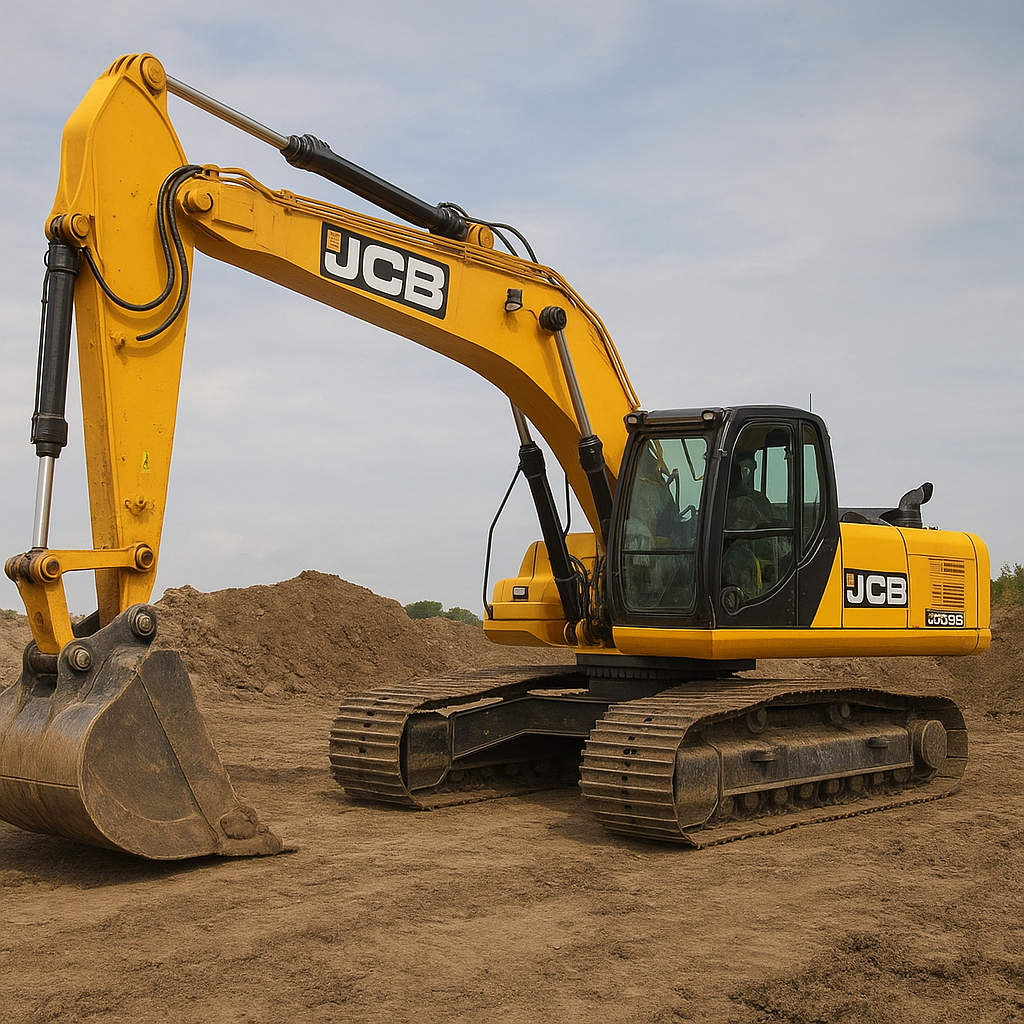
The JCB JS800 is a member of the heavy-duty tracked excavator family designed for demanding earthmoving, quarrying and heavy construction tasks. This article examines the machine’s design principles, typical applications, operational strengths, maintenance considerations and economic and environmental aspects. The goal is to provide a practical, technical and commercially useful portrait that will help owners, operators and specifiers understand where a machine like the JS800 fits in modern site fleets and how to get the most value from it. Throughout the text a few key terms are emphasized to highlight their importance in real-world use.
Design and technical overview
The JS800 embodies the engineering approach used for large crawler excavators: robust structural components, powerful drivetrains and hydraulics tuned to deliver both heavy lifting and sustained cycle performance. Although exact specifications vary with market, configuration and optional packages, machines in this class share common design characteristics and performance expectations.
Core structure and powertrain
- Heavy box-section undercarriage and reinforced upper structure to withstand repetitive high loads and impact events.
- Modern diesel engines meeting regional emissions standards (for example EU Stage V or EPA Tier 4 Final where applicable) with turbocharging and aftertreatment systems such as DOC/DPF and selective catalytic reduction (SCR) in many configurations.
- Hydraulic systems that combine variable-displacement pumps with electronic control valves to balance high flow for work cycles and precision for fine grading tasks.
Typical performance figures for an excavator of the 70–90 tonne class (a category that the JS800 occupies) are:
- Operating weight: approximately 70,000–90,000 kg (varies by counterweight and undercarriage options).
- Net engine power: commonly in the range of 280–400 kW (375–540 hp) depending on tuning and emissions package.
- Bucket capacity: typical factory buckets range from about 1.5 to 4.0 m3 for general purpose use; specialised rock or loading buckets differ.
- Maximum digging depth: commonly around 8–10 m, with long-arm options extending reach.
These figures are indicative for planning and specification; final numbers depend on the precise model year, attachments and customer-selected options. Machine balance between counterweight, boom and stick geometry is designed to provide stable lifting performance while maintaining efficient digging cycles.
Hydraulics, controls and operator environment
- The hydraulic circuit typically includes closed-center or load-sensing systems that prioritise responsiveness and smooth multi-function capability.
- Electronic control modules manage throttle, hydraulic flow sharing and implement prioritisation to reduce fuel consumption under varying loads.
- Cab designs emphasise operator visibility, noise reduction and ergonomics: adjustable seats, climate control, and well-laid controls reduce fatigue during long shifts.
- Telematics and remote monitoring systems are frequently standard or optional, delivering data on location, hours, fuel burn and fault codes for fleet managers.
Innovations such as automatic idle, reversible fans, and smart hydraulic modes tailor the machine’s response to different tasks (heavy digging vs grading) to optimise fuel use and productivity. The integration of _on-board_ diagnostics simplifies fault-finding and reduces downtime.
Applications and industries
The JS800’s size and capability make it a natural choice for heavy-duty tasks where power, reach and durability are the primary requirements. It is commonly found in:
- Quarrying and aggregate production — loading haul trucks, excavating benches, secondary digging and material stacking.
- Major civil engineering projects — large trenching, foundation excavation, embankment preparation and river works.
- Bulk material handling — with appropriate attachments such as grapples or clamshells, the excavator handles scrap, timber, demolition waste and stockpiling tasks.
- Surface mining and large-scale earthmoving — as a primary excavation tool in smaller surface mines, or in staged operations in larger sites.
- Port and terminal operations — handling bulk cargos when fitted with specialized attachments for grabs and magnets.
Its adaptability through attachments and optional configurations means the same base machine can move between roles (digging, loading, breaking rock, material handling), increasing fleet utilisation and lowering overall capital cost per hour when managed efficiently.
Attachment ecosystem and task-specific adaptations
- Hydraulic breakers for demolition or secondary rock breaking.
- Heavy-duty rock buckets and ripper attachments for hard ground and quarry face work.
- Grapples, sorting grabs and magnet attachments for recycling and port duties.
- Quick couplers and tiltrotators for faster tool changes and increased manoeuvrability in precise tasks.
Choosing the right attachment set is critical: it directly affects cycle times, fuel consumption and tool wear. Operators typically select a mix tailored to the predominant tasks on a project, with spares and maintenance strategies aligned to the expected duty cycle.
Performance, efficiency and productivity
Productivity of a large excavator is a function of bucket capacity, cycle time, operator skill and the consistency of material being moved. Performance can be framed in simple, practical terms useful for estimations on site.
Estimating productivity
- Basic formula: tonnes per hour = bucket volume (m3) × material density (t/m3) × cycles per hour.
- Example: a 2.5 m3 bucket for general aggregates (density ≈ 1.6 t/m3) at 15 cycles/hour yields about 60 t/hour.
Cycle times depend on reach, dump height and operator technique. Large machines deliver powerful breakout forces and fast crowding speeds, which reduce cycle times in aggregate and rock tasks compared to smaller units. However, travel and swing times also matter—well-arranged sites and experienced operators can unlock the machine’s full potential.
Fuel economy and operating costs
Fuel consumption varies with load factor and machine settings. For heavy class excavators, typical working consumption might range from about 20 to 50 litres per hour depending on the duty (light grading vs full-load rock excavation). Telemetry-driven management and eco modes can reduce fuel burn significantly over a year by optimising idle time, limiting high-rev running and matching hydraulic output to the task.
- Key cost drivers: fuel, undercarriage wear, hydraulic and engine oil service intervals, buckets and teeth, and major component rebuilds (engine, hydraulic pumps, swing motors).
- Undercarriage replacement is often one of the single largest maintenance costs; track life depends on material, operator technique and ground conditions.
Proactive maintenance and operator training lead to measurable gains in availability and lower total cost of ownership. Fleet-monitoring systems that collect utilisation and fault data allow predictive interventions, lowering expensive reactive repairs.
Maintenance, safety and operator support
Effective maintenance for a machine like the JS800 balances routine service, predictive checks and keeping critical spares on hand. Given the scale of parts and the cost of downtime, best practice emphasises planned interventions and data-driven servicing.
Routine and planned maintenance
- Daily checks of fluid levels, visual inspection of hydraulic hoses and pins, and clearing radiators or coolers of debris.
- Scheduled oil and filter changes according to the manufacturer’s intervals, often expressed in hours of operation (service intervals commonly fall in the 250–500 hour range for many systems).
- Periodic structural inspections for weld cracks, boom and stick wear, and undercarriage measurement to plan rebuilds before failure.
Keeping a log of hours, fuel use and fault codes improves component life forecasting. Where available, OEM parts and authorised service networks reduce risk and help maintain warranty provisions.
Safety systems and operator protection
- Modern excavators include ROPS/FOPS certified cabs, reinforced glass, and ergonomic entry/egress points to reduce slips and falls.
- Visibility aids — 360° cameras, side and rear cameras, and radar/ultrasonic obstacle warnings — reduce the incidence of collisions on busy sites.
- Optional load-moment and stability systems limit lift heights and warn operators about approaching safe-load thresholds.
Training and safe operating procedures are as important as technology. A well-trained operator can dramatically reduce wear, avoid unsafe lifting and reduce fuel consumption.
Economic and environmental considerations
Purchasing and operating a heavy excavator is a long-term capital decision. Financial planning should account for acquisition (or lease) costs, anticipated utilisation, maintenance budgets and expected resale value.
Acquisition and lifecycle cost
- Capital costs are influenced by specification—arm length, undercarriage width, hydraulic package and telematics add up quickly.
- Leasing and rental options often suit contractors with variable workloads; ownership suits those with steady, predictable utilisation.
- Resale value is supported by documented maintenance, telematics records and use history; machines with full service documentation typically achieve higher trade-in values.
When estimating lifetime operating cost, include fuel, scheduled maintenance, unscheduled repairs, tyres or tracks, and expected overhaul costs after major component life cycles (engine and hydraulic components). Many operators model cost-per-hour to compare alternatives.
Environmental impact and compliance
- Engines must comply with regional emissions standards; many modern models include aftertreatment and management systems to meet State-of-the-art requirements.
- Fuel-efficient control strategies and the use of biodiesel blends in some regions can reduce lifecycle greenhouse gas emissions.
- Noise reduction measures and selective scheduling can mitigate impact on sensitive neighbourhoods during construction phases.
Increasingly, sites track carbon and energy metrics; machines with telematics that report fuel burn help contractors calculate and reduce carbon footprints. Some fleets are experimenting with hybrid hydraulic solutions or battery-electric auxiliaries for further reductions, particularly in urban or noise-sensitive environments.
Real-world examples, procurement tips and lifecycle planning
Operators and fleet managers typically evaluate machines against specific criteria: initial cost, expected utilisation, fuel efficiency and ease of service. Below are practical tips and scenarios illustrating how a high-capacity excavator like the JS800 fits into different operations.
Procurement and specification tips
- Match the machine to the primary duty — avoid overspecifying power for mainly loading tasks, but ensure sufficient mass and breakout force for rock or compacted materials.
- Prioritise undercarriage configuration based on ground conditions: wider shoes for soft ground, heavier segments and rock guards for abrasive quarry floors.
- Require telematics and service intervals in any procurement specification to monitor utilisation and protect residual value.
Sample use-cases
- Quarry: dedicated face machine with rock bucket and ripper; high breakout force and abrasion-resistant components are priority items.
- Civil earthworks: long-reach or extendible-arm variants for deep excavation and slope shaping; focus on fuel economy and cycle efficiency.
- Ports and recycling: grapple and magnet-equipped machines; reinforce undercarriage and supply corrosion-protection packages.
Lifecycle planning that estimates component replacement intervals, aligns maintenance windows with low-production periods and keeps critical spares near the site reduces unplanned downtime and improves project predictability.
Advanced features, telematics and future directions
Modern large excavators are increasingly defined by their integration of electronics, connectivity and advanced hydraulic control strategies. These features enhance safety, enable remote diagnostics and support predictive maintenance.
- Telematics platforms provide real-time location, fuel consumption, idle time and fault history. Fleet managers can use this data to optimise deployment and predict component replacement.
- Integration with jobsite systems enables automated reporting for compliance and productivity benchmarking.
- Driver-assist and semi-autonomous features — for example automated grading assistance or swing-limiting — reduce the cognitive load on operators and improve repeatability for precision tasks.
On the horizon, the spread of electrified hydraulics, enhanced autonomy and alternative fuels will change how heavy machines are specified for urban and environmentally sensitive projects. Operators who stay current with telematics and maintenance analytics will capture the greatest value from these technological shifts.
Summary and practical recommendations
The JCB JS800 represents a class of heavy excavator designed to deliver high productivity, strong breakout forces and long service life in demanding environments. Key considerations when specifying or operating such a machine include matching the machine configuration to the primary duty, investing in operator training, and using telematics-driven maintenance to reduce downtime and total cost of ownership.
- Prioritise the right combination of bucket size, undercarriage and hydraulic options for the intended work.
- Implement a documented preventive maintenance schedule and keep critical spares for common wear items.
- Use telematics and onboard diagnostics to manage fuel consumption and service planning.
- Ensure operator comfort and safety systems are part of the specification to protect workforce welfare and maintain high utilisation.
With the right support and deployment strategy, a heavy-class excavator like the JS800 can be a highly versatile and valuable asset across quarrying, construction, recycling and port operations, delivering sustained performance while allowing fleet managers to balance cost, safety and environmental impact.
)
)