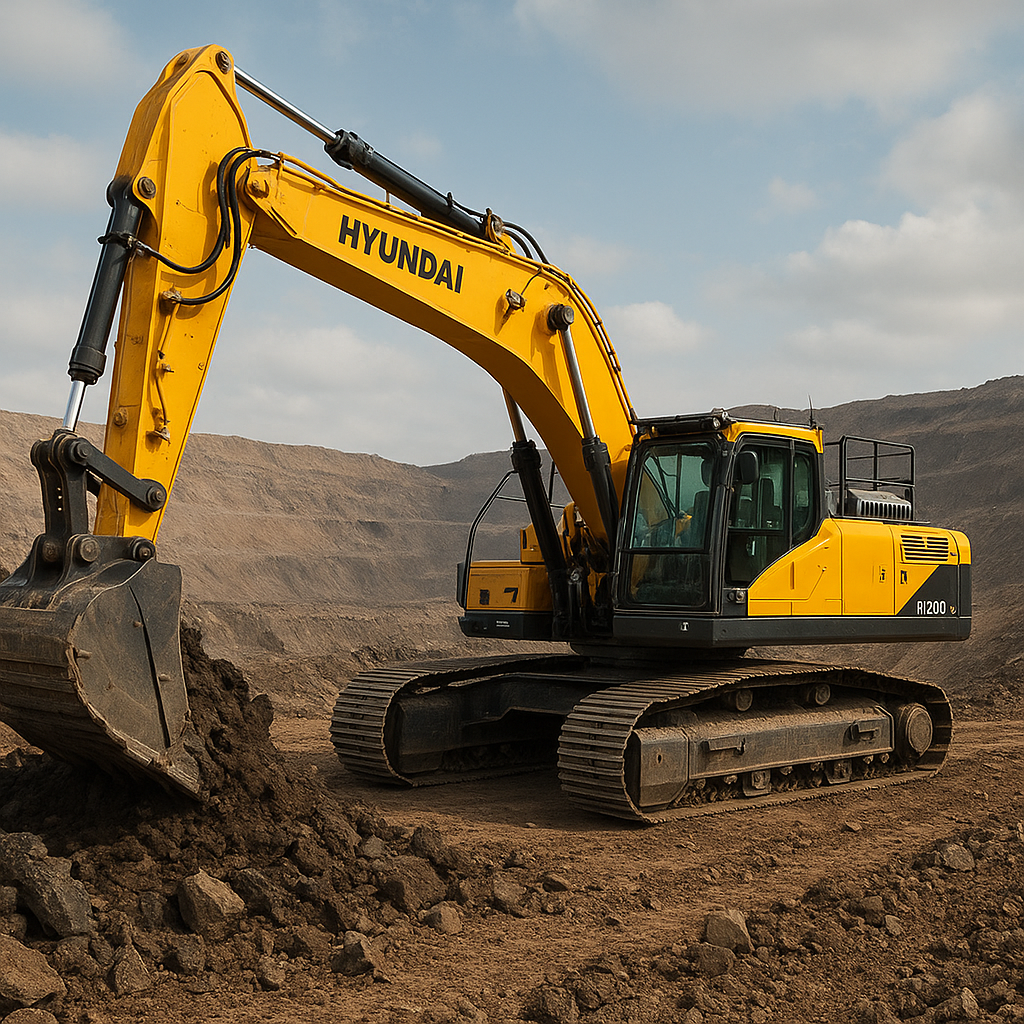
The Hyundai R1200-9 is a heavyweight in the realm of large hydraulic excavators designed for demanding applications such as mining, heavy excavation, and large-scale civil engineering projects. Built to combine robust mechanical components with modern hydraulic and electronic systems, this machine aims to deliver sustained productivity, high durability, and operator-focused ergonomics for continuous, long-hour operations. Below are detailed sections describing typical specifications, real-world uses, maintenance and operational considerations, and other valuable insights for fleet managers, operators, and procurement teams.
Design and technical characteristics
General architecture and purpose
The Hyundai R1200-9 is engineered as a full-sized hydraulic excavator intended primarily for material handling at mining sites, heavy earthmoving, quarrying, and large-scale foundation work. Its basic layout follows conventional excavator architecture—cab, upper structure (house), boom, arm, bucket, and tracked undercarriage—while incorporating reinforced components and heavy-duty hydraulics to withstand the high stresses of continuous loading and abrasive materials.
Powertrain and hydraulics
The machine typically uses a high-output diesel engine matched to an advanced hydraulic system. In modern variants, engine output is commonly in the range of 350–450 kW (approximately 470–600 hp), though exact figures depend on regional emission tuning and optional packages. The hydraulic system often features variable-displacement pumps, high-flow main circuits, and electronically controlled valves to optimize response, efficiency, and attachment control.
- Engine: heavy-duty turbocharged diesel, configured to meet local emission standards (Tier/Stage/Tier 4 Final/Stage V options in many markets).
- Hydraulics: load-sensing or electronically modulated systems for improved fuel efficiency and tool control.
- Transmission: heavy-duty final drives and planetary gearboxes sized for continuous torque delivery under load.
Structural elements and attachments
For mining and heavy excavation, the R1200-9 is usually reinforced with thicker booms, stronger stick assemblies, and heavy-duty pins and bushings. Attachment options are central to the machine’s versatility:
- Buckets: digging, rock, and high-capacity mining buckets—sizes vary widely depending on application.
- Hydraulic breakers and crushers for secondary breaking and demolition in quarrying.
- Grapples, rakes, and specialized tools for material sorting and loading.
- Quick couplers to accelerate tool changes on site.
Applications and on-site performance
Mining operations
In mining, the R1200-9 is commonly deployed for face digging, loading haul trucks, bench trimming, and overburden removal. Its key advantages in mining include high continuous digging force, robust undercarriage to traverse uneven benches, and options for ultra-heavy buckets that increase payload per cycle, improving overall fleet efficiency. When used as part of a matched system—excavator, haul truck, and processing plant—the R1200-9 can significantly influence mine productivity and cost per ton.
Quarrying and aggregate production
Quarry owners often choose large excavators to handle rock removal, feed crushing plants, or perform secondary breaking. In this role, a heavy excavator’s ability to handle dense, abrasive material with minimal downtime is crucial. Rock buckets, wear packages, and reinforced linkage systems are typical adaptations for this environment.
Civil engineering and heavy infrastructure
Large-diameter foundation excavations, canal dredging, and large trenching projects are other domains where the R1200-9 finds application. Its reach, bucket capacity options, and the availability of special-purpose attachments allow it to tackle projects that require both depth and sustained excavation rates.
Performance metrics and productivity indicators
Key performance indicators for machines of this class include cycle time, bucket fill factor, truck matching (payload vs. bucket size), and availability (uptime). Typical ranges and considerations include:
- Bucket capacity: varies by application—common ranges are 3–10 m³ depending on design (smaller for rock buckets, larger for high-capacity mine buckets).
- Operating weight: usually within a broad class, commonly approximated at 100–140 metric tons depending on configuration and attachments.
- Digging depth and reach: standard configurations typically offer maximum digging depths in the range of 7–9 meters and maximum reaches over 12 meters, though these numbers change with boom/arm options.
- Breakout force: heavy-duty models may provide bucket breakout forces on the order of several hundred kilonewtons (e.g., 300–450 kN), important for tackling compacted or rocky material.
Maintenance, lifecycle costs and fleet management
Maintenance strategy
On large excavators, preventive and predictive maintenance programs are critical to control lifecycle costs. The R1200-9 is typically supported by a maintenance regimen that includes scheduled oil and filter changes, track and sprocket inspections, periodic pin-and-bushing checks, and hydraulic fluid analysis to detect contamination or wear. Key elements of a robust maintenance approach:
- Daily pre-start inspections for leaks, wear, and critical fasteners.
- Condition monitoring using telematics and fluid diagnostics to schedule interventions before failures occur.
- Use of proper lubrication and grease schedules to extend pin/bushing life.
- Wear-part inventory planning (teeth, adapters, cutting edges) to minimize downtime during replacements.
Fuel consumption and operating costs
Fuel consumption for large mining excavators can vary widely depending on duty cycle, material density, operator skill, and site conditions. Typical fuel consumption ranges for this machine class might be roughly 50–200 liters per hour under continuous heavy loading, with lower averages in mixed duty cycles. Factors that influence fuel use and cost per ton include bucket fill efficiency, matching to haul trucks (minimizing truck idle time), and use of eco modes or smart hydraulic controls.
Life expectancy and residual values
When properly maintained, heavy excavators such as the R1200-9 can remain productive for many thousands of machine hours—often exceeding 25,000–30,000 hours over their useful life in some fleets. Residual value is influenced by brand reputation, maintenance records, hours, and the condition of structural components. A machine with comprehensive service history and refurbished wear parts will command a higher resale price.
Safety, operator comfort and environmental considerations
Operator environment
Operator comfort is a key factor for sustained productivity. Typical features used to enhance operator performance include ergonomically designed seats with suspension, multi-function joysticks, climate-controlled cabs, excellent sightlines, and low-vibration designs. Cab options often include noise insulation, large displays for machine diagnostics, and camera systems for blind-spot reduction.
Safety systems
Mining environments require stringent safety protocols. The R1200-9 is generally offered with ROPS/FOPS-certified cab options, emergency shutdown systems, anti-slip surfaces on service points, and optional proximity detection or collision-avoidance systems. Integrated telematics enable fleet supervisors to monitor machine location, speed, and operating hours, which supports safer site logistics and incident investigation.
Emissions and environmental impact
Modern heavy excavators are increasingly designed to meet strict emission standards. Depending on market and year, the machine may be configured to comply with Stage V (EU), Tier 4 Final (US/EU), or other local regulations. Strategies to reduce environmental footprint include:
- Engine aftertreatment systems (DOC, DPF, SCR) for NOx and particulate control.
- Idle-reduction features and automatic shutdowns to save fuel and cut emissions.
- Hydraulic systems optimized for reduced parasitic losses and better fuel economy.
Attachments, customization and technological upgrades
Attachment ecosystem
Versatility is achieved through a broad range of OEM and third-party attachments. For the R1200-9, common heavy-duty attachments include:
- Mining buckets with reinforced lips and wear packages.
- High-power hydraulic breakers for breaking oversize rock.
- Shears and crushers for demolition and secondary crushing.
- Material handling booms and grapples for loading and sorting tasks.
Electronics and telematics
Modern production models are equipped with on-board diagnostics and telematics platforms that provide near-real-time data on fuel burn, machine location, utilization, fault codes, and maintenance alerts. These systems support remote troubleshooting, predictive maintenance scheduling, and data-driven decisions to optimize fleet productivity.
Customization for specific tasks
Fleet managers often work with manufacturers and aftermarket suppliers to tailor machines for specialized tasks: extended-reach booms for dredging, extra counterweight for heavy-duty lifting, or sealed electrical systems for dusty or wet conditions. Warranty and service agreements can be adapted to match operational risk profiles.
Comparisons, market positioning and procurement guidance
How it compares to peers
The R1200-9 competes in the large excavator segment with established global models from manufacturers like Caterpillar, Komatsu, Hitachi, and Liebherr. Competitive considerations include:
- Total cost of ownership (purchase price plus lifecycle maintenance and fuel costs).
- Dealer network and aftermarket support for spare parts and field service.
- Availability of factory-certified attachments and integration with fleet telematics.
- Resale values influenced by brand reputation and global presence.
Buying considerations
When evaluating R1200-9 units, procurement teams should assess:
- Work profile matching: ensure bucket size and hydraulic flow align with truck payloads and cycle demands.
- Site fit: track width, transport disassembly requirements, and ground pressure for soft terrain.
- After-sales support: warranty terms, local parts inventory, and service technician availability.
- Financing and fleet replacement strategies linked to expected hours and project timelines.
Operational tips and best practices
Operator training and productivity
Operator skill has a major impact on excavator productivity and component life. Key training points include proper bucket filling techniques, minimizing unnecessary swing angles, staged digging approaches to reduce shock loads, and using machine modes to match hydraulic power to task demands.
Site layout and truck matching
Maximizing productivity requires matching excavator bucket capacity to haul truck bed size to minimize partial loads. Site layout should minimize swing distances and truck idle time. Efficient loading cycles and consistent truck arrival patterns significantly improve tons-per-hour output.
Wear management
Proactive wear management—such as rotating buckets between machines, using bolt-on wear segments, and applying hardfacing in high-wear zones—extends component life and reduces unplanned downtime. Scheduled undercarriage inspections and alignment checks prevent premature wear and track failures.
Real-world examples and case notes
Mining fleet implementations
In open-pit operations, the R1200-9 is often integrated into fleets where it loads rigid- or articulated-haul trucks. Typical considerations in these implementations are optimized bench design for safe operation, adequate bench width for maneuvering, and centralized maintenance yards for quick service turnaround. Operators report marked improvements in loading cycle stability when machines are matched to truck sizes and when consistent maintenance regimens are applied.
Quarry and municipal projects
Quarry managers value the R1200-9’s ability to reduce the number of passes required per load when equipped with larger capacity buckets, translating directly to lower fuel per ton and higher throughput. Municipal heavy works—like riverbank stabilization and bulk excavation—benefit from the machine’s reach and attachment flexibility.
Summary and strategic considerations
The Hyundai R1200-9 represents a strong contender in the heavy excavator class for mining, quarrying, and large civil projects. Its strengths lie in robust structural design, versatile attachment options, and the availability of modern hydraulic and electronic control systems that promote efficiency and uptime. For buyers and fleet managers, critical decisions should be guided by application-specific metrics: matching bucket size to trucks, planning maintenance and parts logistics, and investing in operator training. With careful lifecycle management, machines of this size can deliver excellent productivity and a competitive total cost of ownership in demanding operational environments.
)
)