The integration of advanced machinery has radically transformed the landscape of car manufacturing, ushering in unparalleled levels of efficiency, precision, and productivity. Through the deployment of specialized automated systems, assembly processes once dependent on manual labor are now handled with synchronized accuracy. From body shop welding to final quality checks, these machines have become indispensable resources, minimizing errors and optimizing cycle times. This article delves into the major facets of modern automated machines at work in the automotive industry, exploring their roles, benefits, challenges, and future prospects.
Assembly Line Transformation
In the initial stages of vehicle production, the body-in-white phase demands meticulous coordination. Traditional conveyor belts have evolved into highly adaptable platforms equipped with smart sensors and servo drives. These systems enable continuous monitoring of component placement and alignment. Through automated guided vehicles (AGVs), heavy parts such as chassis frames are transported seamlessly between workstations without human intervention. AGVs rely on laser guidance or magnetic tape, ensuring safe navigation around personnel and obstacles.
Furthermore, modular assembly cells powered by robotic arms allow rapid reconfiguration to accommodate multiple vehicle models on the same line. Each robot is programmed with specific paths and torque controls, enabling consistent fastening of bolts, insertion of inserts, and application of sealants. Integrated vision systems verify the correct positioning of each part, drastically reducing defect rates. The result is an agile production environment where changeovers between different car variants take mere hours instead of days.
Key advantages of this transformation include:
- Boosted safety by limiting operator exposure to hazardous tasks
- Increased throughput with minimal downtime
- Enhanced repeatability ensuring uniform build quality
- Scalability to adjust to demand fluctuations
Advanced Robotics in Welding and Painting
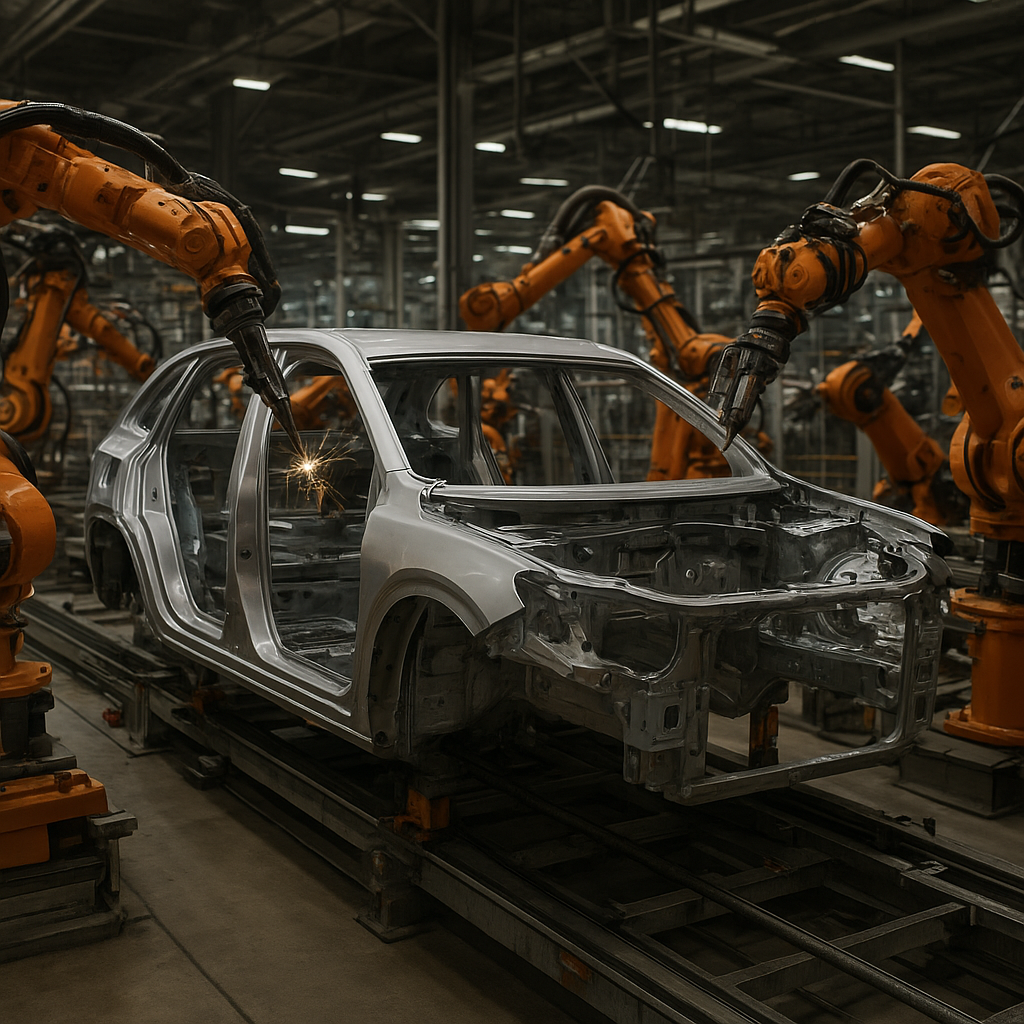
The welding and painting departments exemplify where automation achieves peak performance. High-precision spot welding robots join steel or aluminum panels within milliseconds, guided by CAD-based programs. These robots maintain consistent weld quality by constantly adjusting current and pressure parameters in real time. In addition, laser welding cells offer narrow heat-affected zones, reducing material distortion and improving overall vehicle stiffness.
Robotic Welding Cells
Modern cells leverage multi-axis manipulators capable of accessing complex joint geometries. Equipped with force sensors and adaptive control algorithms, they compensate for slight part misalignments. As a result, weld seam integrity is verified instantly through inline quality checks, eliminating the need for time-consuming manual inspections.
Automated Paint Shops
Painting garages incorporate robots with electrostatic spray guns, which deposit uniform coatings while recovering overspray for reuse. The integration of environmental controls maintains optimal humidity and temperature, ensuring consistent paint adhesion and finish. During the baking process, conveyorized ovens cure the paint evenly, delivering a durable and glossy surface. Data from each spray cycle is logged to trace any potential imperfections back to specific machines or batches.
Quality Control and Inspection Systems
Beyond assembly and finishing, automated machines play a pivotal role in quality assurance. Vision inspection stations employ high-resolution cameras and laser triangulation scanners to detect surface defects such as dents, scratches, or paint inconsistencies. Advanced software algorithms analyze point clouds and pixel data, flagging anomalies within milliseconds.
Coordinate measuring machines (CMMs) and portable scanning arms further verify dimensional accuracy of critical components. These devices compare physical measurements against digital design models, ensuring that tolerances remain within specification. Any deviation triggers immediate alerts to production supervisors, preventing defective vehicles from advancing down the line.
Innovations in non-destructive testing (NDT) have introduced ultrasonic and X-ray systems into assembly plants. Such equipment assesses weld joint integrity and internal castings without dismantling parts. The use of AI-driven pattern recognition enhances defect detection rates, leveraging historical data to predict failure modes and suggest corrective actions.
Supply Chain Integration and Material Handling
Automated machines extend beyond the shop floor into logistics and warehouse management. Robotic palletizers, automated storage and retrieval systems (AS/RS), and autonomous forklifts streamline the flow of raw materials and finished goods. By coordinating inventory levels and replenishment schedules, these systems help maintain just-in-time (JIT) supply chains, reducing carrying costs and inventory obsolescence.
At inbound docks, robotic arms unload crates and pallets, scanning barcodes or RFID tags to update enterprise resource planning (ERP) systems in real time. This connectivity ensures that production planners have accurate visibility into part availability, preventing bottlenecks and late shipments. Outbound logistics benefit from machine-driven sorting and packaging cells that prepare vehicles or spare parts for distribution with minimal human intervention.
- Automated labeling and tracking improve traceability
- Temperature-controlled AGVs handle sensitive components
- Predictive analytics optimize routing and resource allocation
Maintenance, Safety, and Workforce Collaboration
Even the most advanced machines require diligent maintenance to sustain peak performance. Predictive maintenance platforms collect data on motor currents, vibration levels, and temperature profiles, forecasting potential failures before they occur. Scheduled service windows are synchronized with production plans to minimize unproductive downtime.
Safety remains paramount, with machines equipped with light curtains, pressure-sensitive mats, and emergency stop mechanisms. Collaborative robots, or cobots, are designed to work side by side with human operators. Their force-limited joints automatically halt motion upon encountering unexpected resistance, ensuring safe interaction. This collaboration allows human workers to focus on value-added tasks such as complex assembly, quality audits, and continuous improvement initiatives.
Future Trends and Challenges
Looking ahead, the drive toward Industry 4.0 and the Internet of Things (IoT) will further revolutionize vehicle production. Digital twins—virtual replicas of physical processes—will enable real-time simulation and optimization. Machine learning algorithms will self-tune robotic parameters based on performance metrics, achieving higher quality and lower scrap rates. Edge computing will process data locally at machine nodes, reducing latency and dependency on central servers.
However, challenges persist. The initial investment in advanced automation can be substantial, requiring careful cost–benefit analysis. Cybersecurity risks increase as more devices connect to networks, necessitating robust safeguards. Workforce upskilling is crucial to bridge the gap between traditional manufacturing roles and emerging technical positions. By addressing these hurdles, the automotive industry can continue its trajectory toward smarter, safer, and more sustainable production models.