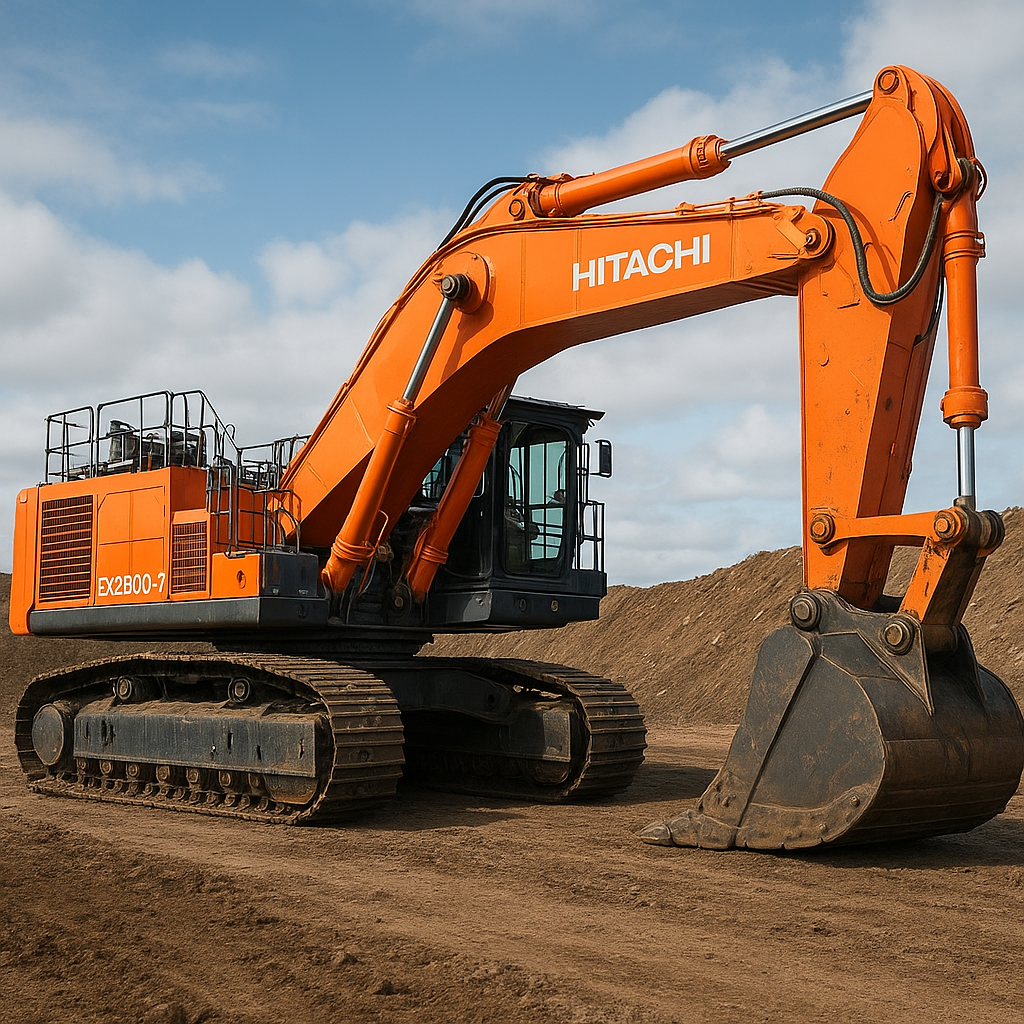
The Hitachi EX2500-7 is a heavy-duty hydraulic mining excavator designed for high-production open-pit mining, quarrying, and large-scale earthmoving operations. Combining robust mechanical components with modern control and monitoring systems, the machine aims to deliver consistent productivity, long service intervals and relatively low total cost of ownership for large-scale mining fleets. Below you will find an in-depth look at the EX2500-7’s design, capabilities, common applications, technology, maintenance needs and market considerations.
Overview and design philosophy
The EX2500-7 is part of Hitachi’s lineup of large excavators intended for the demanding environments of surface mining and heavy quarry work. Built with a focus on durability, uptime and ease of service, the machine balances raw digging power with systems that help reduce lifecycle costs. Major design priorities include a rugged undercarriage to withstand abrasive conditions, heavy-duty booms and arms for repeated high-impact loading cycles, and a hydraulics layout that supports fast cycle times and consistent digging force.
Key design elements typically emphasized by Hitachi for machines in this class include reinforced structures in high-stress areas, easy access to service points, modular components for simplified repairs, and integrated monitoring for proactive maintenance planning. The cab is engineered to reduce operator fatigue through good visibility, ergonomic controls and climate control features.
Typical technical specifications and performance data
Specifications for the EX2500-7 depend on configuration, market, and attachments. The values below are representative of the 250-ton class large excavator and are provided as typical figures; exact numbers can vary by region, optional equipment and bucket selection.
- Operating weight: approximately 230,000–260,000 kg (230–260 metric tons).
- Engine power: in the range of 1,100–1,400 kW (about 1,475–1,880 hp) depending on emission package and tuning.
- Bucket capacity: common bucket sizes for mining duty range from about 11 to 24 m³ (struck or heaped capacities vary by bucket shape and density of material).
- Maximum digging reach (ground level): typically 17–21 m, depending on boom/arm configuration.
- Maximum digging depth: generally 9–12 m, based on boom and arm combination.
- Bucket breakout force: usually in the high hundreds of kN (specific figures depend on arm/boom geometry and hydraulic pressure).
- Hydraulic system: high-flow, load-sensing or electronically controlled main pumps for optimized power distribution and fuel efficiency.
- Travel speed: low-range travel speeds designed for repositioning on-site rather than long-distance travel; typical travel speeds range from 1.5 to 3.5 km/h depending on undercarriage options and slope conditions.
- Fuel consumption: varies widely with application, but in heavy continuous loading operations an excavator of this class may consume several hundred liters per hour under full load. Actual fleet data recorded by operators tends to vary with material density, cycle time, and operator technique.
Manufacturers often publish variant-specific datasheets. When selecting an EX2500-7 for tender or procurement purposes, ask the OEM or dealer for the exact configuration sheet showing emission level (Tier/Stage), bucket geometry, hydraulic attachments and predicted cycle performance for the target material.
Primary applications and real-world use cases
The EX2500-7 is engineered for several intensive applications where mass material movement and high productivity are required. Common use cases include:
- Open-pit mining: primary loading of haul trucks in coal, copper, iron ore and other bulk mining operations. The machine’s large bucket sizes and robust structure make it ideal for moving large volumes of overburden and ore.
- Quarrying: loading crushers and stockpiles with blasted rock, aggregates and heavy stone products.
- Bulk material handling: terminal operations, stockyard reclaim and large-scale earthworks where continuous high-capacity loading is necessary.
- High-capacity stripping operations: removing overburden in sequential benches where cycle speed and consistent bucket fill factor drive unit economics.
- Support roles: with appropriate attachments, EX2500-7 machines can be used for secondary tasks such as hydraulic breaker work for secondary fragmentation, or for placing bulk materials during construction of mine infrastructure.
In practice, these machines are often paired with ultra-class haul trucks (e.g., 100+ metric ton payload range) and other large mining equipment. Productivity is measured by matched cycles: bucket fill factor, truck spotting time, and synchronization with haul truck loading are critical to achieving the expected tonnes-per-hour output.
Operator comfort, safety and technology
Hitachi equips large excavators with features designed to improve operator efficiency, safety and comfort—important factors when operators work long shifts in harsh environments.
Cab and controls
- The cab layout emphasizes visibility toward the loading point and immediate surroundings, often with wide glass areas, elevated seating and CCTV camera feeds to reduce blind spots.
- Ergonomic joysticks, adjustable seats and climate control reduce fatigue and improve focus for higher consistent productivity.
- Operator interfaces frequently include multi-function displays for machine status, diagnostics and performance feedback.
Safety systems
- Standard ROPS/FOPS protection and reinforced glazing for impact resistance.
- Proximity detection systems and rear-facing cameras are common options in mining setups to mitigate collision risk with personnel and other machines.
- Automatic idle and engine protection logic prevent damage from operator error or extreme conditions.
Telematics and remote monitoring
One of the key enablers for modern fleet performance is telematics. Hitachi’s proprietary systems (such as ConSite telematics) provide remote diagnostics, utilization tracking and health monitoring. These systems allow fleet managers to:
- Track machine hours, fuel usage and idle time for optimized scheduling.
- Receive alerts for maintenance intervals, abnormal engine events or hydraulic anomalies.
- Analyze productivity trends across shifts and sites to reduce downtime and improve asset utilization.
Attachments and customization options
To make the EX2500-7 versatile across different material types and tasks, a broad set of attachments and options are available:
- Bucket types: standard rock buckets, heavy-duty rock buckets, coal and aggregate buckets, and low-density material buckets. Bucket geometry affects fill factor, cycle times and wear life.
- Hydraulic thumbs and grapples: for selective handling tasks and loading broken rock or scrap.
- Quick couplers: reduce attachment-change time to keep the machine productive across varied tasks.
- Hydraulic breakers: for secondary fragmentation and demolition tasks in pits and quarries.
- Wear packages: wear plates, lined booms/arms and reinforced stick nose options for abrasive environments.
- Optional counterweights and undercarriage configurations: to tune stability and ground pressure depending on the workface and transportation constraints.
Maintenance, reliability and lifecycle considerations
Large excavators like the EX2500-7 are long-term investments whose value depends heavily on reliability and predictable maintenance costs. Key considerations include:
- Preventive maintenance: regular inspection of hydraulic hoses, pins and bushings, undercarriage components and wear parts extends service intervals and avoids catastrophic failures.
- Oil and filter regimes: managing hydraulic oil, engine oil and final drive lubrication per OEM specifications is critical to reducing wear.
- Component modularity: modular designs enable faster replacement of major components (pumps, engines, pumps) and minimize downtime.
- Wear part inventory planning: maintaining a stock of critical wear items such as teeth, adapters and track links is common practice at large mine sites.
- Life expectancy: with good maintenance, major mining excavators can serve 10–20 years or more, with midlife rebuilds of major components extending operational life.
Data-backed fleet management via telematics helps minimize unplanned stops and enables predictive replacement of components before failure. This approach improves availability rates and lowers overall cost per tonne moved.
Economic factors: purchasing, operating costs and ROI
When evaluating the EX2500-7 for purchase, operators must consider multiple factors that impact total cost of ownership (TCO): initial acquisition price, fuel consumption, maintenance labor and parts, resale value and productivity relative to competing models. Some practical points:
- Acquisition cost: large mining excavators represent a significant capital expense; pricing depends on options, attachments and local dealer support.
- Fuel and efficiency: fuel is typically the largest variable operating cost. Matching bucket size to haul truck payload and optimizing cycle times are essential to minimize liters-per-ton of material moved.
- Availability: unplanned downtime directly reduces tonnes-per-hour and increases unit cost; strong dealer support and parts availability lower these risks.
- Resale and lifecycle: a well-maintained EX2500-7 from a reputable fleet can have strong resale value in secondary markets for mines with lower production demands or for contractors expanding capacity.
Return on investment is commonly evaluated as cost per tonne moved. Improvements in operator training, cycle optimization and predictive maintenance contribute heavily to reducing that metric and justifying the initial purchase.
Environmental and regulatory considerations
Large excavators must comply with local emissions standards (for engines) and noise regulations. Modern variants of machines like the EX2500-7 are offered with engines that meet Tier/Stage emissions requirements in different markets. Additional considerations include:
- Use of selective catalytic reduction (SCR) or diesel particulate filters (DPF) to meet emissions targets.
- Fuel management systems and idle-reduction strategies to lower greenhouse gas emissions and operating costs.
- Noise attenuation packages for operations near communities or sensitive areas.
Market statistics and fleet-level performance (industry context)
While specific sales figures for the EX2500-7 are typically not published in granular detail by OEMs, several broader market observations are relevant:
- The global fleet of large-class mining excavators (200–300 ton class) is concentrated in regions with heavy open-pit mining activity: Australia, North and South America (notably Chile, Peru, the U.S. and Canada), South Africa and parts of Asia.
- Productivity in matched truck-excavator fleets: an EX2500-class excavator paired with appropriately sized haul trucks can routinely achieve several thousand tonnes per hour under ideal conditions; precise metrics depend on material density and cycle efficiency.
- Fuel efficiency gains: modern hydraulic and engine control systems can reduce fuel consumption by several percent compared with older-generation machines, which translates into substantial cost savings at scale in large mine sites.
- Lifecycle costs: operators generally report that upkeep on major mining excavators represents a material portion of total lifecycle cost; therefore, telematics-driven maintenance and OEM support agreements are common to protect uptime.
For procurement teams, benchmarking against peer machines from other manufacturers (Komatsu, Caterpillar, Liebherr, etc.) in the same class is standard practice. Metrics to compare include fuel consumption per tonne, reliability records, dealer network strength and overall maintenance cost per operating hour.
Practical tips for operators and fleet managers
- Ensure bucket sizing and geometry are matched to haul truck payload to avoid under- or over-loading, which reduces productivity or increases cycle times.
- Invest in operator training focused on consistent fill techniques, spotting efficiency and avoidance of excessive swing times.
- Use telematics actively: set up alerts for temperature, hydraulic pressure and fuel patterns to spot anomalies early.
- Plan spare parts inventory based on actual telemetry-driven usage rather than simple time-based schedules to lower carrying costs while avoiding stockouts.
- Document and analyze cycle times and truck queues to prioritize process changes that increase effective machine utilization.
Conclusion
The Hitachi EX2500-7 represents a class of heavy hydraulic excavators built for high-production surface mining and quarry applications. With strong emphasis on durable structures, hydraulic performance and integrated monitoring, machines in this class deliver the scale and capability required to move large volumes of material efficiently. Key to maximizing value are correct configuration and bucket selection, attentive maintenance supported by telematics, and continuous process optimization in matched truck-excavator fleets. While specific performance and cost figures vary by site and setup, the EX2500-7’s role in modern heavy mining fleets is clear: it is a core productivity asset whose contribution to tonnes-per-hour and cost-per-tonne metrics can be decisive for large-scale operations.
)
)