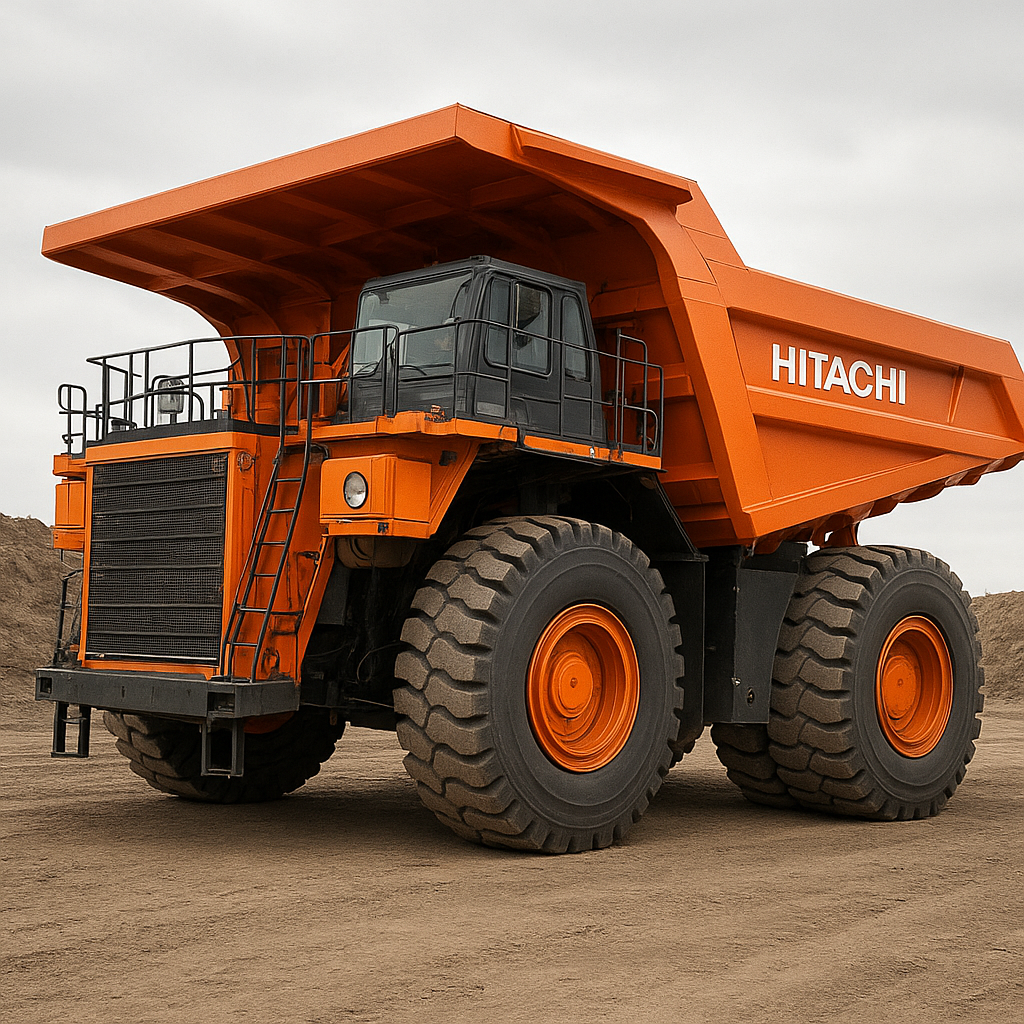
The following article examines the Hitachi EH4000AC-3 in detail — a heavy-duty, rigid-frame haul truck designed for the most demanding open-pit mining applications. This machine represents a generation of large capacity off-highway trucks that use diesel-electric AC drive technology to deliver high productivity, improved fuel efficiency and enhanced reliability in severe operating conditions. Below you will find an overview of the machine, its main technical characteristics (including commonly quoted approximate statistics), operational contexts where the EH4000AC-3 excels, and practical considerations for maintenance, safety and lifecycle economics.
Overview and role in modern mining operations
The Hitachi EH4000AC-3 is part of Hitachi’s family of large rigid-frame haul trucks, engineered primarily for high-production open-pit mines extracting bulk commodities such as iron ore, copper, and coal. The EH4000AC-3 is notable for using a diesel engine coupled to an electrical generator and driven by alternating current motors mounted at the axles (hence the AC in the designation). This diesel-electric architecture gives the truck strong torque characteristics at low speed, simplified transmission systems, and effective braking via dynamic regenerative capability.
In a typical mine fleet the EH4000AC-3 is assigned to the highest-capacity loading benches where large excavators, rope shovels or hydraulic shovels can fill its body quickly. Used in tandem with high-capacity loaders, crushers and haulage infrastructure, the EH4000AC-3 contributes to achieving targets for tonnes-per-hour and overall mine throughput.
Technical characteristics and approximate specifications
Manufacturer data and field reports for different configurations can vary by region and customer options. The EH4000AC-3 is commonly quoted with the following typical values (approximate):
- Nominal payload: around 220 metric tonnes (this figure may be listed in some sources as 200–230 t depending on body and configuration)
- Drive system: diesel-electric with AC traction motors (diesel engine drives electrical generator; power distributed to wheel motors)
- Engine power: typically in the 1,600–2,200 kW class (approx. 2,150–2,950 hp) depending on engine fitment and tuning
- Operating (loaded) weight: often in the range of 300–350 tonnes complete (truck plus payload), depending on payload and body options
- Top speed: unloaded and loaded speed ranges typically vary — unloaded top speeds may approach 50–60 km/h while loaded transit speeds commonly range 30–45 km/h depending on grade and safety limits
- Fuel tank capacity: commonly in the order of 1,200–2,000 liters; actual size depends on regional options and fuel system choices
- Steering and suspension: front-wheel steering with heavy-duty bogie and final drives; designed for high dynamic loads on haul roads
- Braking: combination of service brakes and dynamic (regenerative) braking capable of absorbing large amounts of kinetic energy on declines
These numbers should be treated as representative. Exact specifications for a given EH4000AC-3 can be found in the machine’s official specification sheet provided to customers at purchase or in Hitachi’s product manuals. The most important message is that the EH4000AC-3 is built for continuous, high-tonnage haul cycles and balances power, braking, and robustness for that role.
Main design features that affect performance
The EH4000AC-3 incorporates several design choices targeted at maximizing uptime and lowering total cost of ownership in the tough environment of surface mining:
- Diesel-electric AC traction — The use of AC traction motors provides high torque at low speeds, better adhesion control, and reduced mechanical complexity compared with multi-speed torque-converter transmissions. AC drives also allow for smoother and more efficient dynamic braking, contributing to reduced brake wear.
- Load-optimized body and structure — The frame and dump body are engineered to resist fatigue from heavy and repetitive cycles. Bodies can be specified for different ore types and densities; lining and wear-resistant steels extend service life under abrasive loads.
- Cabs and ergonomics — Operator cabins are designed for extended shifts with improved visibility, climate control, vibration isolation and user-friendly controls. Ergonomics reduce operator fatigue and can materially affect productivity and safety.
- Service access and modular components — Key systems are arranged to permit relatively rapid maintenance interventions. Modular electrical and powertrain components simplify repairs and replacements in remote sites.
- Telematics and fleet management — Modern EH4000AC-3 units are often equipped with telematics suites enabling remote monitoring of machine health, fuel consumption, cycle times and GPS-based positioning; these data help optimize routing and predictive maintenance.
Applications and the types of operations that benefit most
The EH4000AC-3 finds its highest value in operations requiring sustained, very high payload throughput. Typical applications include:
- Large open-pit copper mines — where massive volumes of ore and waste rock must be moved daily during production and pre-stripping phases.
- Iron ore operations — in regions where high-density loads and long haul distances favor trucks with large-capacity payloads to reduce the number of cycles and unit cost per tonne.
- Coal mines — particularly high-capacity surface coal mines where heavy haulage with robust trucks is essential.
- Quarries and infrastructure projects — when exceptionally large masses are moved, though most infrastructure works use smaller trucks due to road and site limits.
When matched correctly to the mine design (bench width, shovel type, haul road geometry, and crushing capacity), the EH4000AC-3 can significantly reduce unit haul cost by carrying more per cycle and by using the advantages of AC drive systems to maintain stable cycle times even on grades.
Operational performance: productivity, fuel usage and economics
Two key performance measures for haul trucks are tonnes moved per hour and operating cost per tonne. For a truck with about 220 tonnes of payload, theoretical maximum hourly throughput depends on cycle time (loading, travel to dump, dumping, return). Example calculations are useful to illustrate potential productivity, though actual numbers depend on mine layout:
- Assume payload 220 t and cycle time 20 minutes: one truck would perform 3 cycles per hour, moving 660 t/h.
- With 10 trucks operating in a shuttle, the fleet throughput would be 6,600 t/h under ideal conditions.
Fuel consumption is influenced by load profile, duty cycle, and grade. Diesel-electric AC trucks can show improved fuel efficiency compared with mechanical-drive trucks under certain duty cycles due to more efficient power transmission and regenerative braking recovery on descents. Typical operational teams focus on:
- Maximizing shovel-truck matching to reduce waiting time.
- Designing haul roads to reduce severe grades and tight corners that increase fuel burn and wear.
- Using telematics to identify inefficient cycles and unintended idling.
Lifecycle economics also factor in tire costs (which are substantial for very large trucks), scheduled maintenance intervals, consumables (engine oil, filters), and downtime. The modular electrical packages on AC drive trucks can reduce some mechanical wear points, while the heavy-duty components still demand rigorous maintenance regimes.
Maintenance, reliability and common service strategies
Maintenance planning for an EH4000AC-3 typically follows a mix of scheduled preventive tasks and condition-based maintenance driven by telematics. Key elements include:
- Powertrain health monitoring — Continuous monitoring of the generator, inverters and traction motors helps identify wear or anomalies before catastrophic failures occur.
- Tire management — Large haul truck tires represent a high proportion of operating cost; monitoring tread wear, wheel alignment and haul road conditions is essential.
- Brake system maintenance — Although dynamic braking reduces mechanical brake wear, service brake systems still require inspection and replacement on schedule.
- Structural inspection — Frame and body fatigue cracks are inspected during routine maintenance windows. Welding repairs and reinforcement are sometimes required in high-stress operations.
- Fluid and filter change intervals — Maintaining clean cooling, lubrication and hydraulic fluids preserves component life under heavy load.
Operators often implement condition-monitoring sensors for vibration, temperature and oil analysis to extend component life while avoiding unplanned downtime. Spare parts logistics for major electrical modules and motors are planned proactively because of longer lead times in remote locations.
Safety, operator environment and environmental factors
Safety systems on the EH4000AC-3 include operator protection structures, collision avoidance aids (often via fleet management systems), enhanced lighting packages and improved visibility from the cab. The cab environment emphasizes reducing vibration and noise exposure to protect operators during long shifts.
From an environmental standpoint, diesel-electric trucks can offer advantages in fuel consumption and emissions per tonne moved when compared with older mechanical-drive predecessors. Additionally, dynamic braking reduces thermal load on mechanical brakes and may reduce particulate emissions associated with brake wear. Mine operators may also pursue fleet-wide strategies such as optimized haul road design, reduced empty travel, and alternative fuels blending to cut greenhouse gas emissions per unit of product hauled.
Comparisons and market position
The EH4000AC-3 competes in the high-capacity haul truck segment with machines from other major OEMs. Its diesel-electric AC drivetrain and Hitachi’s engineering focus place it among machines favored for reliability and power delivery. Buyers typically compare trucks on metrics such as payload-to-fuel consumption ratio, total cost of ownership, service network availability, cab ergonomics and compatibility with existing mine equipment (loaders and shovels).
Choice of a particular model is often driven by local dealer support, parts availability, and prior fleet commonality considerations — mines managing mixed-brand fleets will weigh the benefits of a proven machine against the convenience of standardization.
Real-world considerations for adoption and operation
When integrating EH4000AC-3 units into a mine, operational teams must consider:
- Haul road geometry and bench design to accommodate large turning radii, braking distances and pit access.
- Loading equipment capacity and bucket size to achieve efficient matched cycles (shovel bucket sizes must match the truck payload to avoid underfilling or overload).
- Maintenance facilities and lifting capacity for servicing large electrical modules, wheel assemblies and body repairs.
- Training for operators and maintenance crews on AC drive characteristics, safety systems, and telematics interpretation.
- Environmental permitting and local regulations regarding noise, emissions and haul road dust control.
Conclusion: place in the fleet and long-term value
The Hitachi EH4000AC-3 is a robust heavyweight in the surface mining haul truck class, combining the advantages of diesel-electric AC traction with heavy structural engineering to meet the needs of high-capacity mining operations. When properly matched to the mine plan and supported by disciplined maintenance and telematics-driven optimization, it becomes a central contributor to productivity targets and cost-per-ton goals. Operators considering this model should evaluate total lifecycle costs, support networks, and integration with their existing mining equipment to ensure the best return on investment.
)
)