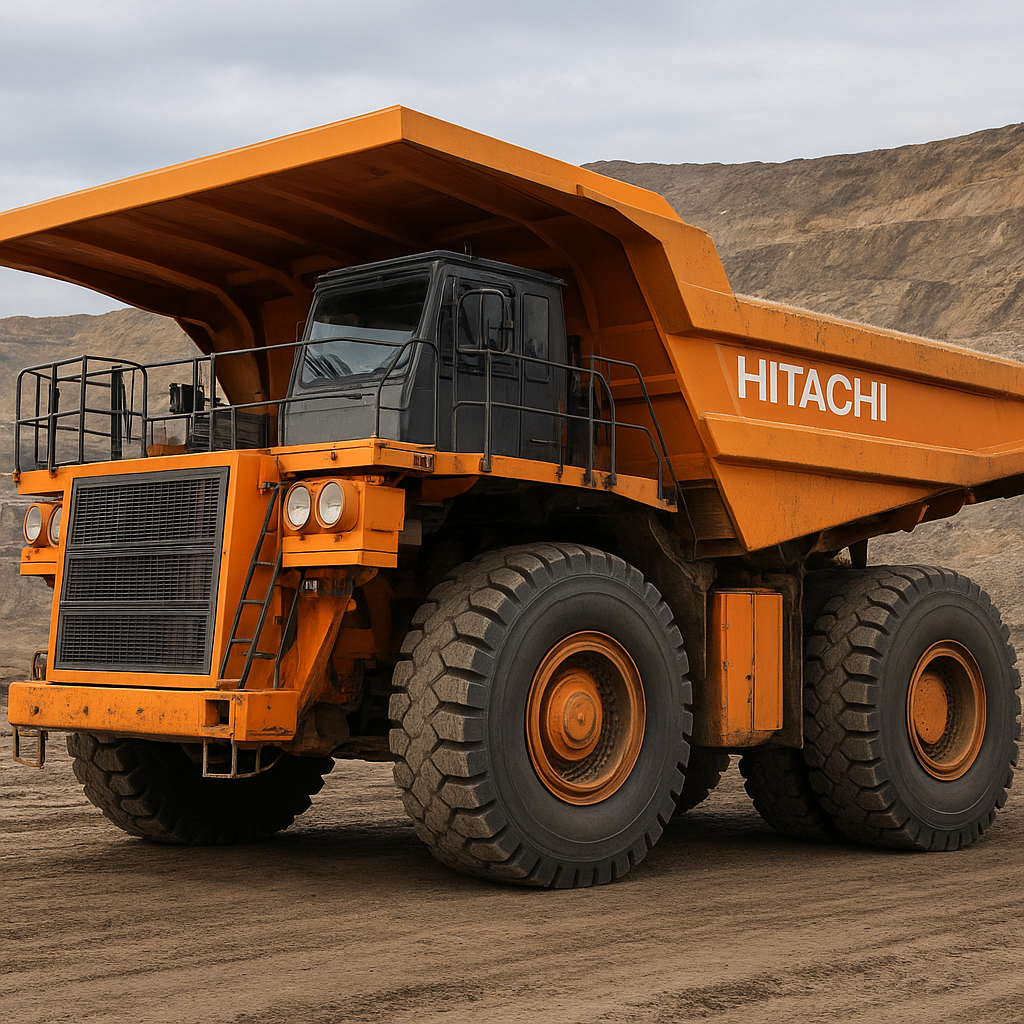
The Hitachi EH3000 is a purpose-built off-highway haul truck designed for heavy-duty surface mining and large earthmoving operations. Over the years it has become known for its robust construction, reliable driveline and a balance between durability and operational efficiency. This article reviews the EH3000’s design philosophy, typical technical characteristics, areas of application, operational considerations and the value it brings to mining and infrastructure projects worldwide. Where specific statistical data are cited, they are given as typical or approximate values because exact figures depend on model year, regional configuration and optional equipment.
Design and technical characteristics
The EH3000 belongs to Hitachi’s class of rigid-frame, rear-dump trucks intended to haul large volumes of rock, ore or overburden. It shares many design principles common to ultra-class and large-class haul trucks: a heavy-duty ladder frame, large-capacity dump body, and a powertrain engineered to handle severe duty cycles. Key engineering goals for the EH3000 include maximizing payload per cycle, minimizing downtime, and ensuring safe operation in challenging mining environments.
Structure and chassis
- Frame: The main frame is a welded box-section ladder design, optimized to resist bending and torsional stresses generated by heavy payloads and rough terrain. Reinforcements are commonly added at pivot and dump body mounting points.
- Suspension: Typically uses a rigid axle arrangement with heavy-duty leaf springs or torque rods; some configurations incorporate enhanced shock absorption for operator comfort and component longevity.
- Body: The dump body is constructed from abrasion-resistant steel and is designed to simplify loading, reduce material hang-up and allow quick dumping. Body options include different liner materials and wear packages.
Powertrain and driveline
The EH3000 has been supplied with robust diesel engines from major industrial engine manufacturers; engine selection and final power ratings vary by market and production year. The driveline is engineered to deliver high torque at low speeds for hauling heavy loads up grades, with either mechanical or electric drive variants depending on the configuration.
- Engine: Typical engines in this class provide heavy torque and sustained power for long haul cycles. Engines are usually turbocharged and intercooled, with electronic control for fuel efficiency and emissions management.
- Transmission: Options include multi-speed automatic transmissions or diesel-electric (AC) drive systems in some newer or specialized models. The AC drive variants provide smoother torque delivery and are simpler in terms of mechanical wear points.
- Axles and brakes: Heavy-duty planetary axles with multiple-disc service brakes and robust parking brakes are standard. Many units are equipped with engine retarders and/or hydraulic retardation systems for downhill control.
Typical specifications (approximate)
Exact numbers vary with model year and customization. The values below represent commonly reported ranges for the EH3000-class trucks; treat them as indicative rather than definitive.
- Payload: Approximately 100–200 tonnes (typical mid-to-large class payload range; specific EH3000 configurations often advertised near the middle of this range).
- Empty operating weight (approx): 40–70 tonnes, depending on equipment and body options.
- Engine power: Frequently in the range of 700–1,600 kW (roughly 1,000–2,200 hp), depending on engine selection and region-specific emissions tuning.
- Top speed (empty): Normally 50–60 km/h; loaded top speed and uphill speeds are considerably lower and depend on grade and payload.
- Turning radius: Designed to match mining-site haul road geometry; typical values vary substantially by steering geometry and tire choice.
- Tire sizes: Massive OTR tires in the 33.00R51 to 40.00R57 range are commonly used, with tire selection tuned to the operation’s cycle, payload and road conditions.
- Fuel capacity: Large tanks to support long shifts—often several hundreds of liters (values vary with configuration and regional refueling strategy).
Note: Many mine operators and fleet managers specify custom configurations—different engine packages, payload-limiting software, or alternative driveline choices—so published data should be cross-checked with the exact machine VIN and specification sheet.
Where the EH3000 is used
The primary application for the EH3000 is in surface mining—both metal ore and coal operations—and in large-scale civil earthworks. It is suited to operations where robust transport capacity and high availability are required. Typical use-cases include:
- Open-pit mining: Hauling ore from benches to crushers, coarse ore stockpiles, or primary crushers. The EH3000’s reliability and payload make it suitable for continuous high-tonnage operations.
- Overburden removal: Moving large volumes of waste rock and overburden during pit development and expansion phases.
- Quarrying and aggregate: High-capacity aggregate movements in large quarries where cycle times are long and machines encounter abrasive materials.
- Infrastructure and earthmoving: Projects like dam construction, road building and large excavations where a few high-capacity haulers reduce the number of cycles and fleet complexity.
Operators choose EH3000 units when they want a combination of high payload capability, proven mechanical systems and a platform that allows for easy maintenance and parts availability.
Operational performance and economics
One of the strongest value propositions of the EH3000 is its potential to deliver low cost per tonne moved when managed correctly. Fleet economics depend on cycle time, fuel consumption, availability, tire life and maintenance costs. The EH3000, when matched to site requirements, can be an efficient asset for bulk material movement.
Fuel efficiency and productivity
- Fuel consumption is a major operating cost; it varies with payload, terrain, speed and operator behavior. Modern operator training programs, telematics and powertrain control strategies can reduce fuel burn per tonne by optimizing shift points and reducing idle time.
- Productivity metrics normally tracked include tons per hour, payload per cycle, and machine availability. In many operations, an EH3000-sized truck will be paired with shovels or loaders sized to achieve a 30–45 second theoretical fill time for efficient cycles.
Availability and maintenance costs
Availability—the percentage of scheduled time a machine is ready to operate—is crucial. The EH3000 was engineered with component accessibility and serviceability in mind, which helps reduce mean time to repair (MTTR). Key maintenance and lifecycle cost drivers include:
- Engine and driveline overhauls
- Tire replacement (a significant line-item in cost per hour)
- Brake and retarder wear
- Hydraulic and electrical system servicing
Preventive maintenance regimes, condition monitoring systems and the use of OEM or approved parts significantly affect total cost of ownership. Telematics packages can alert maintenance teams to developing faults before they cause a breakdown, increasing the fleet’s overall efficiency.
Operator environment and safety features
The EH3000 places emphasis on operator ergonomics and safety—two critical elements in modern mining operations. Cab design, visibility, control layout and safety systems all contribute to both productivity and reduced incident rates.
- Cab: Spacious cabs with vibration and sound insulation, climate control, adjustable seating and controls reduce operator fatigue during long shifts.
- Visibility and cameras: Large glazed areas plus optional camera systems improve visibility around the vehicle, which is vital for working in dense site traffic.
- Safety systems: ROPS/FOPS certified cabs, automatic braking aids, proximity detection integration and emergency egress features are commonly included to meet modern regulatory standards.
- Automation and assistance: While the EH3000 is primarily a conventional truck, many operators retrofit telematics, operator assistance software and fleet management systems that assist with route planning, speed limiting and collision avoidance.
Maintenance practices and lifecycle management
Effective lifecycle management extends the service life of an EH3000 while keeping operating costs predictable. Common best practices include scheduled maintenance based on either time or engine hours, condition-based maintenance using oil sampling and vibration analysis, and structured parts inventory management.
Planned maintenance
- Daily walk-arounds and pre-shift inspections
- Engine oil and filter changes at manufacturer-recommended intervals
- Scheduled axle, transmission and hydraulic servicing
- Tire monitoring and rotation plans to maximize wear life
Rebuilds and remanufacturing
Like many large haul trucks, the EH3000 can be rebuilt or remanufactured to extend service life. Major components such as engines, transmissions, axles and frames are candidates for reman work. Rebuild programs can be economically attractive, giving operators lower capital expenditure compared to buying new while restoring much of the original capability.
Market presence, variants and historical context
Hitachi’s EH-series trucks have served a wide range of mines globally. While technology and scale have evolved, the EH3000 has been a workhorse in markets where its payload class and operational characteristics align with site needs. Variants of the basic model have included different cab options, driveline types and wear packages to suit region-specific requirements.
- Regional support: Hitachi and its dealer networks provide parts and service in many mining regions, which affects total cost of ownership and uptime positively.
- Competition: The EH3000 competes with similar-size machines from other manufacturers; choice is often made on the basis of service support, fuel economy, payload matching and operator preference.
- Evolution: Over time, upgrades such as electronic engine controls, improved ergonomics and telematics have been introduced to enhance functionality and meet regulatory emissions standards.
Environmental considerations and emissions
Like all large diesel-powered haul trucks, the EH3000’s environmental footprint centers on fuel consumption and emissions. Modern regulatory environments and operator sustainability goals have pushed firms to adopt cleaner engines, improved fuel management practices and, in some cases, alternative powertrains or electrification at the fleet level.
- Emissions control: Newer engines comply with regional emissions standards through improved combustion control and exhaust aftertreatment.
- Fuel management: Optimized haul road design, speed management and operator training reduce fuel consumption and related CO2 emissions.
- Electrification trends: While complete electrification of large haul trucks is still in development for many sizes and duty cycles, hybrid and trolley-assist systems are increasingly used in some mines to reduce diesel consumption. An EH3000 platform may be adapted over time with hybrid components or as part of an electrified haul network depending on site investment.
Case studies and real-world examples
Operators that deploy EH3000-class trucks typically report benefits in operational efficiency when machines are well-matched to the site. Examples of measurable outcomes include:
- Improvement in tons-per-hour through proper shovel-truck pairing
- Reduced downtime after introducing condition monitoring and telematics
- Extended tire life through optimized payload management and road maintenance
Case study specifics vary by operation and many large mining companies publish annual reports or technical papers that detail the evolution of their fleets and the impacts of specific truck models on key performance indicators.
Purchasing, fleet integration and resale value
When procuring EH3000 trucks, mine planners evaluate total lifecycle costs, compatibility with existing fleet assets and resale value. Variables that influence purchasing decisions include:
- Availability of local service and spare parts
- Financing and leasing options
- Compatibility with existing loaders/shovels for cycle-time optimization
- Residual value and demand in the secondary market
Resale value is generally influenced by machine condition, hours of operation, maintenance history and global demand for used mining equipment. Well-maintained EH3000 units with full service records typically command better prices on the secondary market.
Summary and outlook
The Hitachi EH3000 is a durable, high-capacity haul truck platform that fills an important role in surface mining and heavy earthmoving. Its strengths are in robust mechanical design, the ability to carry large payloads efficiently, and adaptability through multiple configurations and maintenance strategies. While exact specifications and performance metrics depend on model year and customization, the EH3000 remains a common choice where reliability, maintenance accessibility and fleet economics are priorities.
Looking forward, the EH3000 and its peers will continue to be influenced by trends toward improved emissions control, telematics-driven predictive maintenance and partial electrification of haul networks. For operators considering this class of truck, success depends less on the specific model name and more on matching truck capability to site-specific cycle times, payloads and support infrastructure.
)
)