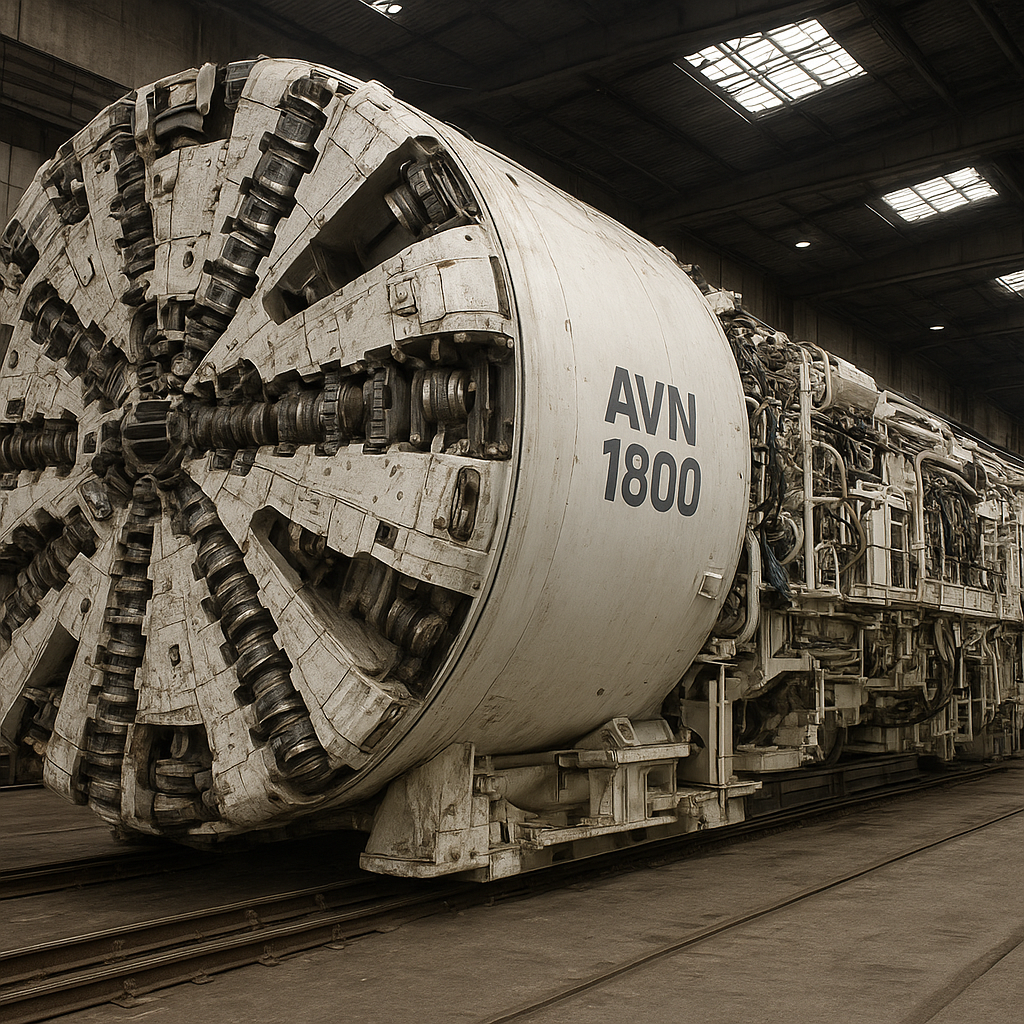
The Herrenknecht AVN 1800 is a specialized tunnel boring machine (TBM) concept tailored for small- to medium-diameter underground works. This article examines the machine’s typical design characteristics, operational fields, logistical and safety considerations, and the broader technical and environmental context in which a TBM of this class operates. The AVN 1800 is part of Herrenknecht’s portfolio of bespoke machines and modular systems aimed at delivering high-precision boring in urban and constrained environments. Below you will find a detailed overview of where this machine is applied, how it performs, and which factors influence its selection and deployment.
Design and technical characteristics
The AVN 1800 is typically defined by an excavation diameter of approximately 1.8 meters (1800 mm), making it suitable for a variety of small-bore tunnels such as utility ducts, service galleries, and smaller sewer or water conveyance lines. Herrenknecht’s machines emphasize modularity and adaptability: the AVN 1800 can be equipped in different configurations depending on ground conditions and project requirements, including options for screw conveyor systems, segmental lining, and either Earth Pressure Balance (EPB) or slurry support where appropriate.
Key technical features commonly associated with a machine in this class:
- Cutterhead design: a compact, robust head that can be fitted with disc cutters, carbide tools or mixed-cutting tools depending on rock or mixed ground.
- Support system: capabilities for temporary or permanent lining installation; in small diameters this often means pre-cast segments, concrete lining, or sprayed concrete depending on the project.
- Drive and power: modular drive units sized to balance torque and rotation speed for efficient cutting in variable strata. Installed power for machines of this class typically ranges from modest to medium, configured to match expected face loads and auxiliary systems.
- Soil conditioning: capacity for adding conditioners or polymer slurries when operating as an EPB or in mixed-face conditions, facilitating continuous muck transport and stable face pressure.
- Muck removal: conveyor or screw systems, typically tailored to the excavation diameter and alignment constraints to ensure reliable removal of spoil without interrupting progress.
- Control and instrumentation: integrated guidance systems (laser, gyro, or inertial navigation), thrust/readout instrumentation, and remote monitoring capabilities for real-time performance optimization.
A few design priorities for the AVN 1800:
- Compactness to fit in constrained launch/recovery shafts common in urban projects.
- Low-vibration operation to minimize disturbance to surrounding structures.
- Ease of transport and assembly — many components are sized for standard road transport and staged assembly underground.
- High adaptability — the machine is intended to be reconfigurable so the same base TBM can serve several nearby drives with differing ground conditions.
Primary applications and use cases
The AVN 1800 is best suited to projects where the tunnel diameter requirement falls in the small-to-medium range and where precision, minimal surface disruption, and continuous operations are prioritized. Typical applications include:
- Utility tunnels and ducts — telecommunications, energy cables, district heating or cooling pipes, and water supply mains.
- Sewer and stormwater conveyance — lining or replacing aging systems without major surface excavation.
- Microtunneling projects — short to medium-length drives under roadways, railways, and sensitive urban infrastructure, where a small-diameter TBM reduces traffic and disruption.
- Access and service galleries — for maintenance access to larger underground structures or interconnecting service passages.
- Hydropower and irrigation tunnels — when small-diameter exploratory or pressure lines are required in constrained mountain settings.
Advantages that make the AVN 1800 desirable for these tasks:
- Minimal surface footprint for launch and retrieval shafts, which reduces permitting complexity and urban disruption.
- High precision navigation that enables accurate alignment through congested subsurface utility environments.
- Lower risk of settlement and surface damage compared with open-cut methods, particularly when using pressure-balanced configurations in soft ground.
Operational performance and statistical indicators
The productivity and statistical performance of a TBM such as the AVN 1800 depend heavily on ground conditions, logistics, and technical configuration. Rather than presenting single fixed numbers, the following ranges illustrate typical performance metrics observed in small-diameter TBM projects:
- Excavation diameter: ~1.6–2.0 m for a machine referred to as “1800” depending on cutterhead overcut and lining thickness.
- Advance rate: Highly variable; in homogeneous soft ground with optimized logistics and continuous operations, daily advances can reach several meters (often expressed as tens to a few hundred meters per week in practice for many urban drives). In mixed face or rock, advance may be measured in meters per day or less, depending on the difficulty of excavation and rock hardness.
- Installed power: Scaled to the machine; smaller TBMs typically have installed drive and auxiliary power in the low hundreds of kilowatts, but exact figures depend on cutterhead design, conveyor systems, and conditioning equipment.
- Muck removal capacity: Designed to match advance rates; screw conveyors or belt systems in the shield and slurry-handling systems when a slurry configuration is chosen.
- Alignment accuracy: Modern guidance systems used on Herrenknecht machines can achieve centimeter-level accuracy over long distances with frequent checks and corrections, which is critical in dense urban environments.
Notable statistical observations from the industry relevant to machines of this class:
- Tunneling in urban environments typically dedicates a significant proportion of total project time to planning, monitoring, and mitigation activities rather than to pure boring time; the TBM’s continuous performance is only one component of schedule performance.
- Project productivity improvements often come from logistics optimization (spoil handling, segment supply, shaft access, maintenance planning) rather than raw increases in cutterhead speed.
- Small-diameter TBMs often realize better cost-effectiveness than open-cut excavation in congested or environmentally sensitive areas due to lower restoration and traffic-management costs.
Site preparation, logistics and assembly
Operating an AVN 1800 requires careful site preparation to manage shafts, spoil, segment supply, and the workforce. Key logistical elements include:
- Launch shaft design: For a 1.8 m-class TBM, launch shafts are usually compact but must allow for safe assembly of the shield, installation of the hydraulics and jacking system, and space for initial segment handling or temporary supports.
- Drainage and dewatering: Groundwater control plans are essential if operating below the water table; options include temporary wells, grouting, or configuring the machine for pressurized-face operation (EPB/slurry).
- Spoil handling: Screw conveyors in the shield or conveyor belts through the shaft are arranged to remove spoil continuously, avoiding stoppages. For slurry systems, slurry separation plants and pipelines to disposal or treatment sites are required.
- Segment logistics: If the drive uses pre-cast segments, precise coordination of delivery, storage in the shaft, and erection sequences is required to maintain continuous tunneling.
- Transport and assembly constraints: Component sizes are designed to fit on standard trucks and through urban roads where possible, but careful route planning is necessary for oversized parts.
Because the AVN 1800 is often used in urban retrofit or replacement works, coordination with utilities, traffic authorities, and local stakeholders is a major part of the pre-construction program. Minimizing disruptions to roadways and ensuring safe pedestrian environments at shaft sites are planning priorities.
Safety, monitoring and environmental considerations
Safety and environmental performance are prime concerns for all modern tunneling projects. For a small-diameter TBM like the AVN 1800, relevant topics include:
- Ground stability and settlement monitoring: Extensive instrumentation (inclinometers, surface settlement points, building movement sensors) is deployed when boring beneath sensitive structures.
- Face pressure control: EPB or slurry systems are used to maintain face stability and minimize settlement in soft soils. Active control of excavation pressure mitigates the risk of ground loss.
- Dust, noise and vibration: The enclosed nature of TBM operations reduces dust escape; however, vibration from cutting in rock can be transmitted to nearby structures, so vibration monitoring and mitigation strategies (reduced advance rates, modified cutting tools) are used.
- Waste handling and water treatment: Slurry systems require treatment plants to handle separated fines and contaminated water; spoil from uncontrolled excavation must be tested and appropriately disposed of.
- Emergency procedures: Small-diameter drives still require well-developed emergency egress, ventilation, and communication plans to protect personnel working in confined conditions.
The environmental benefits of using a TBM rather than open-cut excavation often include reduced surface disturbance, lower traffic disruption, and reduced need for large-scale restoration work — particularly valuable in dense urban areas where surface impacts translate to large social and economic costs.
Maintenance, refurbishment and lifecycle considerations
Like all TBMs, an AVN 1800 requires an organized maintenance strategy to ensure consistent performance and to extend the service life of critical components. Important points include:
- Cutter and tool replacement: Tool wear depends on ground abrasivity; planned maintenance windows and spare tool stocks reduce downtime.
- Hydraulic and electrical systems: Regular inspection of hydraulic seals, hoses, and electrical connectors prevents unexpected failures, especially in wet or abrasive environments.
- Shield and screw conveyor wear: Liners and replaceable wear components are pre-planned consumables; rapid replacement techniques speed repairs.
- Refurbishment: After completion of one or several drives, TBMs are often refurbished for subsequent projects. Herrenknecht machines are designed for such reconditioning to maximize return on investment.
- Spare parts and lifecycle support: Access to manufacturer support, spare component inventories, and trained service teams is critical for minimizing project risk on long or multiple-stage programs.
A robust maintenance and overhaul plan does not only extend machine life but also stabilizes scheduling and budgeting for contractors.
Notable project types and practical examples
While individual project confidentiality may limit the availability of full public statistics for a specific AVN 1800 instance, the machine type is commonly applied in projects such as:
- Urban sewer renewals where existing pipelines are replaced without surface excavation.
- Installation of new fiber-optic or power ducts beneath congested downtown streets.
- Connecting shafts and galleries inside larger tunnel complexes where small-diameter interconnecting drives are needed.
- Small-bore water supply tunnels in municipal infrastructure upgrades.
Typical project delivery models for these TBM applications often feature:
- Short drives (hundreds of meters) done as part of phased city infrastructure upgrades.
- Multiple short setup and retrieval operations over several sites — benefiting from the machine’s reconfigurability and relatively compact logistics footprint.
Economic and comparative considerations
Choosing a TBM such as the AVN 1800 involves comparing life-cycle costs against alternative methods (open-cut, microtunneling by guided auger boring, or directional drilling). Some economic considerations:
- Capital cost versus productivity: small TBMs have lower absolute capital cost than large shields, but unit costs per meter depend on advance rates, tooling wear, and logistics efficiency.
- Surface restoration and traffic management savings: often the decisive economic advantage in urban projects where open-cut methods would cause major disruption and high reinstatement costs.
- Risk transfer and contractual structures: TBM use can be coupled with fixed-price contracts where the contractor’s expertise in TBM operation and risk management delivers value to the client.
A careful feasibility assessment typically quantifies these comparative costs and risks, including sensitivity to ground conditions and the availability of shaft sites.
Conclusion and outlook
The Herrenknecht AVN 1800 represents a class of compact, flexible TBMs engineered to meet the demands of modern urban and utility tunneling. With an approximate excavation diameter of 1.8 meters, this machine is optimized for applications where precision, low environmental impact, and logistical adaptability are essential. Its strengths lie in modular design, a focus on continuous muck handling and face stability, and the capability to be configured for varied ground conditions.
Future developments in the small-diameter TBM space will continue to emphasize automation, remote monitoring, and advanced soil conditioning to further increase safety, reduce settlement risks, and improve productivity. For contractors and owners considering a machine like the AVN 1800, thorough site investigation, logistical planning, and an integrated maintenance and monitoring program are the keys to achieving reliable, cost-effective project delivery.
Key terms: Herrenknecht, TBM, AVN 1800, diameter, cutterhead, EPB, slurry, tunnel, logistics, segmentation
)
)