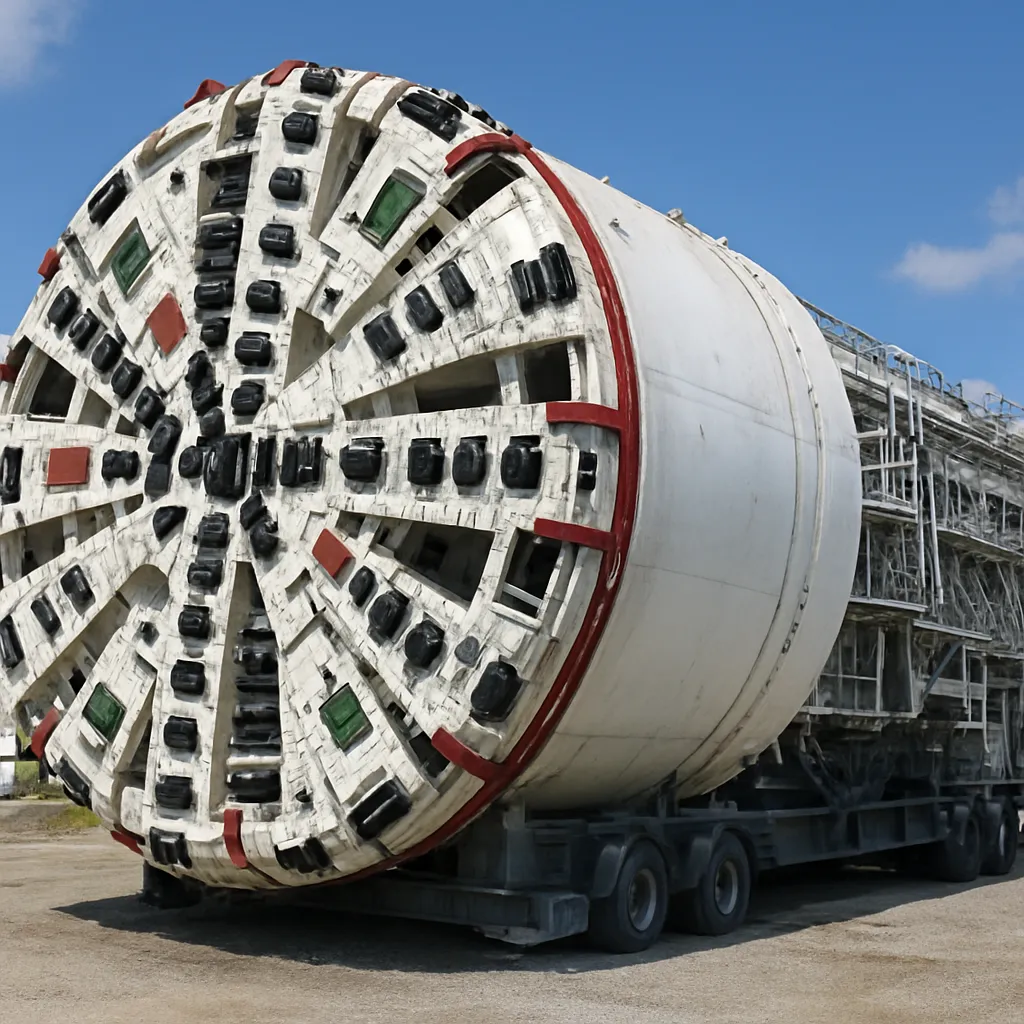
The Herrenknecht S-960 TBM is a high-capacity, modern tunnel boring machine designed for challenging underground projects where water pressure, soft ground and large tunnel diameters demand robust technology. This article examines the machine’s design principles, typical applications, operational performance, and maintenance considerations. It also highlights environmental and safety aspects as well as innovations that make the S-960 a reliable choice for major infrastructure works. Throughout the text, key terms are emphasized to help orient readers to the most important concepts and components.
Design and technical characteristics
The S-960 is part of Herrenknecht’s family of large-diameter slurry-shield tunnel boring machines. The designation S-960 typically denotes a machine with a cutterhead diameter of approximately 9.6 m, making it suited to transit, water conveyance and utility tunnels that require a spacious internal profile. Like other slurry shields, the S-960 is engineered to balance external groundwater and earth pressures by using a pressurized slurry chamber directly behind the cutterhead, allowing safe excavation in saturated, loose or unstable soils.
Key components and features include:
- Cutterhead: A reinforced, rotating cutting wheel fitted with mixed cutters and openings for slurry flow. Cutterhead design can be adapted to the geology (e.g., mix of scrapers, disc cutters, and drag bits).
- Slurry system: A closed-loop slurry circulation system pumps bentonite or other carrier fluids through the cutterhead and returns spoil-laden slurry to a surface separation plant for solids removal and recycling.
- Shield and backup: A pressurized shield in front of the backup supports the ground; the backup train carries conveyors, pumps, pipes and hydraulic equipment, often split into multiple segments for transport and assembly in-situ.
- Segment erector: An automated mechanism inside the shield installs precast concrete segmental lining rings as the machine advances.
- Grouting and tail sealing: Systems for injecting grout into the annulus between the erected segments and excavated ground to secure the lining and control settlement.
- Guidance & control: Advanced navigation and steering systems with high-precision sensors allow alignment control to within millimeter-level tolerances over long distances.
Typical technical ranges for machines of this class (actual specifications vary by contract and configuration):
- Cutterhead diameter: ~9.6 m
- Overall installed drive power: commonly in the multiple-megawatt range (several thousand kW)
- Cutterhead torque: up to several hundred to a few thousand kNm depending on gearbox and motor configuration
- Thrust force: several thousand to tens of thousands of tonnes of total thrust provided by hydraulic jacks
- Advance rate: highly variable; typical averages between 5–30 m/day depending on geology, with peak single-day advances higher in optimal conditions
- Slurry volume handling: several hundred to a few thousand cubic meters in the circulation system and separation plant capacity
Where the S-960 is applied
The S-960’s strengths make it particularly valuable in large and complex underground projects. Typical applications include:
- Metro and rail tunnels: Large-diameter single-bore tunnels for multiple tracks, stations or service galleries in urban settings where ground conditions include soft soils, high water tables, or mixed face geology.
- Water supply and pressure tunnels: Conveyance tunnels for drinking water, raw water or pumped systems that require a watertight lining and smooth internal profile for hydraulic efficiency.
- Sewer and large-diameter drain galleries: Replacement or new-build projects under rivers, cities or sensitive infrastructure where open excavation is impractical.
- Undersea and river crossings: When tunneling below seabeds or riverbeds with high hydrostatic pressures, the slurry-shield configuration provides safety and control.
- Utility and cable corridors: Long stretches carrying multiple utilities in a single tunnel, where a large cross-section saves on long-term maintenance and operational flexibility.
Because the machine balances external pressures with a controlled slurry medium, the S-960 excels where water-bearing soils and unstable sands would prevent the safe use of open-face or TBMs without pressure control, such as conventional open TBMs in dry rock. The S-960 can also be fitted with cutting tools and chamber arrangements tuned for heterogeneous conditions, including cobbles, gravel horizons and interbedded clays.
Operational performance and productivity
Operational performance depends on many factors: geology, tunnel alignment, logistics (segment supply, spoil disposal), personnel and contractor expertise. Nevertheless, patterns and expectations can be summarized to give prospective clients and engineers a realistic picture.
Advance rates and contributing factors
Advance rates for a large slurry-shield TBM like the S-960 typically range from a few meters per day in extremely difficult ground to tens of meters per day in favorable conditions. Factors that influence rate include:
- Geology and presence of boulders or cobbles (slow down cutting and increase wear)
- Groundwater pressure and required dewatering or pressure management
- Reliability of slurry separation and recycling systems (downtime reduces effective advance)
- Segment production and logistics—delays in segment supply or segment erector failures directly limit progress
- Crew shifts, maintenance strategies, and availability of spare parts
Spoil handling and slurry processing
The slurry circuit is central to the S-960’s operation. Excavated material is transferred in suspension to the surface where a separation plant removes solids and regenerates the carrier fluid. Typical slurry plant components include hydrocyclones, decanting centrifuges, screens and storage tanks. Efficient solids separation reduces operating cost by minimizing fresh slurry additives and limiting waste disposal volumes.
Alignment and tolerances
Precision guidance systems allow the S-960 to meet tight alignment tolerances over long drives. Gyroscopes, laser target systems and continuous monitoring ensure that line and grade are maintained, which is essential for tunnels that must accurately connect to shafts, portals or other tunnel segments. Typical achieved tolerances are within a few tens of millimeters over hundreds of meters, depending on survey references and ground movement control measures.
Environmental and safety considerations
Large urban tunneling projects attract strong attention to environmental performance and safety. The S-960’s slurry shield design has both advantages and obligations in this context.
- Ground settlement control: By pressurizing the face with slurry, the S-960 minimizes settlement risk above the tunnel and reduces the possibility of sinkholes or damage to existing structures.
- Noise and vibration: TBM operations are generally quieter and produce less vibration at the surface than open excavation or blasting; nonetheless, measures must be in place to monitor and mitigate effects on sensitive structures.
- Waste management: Separated solids from the slurry circuit require proper disposal. Modern projects emphasize recycling of slurry media and minimizing waste volume through efficient separation technology.
- Water protection: Construction must prevent contamination of aquifers and ensure that slurry and fines do not pollute surface or groundwater—containment, monitoring and treatment systems are mandatory.
- Safety systems: Face stability under pressure, reliable emergency protocols for personnel, and redundant monitoring of pressures and seals are critical to prevent incidents related to face loss, blowbacks or flooding.
Maintenance, lifecycle and costs
Investment in a machine like the S-960 is substantial. TBMs of this size are typically mobilized for major projects where the tunnel length and complexity justify the capital and operating expenditure. Lifecycle costs include procurement or rental, transport and assembly, operation (crew, energy, slurry additives), wear parts (cutters, wear plates, seals), and eventual disassembly.
- Wear parts: Cutter tools and wear plates are consumables that require regular change-outs. In abrasive ground, shield and cutterhead maintenance intervals shorten and spare-part logistics become a major cost driver.
- Scheduled maintenance: Planned downtime for inspection of the cutterhead, bearings, thrust cylinders and slurry pumps is essential to prevent catastrophic failures and extend machine life.
- Reusability: Large machines are often dismantled and transported to new sites after a project; modular design and careful documentation shorten turnaround time between projects.
- Economic considerations: The choice between using an S-960 or multiple smaller bores often comes down to project-specific cost-benefit analysis: single large bore can reduce long-term operational costs (e.g., for multi-track transit) but demands higher up-front tunneling cost and more complex logistics.
Innovations, automation and digitalization
Herrenknecht and the tunneling industry have advanced in areas relevant to the S-960, integrating digital tools and automated systems that improve efficiency and safety.
- Remote monitoring: Real-time telemetry on drive power, torque, slurry pressures and alignment metrics helps troubleshoot problems early and optimize daily performance.
- Predictive maintenance: Data-driven models predict wear and component failure, enabling maintenance to be scheduled before breakdowns occur.
- Automated segment erection and grouting: The segment erector and grouting routines are increasingly automated to reduce human exposure inside the shield and to speed up ring closure.
- Geotechnical integration: Combining geological forecasting with machine sensor data allows dynamic adjustment of cutterhead torque, advance rate and slurry parameters to suit changing conditions.
Case studies and practical examples
While specific project names and machine allocations can vary, large slurry-shield TBMs with diameters in the 8–10 m range are frequently deployed for projects such as urban rail bypasses, combined sewer overflow tunnels and major water transfer tunnels. Lessons learned from such projects are broadly applicable to S-960 operations:
- Logistical planning for segment supply is as decisive as machine reliability; delays in precast production often stall machine progress.
- Efficient slurry separation saves both time and operational cost; investments in high-performance separation equipment pay back quickly in long drives.
- Detailed pre-construction geological and hydrogeological investigations reduce unknowns and enable more reliable selection of cutter tools and slurry recipes.
- Coordinated emergency response plans and continuous environmental monitoring facilitate safe tunneling in dense urban environments.
Advantages and limitations
Advantages of the S-960 and similar slurry-shield TBMs:
- Excellent face control in high water-pressure and loose ground conditions
- Capability to create a large-diameter bore in a single pass, reducing the need for multiple smaller bores
- High degree of automation with segmental lining installation
- Reduced surface disruption compared to open-cut methods
Limitations and challenges:
- High initial cost and complexity—suitable only for projects with sufficient scale
- Slurry management and waste disposal create logistical and environmental demands
- Sensitivity to hard inclusions (boulders, cobbles) which can cause downtime and require cutterhead protection strategies
- Extensive transport and assembly effort for large components in urban or restricted sites
Key performance indicators and statistics
For procurement and planning, the most relevant performance indicators include advance rate (m/day), mean time between failures (MTBF), slurry separation efficiency, and consumable wear rates. Typical benchmark figures for machines in this class, reflecting historical industry experience rather than a single guaranteed output, are:
- Average advance: 5–25 m/day across mixed to favorable ground conditions
- Maximum short-term advance (best-case): up to 50 m/day in very favorable, homogeneous soils
- Slurry solids separation efficiency: >90% solids removal achievable with multi-stage plant
- Face pressure control: maintained to within small fractions of design pressure to prevent settlement
Project-specific contracts often contain bespoke specification tables listing exact drive power, torque, thrust and hydraulic capacities for the particular S-960 delivered. Those values are determined after careful geotechnical studies and are tailored to the demands of the planned drive.
Conclusions and outlook
The Herrenknecht S-960 is a representative example of modern slurry-shield TBM technology, optimized for large-diameter tunnels in challenging ground and high groundwater conditions. Its primary strengths are robust face control, integrated segmental lining installation and adaptability to complex ground conditions. Effective deployment requires careful planning of slurry processing, segment logistics and maintenance regimes. Ongoing innovations in monitoring, automation and separation technology continue to enhance the productivity and environmental performance of machines in this class, making them a central tool for major underground infrastructure projects.
Note: Specific numeric parameters for any delivered S-960 unit (installed power, thrust capacity, torque, shield length, backup configuration) will depend on the project-specific configuration defined by the client and the ground conditions encountered. For precise data, consult project documentation or Herrenknecht technical specifications supplied for the particular contract.
)
)