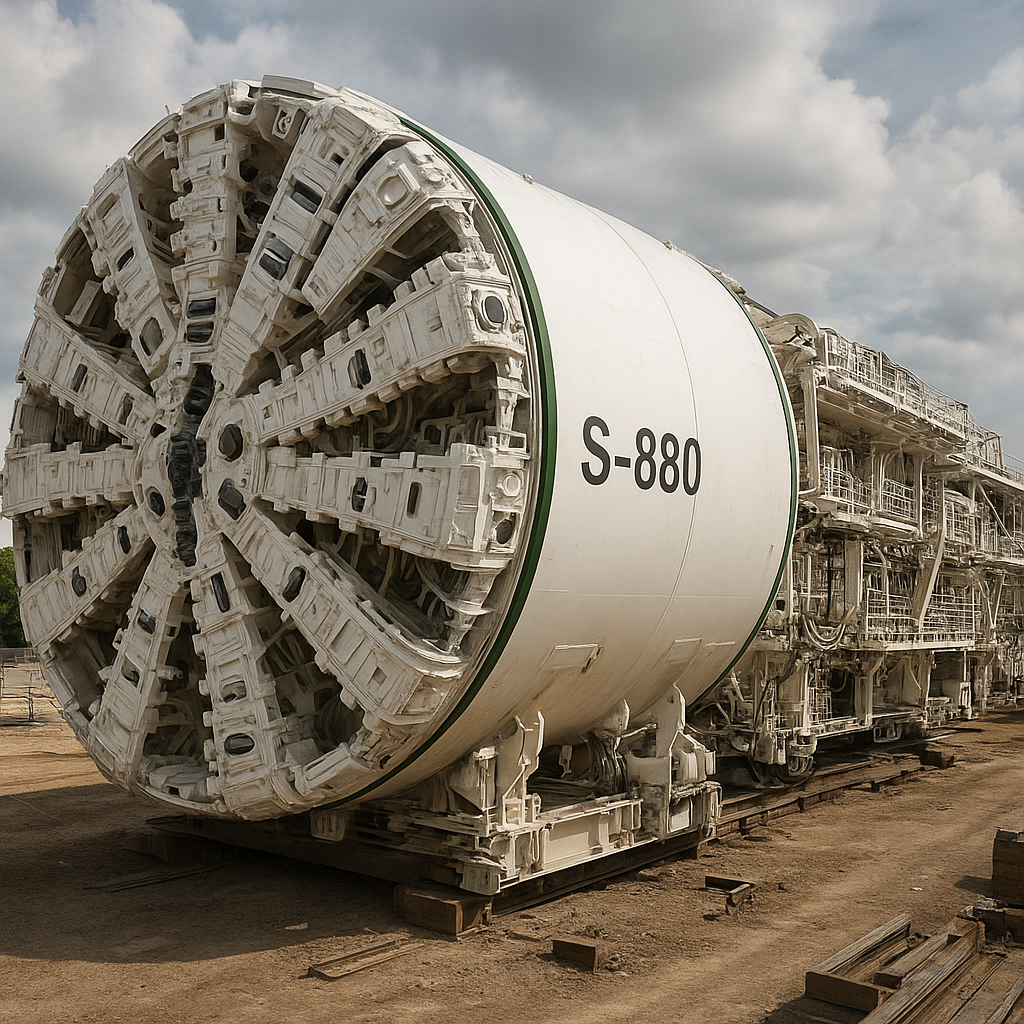
The Herrenknecht S-880 is a high-capacity tunnel boring machine (TBM) designed to meet the demanding requirements of modern underground construction. Built to operate in challenging, water-bearing and soft ground conditions, the S-880 combines proven mechanical systems with advanced process technology to deliver continuous, safe and efficient excavation. In this article we explore the machine’s design, typical technical parameters, operational processes, main applications, and the benefits and challenges associated with using such a machine on large civil engineering projects.
Design and technical characteristics
General configuration
The S-880 is provided as a full-face slurry shield TBM, optimized to control the excavation face by means of a pressurized slurry circuit. As with other slurry-type machines, it separates the excavated material from the transport medium on the surface, enabling safe tunnelling through loose, saturated soils and strata with elevated groundwater pressure. The machine typically consists of a rotating cutterhead, a shield, a series of backup gantries that house conveyors, pumps and control equipment, and a trailing backup that integrates slurry separation and support systems. The machine is commonly launched from a shaft or drive portal and is retrieved at the receiving shaft.
Key structural elements
- Cutting system: robust disc cutters and scraper tools arranged on the cutterhead for optimal soil engagement and wear distribution.
- Shield and bulkhead: front protection and seal arrangements that maintain controlled face conditions.
- Slurry circuit: pumps, pipelines, conditioning tanks and separation units (decanters, hydrocyclones, filter presses) to treat and recycle slurry.
- Propulsion: hydraulic thrust cylinders generating enormous axial force to press the shield against segmental rings while jacking forward.
- Guidance and jacking: steering sensors, hydraulic jacks and thrust frames for precise alignment and ring erection.
Typical specifications and performance indicators
Model designations such as S-880 often reflect the nominal excavated diameter in decimeters (S-880 ≈ 8.80 m), though variants exist depending on project requirements. Exact figures depend on configuration, geology and project constraints, but typical ranges for a machine in this class are:
- Cutterhead diameter: around 8.5–9.5 m (nominally 8.8 m for S-880).
- Total machine length (including backup): 80–200 m depending on installed equipment and separation plants.
- Machine weight: several thousand tonnes in assembled form (transportable in sections).
- Installed power: 2,000–8,000 kW for cutter drive, pumps and auxiliary systems.
- Thrust capacity: multiple hydraulic cylinders delivering several thousand to tens of thousands of kN.
- Cutterhead torque: up to several hundred to over a thousand kNm depending on drive configuration.
- Advance rate: highly variable — typical sustained averages range from a few meters per day in difficult ground to 30–50 m/day or more in favorable conditions; short bursts can be significantly higher.
These numbers are indicative; project-specific packages (power ratings, slurry treatment capacity, conveyor systems) will alter the exact performance envelope.
Applications and operating environments
Where the S-880 excels
The S-880 is engineered primarily for use in soft ground with significant groundwater presence or where cobbles and mixed face conditions would make open-face excavation risky. Typical applications include:
- Urban metro and rail tunnels where settlement control is critical and surface disruption must be minimized.
- Water and sewer tunnels requiring stable face control under high hydrostatic pressure.
- Road tunnels in soft ground or under rivers and estuaries where a slurry shield reduces the risk of inflow and ground loss.
- Hydropower headrace and pressure tunnels where long, deep drives pass through saturated or unconsolidated material.
- Undersea alignments and river crossings where watertight excavation is required.
Environmental and site constraints
Slurry TBMs such as the S-880 are often chosen where strict environmental requirements for settlement, water quality and noise are imposed. By controlling the face with pressurized slurry and using closed-loop separation systems, the machine reduces the risk of uncontrolled groundwater drawdown and excessive surface settlement. However, slurry treatment and disposal require careful planning: treatment plants, dewatering, and residual solids handling generate logistical and regulatory responsibilities for the project team.
Operational process and logistics
Excavation cycle and slurry management
In slurry-mode operation the cutterhead disintegrates and transports the excavated material into the slurry-filled excavation chamber. The slurry (typically bentonite-based or polymer-augmented) suspends the spoil and transmits face pressure. A powerful slurry pump moves the spoil-laden slurry through high-pressure pipelines back to the surface where a separation plant recovers solids and reconditions the fluid for re-use. Key equipment and steps include:
- Primary pumps and booster stations to maintain steady flow and pressure.
- Hydrocyclones, centrifuges and filter presses to separate fines and coarser particles.
- Conditioning tanks to replenish bentonite or polymers and adjust rheological properties.
- Disposal or stabilization of residual cake and fines in compliance with environmental permits.
Segmental lining and ring erection
The S-880 typically installs pre-cast concrete segmental rings immediately behind the shield. A ring erector positions and bolts segments to form a continuous lining that transfers load and seals the tunnel. The system allows immediate structural support, rapid jacking and continued excavation. Grouting behind the lining is often necessary to fill annular gaps and reduce settlement. Typical ring erection cycle times and segment handling strategies are a critical part of operational planning and crew scheduling.
Guidance, monitoring and control
Modern TBMs are equipped with sophisticated guidance systems, combining laser-based alignment, inertial measurement units, face deformation sensors and geotechnical monitoring. The S-880’s control room integrates these data streams to maintain the designed alignment within tight tolerances — often within centimeters over long distances. Continuous monitoring of slurry properties, cutterhead torque and thrust, and settlement gauges enables proactive adjustments to minimize risk and optimize progress.
Advantages, challenges and innovations
Advantages
- High face stability and groundwater control in variable and saturated soils.
- Reduced surface disruption compared to cut-and-cover methods — critical in dense urban settings.
- Continuous excavation and lining installation enabling high productivity on long drives.
- Improved worker safety by maintaining a pressurized, controlled excavation environment.
Challenges and risks
- Complex slurry handling and separation systems introduce additional capital and operational costs.
- Slurry disposal and environmental compliance require careful planning and monitoring.
- Wear on cutting tools and cutterhead components can be significant in abrasive ground, impacting maintenance windows and operating cost.
- Logistics for launching, assembling and transporting large TBM components can be demanding, particularly in constrained urban sites.
Technological trends and recent innovations
TBM technology continues to evolve. Key innovations relevant to machines like the S-880 include:
- Digitalization: real-time data analytics, predictive maintenance algorithms and model-based process control to reduce downtime and optimize performance.
- Advanced materials: wear-resistant cutterheads and coatings extend component life in abrasive conditions.
- Hybrid approaches: combined EPB-slurry capability or rapid exchange systems to adapt to changing geology.
- Improved slurry treatment: higher-efficiency centrifuges and closed-loop systems reduce water and chemical consumption.
Economics, maintenance and project planning
Cost drivers
The cost of employing an S-880-class machine depends on multiple factors: manufacture or rental cost, mobilization and assembly, support infrastructure (separation plant, shafts, power supply), manpower, maintenance and slurry consumables. Large civil projects commonly weigh the higher capital and operating costs of slurry TBMs against the savings from reduced surface disruption, shorter construction windows and lower risk of costly settlement damage.
Maintenance strategy and lifecycle
Effective maintenance planning is crucial. Wear on cutters, seals and hydraulic components is driven by geology and operational intensity. Maintenance activities include scheduled cutterhead inspections, cutter replacement, seal changes and periodic overhauls of drives and pumps. Typical strategies include predictive maintenance based on torque and vibration signatures, supplemented by planned “maintenance windows” during which the cutterhead is inspected and service items replaced.
Project planning considerations
Deploying a machine like the S-880 requires detailed geotechnical investigation, permitting for slurry handling and disposal, and logistic planning for shafts, segment production and site access. Contingency planning for variable ground, unforeseen obstructions and emergency intervention is an essential element of responsible project management.
Industry impact and real-world performance
Role in modern tunnelling
Herrenknecht is a leading global TBM manufacturer and machines in the S-class family have enabled many challenging tunnelling projects worldwide. The S-880’s combination of a large diameter and slurry-based face control suits long, deep drives and complex urban assignments. By making possible tunnelling under rivers, through soft soils and beneath existing infrastructure with controlled settlement, machines like the S-880 have expanded the feasible scope of underground works.
Performance metrics and expectations
Performance is always project-specific. Key indicators project teams monitor include:
- Average daily advance (m/day): influenced by geology, working cycles and logistics.
- Mean time between maintenance interventions: a function of abrasive wear and component robustness.
- Slurry recovery and recycling efficiency: important for operating cost and environmental compliance.
- Alignment accuracy and settlement performance: critical for urban infrastructure projects.
Typical long-term averages for slurry TBMs can range from several meters per day in difficult conditions to multiple tens of meters per day in favorable geology with optimized logistics. Variations are common and projects must plan to accommodate wide performance envelopes.
Concluding observations
The Herrenknecht S-880 represents a class of modern, large-diameter slurry TBMs tailored for complex underground projects where groundwater, soft soils and restricted surface conditions present significant risks. Its design emphasizes controlled face pressure, robust cutting systems and integrated slurry management to enable safe and efficient tunnelling. While the initial investment and operational complexity are considerable, the machine’s ability to minimize surface impact, manage water-bearing ground and provide precise alignment make it an essential tool in the repertoire of contemporary tunnelling contractors.
When assessing the S-880 for a specific project, stakeholders should weigh the expected geological conditions, slurry handling logistics and permitting requirements against the operational advantages of controlled-face excavation. With thorough planning, modern monitoring and an experienced tunnelling team, the S-880 is capable of delivering high-performance results on some of the most demanding underground projects.
)
)