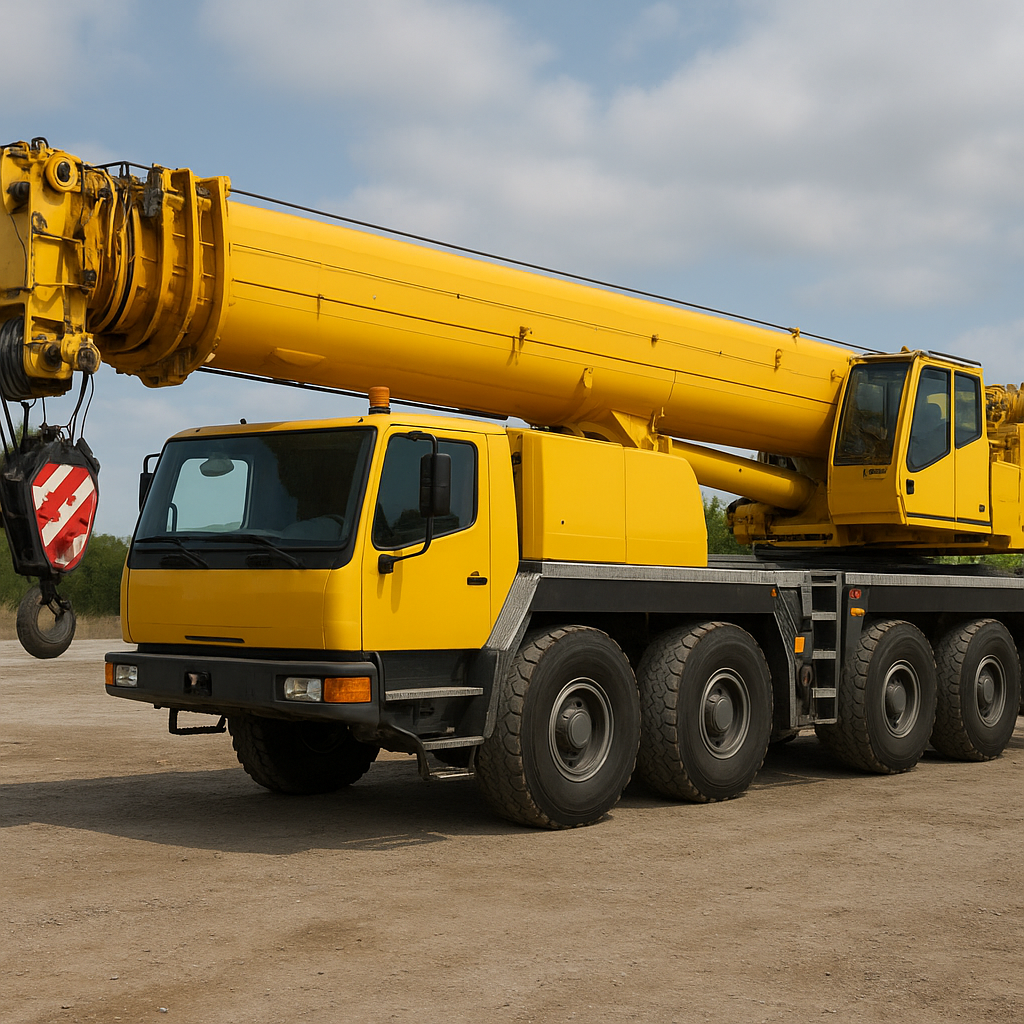
The Grove GMK7550 is a heavyweight member of Grove’s all-terrain crane family, designed to bridge the gap between road mobility and heavy lifting capability on demanding job sites. In this article we explore the machine’s design philosophy, common applications across industries, operational features, safety and maintenance aspects, and practical considerations for fleet managers and rental companies. Wherever possible we include typical technical figures and industry context to help readers understand where this crane performs best and why it is valued by heavy lifting professionals.
Design and technical characteristics
The Grove GMK7550 is engineered as an all-terrain crane that balances highway travelability with powerful on-site performance. Like other models in the GMK family, its core architecture combines a multi-axle carrier and a superstructure with a telescopic boom and slewing mechanism. The result is a machine that can be driven between sites under its own power and then rapidly configured for heavy lifts with the addition of outriggers and counterweight modules.
Typical specifications and modular components
- Lifting capacity: Depending on specific configuration, the GMK7550 is commonly quoted with a maximum nominal lifting capacity in the upper hundreds of tonnes (typical marketed values are around the 500–600 tonne class). Exact figures vary with counterweight, boom configuration and installation of lattice jib sections.
- Telescopic boom: The crane features a multi-section telescopic boom designed for rapid extension and retraction, providing flexible reach for a wide range of jobs. With jibs or lattice extensions fitted, tip heights in excess of 100 meters are achievable in many setups.
- Carrier and axle configuration: All-terrain cranes in this capacity class frequently use multi-axle carriers (often 6–8 axles depending on chassis choice and local road regulations) to carry weight and meet transport restrictions while providing adequate load distribution.
- Counterweights: The GMK7550 uses modular counterweight systems that allow owners to adjust rear ballast to optimize capacity versus travel weight. Counterweights are typically composed of multiple slabs that can be stacked or removed for transport.
- Stability and outriggers: Heavy-duty outriggers with hydraulic extension provide the necessary footprint for safe hoisting. The outrigger system and load moment monitoring work together to maximize safe lifting envelopes.
- Drive and powertrain: A powerful diesel engine combined with hydrostatic or electronically controlled transmissions enable both high on-road speeds and fine maneuvering on site. Auxiliary hydraulic pumps power the hoist, slewing and boom functions.
Manufacturers of cranes in this segment equip them with advanced electronic control systems, including load moment indicators (LMI), real-time diagnostics, and often remote operation modes. These systems increase productivity and improve safety by preventing overloads and providing immediate feedback to the operator.
Common applications and industries
The GMK7550 is especially useful wherever heavy components must be moved and placed precisely, often in constrained or challenging environments. Its combination of mobility and capacity makes it a go-to crane for specialist lifting tasks.
Wind energy and renewable projects
One of the most visible uses of high-capacity all-terrain cranes is in wind turbine installation and maintenance. The GMK7550’s reach and load capability allow it to lift nacelles, towers and heavy components to hub heights required for modern turbines. Its relative roadability helps reduce logistics complexity when traveling between turbine locations.
Construction of industrial facilities and power plants
Large structural elements, process vessels, heat exchangers and preassembled modules all require cranes that can handle multi-ton loads safely and reliably. The GMK7550 is suited for heavy infrastructure projects such as power stations, petrochemical plants, large commercial complexes and industrial expansions.
Bridge building, civil works and heavy lifting
Bridge segments, precast concrete elements and heavy girders are lifted and positioned by cranes in this class. The crane’s capacity and boom reach allow lifting from varied angles, which is essential on complex civil engineering sites where space and access are limited.
Ports, shipyards and marine construction
Shipbuilding and port infrastructure projects often require lifting of heavy components, container cranes, and ship sections. All-terrain cranes provide the lifting capacity while enabling temporary repositioning along quaysides or dry docks.
Operation, safety and performance considerations
Operating a high-capacity machine like the GMK7550 requires a combination of skilled personnel, detailed planning and adherence to safety systems. Below are key operational considerations that determine whether a lift is successful and safe.
Lift planning and site preparation
- Ground assessment: A competent ground bearing capacity assessment is essential. Outrigger loads must be transferred to stable bearing surfaces, often requiring mats or engineered cribbing.
- Lift charts: Operators use manufacturer-supplied lift charts that define safe capacities for given boom lengths, angles and counterweight configurations. These charts form the basis for every lift plan.
- Rigging and sling selection: Proper selection of slings, shackles and spreader bars is vital to distribute loads and avoid point overloads on structural members.
Electronic aids and safety systems
Modern all-terrain cranes include electronic aids to enhance safety and efficiency:
- Load moment indicator (LMI): Prevents the crane from exceeding safe working limits by sensing boom angle, extension and load weight.
- Anti-two-block devices: These mechanically or electronically prevent the hook block from hitting the boom tip, which can cause catastrophic damage.
- Wind and environmental monitoring: Many cranes integrate wind speed sensors and environmental limits into their safety envelope logic.
Operator training and certification
Operators of heavy cranes must be certified to local standards and trained on the specific model’s systems and controls. Familiarity with the GMK7550’s telematics, hydraulic response and LMI behavior significantly reduces the risk of human error during complex lifts.
Maintenance, lifecycle and fleet management
A heavy all-terrain crane is a long-term investment; proper maintenance and management maximize uptime and return on investment. The GMK7550 benefits from modular systems that simplify service and reduce downtime.
Routine service and preventive maintenance
- Scheduled engine and hydraulic system servicing prevents unplanned failures and ensures predictable performance in heavy lifting cycles.
- Regular inspection of boom sections, rope condition, sheaves and pins reduces the risk of fatigue failures. Rope life limits and inspection intervals must be strictly observed.
- Electronic diagnostics and telematics allow remote monitoring of service intervals, hydraulic performance and fault codes, making fleet management more efficient.
Refurbishment and resale value
Crane fleets often cycle models after a decade or more of service. Well-maintained machines retain significant resale value in second-hand markets, especially when records show consistent maintenance and upgrades. Modular counterweights and detachable parts also simplify refurbishment.
Performance statistics, economics and practical examples
Specific numerical performance depends on configuration, but a few general statistics and economic factors are useful when considering the GMK7550 for procurement or rental.
Typical performance figures
- Nominal maximum lifting capacity: Machines in the GMK7550 class are commonly described as being in the 500–600 tonne range (exact value depends on counterweight and boom arrangement).
- Tip height with telescopic boom and jib: Many configurations reach tip heights surpassing 100 meters, with intermediate setups providing 40–80 meters without jib extensions.
- Transportability: The carrier is engineered to meet road regulations in many markets, minimizing special transport requirements compared with crawler alternatives; axle counts and transport width depend on local laws and selected chassis setup.
- Setup time: Depending on site and auxiliary equipment, a heavy all-terrain crane like the GMK7550 can be rigged and ready for initial lifts in a matter of hours, significantly faster than large crawler cranes that require assembly.
Economic considerations
For owners and rental companies, the economics of a crane depend on utilization, maintenance cost and the ability to win projects requiring higher capacities. Key points include:
- Rental demand: High-capacity cranes are often rented for specific projects (e.g., wind farms, industrial builds). The flexibility of all-terrain cranes increases utilization across multiple job types.
- Operating costs: Fuel consumption, servicing intervals and transport logistics affect hourly operating costs. Efficient scheduling and telematics-driven maintenance reduce unexpected downtime.
- Residual value: Models from established brands generally maintain better resale prices, especially if they have updated electronics and documented service history.
Real-world examples
Examples of tasks handled by cranes in this class include:
- Installing turbine nacelles and long blades at onshore wind farms where access roads vary in quality.
- Lifting heavy industrial vessels into place during refinery expansions.
- Positioning prefabricated bridge segments in urban sites with limited space for crawler cranes.
Advantages and limitations compared to alternative crane types
When selecting a crane, project managers must weigh the benefits of all-terrain designs like the GMK7550 against other crane types, namely lattice-boom crawler cranes and truck-mounted mobile cranes.
Advantages
- Mobility: All-terrain cranes can travel on highways and off-road, reducing the need for heavy transporters and assembly crews.
- Versatility: Telescopic booms provide rapid adjustment of reach and configuration for different lifts.
- Faster mobilization and demobilization compared with large lattice crawler cranes, improving project timelines.
Limitations
- For extremely high capacities and long-reach lifts, specialized crawler cranes or multi-crane lifts may still be more suitable.
- Road-legal transport still imposes limits on counterweight and boom sizes—some configurations require disassembly or oversize permits in certain regions.
- Top-heavy lifts at extreme radii may require more counterweight than is practical for road travel, creating trade-offs between transportability and lifting envelope.
Environmental and regulatory factors
Operating heavy lifting equipment today must account for emissions, noise and local regulations. Owners of large all-terrain cranes like the GMK7550 should pay attention to the following:
- Engine emissions standards: Selecting engines or retrofitting aftertreatment systems to meet local emissions rules (e.g., Stage V, Tier 4 final) can be essential for working in urban or sensitive areas.
- Noise abatement: Cranes used near residential areas or in night shifts may require mufflers, operational restrictions and community agreements.
- Permitting and transport regulations: Overweight or overlength transports for counterweights and jib sections require permits and route planning to avoid bridges or restricted roads.
Concluding observations
The Grove GMK7550 sits within a class of heavy all-terrain cranes that are prized for blending substantial lifting capacity with practical mobility. It is particularly well-suited to projects where time-sensitive mobilization, varied terrain and demanding lifts intersect—such as wind farm construction, heavy industrial installations and civil engineering works. While specific numerical ratings depend on configuration, the GMK7550-class cranes typically offer capacities in the upper hundreds of tonnes, telescopic and lattice jib reach options, and modularity that helps owners optimize both on-site performance and transportability.
Prospective buyers and rental managers should evaluate requirements for maximum lift weight, tip height, transport constraints and local regulatory environments. Careful lift planning, continuing operator training and rigorous maintenance regimes keep these complex machines productive over long service lives. Combined with modern telematics and electronic safety systems, the GMK7550 family can deliver efficient, safe outcomes for the most demanding lifting tasks.
)
)