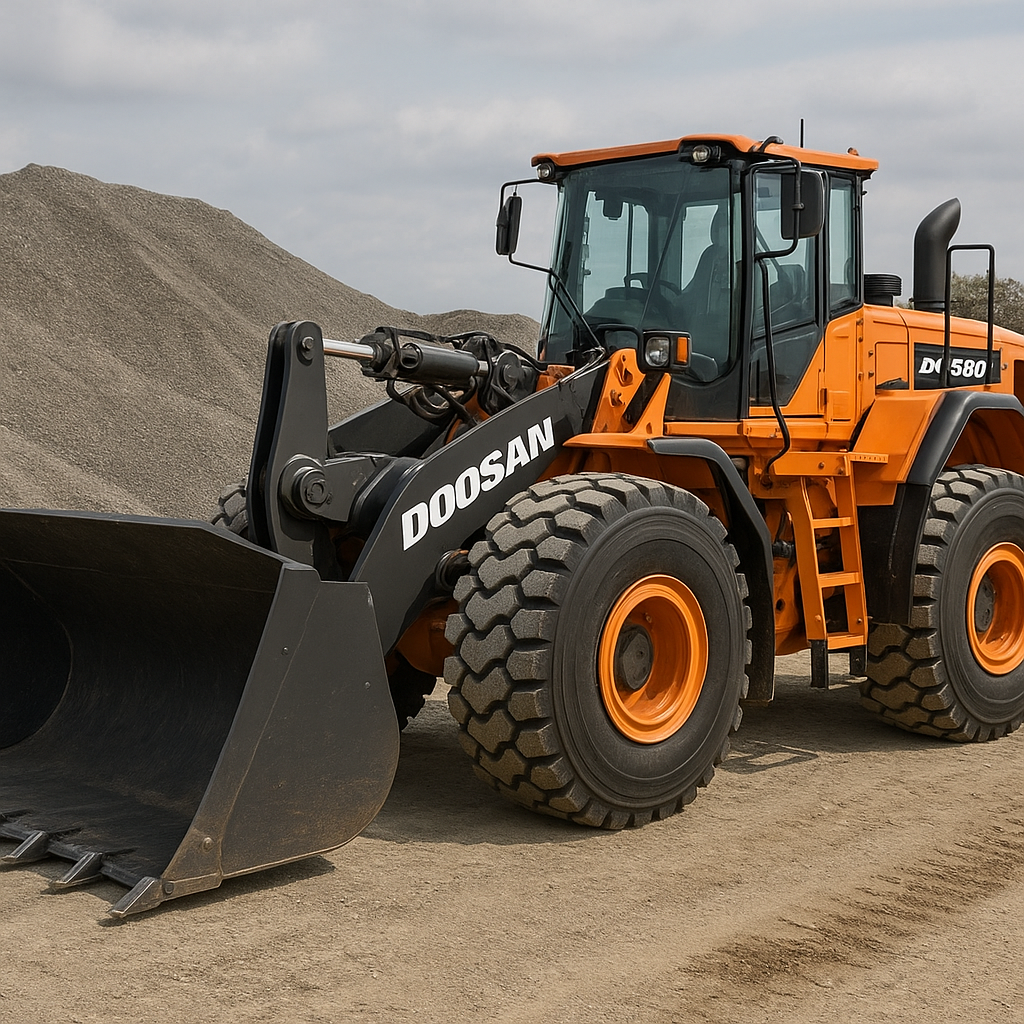
The Doosan DL580CVT-7 is a heavy-duty, versatile machine in the world of earthmoving and material handling. Designed to combine high hauling and loading capacity with improved efficiency and operator comfort, this model represents Doosan’s response to market demand for robust, productive wheel loaders capable of working across mining, quarrying, construction, and bulk material handling environments. The following article explores its typical applications, key technical and operational features, and practical considerations for owners and fleet managers.
Overview and design philosophy
The Doosan DL580CVT-7 belongs to the family of large wheel loaders engineered for demanding applications. The machine emphasizes a balance between power, stability, and controllability. Central to this model is the incorporation of a continuously variable transmission concept (denoted by CVT in the model name), which aims to optimize power delivery and fuel usage compared with traditional powertrain layouts.
Core design principles
- Durability: heavy frame components, reinforced linkages and heat-treated pins and bushings to withstand continuous, high-impact cycles.
- Productivity: high breakout and tear-out forces, large bucket capacities, and fast cycle times.
- Efficiency: drivetrain and hydraulic tuning for lower fuel consumption and better load-sensing performance.
- Serviceability: ground-level access to key service points, modular components and simplified inspection routines.
In this class of machine, the focus is not only on raw power but on how effectively that power can be translated into real-world productivity while controlling operating costs. The DL580CVT-7’s layout typically reflects that philosophy: robust undercarriage and axles, refined hydraulic circuits, and an operator environment engineered for extended shifts.
Applications and industries
The Doosan DL580CVT-7 is suitable for a broad range of heavy-duty tasks. Owners and operators usually deploy it wherever large volumes of granular or broken rock, ores, aggregates, or bulk materials must be moved quickly and reliably. Typical application sectors include:
- Quarries and aggregate production — loading trucks, feeding crushers, stockpile management.
- Mining (surface operations) — shovel replacement in light to medium surface-mining tasks, waste handling and reclaim operations.
- Construction of large civil works — moving earth, backfilling, and handling heavy construction materials on highway, dam, and port projects.
- Ports and bulk terminals — handling coal, grain, fertilizer and other bulk commodities when equipped with appropriate buckets or grapples.
- Recycling and scrap yards — with specialized attachments for handling dense, mixed material.
Flexibility of attachments makes the DL580CVT-7 practical across seasonal and project-based requirements. With quick-couplers and a range of bucket profiles, the same base machine can shift from loading fine aggregates to handling heavy, abrasive rock.
Technical features and performance characteristics
While exact factory specifications can vary by configuration and region, wheel loaders in the same segment as the DL580CVT-7 typically share several defining technical attributes. These influence cycle times, fuel consumption, payload per hour, and overall machine economics.
Powertrain and transmission
The defining element of the DL580CVT-7 name is the CVT-style approach to transmission. Compared with conventional stepped-gear transmissions or traditional torque converters, a continuously variable transmission or a transmission that provides similar variable-ratio behavior offers:
- Smoothed acceleration and more consistent tractive effort under varying loads.
- Potential for improved fuel efficiency through optimized engine speed and gear ratio matching to load conditions.
- Lower operator fatigue due to simpler control inputs in many operating modes.
Typical powerplants for machines in this class are medium-speed diesel engines tuned to provide strong low-end torque—important for initial breakout and push force—while meeting emissions standards (Tier/Stage compliance depending on market). Engine power for large wheel loaders generally ranges from the mid-hundreds of horsepower upward; however, actual installed power depends on the factory options and final specification.
Hydraulics and lifting systems
Hydraulic systems on the DL580CVT-7 are designed for responsive bucket control and high-flow demands for auxiliary circuits. Key points include:
- Load-sensing hydraulic pumps that modulate flow based on demand to reduce parasitic losses.
- High breakout force and strong lift at full height for quick truck loading cycles.
- Fine-flow control for precise material handling, especially when fitted with specialized attachments like grapples or high-dump buckets.
The combination of hydraulics and the loader linkage geometry determines both volumetric productivity (bucket cycles per hour) and fill factor (how well the bucket is filled on each pass)—two of the main operational metrics for any loader.
Buckets, capacities and cycle metrics
Bucket sizes for loaders in the DL580CVT-7 class can vary considerably to match material density and intended use. Examples of typical ranges:
- Bucket capacity: approximately 3.5 to 7.0 m³ depending on material and bucket profile.
- Payload per bucket: varies by material density; operators plan bucket selection to maximize truck matching and minimize spillover.
- Cycle times: modern machines often target shorter total cycle times through faster hydraulics and operator-assist functions like return-to-dig/tilt.
Optimizing the bucket and cycle profile based on material density—the heaviest possible payload while preserving safe lift and truck match—is a major factor in achieving high hourly production.
Operator environment and controls
Long shifts and high-stress tasks make the operator cabin a critical area for productivity. The DL580CVT-7 typically features a cab designed for comfort, visibility, and reduced fatigue:
- High-visibility glazing and optimized A-pillars for improved sightlines to the bucket and surrounding work area.
- Ergonomic controls, adjustable seats, and climate control to sustain long operating periods.
- Integrated monitoring systems displaying fuel usage, maintenance reminders, and machine diagnostics.
Modern operator assist systems—such as automatic retarding, ride control and adjustable transmission modes—help less experienced operators achieve steady, efficient performance while experienced operators can fine-tune settings for maximum productivity.
Maintenance, uptime and lifecycle costs
For large wheel loaders, the total cost of ownership (TCO) is heavily influenced by maintenance strategy, parts availability, and planned downtime. The DL580CVT-7’s design attention to serviceability typically includes:
- Ground-level maintenance points for daily checks (engine oil, hydraulic oil, filters) to minimize service time.
- Modular components enabling faster replacement of wear items like buckets, cutting edges, tires and hydraulic hoses.
- Telematics and remote diagnostics options that can predict maintenance needs and reduce reactive repairs, thereby increasing productivity.
Common lifecycle considerations:
- Tire selection and management represent a major running cost; operators often balance cost vs. durability by choosing appropriate tread and compound for application.
- Scheduled oil and filter changes, hydraulic fluid analysis and cooling-system maintenance extend component life and help maintain efficiency.
- Operator training reduces misuse-related wear and improves cycle efficiency, translating to lower per-ton handling costs.
Attachments and versatility
The versatility of a wheel loader is amplified by its attachment options. The DL580CVT-7 can be configured with a wide range of factory and aftermarket tools, enabling multi-role use across a fleet:
- General purpose and high-capacity buckets for different materials.
- Rock buckets with stronger side cutters for abrasive quarry work.
- Forks, pallet forks and log grapples for port, yard or forestry tasks.
- Snow blades and blowers for municipal or cold-climate operations.
- Specialty tools like sorting grapples or sweepers for recycling facilities and bulk materials handling.
Quick-coupler systems reduce the time and labor required to switch between tasks, increasing machine utilization across multiple daily duties.
Environmental performance and fuel economy
Emissions compliance and fuel economy are increasingly central to purchasing decisions. The DL580CVT-7, by employing a finely tuned powertrain and efficient hydraulics, aims to reduce both emissions and fuel burn compared with older machines. Typical benefits include:
- Lower idling consumption because of auto-shutdown or low-idle management features.
- Improved work-mode management: eco modes or automatic power-limiting for non-demanding tasks reduce fuel consumption.
- Potential fuel savings versus legacy machines in the fleet—often reported at single-digit to low double-digit percentages depending on duty cycle and operator behavior.
Real-world fuel consumption is application-specific, but heavy-loading cycles will see higher consumption rates than light material handling or cleanup tasks. Fleet managers commonly track liters-per-ton moved as a metric to compare machine efficiency across sites.
Safety systems and operator aids
Safety is integral in the design of modern wheel loaders. The DL580CVT-7 is typically equipped with features aimed at preventing accidents and protecting the operator:
- Rollover protection structures (ROPS) and falling-object protective structures (FOPS) in the cab design.
- Backup cameras, radar and proximity systems to alert operators of pedestrians or obstacles in blind spots.
- Hydraulic interlocks and system health monitoring to prevent unexpected movements and warn of system faults early.
These systems are especially important on busy sites where visibility is constrained or where multiple machine types operate in close proximity.
Market position, economics and estimated metrics
The DL580CVT-7 fits into the upper middle to large wheel loader market, offering a balance of capacity and operating economy. While exact production numbers and sales figures vary regionally and across fiscal cycles, several economic observations are consistent:
- Owners prioritize machines that reduce cost-per-ton moved; those benefits are often realized through a combination of higher bucket fill factors, faster cycles and improved fuel economy.
- Resale value is supported by brand reputation, global dealer networks and availability of parts; Doosan’s service footprint in many markets helps maintain residual values.
- Fleet lifecycle models usually plan for multi-year depreciation with mid-life major service intervals (engine overhaul, hydraulic component renewals) to preserve uptime.
Manufacturers and independent studies commonly report that technological upgrades such as variable-ratio transmissions, load-sensing hydraulics, and telematics can yield measurable improvements in fuel consumption and uptime. Conservative estimates from industry sources suggest fuel reductions in the range of 5–15% for well-optimized new machines versus older baseline models, while uptime improvements vary widely based on maintenance regimes.
Practical considerations for buyers and fleet managers
When evaluating the DL580CVT-7 or similar machines, purchasers should consider:
- Match the bucket capacity and machine weight to the material density and the trucks being loaded to avoid under- or over-sizing.
- Review service access, parts lead times and local dealer support to minimize downtime risks.
- Assess available telematics and fleet-management tools to optimize maintenance scheduling and monitor fuel and productivity metrics.
- Factor in total cost of ownership, not just purchase price—include fuel, tires, filters, operator training and expected resale value.
Operators and supervisors should also run acceptance tests on new or leased machines in real-world conditions to verify promised cycle times and fuel figures before committing to long-term contracts.
Summary and concluding perspective
The Doosan DL580CVT-7 represents a class of modern, heavy-duty wheel loader engineered for demanding material handling tasks across mining, quarrying, ports and large civil construction. With a combined focus on power delivery through a CVT-oriented approach, adaptable attachments, robust hydraulics, and operator-centric features, the model seeks to deliver strong hourly production while addressing operating costs. Attention to maintenance and serviceability, along with careful matching of bucket and tires to the job, are critical to realizing the machine’s potential. For fleet managers the decision to select such a loader should rest on application fit, lifecycle cost analysis and the support infrastructure available in their operating region.
)
)