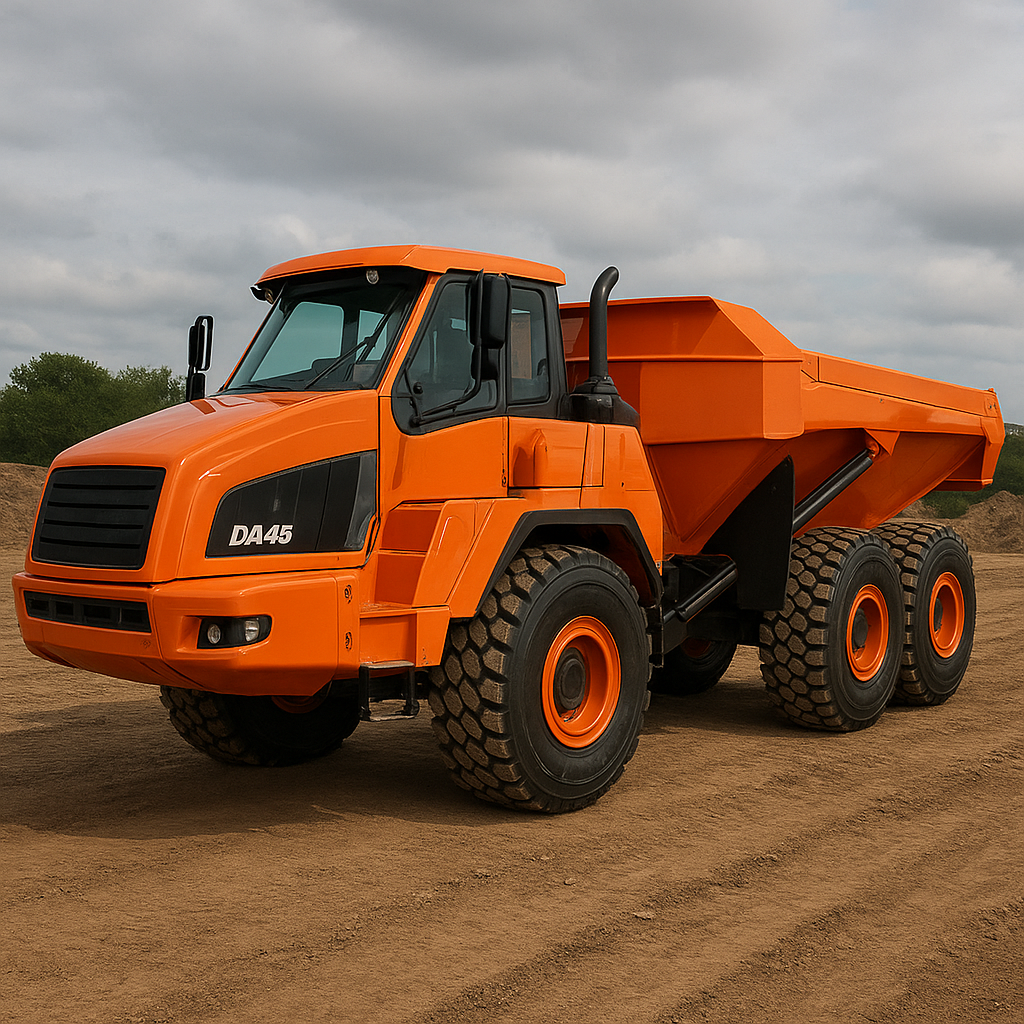
The Doosan DA45 is a heavyweight solution in the world of off‑road haulage, designed to move large volumes of material reliably across challenging terrains. In this article we examine the machine’s design, typical applications, technical characteristics, operational considerations and the reasons it is selected for demanding civil engineering, quarrying and mining tasks. Practical information about capacities, estimated performance figures and maintenance considerations is included to help fleet managers, operators and project planners evaluate the DA45 for their needs.
Overview and positioning in the market
The Doosan DA45 is an articulated dump truck developed to serve heavy construction, quarrying and mining operations where robust mobility and large payloads are required. Positioned in the 40–50 tonne class of ADTs, the DA45 competes with machines from other global manufacturers offering similar payloads and off‑road performance. Doosan designed this model to combine proven chassis architecture with modern drivetrain and operator comfort upgrades, delivering a blend of productivity and durability suited to harsh working environments.
Key characteristics at a glance
- Class: High‑capacity articulated dump truck
- Nominal payload: commonly specified around 45 tonnes (nominal class)
- Body volume: typical heaped volume in the mid‑20s to low‑30s cubic metres depending on body style
- Drive configuration: full time AWD with articulated steering
- Applications: open‑pit mining, large‑scale earthmoving, quarrying, heavy infrastructure projects
Design and technical features
The DA45’s architecture reflects the core strengths of articulated haulers: a pivoting front/rear frame for excellent off‑road articulation, heavy‑duty axles, and a rigid powertrain optimized for torque at low speeds. The machine is built to maintain traction and stability on steep, uneven ground while minimizing downtime.
Chassis, articulation and suspension
The articulated frame allows the front and rear modules to move independently, improving tyre ground contact and enabling tighter turning radii than rigid‑frame trucks. The rear suspension design (usually a combination of oscillating axle and heavy‑duty bogie) provides a balance between ride comfort and load‑carrying capability. Structural reinforcements in the frame and dump body mounting points extend service life under continuous heavy loading.
Powertrain and transmission
Doosan typically pairs the DA45 with industrial diesel engines from reputable manufacturers, tuned for high low‑end torque to accelerate a full load from standstill and maintain traction on slopes. The engine is mated to a robust automatic transmission with multiple gears and often includes torque converter lock‑up and retardation options to assist on downgrades. Engine and transmission options may vary by market and model year, allowing customers to optimize for fuel consumption or maximum pull‑out power.
Hydraulics, body and tipping system
The hydraulic system is sized to provide rapid, reliable tipping cycles even with heavy loads. Bodies are available in different profiles (standard, multi‑haul, rock body) and materials (wear‑resistant steel, optional liners) to match the application — for example, rock bodies with higher sides and reinforced edges for blast rock in quarries. Tipping angles and down‑dump clearance are designed for quick discharge into crushers, hoppers or stockpiles.
Applications and operational roles
The DA45 serves a range of heavy hauling tasks where its combination of payload, off‑road mobility and durability are advantageous. Typical applications include:
- Open‑pit mining and large quarried material transport
- Major civil works such as dam construction, roadworks and large earthworks projects
- Infrastructure projects requiring movement of bulk aggregates across rough terrain
- Contract aggregate and quarry operations where cycle times and volume per shift are critical
Why projects select a 45‑tonne articulated hauler
Projects aiming to maximise material moved per cycle while keeping unit operating costs predictable commonly choose machines in this class. The DA45 reduces the number of machines required on site (compared with lower‑capacity trucks), simplifies logistics around loading and hauling zones, and can often work with standard loading shovels and excavators used in medium to large operations.
Performance, capacities and statistical figures
Exact specifications for the DA45 vary with model year, country configuration and optional equipment. Below are representative figures commonly quoted for trucks in the 45‑tonne articulated category and for Doosan machines close to this size. These figures should be used as indicative ranges rather than absolutes; consult manufacturer documentation or a local dealer for definitive numbers.
Representative technical data (typical ranges)
- Nominal payload capacity: approximately 45 tonnes
- Body volume (heaped): typically 25–33 m³ depending on body style
- Engine power: commonly in the range of 300–420 kW (around 400–560 hp) depending on configuration
- Top travel speed (loaded/unloaded): typically 50–60 km/h unloaded, 40–55 km/h loaded depending on gearing
- Fuel tank capacity: commonly 500–900 litres depending on options
- Operating weight (empty): often in the 25–35 tonne range
- Turning radius and articulation angle: designed for tight manoeuvring relative to rigid trucks; specific values depend on chassis geometry
Example operational performance metrics (variable by duty cycle):
- Average fuel consumption under heavy duty: often between 25–45 L/h depending on load, terrain and operator technique
- Typical cycle time influence: payload and body volume directly affect bucket/truck matching to excavators — larger payload reduces cycles per shift
- Service intervals: major service intervals often specified in running hours (e.g., 500, 1,000 and 2,000 hours levels) with oil, filters and inspections staged accordingly
Operational capacity planning
When planning a fleet, project managers use payload × cycles × machine availability to estimate daily throughput. The DA45’s high payload means fewer trucks may be needed for a target tonnage per shift, but planners must also consider haul distances, road profile, and loading equipment dwell times to achieve maximum efficiency.
Operator comfort, safety and electronics
Modern Doosan articulated haulers place emphasis on operator ergonomics and safety systems to reduce fatigue and incidents. Comfortable cab layouts, efficient climate control, and good sightlines help operators maintain productivity over long shifts.
Safety systems
Standard and optional safety features frequently include ROPS/FOPS certified cabs, seat belt reminder systems, reversing alarms, camera systems for rear and side visibility, automatic park brake interlocks, and machine stability control systems. Advanced diagnostics and telematics help fleet managers monitor operating parameters and identify unsafe conditions or mechanical issues before they escalate.
Cab design and ergonomics
Controls are logically arranged for minimal operator distraction, with adjustable seats, tilt/telescopic steering, and intuitive display panels. Visibility to the dump body and immediate surroundings is aided by large windows and option camera systems. Comfortable environments reduce fatigue and contribute to consistent cycle performance.
Maintenance, serviceability and lifecycle costs
Ease of service is a major factor in the total cost of ownership for high‑capacity haulers. The DA45 is engineered for accessibility to filters, drains, and major components to speed routine maintenance and reduce downtime. Planned maintenance regimes and the availability of local dealer support are critical to maintaining utilisation.
Preventive maintenance practices
- Daily checks: fluid levels, tyre condition and pressure, visual inspection of the drive train and hydraulic lines
- Scheduled services: engine oil and filter changes, transmission and final drive checks, cooling system servicing
- Component life monitoring: track wear components and plan refurbishments such as axle overhauls and body floor replacements
Strong dealer networks supplying genuine parts and trained technicians help preserve machine uptime. Telematics packages, where fitted, enable remote monitoring of hours, fuel use and fault codes, improving planning for maintenance windows and reducing unexpected failures.
Economic and environmental considerations
When choosing an articulated hauler like the DA45, purchasers weigh acquisition cost, operating cost per tonne, and expected machine life. Higher payload machines reduce the number of trips and labour hours required to move a fixed quantity of material, which can create operational savings even when the purchase price is higher.
Fuel efficiency and emissions
Newer engine configurations conform to relevant emissions standards (EU Stage/V, EPA Tier) depending on market and model year, and offer improved fuel consumption through electronic engine management and optimized gear ratios. Features that contribute to lower fuel burn include economy modes, controlled auto‑shift transmissions and reduced idling strategies. Selecting the correct tyre size, maintaining correct tyre pressures and training operators on fuel‑efficient driving practices also reduce fuel expenditure.
Total cost of ownership
Important TCO factors include residual value, parts availability, ease of major component replacement, and the machine’s expected hours before major overhauls. Doosan’s positioning in many markets is competitive on service intervals and parts pricing, but regional dealer support is pivotal to achieving favourable TCO outcomes.
Real‑world examples and typical fleet use
In quarries handling blasted rock, contractors often pair a 45‑tonne class articulated hauler with 5–7 m³ class excavators or medium‑sized loaders, balancing excavator bucket size and truck body volume to minimise shovel waiting times. In infrastructure projects, DA45‑class units become workhorses on earthmoving tasks where haul roads are rough, graded or temporary.
Case scenarios
- Quarry application: a DA45 running 10–12 cycles per hour on a short haul (less than 2 km) can achieve large daily throughputs, especially when paired with high‑productivity loaders.
- Long haul/mining: on longer hauls with higher average speeds, fuel consumption per tonne typically drops as travel speed increases and tyre slip reduces — but careful matching of gearing and engine configuration is necessary.
- Construction projects: DA45 trucks are used to clear and redistribute cut material across a site in fewer cycles compared with smaller ADTs, improving schedule adherence for large earthworks.
Choosing the right configuration and tips for procurement
Selecting the appropriate DA45 configuration requires considering material type, haul distances, road gradients, loading equipment and weather conditions. Some practical procurement tips:
- Match body type to material — rock bodies for blasted rock, standard bodies for aggregates and earth.
- Consider tyre choices and sizes that balance flotation, wear life and purchase cost.
- Enable telematics for fleet visibility and preventive maintenance scheduling.
- Evaluate local dealer support for parts and service response times before purchase.
Operator training and efficiency
Investing in operator training yields better fuel economy, reduced wear and fewer incidents. Training should cover effective shifting and throttle control, correct tipping procedures, and daily inspection routines. Using machine telematics to provide operator feedback is an effective way to improve performance over time.
Final considerations
The Doosan DA45 class of articulated hauler is a capable option for contractors and mine operators needing dependable high‑capacity haulage across difficult ground. Its combination of an articulated design, robust drivetrain, varied body choices and modern cab features makes it a practical choice for many large‑scale bulk handling scenarios. While specific technical numbers vary with configuration and model year, the overarching benefits of higher payloads, good off‑road mobility and serviceability are consistent reasons this class remains popular.
Note on specifications
Exact technical specifications (payload, engine output, body volume, weights and fuel capacity) differ by production year, regional emissions requirements and optional equipment. For precise numbers relevant to a planned purchase or fleet comparison, consult the current Doosan sales literature or an authorised dealer to obtain model‑specific datasheets and performance figures.
)
)