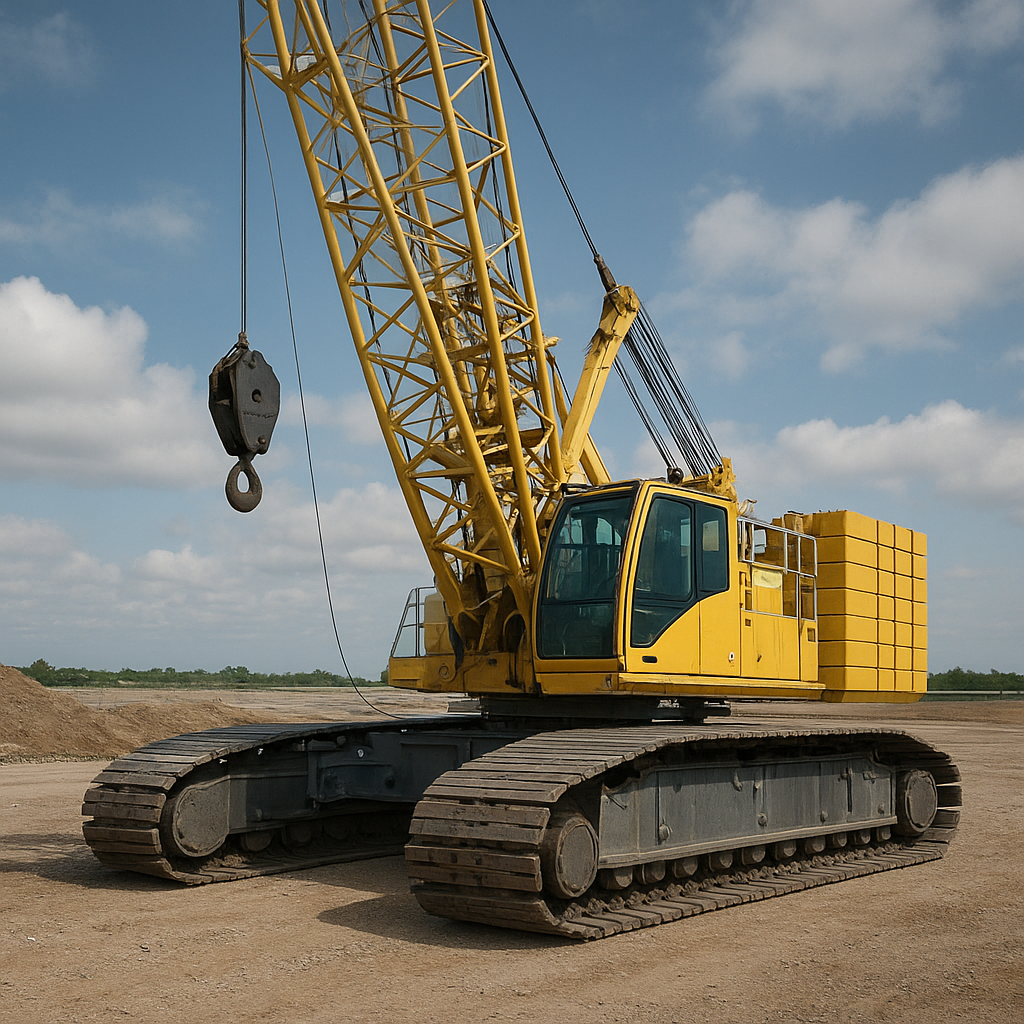
The Demag CC 3800-1 is a representative of high-capacity lattice-boom crawler cranes designed for heavy-duty lifting in complex and demanding environments. Combining robust mechanical architecture with modular design, this class of crane has become a preferred choice for sectors that require substantial lifting performance, long reach and reliable off-road mobility. The following article outlines the machine’s characteristics, typical applications, operational considerations, transport and assembly, maintenance and safety aspects, and contextual information useful for owners and operators.
Overview and design philosophy
The CC 3800-1 belongs to a family of large crawler cranes originally developed by Demag and later supported under corporate owners like Terex and Tadano in subsequent years. The design philosophy centers on modularity, structural strength and flexible configuration. A lattice boom system, multiple hoists, and a substantial counterweight system allow operators to adapt the machine for a wide variety of lifts.
Crawler undercarriage gives the crane superior site mobility and ground-bearing distribution compared with wheeled or truck-mounted cranes, enabling work on soft or uneven terrain without extensive ground preparation. The lattice boom and jib sections provide a favorable strength-to-weight ratio, which is essential for achieving long reaches while keeping transport segments manageable.
Technical features and typical specifications
Exact technical specifications can vary by production year, optional packages and configuration. Many data points for this crane class are given as ranges because maximum capacity and reach depend on boom length, jib attachments, counterweight amount and rigging method.
- Lifting capacity: Typical maximum lifts for machines in the CC 3800 family are in the range of several hundred tonnes. Depending on configuration, boom length and radius, practical lifting capacities for this class usually fall between approximately 300 and 700 tonnes.
- Boom length and reach: Lattice main boom systems are modular. Main booms typically extend beyond 60–80 meters in standard arrangements, with lattice jibs and extension systems enabling combined reaches that can exceed 100 meters in some setups.
- Counterweight: Modular counterweight blocks permit precise balancing for particular lifts. Total counterweight for this type of crane can amount to several tens to a few hundred tonnes, configured as discrete slabs to facilitate transport and reassembly.
- Propulsion and power: Diesel engines in this class normally deliver several hundred kilowatts of power to hydraulic pumps, winches and travel drives. Engine choice and power output depend on the factory-built standard and retrofit options.
- Mobility: Track gauge and shoe width are selected to reduce ground pressure. Crawler undercarriage allows travel on-site and precise positioning of massive loads.
- Slewing and winch systems: Multiple winches including main, auxiliary and luffing hoists, plus a robust slewing mechanism, enable controlled multi-line lifts and fine-tuned load handling.
Because this crane type is intended for heavy and often bespoke lifts, manufacturers publish load charts for each configuration. Operators must consult the specific load chart for the complete machine configuration, boom length, radius and counterweight before planning a lift.
Applications and industries
Demag CC 3800-1 cranes are widely used where large weights and long reaches are required. Typical industries and use cases include:
- Power generation: Erecting turbines, heavy heat exchangers, boilers and transformer installations in thermal and combined-cycle power plants.
- Wind energy: Assembly and maintenance of onshore and offshore wind turbine components. The crane’s long reach and heavy lift capability are ideal for nacelle and generator installation, tower segments and large foundation work.
- Petrochemical and refining: Lifting reaction vessels, distillation columns and large piping modules during plant construction and turnarounds.
- Heavy civil engineering: Bridge construction, placing large precast segments, and piers where a combination of reach and load capacity is needed.
- Shipbuilding and ports: Handling ship sections, propulsors and other massive marine components.
- Industrial assembly yards: Moving prefabricated modules, heavy press tools, and large structural frames.
In many of these sectors, the crane’s modularity reduces the need for multiple specialized machines and enables single-crane solutions for complex lifts, which can reduce coordination time and site congestion.
Assembly, transport and site logistics
Because the CC 3800-1 is a heavy and modular crane, careful planning of transport and assembly is required. Transport considerations include the breakdown of the crane into road-legal segments, weight limitations per axle, and the availability of heavy-haul vehicles at the project site.
Typical steps for mobilization:
- Deliver base crawler sections and counterweight blocks in load-limited trailers.
- Transport main boom and jib sections as discrete segments; these are often designed for relatively easy assembly using the crane itself or auxiliary erection cranes.
- Assemble the superstructure, install hydraulic and electrical connections, and rig the winches and ropes.
- Install counterweight in stages to maintain stability during progressive erection of the boom.
On constrained sites, smaller auxiliary cranes may erect the main crane or sections may be assembled using mobile telescopic cranes or barge-mounted derricks in maritime settings. Rigging and assembly sequences are choreographed to ensure safety and to remain within manufacturer-specified limits throughout erection.
Operational performance and versatility
The crawler crane’s true value lies in its ability to perform a wide range of lifts under varying conditions. Some performance attributes:
- High load stability: Track-based undercarriage distributes weight over a large area, reducing ground pressure and increasing stability on soft soils when supported by proper track mats or ground reinforcement.
- Fine control: Multiple hoists allow simultaneous use of different lines for load control and precise placement, reducing load swing and permitting complex positioning maneuvers.
- Terrain adaptability: The crawlers allow relocation across rough terrain, facilitating repositioning without full disassembly for many site layouts.
- Adaptable rigging: The lattice boom architecture supports various jibs, luffing systems and auxiliary equipment for special tasks like derrick lifts or tandem configurations with other cranes.
Operators often pair the CC 3800-1 with lifting accessories such as synthetic slings, spreader bars, platform lifts and tag lines to manage large, awkward or fragile loads. The crane’s control systems include load moment indicators and monitoring systems that help maintain safe operating envelopes.
Safety systems and operational controls
Safety is central to operating large crawler cranes. Basic and advanced safety elements include:
- Load moment indicators (LMI): Provide real-time feedback on radius, load, boom angle and stability margins. Operators must adhere to LMI warnings and limits to avoid overloads.
- Anti-two-block devices: Prevent dangerous contact between the hook block and boom tip, which can cause load line failure.
- Redundant braking and emergency stop systems: Ensure immediate response to critical failures.
- Operator cabins and ergonomics: Modern cabins offer clear visibility, climate control and ergonomically arranged controls to reduce fatigue and improve precision.
- Safety interlocks and software monitoring: Electronic systems can limit motions beyond safe configurations and log operational parameters for post-operational review.
Pre-lift planning is mandatory: ground assessments, load path evaluation, exclusion zones, weather windows (wind and lightning constraints) and contingency plans for unforeseen events must be part of every lift plan.
Maintenance considerations and lifecycle costs
Proper preventive maintenance extends service life and prevents costly downtime. Maintenance items for large crawler cranes include:
- Regular inspection and lubrication of boom section pins, sheaves and hoist drums.
- Wire rope inspection and replacement according to wear, core condition, and fatigue criteria.
- Track pad and undercarriage checks, including shoe bolts and wear pads.
- Hydraulic system maintenance to prevent contamination and ensure proper pressure control.
- Engine servicing, emission control checks and fuel system maintenance.
- Electronic system diagnostics and software updates for load monitoring and safety systems.
Lifecycle costs include acquisition, transport and mobilization, routine maintenance, parts replacement (especially for wire ropes and sheaves), and eventual refurbishment or sale. Because these cranes are capital-intensive, operators frequently consider rental or contract lifting from specialist companies to manage cost and risk.
Environmental and sustainability aspects
Large crawler cranes consume significant fuel and material resources, but careful planning can minimize environmental impact:
- Emission control: Modern engines and retrofit options reduce particulate and NOx emissions. Fleet managers plan engine upgrades and selective catalytic reduction systems where regulations require.
- Site footprint reduction: The crawler design reduces the need for extensive temporary works in some circumstances, which can lower disturbance to surroundings.
- Noise management: Sound-reduction enclosures and operational scheduling reduce noise impact on nearby communities and sensitive operations.
- Recycling of components: Lattice sections and counterweight blocks can be recovered and reused, and metals are recyclable at end-of-life.
Operational case examples
Typical project scenarios where the CC 3800-1 has advantages:
- Wind farm construction onshore: Single-crane solutions for multiple turbines reduce the number of machine moves and allow efficient erection of towers and nacelles when ground conditions are variable.
- Industrial plant shutdown: Heavy exchangers and reactors are replaced with minimal downtime using planned lifts executed by experienced crews and purpose-built rigging.
- Bridge segment placement: Long-reach requirements and the need to handle very heavy precast segments can favor a lattice-boom crawler for the combined reach and capacity.
- Shipyard module installation: Lifting large prefabricated blocks into ship hulls where local travel on track mats and precise positioning are essential.
Market context and ownership models
Large crawler cranes are often owned by specialist lifting and rental companies that serve multiple industries. Ownership models include:
- Full ownership: For companies with stable, continuous demand.
- Long-term leasing: Useful when capital budgets are constrained or projects span multiple years.
- Short-term rental: Common for contractors who require a specific crane for a few lifts or a short project period; this avoids transport and storage costs.
- Multi-crane collaboration: For extremely heavy lifts beyond single-crane capacity, synchronized lifts with multiple cranes are planned and executed by specialist contractors.
Because demographic trends in heavy construction and energy sectors influence crane demand, market conditions for cranes like the CC 3800-1 fluctuate with investment in infrastructure, energy, and large-scale industrial projects.
Statistical and performance-related notes
Precise statistical data for a specific machine configuration depend on the serial and optional equipment. However, a few representative figures and observations for cranes in this class include:
- Typical maximum main hoist capacities for lattice crawler cranes in the mid-high capacity range may be cited in the low hundreds of tonnes up to several hundred tonnes depending on the setup.
- Combined boom and jib reaches over 100 meters are achievable with multi-section lattice booms and long head-jibs; however, available lifting capacity at extreme reaches declines rapidly with radius.
- Transport breakdown frequently involves tens of trailers for the full mobilization, with counterweight, tracks, superstructure, boom sections and accessories each requiring separate transport.
- Typical on-site assembly time ranges from several days to a few weeks depending on site constraints, local lifting support and required rigging complexity.
Operators must always use manufacturer load charts and site-specific calculations to determine permissible lifts; the generic numbers above are intended only as orientation and are not a substitute for official documentation.
Common challenges and mitigation strategies
Operating a large crawler crane involves addressing logistical, environmental and technical challenges:
- Site access: Narrow roads, weight-restricted bridges and limited staging areas complicate transport. Early route surveys and permits are essential.
- Ground conditions: Soft or uneven ground may require matting, temporary roads or ground improvement to prevent sinking or instability.
- Weather: High winds and storms can halt operations. Wind limits for particular loads and configurations must be respected.
- Coordination: Large lifts often demand multiple trades working simultaneously; clear communication protocols and an experienced lift supervisor help prevent delays and incidents.
Mitigation depends on planning: geotechnical studies, route surveys, contingency resources and certified rigging personnel are central to successful project execution.
Conclusion
The Demag CC 3800-1 and similar lattice-boom crawler cranes represent a class of machines engineered for heavy lifting, extended reach and site versatility. Their modular architecture, robust lifting components and crawler mobility make them suitable for power, wind, petrochemical, marine and civil projects where large weights and long radii are part of the challenge. While operational and logistical demands are substantial, the right planning, safety practices and maintenance regimes unlock the crane’s value and enable complex lifts that would be impractical with smaller machines.
Reliability, modularity, capacity, stability, reach, mobility, safety, efficiency, maintenance and versatility are the core attributes that make this class of crane indispensable on many modern construction and industrial projects.
)
)