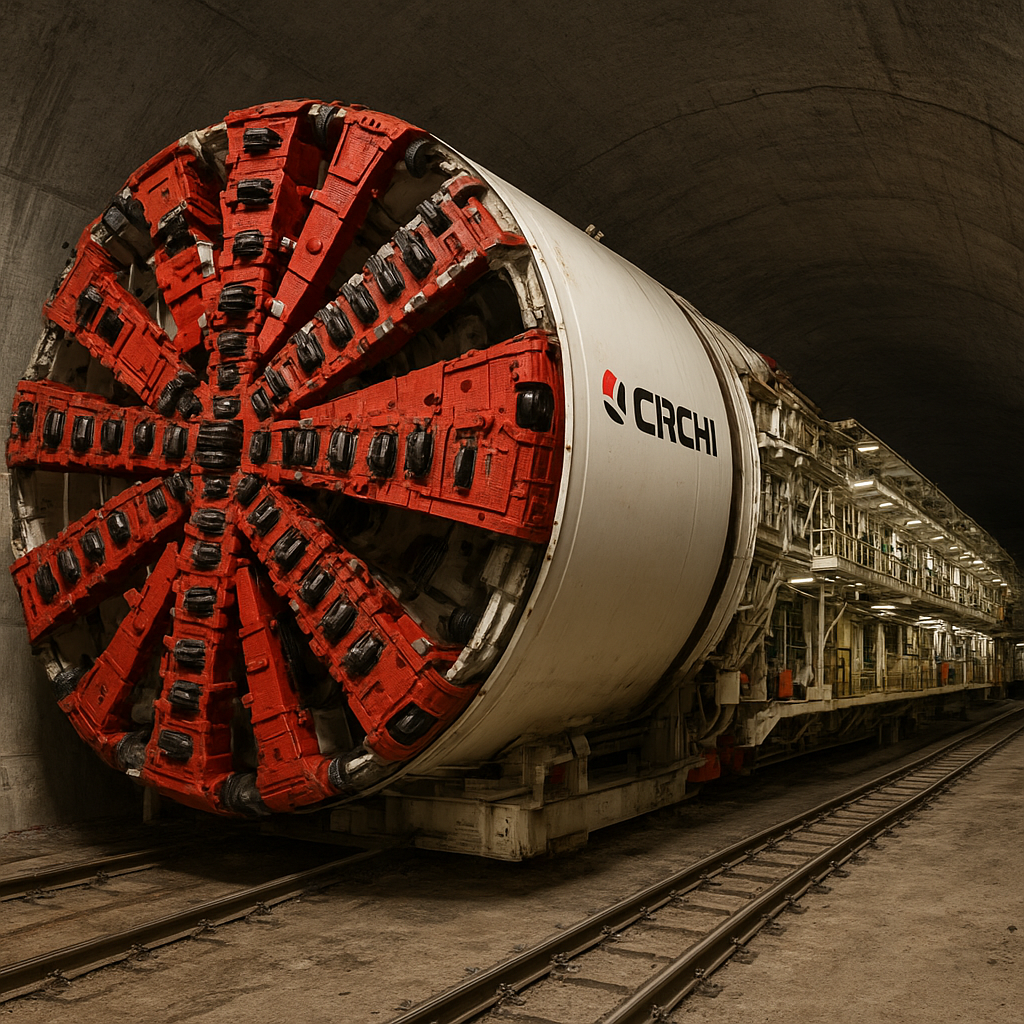
The CRCHI Slurry TBM 16m represents a class of large-diameter, slurry-shield tunnel boring machines designed to excavate in soft, water-bearing and mixed ground conditions where ground control and face pressure management are critical. This article examines the machine’s purpose, core components, typical performance and applications, operational considerations and environmental and safety aspects. It also provides illustrative numerical estimates and practical notes drawn from industry practice to help engineers, project managers and technical readers understand where and how a 16 m slurry TBM can be most effectively deployed.
Overview and key capabilities
The CRCHI 16 m slurry TBM is engineered to deliver controlled excavation in challenging subsoil environments. As a slurry-shield machine, it uses a pressurized slurry medium at the cutting face to support the ground and transport the excavated material away from the face to the surface for separation. This approach is particularly suitable where the geology consists of alluvium, sandy layers, silty soils, cobbles or heterogeneous deposits with high groundwater pressure.
At 16 m outside diameter, the machine creates a gross cross-sectional excavation area of approximately 201 m² (π × 8²). This translates to roughly 201 cubic metres of excavated material per metre of tunnel. Such volumes require substantial logistics for slurry handling, spoil removal and segmental lining installation, meaning the machine is best used on major infrastructure projects where large-diameter bored tunnels are required — for example, road and railway underpasses, metro caverns, submerged crossings and large utility culverts.
- Primary advantages: robust face support under high groundwater pressure; reduced surface settlement; ability to handle cobbles and boulders with appropriate cutterhead design.
- Typical limitations: larger mobilization footprint; significant slurry treatment and disposal/reuse infrastructure; higher capital and operational costs compared with smaller TBMs.
Major components and engineering features
A 16 m slurry TBM is complex and integrates mechanical, hydraulic and process systems. The principal elements include:
- Cutterhead and shield: a heavy-duty, replaceable cutterhead designed to cope with abrasive and mixed-face conditions. The shield encloses the machine and provides the structural envelope for backup equipment.
- Slurry chamber: the internal space where slurry mixes with excavated material (cuttings/solids) before being pumped to the surface.
- Slurry pumps and pipelines: high-capacity centrifugal pumps convey the spoil-laden slurry from the TBM to the separation plant at surface or to intermediate booster stations.
- Slurry separation plant: hydrocyclones, centrifuges, screens and flocculation systems that separate solids from slurry, recover the carrier fluid and condition fines for disposal or reuse.
- Segment erector and ring building system: robotic or semi-automatic equipment inside the trailing shield that installs precast concrete ring segments and grout injection for annulus filling.
- Guidance and instrumentation: laser/gyro based alignment systems, face pressure sensors, cutterhead torque and thrust measurement, and geotechnical monitoring for settlement and ground/face behaviour.
- Backup train: a series of modular trailers behind the shield that carry slurry pumps, personnel access, hydraulic power units, spare parts, conveyor belts or muck cars and other utilities.
Specific design choices — cutterhead geometry, wear materials, degree of shielding and number of slurry transfer lines — are tuned to project geology and logistics. Typical cutterhead diameters are slightly smaller than the shield OD to accommodate cutting tools and wear liners; the machine’s overall mechanics are built to withstand sustained thrusts and torques required to push rings and break up resistant inclusions.
Applications and project types
The CRCHI 16 m slurry TBM is suited to projects where a large clear internal diameter or strong face control is required. Common applications include:
- Urban metro tunnels or station caverns where large cross-sections are beneficial for passenger flow, emergency egress and mechanical systems.
- Undersea tunnels and river crossings where high hydrostatic pressures necessitate positive face support to avoid inflows and ground loss.
- Large utility tunnels (multi-utility galleries) designed to accommodate numerous pipelines, cables and maintenance accessways.
- Road tunnels and highway bypasses that require a single large bore rather than twin small tunnels for operational or maintenance reasons.
Because slurry-shield TBMs excel at maintaining face stability in loose, saturated soils, they are commonly selected over Earth Pressure Balance (EPB) machines when the ground contains a high fraction of non-cohesive sand, gravel, or when high inflow risk is present. The ability to tailor slurry properties — density, viscosity and solids concentration — and actively control face pressure gives engineers a powerful means to minimize surface settlement and protect adjacent structures during tunnelling in populated areas.
Performance metrics and illustrative statistics
Performance depends strongly on geology, logistics and project constraints. The following figures are industry-typical estimates for a machine of this diameter and are intended as a practical reference rather than guaranteed values:
- Excavation volume: ~201 m³ per metre of tunnel (16 m OD, net area adjusted by lining thickness may be somewhat less).
- Advance rates: average daily progress commonly ranges from 5 to 30 m/day. In favourable soft ground and uninterrupted logistics, long-term averages of 15–25 m/day are possible; in heterogeneous or cobble-rich soils, rates may fall under 5–10 m/day.
- Slurry throughput: separation plants for this machine class often handle several hundred cubic metres per hour of slurry (typical ranges ~200–800 m³/h), depending on cuttings load and desired cycle times.
- Shield pressure control: face support pressures are actively maintained and may range from slightly below hydrostatic to above hydrostatic pressure as needed to prevent inflow and settlement; control tolerances and set points are defined by geotechnical design and instrumentation feedback.
- Ring building: ring erection cycle times (cutter advance + segment installation + grout injection) typically govern tunnelling rhythm; a well-optimized team can achieve ring cycles commensurate with the higher end of the advance rate range.
Logistics, such as the capacity of the slurry separation plant, spoil disposal options, segment supply and backup maintenance schedules, often become the bottlenecks limiting practical daily progress for a 16 m TBM.
Operational workflow and best practices
Operating a slurry TBM of this class requires careful coordination across multiple systems. Typical operational workflow includes the following stages and controls:
Start-up and launch
Before launch, the machine is assembled in a launch shaft or cavern: shield sections, cutterhead, backup modules and slurry pipelines are installed. Pre-tunnel instrumentation is established and baseline geotechnical data are confirmed. A critical aspect is commissioning the slurry system and separation plant, ensuring that slurry chemistry (e.g., bentonite content, polymer additives) is optimized for cuttings transport and flocculation characteristics.
Face control and excavation
The cutterhead rotates and excavates while slurry pressure at the face is balanced to the required set-point. Spoil enters the slurry chamber and is conveyed to the separation plant for solids extraction. Continuous monitoring of face pressure, torque and thrust helps operators detect changes in ground conditions. When encountering harder inclusions, cutterhead speeds and thrusts are adjusted to avoid overloading the drive system.
Ring erection and grouting
After each advance, the segment erector places precast concrete segments to build a reinforced ring. The annular space is then filled with grout to lock the lining to surrounding ground and prevent settlement. Quality control of segment watertightness (gaskets) and grout filling is essential, especially in high-pressure conditions.
Slurry handling and environmental management
Effective slurry recycling is both an environmental and economic priority. Separation trains remove coarse and fine solids, allowing carrier fluid to be reused. Solid residues (filter cake) must be stabilised and disposed of according to local regulations. Many projects adopt staged treatment strategies — hydrocyclones for coarse separation, centrifuges for fine particle removal, chemical treatment or flocculation for suspended solids — before discharge or beneficial reuse.
Maintenance, wear and spare parts strategy
Wear is a major operational consideration. Cutterhead wear, wear of wear plates and liners inside the slurry chamber, seals and pump components degrade under abrasive, high-pressure conditions. Planned preventative maintenance and a robust spare parts inventory are necessary to maintain productivity. Key points:
- Regular inspection of cutting tools and cutters; replace or recondition as soon as performance metrics (torque increases, specific energy rises) indicate significant wear.
- Monitor slurry pump pressures and wear rings; implement a schedule for replacing pump impellers and casings based on cumulative abrasion hours.
- Keep an inventory of critical seals, gaskets and hydraulic components to reduce downtime during wear-related interventions.
- Design backup modules with quick-change capability, enabling segments of pumps or electrical systems to be exchanged without major disruption to tunnelling operations.
Safety and environmental considerations
Large-diameter slurry TBM projects must meet stringent safety and environmental standards, especially when tunnelling under populated areas or bodies of water. Important measures include:
- Settlement control: continuous surface and building monitoring using geodetic and geotechnical instruments to detect and respond to subsidence trends.
- Pressure management: robust control schemes and interlocks to prevent sudden pressure drops or surges that might cause inflows.
- Slurry management: closed-loop systems, secondary containment and appropriate waste treatment to avoid contamination of surface water bodies or groundwater resources.
- Emergency response: contingency plans for major leaks, pipeline ruptures or face instability, including grouting strategies, freezing techniques or staged evacuation protocols for personnel.
From an environmental perspective, maximizing slurry recovery and reducing solid disposal volumes are priorities. Many modern projects aim for >90% slurry reuse after treatment, reducing the quantity of fresh bentonite or polymer required and minimizing treated solid waste volumes.
Design optimization and technological trends
Advances in TBM technology and project methodologies have improved the efficiency and safety of large slurry-shield tunnelling. Notable trends include:
- Improved cutterhead designs that combine open and closed features to better handle mixed faces with cobbles, while maintaining slurry flow characteristics.
- Real-time instrumentation and digital twin technologies that enable predictive maintenance, automatic adjustment of operational parameters and remote diagnostics.
- Enhanced separation systems that reduce solids loss and improve slurry recovery using modular centrifuge and dewatering trains tailored to the project’s silt content.
- Robotic segment erection and automation to increase accuracy, reduce manpower in the shield and improve cycle times.
Logistics, cost drivers and project planning
Deploying a 16 m slurry TBM involves complex logistics and significant capital and operating costs. Key cost drivers to consider in project planning include:
- Mobilization and demobilization of the TBM, often requiring specialized heavy-lift facilities, staging areas and highway/port logistics when equipment is imported.
- Slurry separation plant capital cost and operating expenses, including chemicals, energy for pumps and centrifuges, and solids disposal fees.
- Manufacture, transport and stocking of large precast segments and gaskets; ring quality and supply cadence directly influence tunnelling rhythm.
- Utility relocation, shaft construction, ventilation and support systems for a large tunnelling operation.
Financial planners and project managers must balance the benefit of a single large-bore solution (reduced interface costs, simplified internal systems) against the higher civil and mechanical costs of slurry TBM operation relative to multiple smaller bores.
Case observations and practical recommendations
While specific project performance varies, experience across large slurry TBM projects provides several practical recommendations:
- Invest early in a suitably sized slurry separation plant. Undersizing leads to queueing, reduced advance rates and expensive workarounds.
- Develop a comprehensive geotechnical baseline and risk register that anticipates mixed-face conditions and cobble bands; plan cutterhead and tooling strategies accordingly.
- Implement rigorous instrumentation and data analytics to detect trends in cutterhead torque, face pressure and slurry solids content — early indicators of a changing ground condition.
- Adopt a robust spare parts policy for high-wear components; downtime for replacement of items such as pump impellers or cutter tools can cost many times the parts’ replacement value in lost progress.
- Engage stakeholders early about slurry disposal and reuse plans. Permitting and community acceptance are often decisive constraints on slurry TBM project schedules.
Concluding perspective
The CRCHI Slurry TBM 16m typifies the class of large-bore slurry-shield machines that make modern, ambitious tunnelling projects feasible in difficult ground and high-water-pressure environments. Its strengths — controlled excavation under pressurized face conditions, flexibility in handling heterogeneity in soils and the ability to deliver a single large internal space — make it a preferred option for underwater crossings, large urban tunnels and utility galleries. However, these benefits come with substantial logistical, environmental and cost implications that require careful planning, reliable separation and slurry management capability, and a disciplined maintenance regime.
Choosing and operating a 16 m slurry TBM successfully demands not only a technically sound machine but also a project organization that can manage the interfaces between civil works, slurry treatment, segment supply and stakeholder concerns. When these elements are aligned, the machine becomes a powerful tool for delivering safe, efficient and low-settlement tunnelling in some of the most challenging subsurface conditions engineers encounter.
)
)