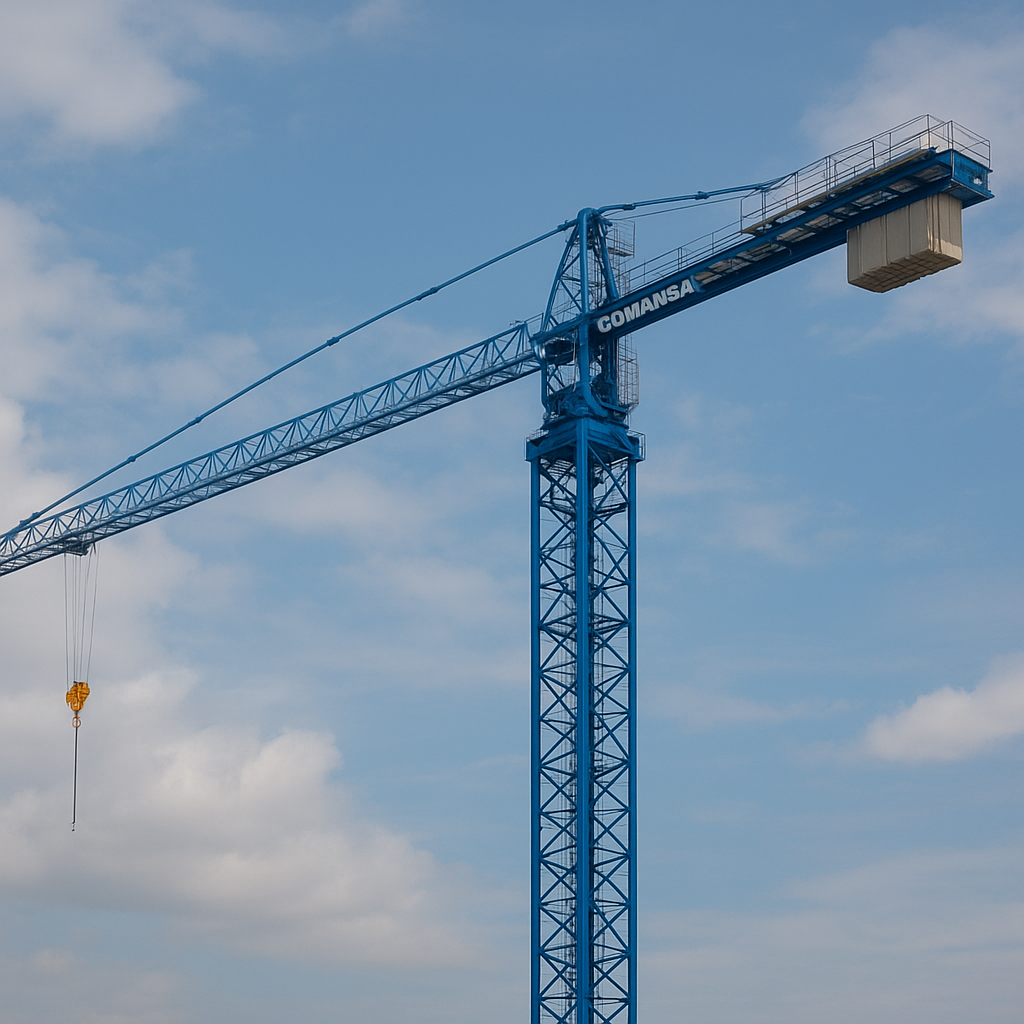
This article explores the COMANSA 21LC1050 in detail — a heavy-duty tower crane model designed for large construction projects. It covers the machine’s design philosophy, common applications, technical and operational considerations, and practical insights for buyers and site managers. Where appropriate, representative performance figures are provided, but exact values depend on the chosen configuration, country-specific standards, and on-site setup.
Overview and design philosophy
COMANSA’s 21LC series represents a family of large-capacity, top-slewing tower crane designs oriented toward structural and heavy civil works. The 21LC1050 sits among the series as a high-capacity unit intended for projects that demand high lifts, long working radii, and robust on-site versatility. Typical uses include high-rise construction, bridge elements, precast concrete placement, industrial plants, and infrastructure works where heavy modules, large formwork or prefabricated components must be lifted and precisely positioned.
The design emphasis of the 21LC1050 is on a balance between raw lifting capacity and operational adaptability. It is built around a modular mast and jib system that allows different combinations of height and radius depending on site constraints. The crane is engineered to deliver steady, controllable lifts at increasing radii, while maintaining compact transport and assembly requirements relative to its lifting class.
Key technical features and typical specifications
Below are representative technical highlights for the COMANSA 21LC1050. Note: configuration choices (mast height, counterweights, jib length, hoist options) change final figures; always consult the manufacturer or a certified dealer for certified numbers for a planned configuration.
- Maximum nominal capacity: Commonly specified around 50 tonnes at minimum radius (model number suffix 50 often indicates 50 t class). This represents the crane’s top-class lifting rating with an optimal configuration.
- Working radius: Jib configurations for this class typically range from modest radii up to very long radii (for example, from 10 m to 60+ m depending on jib sections). The 21LC series commonly supports long-jib configurations for jobsite versatility.
- Tip capacity: Tip or maximum radius lifting capacity is considerably lower than the nominal capacity; typical tip loads for a crane in this class can be in the low single tonnes (e.g., 1–5 t) at the maximum radius depending on jib length.
- Hoist and speed: Multi-line hoists, variable frequency drives and multiple speed ranges for hoist/auxiliary winches are typical. Hoist line capacities and speeds vary by configuration but are designed for both heavy lifts and precise placement operations.
- Mast system: Modular, bolted mast sections allowing climbing or crane-assisted mast erection. Mast heights can be extended incrementally using standard sections to reach the required elevation.
- Counterweights and ballast: Configurable counterweight systems to match lift charts for different radii, including space-efficient transportable ballast blocks.
- Rotation and slewing: Robust gearbox and slew ring assembly to manage heavy-load rotation with precision and safety systems for anti-collision where specified.
- Transportability: Mast sections, jib segments, and counterweights designed to fit standard road transport modules as much as possible to optimize logistics and reduce setup time.
Representative lift chart examples
For a crane in the 50 t class, a simplified example of capacity vs radius is:
- At minimum radius (very short reach): up to ~50 t
- At medium radii (20–30 m): tens-of-tonne capacities (e.g., 10–30 t depending on configuration)
- At maximum radius (longest jib): tip loads of a few tonnes (often 1–5 t)
These ranges are illustrative. The exact load table is provided by COMANSA for each specific assembly, and must be consulted during lift planning.
Applications and sectors where it excels
The COMANSA 21LC1050 is particularly suited to work that combines high loads with the need for reach and precision. Typical applications include:
- High-rise construction: Lifting steel sections, precast concrete panels and MEP modules to upper floors while offering the mast heights required for tall structures.
- Bridge and infrastructure projects: Handling heavy cast-in-place forms, precast beams, deck segments and bridge bearings where heavy lift performance is essential.
- Industrial plants and power stations: Installation of heavy equipment such as turbines, generators, large piping modules, and HVAC units.
- Offshore and port civil works: Onshore assembly yards and quay-side construction where large prefabricated elements and containers must move tilting into place.
- Prefabrication yards: Fast, repeatable placement of large precast units during factory or yard operations to support rapid modular construction.
Operation, assembly and site logistics
A crane of this class demands thorough planning well before physical arrival. Key operational and logistical considerations include:
- Foundation and base: A proper base or crane foundation is critical. Load distribution must be verified through geotechnical and structural assessment for the site to avoid settlement or tipping risks.
- Erection strategy: The modular mast and jib allow staged erection, often using mobile cranes or even self-erection procedures supported by the crane itself in smaller configurations. Assembly sequencing is defined in the erection manual and must be followed by certified teams.
- Transport planning: Transport of jib segments, mast elements and counterweights requires permits for oversized loads in many jurisdictions. Prefabricated ballast blocks help reduce the need for immediate on-site concrete ballast operations.
- Operational control: Modern 21LC units are compatible with electronic weighing, load moment limiting (LML), and operator assistance systems to enhance safety and productivity. Remote diagnostics and telematics may be available for fleet management.
- Climbing and tie-in: For taller structures, climbing frames or crane-assisted climbing systems are deployed and the crane is secured to the structure at intervals using ties tailored to building progress.
Safety features, compliance and operator considerations
Safety is central for any heavy crane installation. The 21LC1050 integrates mechanical and electronic solutions to reduce risk in demanding environments.
- Load moment limiting: Standard LML systems prevent the crane from lifting loads beyond safe limits for given radii, automatically restricting hoist or slew actions to protect the structure.
- Anti-collision systems: When operating multiple cranes on a site, anti-collision systems can be installed to prevent jibs from interfering with each other or with fixed structures.
- Redundancy and brakes: Multiple braking systems and safety catches on hoists ensure positive control in case of failure.
- Operator environment: Ergonomic cabins with climate control, clear sightlines, and modern controls reduce operator fatigue and improve precision. Remote-control options are sometimes available for site flexibility.
- Certifications and inspections: Regular inspections, non-destructive testing for structural elements, and adherence to local and international standards (e.g., EN, ISO) are mandatory. Lift plans must be approved by competent persons and often by third-party certifiers before heavy lifts.
Maintenance, lifecycle and total cost of ownership
A machine like the 21LC1050 represents a significant capital investment. Owners and fleet managers evaluate total cost of ownership (TCO) across purchase price, maintenance, downtime, resale value and operational efficiency.
- Preventive maintenance: Scheduled inspections for gearbox oil, wire rope condition, slewing bearings and structural bolts prolong service life. OEM recommended intervals should be followed, and maintenance logs maintained for regulatory compliance.
- Spare parts and dealer network: Choosing a crane with a broad dealer and spare parts network reduces downtime. COMANSA’s global presence typically means accessible parts and service in many regions.
- Resale and residual value: Cranes maintained to OEM standards and documented histories retain higher resale prices. Modular cranes with common components often have better secondary market liquidity.
- Modernization and upgrades: Telemetry, remote diagnostics, and operator-assist upgrades can be retrofitted to older cranes, offering better fleet optimization and reduced unplanned downtime.
Technological trends and innovations relevant to the 21LC1050
The tower crane industry has been evolving quickly; several trends enhance the capability and attractiveness of high-capacity cranes such as the 21LC1050:
- Digitalization: Remote monitoring and telematics enable predictive maintenance, fuel/electric consumption tracking, and operational analytics that reduce downtime and optimize utilization.
- Operator assistance and automation: Advanced load-control systems, hoist damping, and semi-automated sequences improve precision and repeatability for complex lifts.
- Sustainability: Hybrid and electrically optimized drive systems reduce fuel use and emissions on site. Efficient gearboxes and variable-speed drives reduce energy consumption during operations.
- Safety analytics: Integration of data from LML, wind sensors, and site positioning systems to proactively alert teams to hazardous conditions or misuse.
Buying considerations and lifecycle deployment
When evaluating the 21LC1050 for procurement, consider these practical factors:
- Project fit: Match crane capacity and radius to the most demanding lifts expected on the project, not just average loads. Overspecifying leads to higher cost; underspecifying risks delays and safety issues.
- Configuration flexibility: Determine if the crane’s modularity supports multiple projects in your portfolio, which maximizes utilization and return on investment.
- Support and training: Access to certified operator and rigging training, as well as dealer service agreements, reduces operational risk and preserves value.
- Regulatory compliance: Verify that the crane and its documentation meet local statutory requirements and that import or site-specific certifications won’t create delays.
- Lease vs. buy: For many owners, leasing a 50 t class crane can be economical for short-term projects. For fleets with continuous heavy work, ownership with a planned maintenance program produces lower lifetime costs.
Environmental and site constraints
Large tower cranes are sensitive to environmental constraints:
- Wind: Operational wind limits must be strictly observed; high winds can prevent lifts or mandate crane stow positions.
- Noise and emissions: On dense urban sites, low-noise options and cleaner power systems reduce neighborhood impact and regulatory friction.
- Space: The footprint for assembly, storage of jib and counterweights, and the required crane base area must be confirmed early in site logistics planning.
Comparison to other crane classes and competitive advantages
Compared with medium-duty tower cranes, the 21LC1050 offers higher nominal capacity, more robust hoisting components, and larger mast modules. Its competitive advantages typically include:
- Heavy-lift capability: Enables single-lift installation of large modules, reducing the need for multiple lifts or temporary bracing.
- Configurability: A broad range of jib and mast options allows the same base unit to be tailored to diverse projects.
- Manufacturer support: COMANSA’s established designs and global support network help reduce logistic friction for international projects.
Representative operational case examples
– On a high-rise apartment project, a 21LC1050 configuration with a medium-length jib reduces cycle times by allowing direct delivery of large prefabricated façade panels to upper floors, cutting crane hours compared to multiple lifts with a smaller crane.
– For a bridge segment assembly yard, the crane’s high nominal capacity allows the direct placement of heavy precast segments onto transport frames, streamlining transfer to launching gantries.
– In an industrial retrofit, the crane facilitated the replacement of an incumbent turbine by performing a single heavy lift, avoiding complex partial dismantling and reducing downtime.
Summary and final remarks
The 21LC1050 is a powerful option in COMANSA’s lineup for contractors and owners facing demanding heavy-lift and long-reach challenges. Its modular design, combined with modern safety and electronic assistance systems, makes it suitable for a wide range of projects from high-rise to heavy civil infrastructure. While exact performance metrics and lift charts depend on configuration and local standards, the machine is typically classed in the 50-tonne range at short radii, with a wide variety of jib and mast choices to match site requirements.
Final purchase or rental decisions should be based on a detailed lift plan, site logistics assessment, and consultation with certified COMANSA representatives to ensure the selected configuration provides the required capacities, complies with regional regulations, and fits the project schedule and budget.
)
)