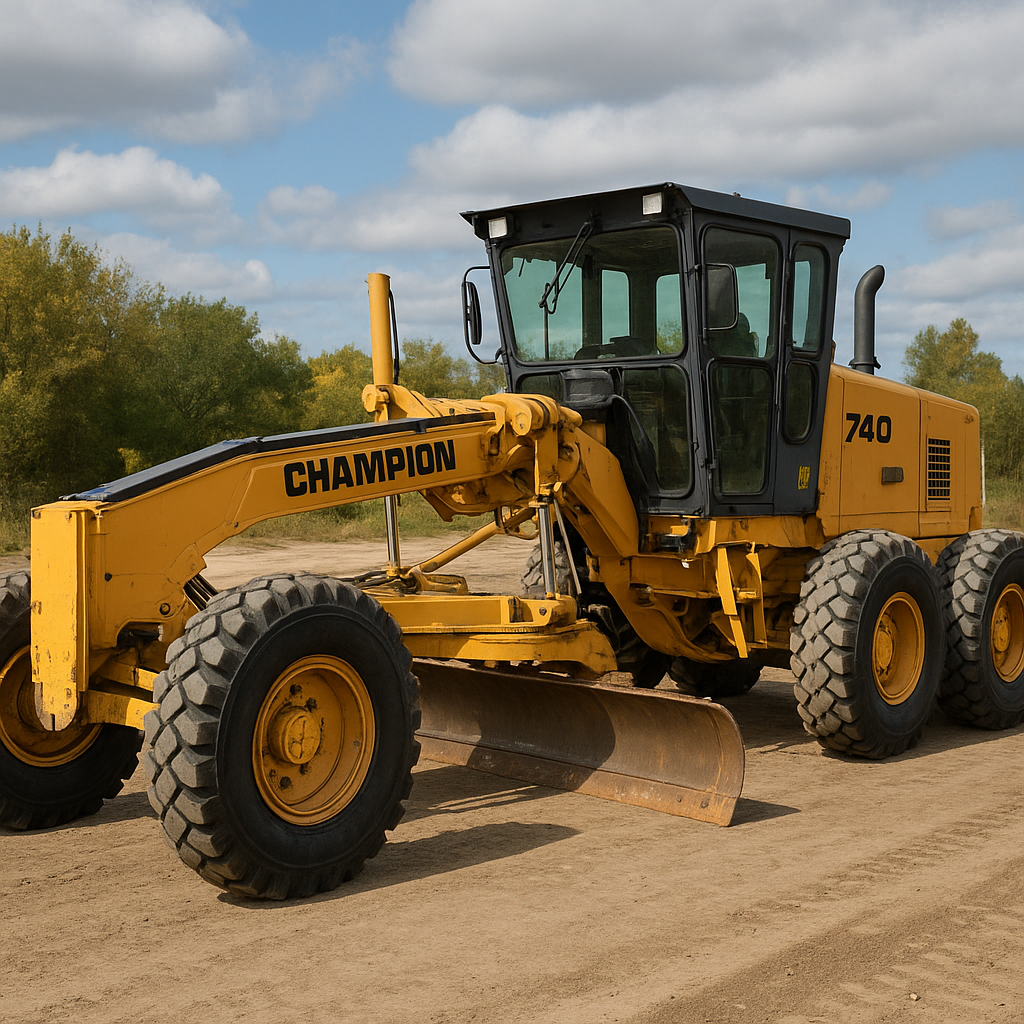
The Champion 740 is a representative example of a mid-size motor grader used around the world in road construction, maintenance, and site preparation. Characterized by a long moldboard, precise steering, and robust hydraulic controls, this machine is built to shape and finish surfaces where accuracy and consistency are essential. In the sections that follow, we will explore the main features, typical applications, operational considerations, maintenance guidance, and market context for the Champion 740. The information below combines general industry knowledge about motor graders with particulars commonly associated with machines in the Champion 700 series and equivalent mid-range models.
Overview and background
The term motor grader covers a class of heavy equipment whose primary tool is a long, adjustable blade (moldboard) mounted between the front and rear axles. The Champion 740 falls into the mid-size segment of this class and is often used for tasks that require precision grading over long surfaces. Although specific production histories for individual Champion models may vary, machines of this type have been manufactured and supported by several brands and dealers worldwide, and the Champion name appears in used-equipment inventories and service networks.
What distinguishes a model like the Champion 740 is its balance between power, maneuverability, and operator control. It is designed for continuous duty in environments such as public road construction, gravel road maintenance, airport apron preparation, and civil engineering sites. Users value models like the 740 for their capacity to produce uniform grades, control drainage profiles, and work in conjunction with heavy hauling and compaction equipment.
Design and technical features
Understanding the design elements of the Champion 740 helps explain why it performs well in grading tasks. Components and systems are engineered to maximize blade control, traction, and durability while keeping operational complexity manageable for field mechanics and operators.
Blade and moldboard
- The central working tool is the moldboard (blade), typically 12–14 feet (3.6–4.3 m) long on mid-size graders. It can be tilted, raised and lowered, angled, and shifted laterally to cut, spread, and shape material.
- Blade controls use hydraulic cylinders to provide quick, precise response. Many Champion 700-series graders offer a circle drive system that allows the moldboard to rotate for a variety of cutting angles and positions.
Hydraulics and control systems
Modern mid-size graders rely heavily on hydraulic power for implement control. The Champion 740 employs a hydraulic system that operates the steer, blade, articulation, and auxiliary attachments. The hydraulics are tuned to provide balance between speed and fine control—important when finishing high-quality surfaces.
Frame, articulation, and traction
- Articulation in the center of the frame allows the grader to operate in tighter patterns and to follow curved alignments. Articulated steering reduces the turning radius and improves maneuverability on confined sites.
- Rear tandem axles provide traction and weight distribution. Some configurations may include differential locks or limited-slip options for difficult traction conditions.
Engine and drivetrain
Powerplants in comparable mid-size graders are typically turbocharged diesel engines producing power in a range that supports both travel speed and blade-cutting forces. While exact numbers vary by year and configuration, machines like the Champion 740 usually have engines delivering sufficient torque for sustained cutting and hauling cycles. Transmission systems may be powershift or torque-converter based, selected to match jobsite requirements.
Operator environment
Comfort and visibility are vital for grading accuracy. The operator station in a Champion 740-style grader is arranged to give a clear line of sight to the blade, front wheels, and the working surface. Controls are laid out to minimize operator fatigue and to allow fine adjustments during finishing passes. Optional climate control, suspension seats, and ergonomic control levers are commonly available.
Typical applications and working environments
The versatility of a mid-size grader like the Champion 740 makes it valuable across many sectors. Below are the most common applications where the machine shows strong performance.
- Public road construction and maintenance: Graders are the primary tool for creating running surfaces on new rural roads, regrading damaged pavements, and shaping drainage crowns on gravel roads.
- Airport and runway work: Precision surface finishing for taxiways and aprons requires stable machines capable of smooth, uniform passes.
- Mining and quarrying site prep: Graders help maintain haul roads and prepare bench faces that reduce truck wear and improve fuel efficiency.
- Snow removal: In colder climates, graders fitted with V-plows or front blades clear heavy snowfall from roads and large paved areas.
- Construction site grading: Fine grading for foundations, parking lots, and landscape subgrades benefits from the moldboard control and visibility of a grader.
- Agricultural and land reclamation: Tasks such as contouring fields, drainage ditching, and preparing terraces for erosion control are well-suited to graders.
Attachments and customization options
One reason graders like the Champion 740 are widely used is the broad array of optional attachments and configurations. These increase versatility and extend the machine’s useful life across seasons and project types.
- Rippers and scarifiers: Mounted at the rear or front to loosen compacted material before grading.
- V-plows and snow wings: For heavy snow removal; these convert the grader into a primary winter-maintenance vehicle.
- GPS and automated grade control: Increasingly common, these systems allow contractors to achieve tight tolerances with fewer passes and less rework.
- Rear boxes and rollers: Optional for spreading and pre-compaction operations.
- High-capacity radiators, cold-start packages, and air filtration: For extreme climates or dusty environments.
Operation, productivity and best practices
Getting the best performance from a Champion 740 requires attention to technique, planning, and machine setup. Productivity doesn’t rely solely on machine power—operator skill and job preparation are equally important.
Pre-job planning
- Survey the site and establish reference points—grade stakes or stringlines—to reduce the need for frequent rechecks.
- Arrange a sequence for material movement that minimizes deadhead travel and frequent turning.
- Select proper blade edge and teeth for the material being cut to optimize cutting efficiency and wear life.
Operator techniques
- Use overlapping passes and consistent speeds to avoid unwanted ridges and troughs.
- Angle the moldboard to spread material evenly; tilt and pitch adjustments help control cutting depth and scar width.
- In windy or dusty conditions, reduce ground speed to maintain control and visibility; in soft soils, engage traction aids if available.
Measuring productivity
Productivity on grading jobs is measured in area graded per hour, linear meters of crown shaped per hour, and the quality of the finish (percentage of passes meeting specified tolerance). Modern graders equipped with GPS and automated controls can reduce rework by significant margins—commonly reported productivity gains range from 10% to over 30% depending on site complexity and prior workflow.
Maintenance, common wear items and lifecycle management
Routine maintenance is essential to maintain the value and efficiency of the Champion 740 over its lifecycle. Proper maintenance also reduces unplanned downtime and improves resale value when the machine is eventually sold.
Daily and weekly checks
- Engine oil level and coolant checks to prevent engine damage.
- Hydraulic oil level and visible hose inspections to identify leaks or chafing.
- Tire or wheel hub inspections (depending on wheel or tandem design) to spot loose bolts and wear.
- Blade cutting edge and end-bit wear checks; rotating or replacing wear parts extends moldboard life and improves grading quality.
Scheduled maintenance
Follow manufacturer intervals for filter changes, hydraulic fluid sampling, and transmission service. Common service intervals for mid-size graders typically include 250-hour, 500-hour and 1,000-hour checkpoints, though specifics depend on hours of operation, load patterns, and local operating conditions.
Common wear items
- Cutting edges, end bits, and circle wear rings.
- Hydraulic seals and hoses that see frequent movement.
- Wear pads and bushings in the circle and articulation joints.
- Tire or drive axle components in heavy haul applications.
Lifecycle and cost of ownership
Cost of ownership for a mid-size grader like the Champion 740 includes fuel, tires, consumables, periodic major service, and downtime. Proper preventative maintenance, use of high-quality lubricants and filters, and installation of protective options (such as dust seals) will lower life-cycle costs and preserve machine resale value.
Market availability, resale considerations and statistical context
The Champion 740 and similar graders are widely available on the used-equipment market. Pricing and availability depend on region, hours of operation, condition, and the extent of refurbishment. In many markets, a well-maintained mid-size grader in working order can retain a substantial portion of its value, particularly if it has documented service history and desirable options such as ride-control, GPS, or renewed hydraulics.
Typical statistical indicators
- Operating weight: Mid-size graders comparable to the 740 typically range between approximately 13,000 kg and 22,000 kg (14–24 US tons), depending on attachments and configuration (approximate figures).
- Engine power: Comparable machines generally produce between 120 and 220 horsepower, depending on model year and emissions configuration (approximate).
- Blade length: Standard moldboards are commonly in the 12–14 ft (3.6–4.3 m) range; end-bit and edge configurations vary with application.
- Service intervals: Typical manufacturer-recommended major service intervals are in the 250–1,000 hour range for routine checks and more extensive servicing at higher hour marks.
Note: These figures are representative for mid-size graders and should be checked against specific machine serial numbers and manufacturer documentation for exact values.
Safety, operator training and regulatory aspects
Effective and safe operation of a Champion 740 requires trained operators familiar with heavy equipment controls, site safety procedures, and local regulations regarding emissions and transport. Employers should ensure operators receive certification or documented training for grader operation, and that machines are equipped with required safety items such as backup alarms, lighting, rollover protection, and appropriate signage for road movements.
- Ensure lockout/tagout procedures are in place for maintenance tasks involving hydraulic or engine work.
- Use appropriate personal protective equipment (PPE) including hearing and eye protection when operating or working nearby.
- Follow local emissions and noise regulations when operating on or near public roads.
Choosing and buying a Champion 740
When sourcing a Champion 740—new or used—prioritize machines with documented maintenance histories and inspect wear items carefully. Consider the expected job types and select options (e.g., GPS, cold weather package, advanced hydraulics) that increase productivity for your most common tasks. For used machines, machine hours, previous usage patterns (e.g., highway maintenance vs. heavy quarry use), and clear title/ownership documentation are critical factors in a purchase decision.
- Request service records and review replacement history for major items such as the circle, engine overhaul, and transmission rebuilds.
- Inspect structural components for cracks or signs of heavy impact—articulation joints and frame welds are high-priority checks.
- Test all hydraulic functions under load to confirm consistent pressure and response.
Summary
The Champion 740 is emblematic of the mid-size motor grader category: versatile, precise, and capable of handling a wide range of surface-shaping tasks. Its strengths lie in moldboard control, operator visibility, and adaptability through attachments and automation systems. With sound maintenance practices, proper operator training, and the right options for the intended jobsite, a machine of this class can deliver dependable performance and reasonable lifecycle costs. Whether used for road maintenance, construction finishing, or winter operations, the Champion 740-style grader remains a core asset for contractors and public agencies that require accurate, durable surface grading.
)
)