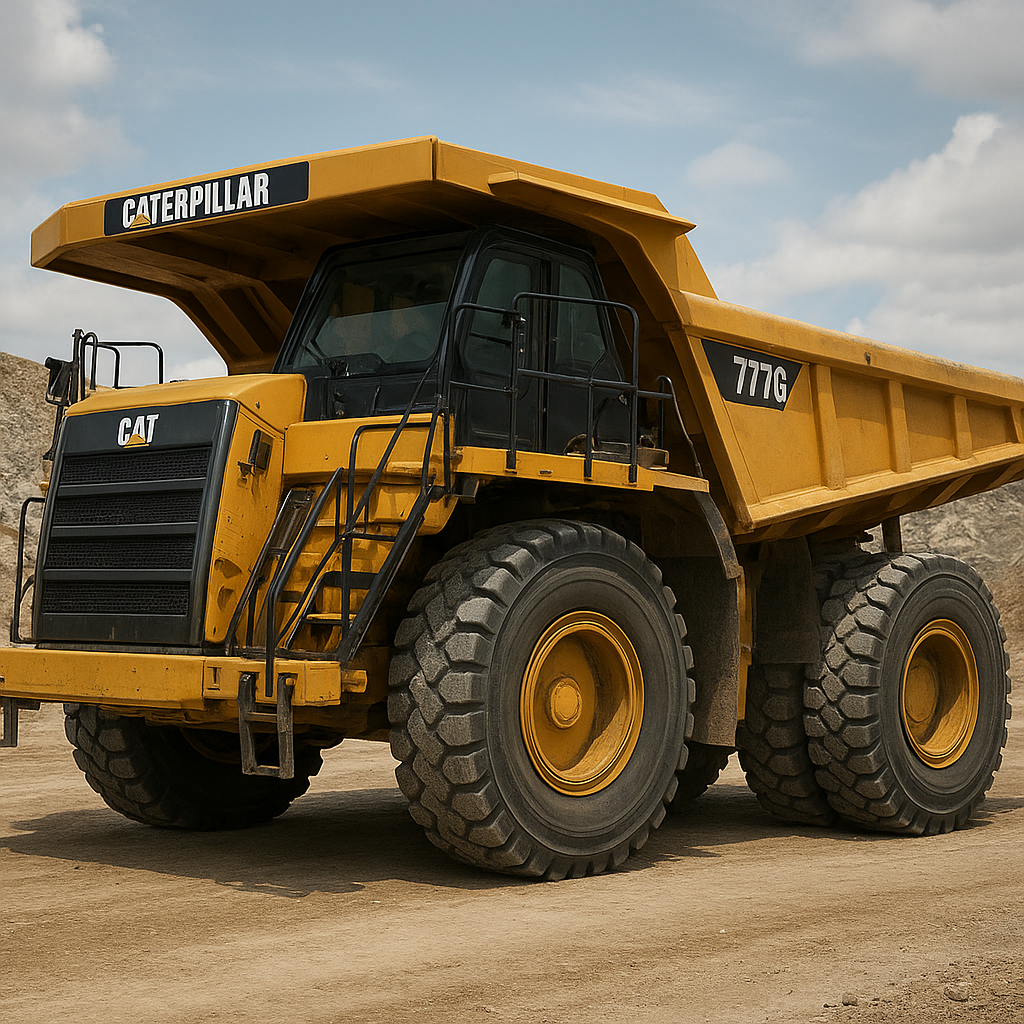
The Caterpillar 777G is a heavy-duty off-highway haul truck designed for demanding mining and large-scale earthmoving operations. Built to move large volumes of material efficiently and reliably, the 777G represents a balance of productivity, durability and serviceability for fleets that require consistent cycle times and long intervals between maintenance. This article explores the 777G’s design principles, common applications, technical and operational characteristics, safety and environmental considerations, and long-term ownership factors that influence its role in modern mining and construction projects.
Design and technical features
The Caterpillar 777G reflects decades of engineering evolution in the 77x series of trucks. Its core focus is on delivering a high-capacity, robust platform that can operate in harsh environments while providing operators with controllability and mechanics with accessibility for upkeep. Key design elements combine frame integrity, driveline durability and systems that support continuous operation in open-pit mines, quarries and major infrastructure sites.
Chassis and structure
- The frame is engineered for heavy cyclic loading and impact resistance, with reinforced structures at stress concentration points to prolong fatigue life and reduce unscheduled downtime.
- Large-dimension axles and wheel-end components are selected to handle heavy payloads and abrasive conditions; these components are designed for straightforward serviceability.
- Bucket or body designs for the 777G are optimized for effective material retention and even load distribution, which helps maintain predictable handling and wear patterns.
Powertrain and traction
The 777G typically uses a high-displacement, turbocharged diesel engine matched to a heavy-duty transmission and driveline suited for off-highway duty cycles. Load-sensing torque converters and power-shift transmissions enable smooth starts under load and efficient travel on ramps and haul roads.
- Power delivery is tuned for consistent acceleration in loaded conditions and for managing heat under long shift cycles.
- Final drives and differential components are robust and often include cooling and filtration systems to extend service life.
- Traction control and wheel slip management systems in modern configurations assist the operator in maximizing drawbar pull while minimizing tire spin and wear.
Operator environment and controls
Operator comfort and ergonomics are important to sustain productivity during long shifts. The 777G cabin emphasizes visibility, intuitive controls and climate control to reduce operator fatigue. Integrated instrumentation and telematics offer real-time feedback on machine performance and health.
- Comfort features typically include adjustable seating, HVAC, and vibration-damping design elements.
- Control layouts are designed to be familiar to operators trained on other Caterpillar equipment, facilitating cross-machine deployment.
- Telematics and fleet management interfaces provide data on fuel use, cycle times and maintenance alerts.
Applications and typical uses
The primary role of the 777G is to efficiently move large quantities of rock, ore, and overburden in environments where frequent, heavy hauling is required. Typical applications include:
- Open-pit mining — moving blasted ore to crushers and waste material to dumps.
- Quarrying — transporting stone and aggregates from the quarry face to processing plants.
- Large civil projects — earthmoving for dams, highways, and major land development where high-volume hauling is required.
- Stockpile management and material transport in bulk-handling facilities where durable, large-capacity trucks reduce the number of cycles needed.
Because of its capacity and robustness, the 777G is often deployed where material density, haul distances and daily tonnage requirements favor fewer, larger cycles rather than many small loads. This can improve overall fleet efficiency when matched with compatible loading equipment (e.g., 5–10 m³ shovels or wheel loaders in the appropriate class).
Performance and specifications (typical ranges)
Exact specifications vary by configuration and market, but the performance envelope of the 777G can be described in general terms. Below are typical figures and operational metrics that fleets and equipment planners use when evaluating this class of machine. Note that actual values depend on options, regional setups and years of manufacture.
- Payload: generally in the range of 85–105 metric tonnes (depending on configuration and local regulatory limits).
- Engine power: commonly between 700 and 1,000 horsepower (approximately 520–745 kW), tuned for heavy continuous-duty cycles.
- Top travel speeds: unloaded top speed may exceed 50 km/h; loaded speeds on grade vary with gradient and gearing.
- Operating weight: gross machine operating weight usually places the truck in the high tens to low hundreds of tonnes category, including body and typical fuel/lubricant load.
- Typical cycle times: a full dip and haul cycle time depends heavily on loading equipment; optimizing loader-truck matching is essential to maximize truck utilization.
Fuel consumption is a critical operational cost. For large haul trucks like the 777G, fuel burn is influenced by payload, duty cycle, haul road condition and operating technique. Modern powertrain and torque-management strategies aim to reduce fuel use per tonne moved, often by several percentage points compared with earlier-generation trucks.
Operational efficiency and maintenance
Maximizing uptime is a key objective for owners of large haul trucks. The 777G incorporates design and service features to simplify routine maintenance and lengthen intervals between overhauls. Reliability-centered maintenance practices, condition monitoring and proper operator training amplify these asset design benefits.
Maintenance considerations
- Routine inspections and scheduled servicing for filters, fluids and critical points are essential to prevent costly failures in the frame, driveline and hydraulics.
- Access points and modular components are often engineered to reduce hands-on labor time during scheduled maintenance.
- Common wear items include tires, brakes, suspension bushings and drivetrain seals — inventory management for these parts helps reduce downtime.
Telematics and condition monitoring
Integrated telematics systems provide fleet managers with data on fuel consumption, idle time, operating hours, load cycles and fault codes. Proactive analysis of these data enables:
- Predictive maintenance scheduling based on actual machine health rather than fixed intervals.
- Optimized dispatching to reduce empty travel and maximize loaded haul time.
- Operator coaching based on fuel-efficiency metrics and cycle performance.
Safety, ergonomics and operator aids
Safety systems on the 777G and similar haul trucks prioritize both collision avoidance and operator protection. Given the size and kinetic energy of these machines, controls and passive safety design must be robust.
- Visibility enhancements such as large glazing areas, cameras and proximity sensors help avoid collisions in congested pits.
- Operator protection includes rollover protection structures, ergonomic seating and restraint systems.
- Speed-limiting, downhill speed control and automatic retarder functions are often available to improve safety on descents.
- Systems for improved communication, including haul road signage and fleet dispatch integration, help manage interactions between trucks, loaders and ancillary vehicles.
Environmental considerations
Modern haul trucks must balance productivity with emissions and environmental stewardship. The 777G can be configured to meet regional emissions standards, and fleets increasingly focus on ways to reduce carbon and particulate footprints.
- Engine calibrations and aftertreatment systems (where fitted) reduce NOx and particulate emissions to comply with local regulations.
- Operational practices — such as reduced idling, matched payload management and smoother haul road profiles — lower fuel consumption per tonne moved.
- Some operations are exploring fuel alternatives or electrification for sections of the fleet; while full electrification of large haul trucks remains in early-adoption phases, battery-electric and trolley-assist systems are increasingly used in certain mines to cut diesel use and emissions.
Costs of ownership and fleet considerations
When evaluating a truck like the 777G, owners look at total cost of ownership (TCO) rather than purchase price alone. TCO includes acquisition, financing, fuel, maintenance, tires, operator labor, downtime costs and eventual resale or salvage value. High initial investment can be justified by:
- Lower unit cost per tonne moved driven by larger payloads and efficient cycles.
- Reduced personnel and operational complexity compared with using many smaller trucks.
- Long service life when proper maintenance and refurbishment strategies are applied.
Key levers to reduce TCO include telematics-led maintenance, operator training for fuel-efficient driving, tire life management programs, and planned rebuilds timed to maximize productivity while minimizing expensive unscheduled repairs.
Variants, upgrades and integration with modern mine operations
The 777G platform can be fitted with a variety of options depending on the operation’s needs: different body types, retarder systems, tire choices and telecommunications packages. These variations ensure the truck can be tailored to haul road geometry, material abrasiveness and local environmental regulations.
- Auxiliary systems such as fire suppression, enhanced lighting and underrun protection are common options for harsh environments.
- Telematics and payload monitoring systems can be factory-installed or retrofitted to allow precise load control and reporting.
- In larger fleet deployments, the 777G is often integrated into mine planning software for load-and-haul scheduling, pit sequencing and maintenance windows to optimize overall throughput.
Market position and lifecycle trends
Caterpillar’s 77x series, including the 777G, competes in the market segment that values a balance between payload capacity and maneuverability. While ultra-large haul trucks (200+ tonne class) are used in very large mining operations, trucks like the 777G remain popular because they:
- Fit many mid-to-large size mines where extremely large equipment is unnecessary.
- Match well with loaders and shovels of common sizes used worldwide.
- Offer more flexible route and ramp handling compared with the largest-class trucks, making them suitable for sites with tighter geometry.
Lifecycle strategies for such trucks often include scheduled mid-life rebuilds, component remanufacturing and resale in secondary markets where the trucks continue useful service for construction or quarrying tasks after primary-mine duty.
Practical tips for operators and fleet managers
To get the most from a 777G in daily operations, consider the following best practices:
- Use telematics to identify and reduce idle time and inefficient cycles.
- Match truck body volume and payload targets to the fleet’s primary loading equipment to minimize partial loads and overloading.
- Invest in tire management programs — tire cost and downtime are major contributors to operating expenses.
- Train operators on fuel-efficient techniques and consistency in loading to reduce variability in cycle times.
- Implement a condition-based maintenance program to catch wear trends early and schedule interventions during planned downtime.
Conclusion and outlook
The Caterpillar 777G is a capable and versatile heavy haul truck, suited to a wide range of mining and bulk-material transport tasks. Its combination of structural strength, powertrain robustness and modern fleet-integration capabilities make it a reliable choice for operations that demand steady production rates and effective lifecycle management. As the industry evolves, incremental improvements in fuel efficiency, telematics, and partial electrification are likely to enhance the value proposition of machines in this class, while continued emphasis on safety and maintenance practices will ensure productive, economical service life.
)
)