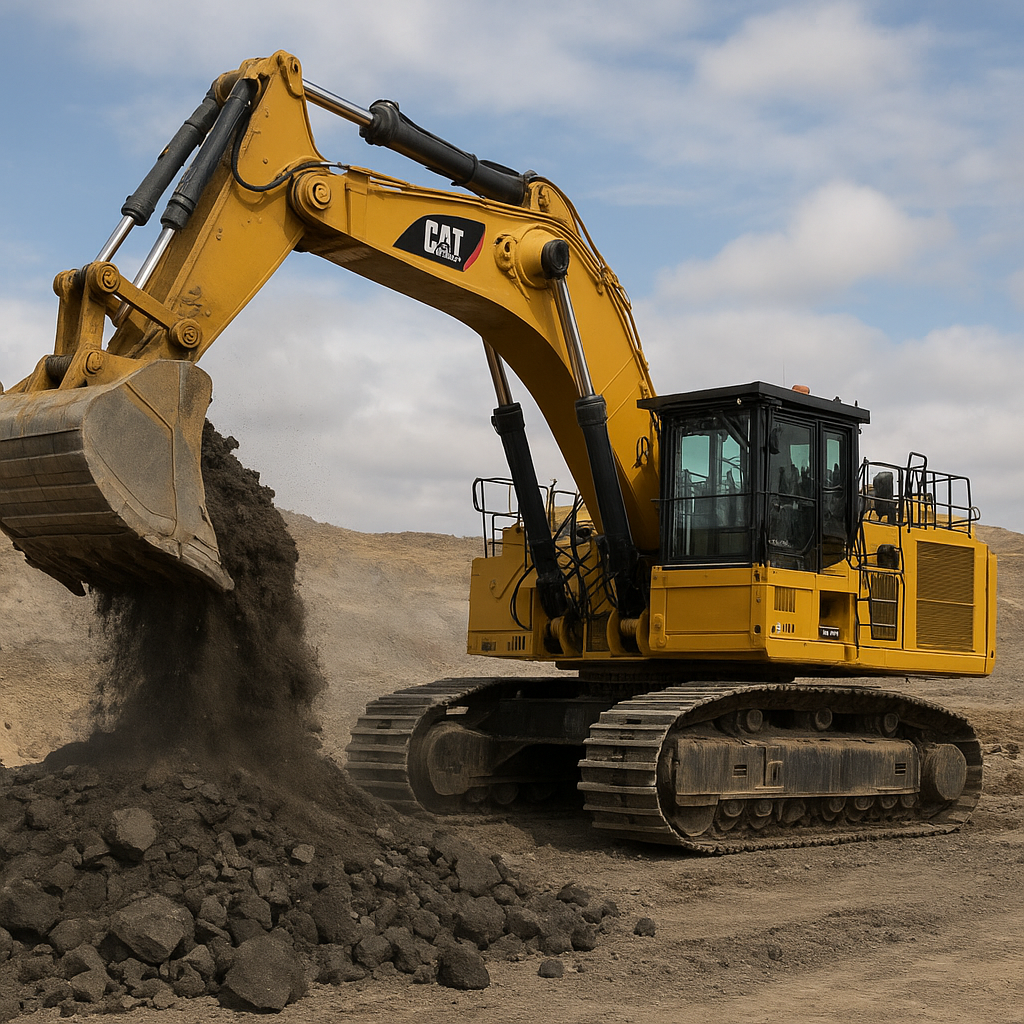
The Caterpillar 6015FS is a heavy-duty mining shovel designed for continuous, high-production material handling in large-scale open-pit and surface mining operations. Combining robust structural design with advanced hydraulics and operator-focused systems, this machine helps mining companies move millions of tonnes of material reliably. Below are detailed descriptions of its design, applications, operating characteristics, maintenance considerations and how it fits into modern mining fleets.
Design and technical features
The 6015FS is built on the proven engineering principles of Caterpillar’s large hydraulic shovel family. Its primary goals are to maximize productivity, ensure durability under extreme conditions and provide a relatively low total cost of ownership through serviceability and support. Typical characteristics include a heavy-duty undercarriage, a reinforced boom and stick, and a range of bucket sizes and attachment options to match rock types and loading targets.
Hydraulic system and powertrain
The shovel employs a powerful hydraulic system optimized for digging, swinging and crowding cycles. The hydraulic architecture is designed to deliver consistent flow and pressure to the working attachments while maintaining efficient fuel use. Many machines in this class incorporate load-sensing and priority-control circuits to optimize performance under variable loads. The powertrain is built to provide a balance between continuous output and service life, with components selected for heavy cycle duty.
Structure and attachments
- Heavy-duty boom and stick assemblies engineered to resist fatigue and shock loading.
- Bucket options ranging from smaller rock buckets for high-penetration digging to large capacity buckets for bulk loading and stockpiling.
- Interchangeable attachments such as rock breakers, hydraulic thumbs, and specialized lip and side cutters to adapt the machine to specific geology and loading equipment.
- Reinforced draglines, if fitted in hybrid configurations, or wear packages for high-abrasion environments.
Operator station and controls
Ergonomics and operator efficiency are central to the 6015FS cabin design. Modern cabins typically include climate control, suspension seating, intuitive joystick controls or electro-hydraulic interfaces and integrated displays showing machine status. Advanced monitoring technologies can feed into fleet management systems, giving supervisors near-real-time visibility on availability and cycle metrics.
Applications and industries
The 6015FS is tailored to high-volume operations where both reach and material handling rates are crucial. Its principal applications include:
- Open-pit mining — stripping overburden, ore extraction, and loading haul trucks up to the size specified by the mine fleet.
- Quarrying — high-production rock excavation and loading for aggregate production.
- Bulk material handling in large stockyards and ports — where consistent, high-capacity loading is required.
- Reclamation and civil earthworks projects on a large scale.
In mining operations, the 6015FS is often paired with large off-highway haul trucks, dozers for bench maintenance and ancillary loading equipment. Matching shovel bucket capacity and cycle times to truck payload is a key part of optimizing the production circuit.
Performance and productivity considerations
Shovel productivity is a function of several interrelated factors: bucket size and fill factor, cycle speed (dig, swing, dump, return), operator skill, material characteristics and the interaction with the hauling fleet. The 6015FS is designed to be competitive in each of these areas.
Cycle characteristics
- High hydraulic horsepower for rapid crowd and lift movements.
- Efficient swing mechanism to minimize time between digging and dumping positions.
- Advanced controls to assist operators in achieving consistent bucket fills, reducing partial loads and improving overall fleet efficiency.
Matching to truck fleets
One of the most critical performance metrics is the shovel-to-truck balance. A well-matched 6015FS and truck fleet combination reduces idle time, increases truck payload utilization and improves truck-shovel productivity. Fleet managers typically plan shovel bucket sizing and cycle times around the haul truck’s payload, body geometry and dump cycle to minimize queuing and waiting between equipment.
Maintenance, lifecycle and total cost of ownership
Long-term operational cost is a primary decision factor when purchasing and operating large mining shovels. The 6015FS is engineered to simplify routine maintenance and extend service intervals where possible, but the heavy-duty nature of mining requires consistent, planned upkeep.
Planned maintenance tasks
- Regular inspections and replacement of wear parts such as bucket teeth, lip shrouds and cutting edges.
- Hydraulic fluid sampling and filtration replacement schedules to protect pumps and actuators.
- Structural inspections for fatigue cracks and weld integrity, particularly on boom, stick and attachment points.
- Undercarriage monitoring and timely replacement of rollers, track shoes and idlers in tracked variants.
Serviceability and aftermarket support
Caterpillar’s global dealer network provides parts, retrofit options and service support, which can significantly influence the machine’s lifecycle costs. Options such as condition monitoring packages, telematics and remote diagnostics can reduce downtime by enabling predictive maintenance.
Safety, ergonomics and operator support
Mining shovels operate in some of the most hazardous workplaces. The 6015FS includes several features to protect operators and ground personnel:
- Robust structures and fall protection for service access points.
- Modern cabin visibility design and camera packages for blind-spot reduction.
- Integrated emergency-stop systems and isolation procedures for maintenance operations.
- Operator training modules that focus on safe digging practices, shutdown procedures and hazard recognition.
Workplace safety is enhanced by interlocking procedures between the shovel and truck fleets, radio or digital communication protocols, and adherence to site-specific traffic and proximity management rules.
Technology integration and digital tools
Digitalization is increasingly important in heavy equipment. The 6015FS can be integrated with fleet management systems and digital solutions to improve mine planning, production tracking and maintenance scheduling.
Examples of technology features
- Telematics for real-time location, hours, fuel consumption and fault codes.
- Payload and cycle monitoring to measure actual tonnes moved per hour and identify performance bottlenecks.
- Remote diagnostics and software updates that reduce the need for on-site specialist visits.
- Operator-assist systems to guide digging into benches and maximize bucket fill consistency.
Environmental considerations
Large hydraulic shovels consume significant amounts of fuel, so environmental performance is evaluated on fuel efficiency, emissions controls and efforts to lower lifecycle environmental impact.
- Modern engines and power management systems help reduce fuel burn per tonne moved, especially when paired with operator-training programs that emphasize efficient dig cycles.
- Use of biodegradable hydraulic oils and improved filtration can reduce the risk of soil contamination during service operations.
- Electrification trends in mining — such as mine-wide electrified shovels or electric drive haul trucks — are reshaping fleet-level emissions profiles. While the 6015FS is traditionally diesel-hydraulic, it can be part of broader electrification strategies via shore-power, hybridization or site-level power management.
Attachments, customization and retrofit options
To suit diverse operational needs, the 6015FS can be equipped with multiple attachment and retrofit choices:
- Wear packages and high-abrasion liners for hard-rock environments.
- Various bucket designs (rock, coal, high-capacity) and hydraulic quick-couplers for rapid adaptation.
- Remote monitoring kits, enhanced cooling systems for high-temperature environments and dust-suppressing seals and enclosures.
- Retrofits for advanced telematics, pit safety systems and energy recovery installations where feasible.
Examples of operational scenarios and case insights
Although specific operational metrics vary widely by site, some general scenarios illustrate how the 6015FS contributes to production goals:
- High-wear hard-rock bench: A 6015FS configured with a smaller, rock-penetration bucket and reinforced wear package focuses on penetration and controlled loading, trading bucket volume for reliable penetration and extended wear life.
- High-volume overburden stripping: Using a large-capacity bucket and optimized swing-speed settings, the 6015FS can move large volumes quickly into haul trucks, minimizing cycle time and reducing truck idle time.
- Port or stockpile reclaim: With specialized buckets and a focus on continuous duty cycles, the shovel can operate across multiple shifts to support uninterrupted material flow into ship loaders or conveyors.
Purchasing and fleet-integration considerations
When adding a 6015FS to a fleet, mines typically evaluate:
- Compatibility with existing haul trucks and pit geometry (reach, swing radius and dumping height).
- Availability of local dealer support and spare parts distribution.
- Operator training requirements and the projected learning curve for new controls or assist systems.
- Total cost of ownership models covering acquisition, parts, fuel, planned overhaul intervals and residual values.
Industry trends and future outlook
The mining equipment landscape is evolving in ways that influence how machines like the 6015FS are deployed:
- Automation: While full autonomy is more commonly applied to haul trucks, shovels are seeing increased automation in assist functions, remote control for certain tasks and integration into coordinated mine operations.
- Energy transition: Energy cost and carbon targets are driving interest in hybrid and electric options across mining fleets. Shovels may adopt electrified systems where infrastructure and economics allow.
- Predictive maintenance: Improved sensors and analytics are reducing unplanned downtime and extending component life through timely interventions.
- Customization: OEMs and dealers are offering more tailored wear and productivity packages to fit specific ore bodies and material conditions.
Final observations
The Caterpillar 6015FS represents a class of heavy hydraulic shovels designed for demanding, high-throughput mining and material handling tasks. Its strengths lie in structural robustness, hydraulic performance and the ability to be integrated into modern digital mine frameworks. Choosing the right configuration and supporting maintenance, operator training and technology tools are critical to unlocking the machine’s full potential and ensuring it contributes to efficient, safe and environmentally responsible mining operations.
Key terms emphasized
Caterpillar, 6015FS, mining shovel, hydraulics, bucket, productivity, durability, maintenance, safety, availability.
)
)