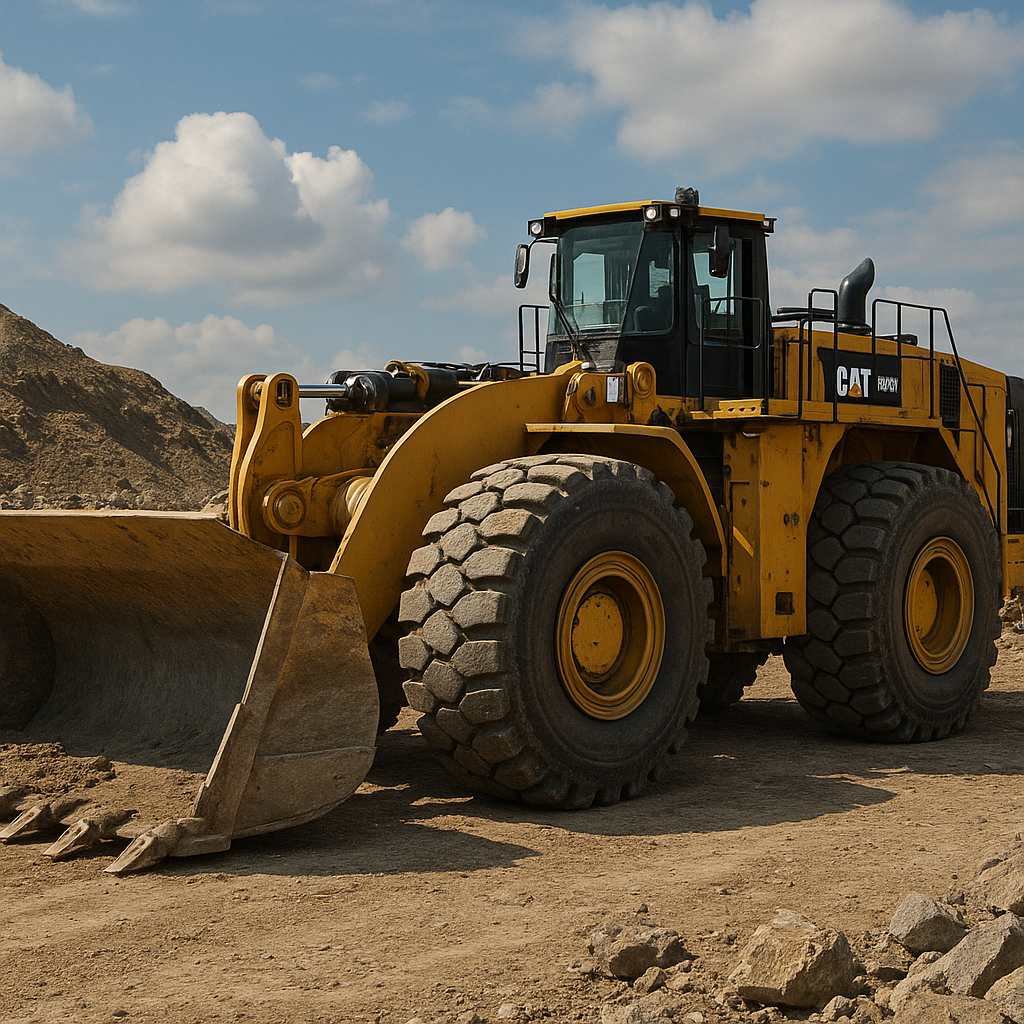
The CAT 994K is a flagship Caterpillar large-capacity wheel loader designed primarily for the most demanding environments. Combining heavy-duty structural design, advanced hydraulic and powertrain systems, and operator-focused ergonomics, this machine is intended to maximize productivity in bulk material handling tasks. The following article examines the 994K’s design philosophy, common applications, technical and operational considerations, and the economic and environmental factors relevant to fleet managers and site supervisors.
Machine overview and design philosophy
The CAT 994K belongs to a family of large wheel loaders engineered for high-throughput operations such as open-pit mining, quarrying, stockpile management, and port or bulk terminal work. Its overall architecture emphasizes robust structural members, heavy-duty axles, and components sized to withstand continuous, heavy loads over long service intervals. Key priorities in the design include maximizing uptime, simplifying serviceability, and delivering consistent cycle times under variable load conditions.
The loader platform integrates a high-capacity front linkage and a range of bucket sizes, allowing customers to match the machine to specific material densities and fleet loading targets. The frame, articulation joints, and loader arms are reinforced to resist common failure modes like fatigue and impact loading, while the driveline components are selected to optimize traction and mobility in rough terrain. While exact configurations vary, the 994K typically supports large bucket volumes and high payloads intended to load large haul trucks or feed crushers and conveyors continuously.
Primary applications and industry use cases
Large wheel loaders such as the 994K are deployed where moving large volumes of material quickly is the primary goal. Typical applications include:
- Open-pit mining — Loading of off-highway mining trucks, coarse ore handling, and reclaim operations.
- Quarries and aggregates — High-cycle loading of trucks and hoppers, stockpile management, and feed to primary crushers.
- Bulk terminals and ports — Handling of coal, iron ore, phosphate, and similar commodities for ship loading and storage yard operations.
- Large civil projects — Situations requiring rapid movement of overburden or large volumes of material where wheeled mobility and quick cycle times are advantageous.
Because of its size and capacity, the 994K is most efficient when paired with large-haul trucks or conveyor systems. In smaller-scale operations, its scale may be excessive from both cost and maneuverability standpoints, making medium wheel loaders or excavators more appropriate.
Technical features and performance considerations
Although exact specifications are configuration-dependent, the 994K is characterized by several technical features that contribute to its performance:
- Heavy-duty powertrain — Designed to deliver sustained torque for accelerate-and-load cycles while providing reliable operation in high ambient temperatures and dusty conditions.
- Robust hydraulics — High-flow hydraulic systems enable fast lift and tilt speeds for quick bucket filling and efficient truck loading.
- Optimized bucket and linkage options — A choice of bucket geometries and capacities allows matching to material types (e.g., wet sticky material versus free-flowing rock) and desired payload targets.
- Advanced cooling systems — High-capacity radiators and cooling packages maintain engine and hydraulic temperatures during prolonged heavy-duty cycles.
- Service access design — Grouped service points, centralized grease banks, and modular components simplify routine maintenance and reduce downtime.
Performance metrics for this class of machine typically focus on cycle time (seconds per load), effective payload per cycle, fuel consumption per tonne moved, and component life (hours between major overhauls). While global numbers vary by site conditions, experienced operators and fleet managers aim to balance bucket selection, engine throttle management, and travel distances to maximize tonnes-per-hour while keeping fuel consumption within acceptable limits.
Operator environment, controls, and safety systems
Operator comfort and ergonomics are important contributors to consistent productivity on extended shifts. The 994K’s cab is designed to reduce fatigue and increase situational awareness through ergonomically placed controls, high-visibility glazing, and vibration-damping mounts. Common features include air-suspended seats, climate control, and intuitive joystick or multi-function lever layouts that reduce repetitive strain.
Safety is addressed through structural design and technology aids. Typical safety features and systems include:
- ROPS/FOPS-protected cab — Protection against rollovers and falling objects.
- Rear and sideview cameras and mirrors for improved visibility around the machine.
- Proximity detection and collision-mitigation options that integrate with site monitoring systems.
- Integrated warning systems for over-temperature, low oil pressure, or transmission faults to help prevent catastrophic failures.
Operator training and standard operating procedures are equally important: correct loading techniques, adherence to recommended lift capacities, and gearbox management can dramatically affect both productivity and equipment life.
Maintenance, serviceability, and lifecycle costs
Large wheel loaders represent a significant capital investment. Minimizing total cost of ownership (TCO) requires a structured approach to maintenance and lifecycle planning. Design features that contribute to lower TCO on the 994K class machines include easy access to fluid and filter locations, centralized greasing points, and modular component replacement strategies that reduce labor time.
Predictive maintenance technologies — such as oil analysis, vibration monitoring, and telematics-based fault trending — extend service intervals and allow for planned, rather than reactive, downtime. Fleetwide condition monitoring can identify emerging issues before they become service-limiting failures, optimizing parts inventories and scheduling. Routine maintenance items typically include engine and hydraulic oil changes, filter replacements, lubrication of articulation points, and inspection of wear components such as bucket teeth and cutting edges.
When evaluating lifecycle costs, considerations include:
- Initial acquisition price versus expected productive life.
- Fuel consumption under duty-specific cycles (load, travel distance, idle time).
- Maintenance intervals and availability of replacement parts in the operating region.
- Resale and trade-in values at different hour thresholds and condition grades.
Fleet integration and productivity optimization
Modern large loaders are most effective when integrated into a coordinated fleet plan. Productivity is maximized by matching the loader’s cycle time to the hauling capacity and to-site logistics. Important factors for optimization include bucket fill factor, truck-bed geometry compatibility, and calibrated loading techniques to avoid underloads or overloading.
Telematics and fleet-management systems are a major advantage in this context. These systems provide data on machine utilization, fuel burn, idle time, and operator behavior. By analyzing trends, fleet managers can:
- Identify underused machines that can be redeployed or sold.
- Coach operators on fuel-saving practices and proper loading techniques.
- Schedule maintenance during low-usage windows to avoid peak production impacts.
- Benchmark productivity between sites and adjust fleet sizes accordingly.
Payload management systems integrated into the loader can provide real-time load weights, helping operators ensure consistent truck loading and reducing time wasted by multiple passes to achieve desired weight targets.
Environmental considerations and emissions
Large engine machines are significant consumers of fuel and contributors to site-level emissions. Manufacturers and fleet operators address environmental concerns by combining engine technologies that comply with regional emissions standards with operational strategies to reduce fuel use. Common approaches include:
- Engine calibration for optimized combustion and aftertreatment systems to meet emissions regulations.
- Automatic idle-shutdown features and intelligent engine management to reduce unnecessary idling.
- Use of alternative fuels or blended fuels where permitted and feasible.
- Regular maintenance to keep engines and hydraulic systems operating at peak efficiency.
Site layout and logistics planning can also reduce unnecessary travel and fuel consumption — for example, minimizing haul distances between loading and dumping points or implementing conveyor systems to reduce truck traffic entirely for certain flows.
Interesting operational examples and case insights
Operators of machines in this class report that the most critical determinants of on-site success are machine selection to match the task, consistent operator training programs, and rigorous preventative maintenance disciplines. In high-capacity loading operations, pairing a large loader such as the 994K with appropriately sized haul trucks reduces unit cost per tonne and smooths production scheduling.
Case observations from large quarry and mining operations commonly highlight:
- The importance of correct bucket selection: too-large buckets reduce fill factor and increase cycle time; too-small buckets underutilize the loader’s capacity.
- The value of real-time payload and telematics data to rapidly identify inefficiencies and monitor equipment health.
- How consistent operator routines produce measurable gains in fuel efficiency and reduced component wear.
Purchasing considerations and resale factors
When considering acquiring a 994K-class loader, purchasers typically evaluate:
- Expected annual throughput and how the machine will match truck sizes in the fleet.
- Availability of local dealer support, parts, and qualified service technicians.
- Financing options, warranties, and extended service agreements that mitigate downtime risk.
- Historical resale values for similar machines in comparable operating regions.
Used equipment markets for large wheel loaders can be cyclical and region-specific. Machines with documented maintenance histories and telematics records usually command higher resale prices because buyers have greater confidence in the remaining useful life.
Future developments and technological trends
The next generation of heavy equipment emphasizes connectivity, automation, and emissions reduction. For large wheel loaders these trends include:
- Telematics enhancements that provide more granular data for predictive maintenance and productivity analytics.
- Partial automation and assistive features (such as automated bucket leveling, grade-assist, or select autonomous cycles) to reduce operator variability and improve consistency.
- Continued improvements in engine and aftertreatment design to meet tightening emissions standards while maintaining fuel efficiency.
- Exploration of alternative drivetrains — electrification or hybrid systems — where duty cycles and site infrastructure make these options viable.
Improvements in materials science and component manufacturing also contribute to increased service lives for structural components and undercarriage parts, reducing long-term replacement costs.
Summary
The CAT 994K-class wheel loader represents a class of machines tailored to high-volume, heavy-duty material-handling tasks. Its value proposition rests on delivering high productivity, robust reliability, and serviceability in tough operating environments. Decisions about deploying such a machine should be driven by alignment between machine capacity and site logistics, the availability of support and parts, and an ongoing commitment to operator training and preventative maintenance. Integrating modern telemetry and payload-management technologies enhances fleet performance and provides measurable returns through reduced fuel consumption and improved uptime. For detailed, configuration-specific statistics (engine power, operating weight, bucket capacity, cycle times), consult the manufacturer’s official specification sheets or a certified dealer to ensure precise matching to your operational needs.
)
)