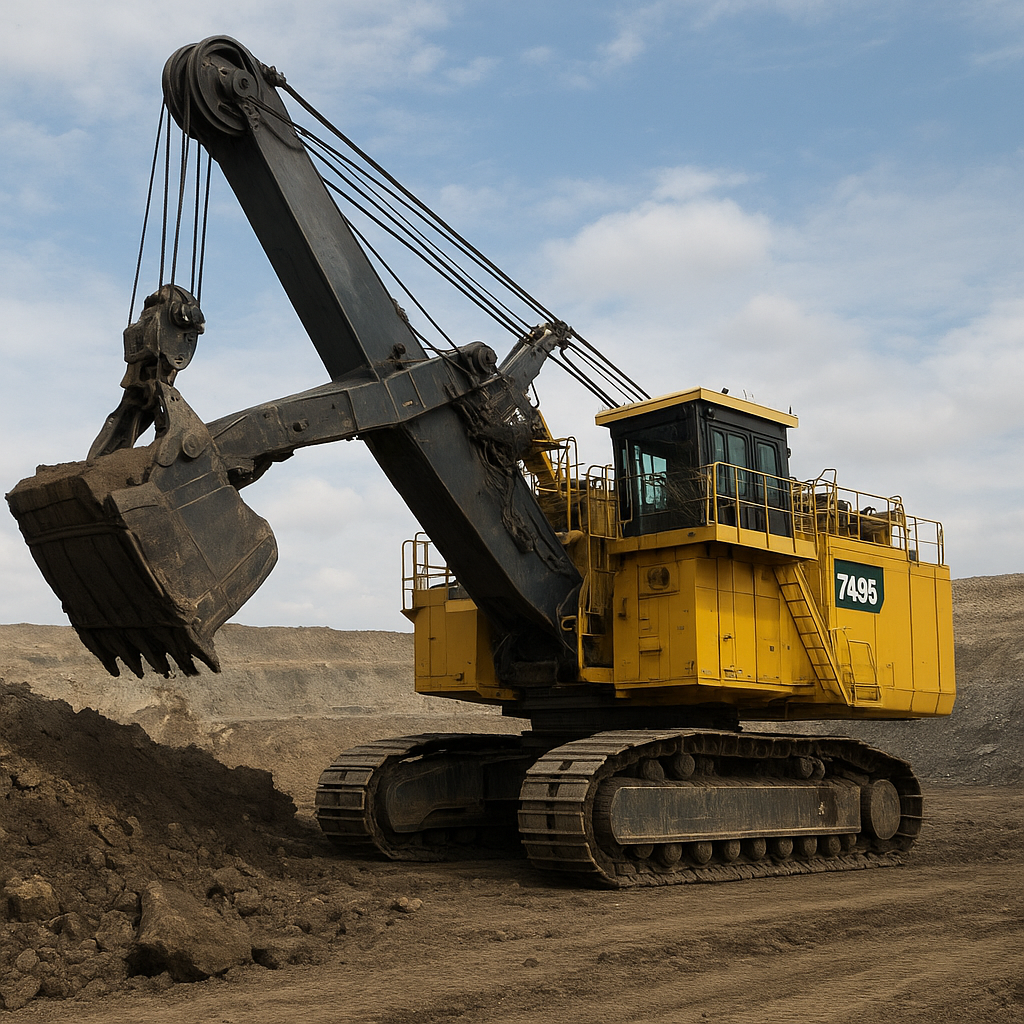
The CAT 7495 is a heavy-duty, electric rope shovel designed for high-productivity mining operations. This machine combines proven mechanical architecture with modern electrical drive systems and advanced controls, making it a cornerstone for open-pit mines that require reliable, high-volume loading of haul trucks and processing circuits. In the following sections we explore the 7495’s design and capabilities, its typical applications across the mining industry, operational and economic considerations, maintenance and safety aspects, and the technological trends shaping the future of large electric shovels.
Overview and fundamental design
The CAT 7495 belongs to a class of large electric rope shovels engineered to move enormous amounts of material in surface mining. Unlike hydraulic excavators, rope shovels use wire ropes and winches to control the dipper, hoist, crowd, and swing systems. The electric drive architecture supplies power to winches and motors via high-voltage electrical systems, offering efficiency, controllability and durability under heavy cyclic loads.
Core components and configuration
- Dipper: The dipper (bucket) is the primary production element. Dipper capacities for shovels in the 7495 size class typically vary by application and configuration, commonly falling in a range that supports match-loading of large haul trucks. Capacities are often configurable to handle ore, overburden or fragmented rock.
- Hoist and crowd systems: Wire ropes, drums and mechanical gearing provide the force needed to raise/lower the dipper and to extend/retract it into the face. These systems are designed for high durability and ease of rope maintenance.
- Electrical drives and transformers: High-voltage systems power AC motors that drive hoist, swing and propel functions. Onboard transformers and switchgear manage the conversion and distribution of electrical power.
- Undercarriage and structural boom: The structural frame, slewing ring and boom are engineered for repetitive, high-stress loading. Condition monitoring and structural health considerations are critical because of the cyclic, high-magnitude stresses.
- Operator cab and control systems: Ergonomically designed cabs with HVAC, advanced controls, and electronic monitoring systems support high operator effectiveness. Many units integrate remote monitoring and automation-ready hardware.
Manufacturers like Caterpillar design these units to be modular where possible, so components such as engines (for auxiliary systems), generators, or specific electrical packages can be adapted to site requirements. The 7495’s electrical operation provides advantages in torque delivery and energy management compared to large hydraulic machines.
Applications and industry use cases
The primary role of the CAT 7495 is in large-scale surface mining. It is most often deployed where continuous, predictable, high-volume loading is required. Typical mining contexts include:
- Coal mining – for removing overburden and loading coal onto haul trucks and conveyors.
- Copper, gold and base metal operations – handling waste rock and ore in large open-pit mines where bench heights and haul-truck fleets are sized for rope-shovel productivity.
- Iron ore and mineral sands – where large tonnages of bulk material must be moved cost-effectively.
- Quarrying and aggregate production – in very large operations requiring heavy, repetitive digging.
Electric rope shovels like the 7495 are particularly well-suited to operations that use large, rigid-frame haul trucks (from around 90-ton payloads up to the largest 400-ton trucks), where match-loading the truck in one or two bites is essential for cycle-time efficiency. They are often paired with production programs that favor predictable, repetitive material handling rather than highly selective excavation.
Match with mine fleet and bench design
Selecting a 7495-class shovel is a function of bench height, haul-truck capacity, material characteristics and production targets. For example, a fleet dominated by 150–240 tonne haul trucks will typically pair well with a shovel whose dipper size and cycle time allow single-pass loading or minimal partial loading, reducing truck cycle time and increasing daily tonnage. Bench design—including berms, floor conditions and ramp geometry—also influences shovel positioning and productivity.
Performance, productivity and key statistics
Performance for a machine like the CAT 7495 is measured in several ways: bucket fill factor, cycle time, hourly tonnage, availability and energy efficiency. While exact metrics vary by site, rock type and fleet match, some general benchmarks and typical ranges help illustrate expected performance:
- Installed electrical power: units in this class commonly require multi-megawatt power feeds, with installed motor power typically in the 2–10 megawatt range depending on configuration and auxiliary systems. The exact requirement depends on hoist power, crowd force and swing motor capacity.
- Bucket/dipper capacity: depending on configuration, dipper volumes for large shovels typically range from roughly 25–60 cubic meters (approximately 33–78 cubic yards). This capacity is matched to haul-truck payloads to optimize cycles.
- Cycle time and hourly production: effective cycle times can range from 20 to 40 seconds per bite in ideal conditions; with proper dipper fill and a well-matched truck fleet, hourly production can be tens of thousands of tonnes – often in the range of several thousand to tens of thousands of tonnes per hour depending on material density and bucket size.
- Machine availability: industry targets for availability for large mining shovels typically exceed 85–90% with effective maintenance regimes and predictive diagnostics. Unplanned downtime is a major cost driver and therefore caterpillar and operators focus strongly on condition-based maintenance.
- Life span: major rope shovels often have economic lives of 15–30 years in heavy-duty mining service when maintained properly; critical wear components (dipper lip, ropes, bearings) are replaced periodically while the main structural frame may serve multiple decades.
These figures are indicative: final production rates and power consumption depend heavily on material abrasiveness, fragmentation, bench design, operator skill, and the degree of automation and monitoring in use. One consistent advantage of electric rope shovels is their strong torque and power delivery, enabling consistent cycle times on heavy cuts that might slow hydraulic machines.
Maintenance, reliability and lifecycle economics
Managing the maintenance of a CAT 7495 requires a structured approach. The machine’s economic value is tied to uptime, predictable operating costs, and longevity of its wear parts. Key maintenance and reliability themes include:
Wear parts and scheduled interventions
- Dipper lips and liners: these receive the highest abrasion and impact wear. Regular inspection and scheduled replacement are normal and are major consumable costs.
- Wire ropes and drums: rope inspection and replacement are critical for safety and performance. Rope life is influenced by loading cycles, corrosion, and sheave wheel condition.
- Swing bearings and slewing rings: regular lubrication regimes and condition monitoring are necessary to avoid catastrophic failures.
- Electrical system health: switchgear, transformers, and motor components are monitored; vibration and thermal imaging are often used to detect incipient faults.
Predictive maintenance and diagnostics
Modern rope shovels in the 7495 class frequently include onboard diagnostics, telematics and integration with maintenance management systems. Predictive maintenance uses vibration analysis, oil condition monitoring, rope condition sensors and electrical monitoring to schedule interventions before failures occur. This approach reduces unplanned downtime and extends component life.
Lifecycle cost considerations
Although initial capital costs for large electric shovels are high, lifecycle costs can be favorable compared to alternative technologies when the machine achieves high availability and productivity. Key economic factors to consider:
- Energy costs: electric operation can be more efficient than diesel-hydraulic alternatives, but requires reliable high-voltage supply and may incur infrastructure costs.
- Consumables: wear parts and rope replacement are predictable ongoing expenses; planning and inventory management reduce long-term downtime.
- Resale and reuse: well-maintained machines retain substantial retrade value, and structures can sometimes be repowered or reconfigured for secondary operations.
Safety, environmental and regulatory considerations
Large rope shovels operate in demanding and potentially hazardous environments. Safety and environmental management are core aspects of responsible operation.
Safety features and practices
- Operator visibility and ergonomics: cabs are designed for clear sightlines and reduced fatigue; cameras and proximity detection systems further improve situational awareness.
- Proximity detection and collision avoidance: integration with mine-wide systems to prevent vehicle interactions and protect ground personnel.
- Rope and structural safety protocols: strict inspection and replacement cycles for ropes, hoist components and structural fasteners are enforced.
- Emergency systems: fail-safe brakes, emergency stop circuits and grounding systems are standard to protect equipment and people.
Environmental aspects
Electric rope shovels offer environmental benefits compared with large diesel-powered systems due to reduced direct emissions at the point of use; however, total environmental impact depends on the source of electrical energy. Site electrification can support decarbonization strategies when paired with low-carbon grid supplies or on-site renewable generation. Additional considerations include dust control, water management for wash and coolant systems, and noise mitigation for nearby communities.
Technological evolution and future trends
Large electric rope shovels are benefiting from continuous technological advances. Trends that shape the present and future of the 7495 class include:
- Automation and autonomy: semi-autonomous or fully autonomous shovel operation is increasingly feasible. Operator-assist systems, automatic crowd and hoist sequencing, and integration with autonomous haul trucks can significantly improve productivity and safety.
- Digitalization: telematics, real-time diagnostics and cloud-based analytics enable predictive maintenance and fleet optimization. Data-driven decision making reduces cost per tonne and improves availability.
- Energy optimization: regenerative braking and hoist energy recovery systems can return energy to the grid or reduce total consumption. Advanced drive control reduces peak demand and improves component life.
- Materials and component improvements: advanced steel grades, surface treatments and wear-resistant materials extend life of buckets, lips, and structural parts.
Integration with broader mine-control systems (fleet management, pit optimization, and processing plant scheduling) gives operators the ability to tune shovel operation to maximize throughput while minimizing energy and maintenance costs.
Operational best practices and tips for maximizing value
To get the most out of a CAT 7495, mines typically employ a mixture of planning, training and technology:
- Design benches, ramps and truck routes to minimize repositioning of the shovel and to ensure safe, efficient truck loading zones.
- Use fragmentation control and blasting practices to ensure fill factors are maximized and cycle times are stabilized.
- Implement a rigorous condition-monitoring program covering ropes, bearings, hydraulic auxiliaries and electrical systems.
- Standardize spare parts inventory to reduce lead times for critical consumables and increase readiness for scheduled maintenance.
- Train operators in optimized digging sequences, including ideal crowd/hoist timing, to maximize dipper fill and reduce wear.
Comparison to alternatives and where the 7495 excels
Compared with large hydraulic excavators, the CAT 7495 and similar rope shovels have several strengths and trade-offs:
- Strengths:
- High-force, high-durability digging advantageous for large bench operations and hard or compacted material.
- Often superior lifecycle cost in high-tonnage, repetitive loading applications due to lower hydraulic maintenance burdens and robust mechanical systems.
- Electric drives facilitate integration with site electrification strategies and offer efficient power delivery.
- Trade-offs:
- Less flexible for highly selective digging or complex face profiles compared with hydraulic excavators.
- Requires substantial electrical infrastructure and might be less mobile between sites without disassembly.
Closing perspectives
The CAT 7495 electric rope shovel represents a powerful, proven solution for mines that require steady, high-volume material handling over long operating campaigns. Its combination of mechanical robustness, high-power electric drives and modern digital systems enables high availability and efficient operation when matched correctly to a mine’s bench design, haul fleet and production goals. With continuous improvements in automation, predictive maintenance and energy recovery, machines in this class are likely to remain central to large-scale surface mining operations as operators pursue higher productivity with lower lifecycle costs and reduced environmental impact.
)
)