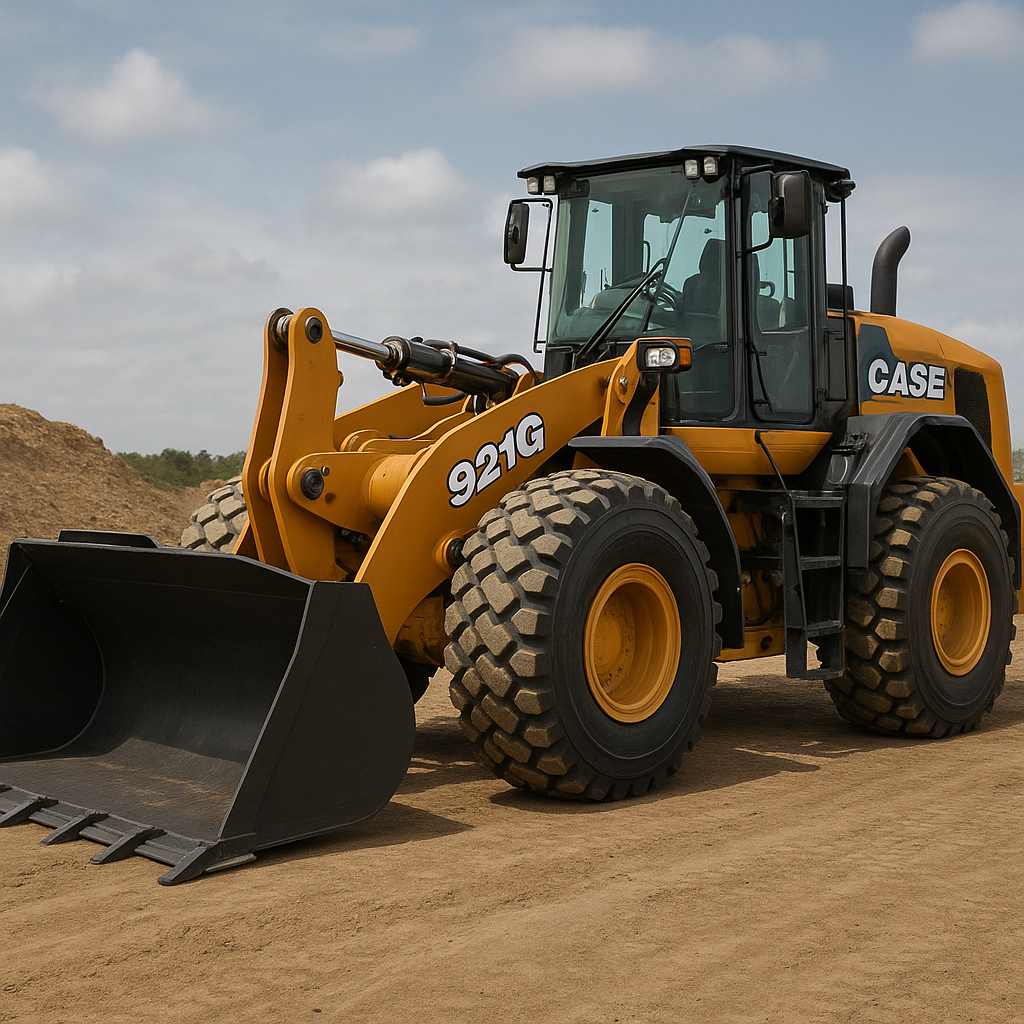
The CASE 921G is a versatile mid-size machine in the CASE lineup of wheel loaders, designed to balance power, fuel economy and operator comfort for a wide range of material-handling tasks. In this article you will find an overview of the machine’s design philosophy, typical technical characteristics, real-world applications, operational and maintenance considerations, and market-related aspects such as lifecycle costs and resale. Wherever specific numbers are referenced, note that values can vary by production year, regional configuration and optional packages.
Overview and design philosophy
The CASE 921G is positioned to serve contractors, municipalities and plant operators who require a reliable wheel loader with a good mix of lifting capacity and maneuverability. CASE designed this model with a focus on serviceability, visibility and robust hydraulics so it can perform effectively in loading, stacking, material handling and light quarry duties.
Key design goals
- Durability in mixed construction and industrial environments.
- Efficient power delivery and reduced operating costs.
- Improved operator ergonomics and visibility for extended shifts.
- Flexibility to accept a broad range of attachments and work tools.
The chassis layout and articulation geometry prioritize stability and balance between lift capacity and traction. CASE typically designs its G-series loaders to be easy to service, with grouped maintenance points and accessible filters, which helps lower downtime and maintenance labor hours.
Typical technical specifications and performance
Exact specifications for the CASE 921G depend on model year and optional equipment. The following figures are presented as typical ranges that reflect common configurations. Where possible, operational context is provided to help interpret the numbers.
Powertrain and engine
- Engine: Turbocharged diesel, emissions level dependent on production year and market (for older units Tier 3/Stage IIIA; later versions upgraded to Tier 4 Final/Stage IV or equivalent where required).
- Rated power: commonly in the mid-horsepower range suitable for a mid-size loader (typical industry examples sit between roughly 90–140 kW / 120–190 hp depending on spec).
- Cooling and air intake systems designed for dusty environments common to construction and quarry work.
CASE focuses on matching engine response to hydraulic demands so the machine can perform frequent lift-and-dump cycles without power lag. Electronic engine management on newer units helps optimize fuel delivery and emissions control.
Hydraulics and breakout performance
- Hydraulic system: load-sensing or pressure-compensated systems (depending on configuration) to provide smooth, efficient attachment control and fast cycle times.
- Hydraulic flow and pressure tuned to provide strong bucket curl and crowding speed for loading trucks and stacking.
- Breakout force and lift-at-full-height figures vary by arm geometry and bucket size; typical machines in this class deliver substantial breakout force for bucket penetration and material breakup.
Load-handling metrics
- Operating weight: commonly in the mid-tonnage range for this class—sufficient to provide traction and stability when handling heavy loads.
- Bucket capacity: varies by application—smaller buckets for dense materials (e.g., 1.8–2.2 m3) and larger light-material buckets for bulk materials (e.g., up to 3.0 m3 or more).
- Rated operating load and tipping load will depend on attachments and counterweight options; always refer to the machine’s load chart for safe operating limits.
Fuel consumption and efficiency
Fuel efficiency is a major consideration for owners. Typical hourly fuel consumption for machines in this class depends on duty cycle—light stockpiling versus heavy truck-loading—and can range widely. Common real-world ranges are between about 8–25 liters per hour, with lower values achieved in steady-state or light-duty tasks and higher values under continuous heavy loading.
Transmission and drive
- Transmission choices usually include powershift or torque-converter automatic transmissions optimized for mixed load-and-travel tasks.
- Multiple gear ranges and manual/automatic modes can improve cycle times and control in ramp or truck-loading work.
- Axles and final drives designed to withstand heavy shock loads often encountered in construction and quarry environments.
Applications and typical use cases
The CASE 921G is widely used across industries because of its balance of size and capability. Operators appreciate models that can be reconfigured with attachments for seasonally shifting roles.
Construction and civil works
- Loading dump trucks with loose materials (sand, gravel, crushed stone).
- Site cleanup and transfer of demolition debris.
- Backfilling, grading support and moving heavy pallets when fitted with forks.
Quarry and aggregate operations
- Handling processed aggregate, feeding crushers or stockpiling blended materials.
- Using specialized buckets for rock or abrasive materials to increase wear life.
Municipal and utility services
- Seasonal tasks like snow removal with snow buckets and pushers.
- Street sweeping support, loading cleared vegetation and green waste.
Agriculture and bulk-material handling
- Handling feed, grain or bulk commodities when equipped with high-capacity buckets.
- Farmstead and feedlot operations where a mix of lifting, stacking and clean-up is necessary.
Recycling, demolition and waste handling
- Material sorting and feeding recycling lines when fitted with grapples or specialized attachments.
- Moving mixed wastes and heavy palletized items in transfer stations.
Operator experience, cab features and safety
CASE emphasizes operator productivity through cab design and control ergonomics. Key elements typically include:
- Large glazing area for improved visibility to the bucket and wheelline, which reduces the number of blind spots during loading and truck approach.
- Ergonomically placed joysticks, adjustable seats and climate control for comfort during long shifts.
- Integrated diagnostics and monitor panels that present engine/hydraulic information and fault codes, simplifying troubleshooting.
- Rollover protection (ROPS) and falling-object protective structures (FOPS) built to applicable safety standards.
Modern CASE units often include optional camera systems and proximity alerts to reduce the risk of collisions in tight yards. Operator training remains one of the most effective ways to increase safety and prolong machine life.
Attachments and versatility
One of the strengths of the CASE 921G is how readily it accepts a variety of attachments to extend its usefulness across seasons and jobs. Typical attachments include:
- Buckets (general-purpose, light-material, multi-purpose / 4-in-1, rock buckets)
- Pallet forks and bale forks for material handling
- Grapples for demolition, scrap and recycling
- Snowplows, snow pushers and blower units for winter maintenance
- High-tip buckets for operations that load high-sided trucks or hoppers
Choosing the right attachment can significantly alter the machine’s productivity and should be evaluated with respect to material density, cycle type and ground conditions.
Maintenance, serviceability and lifecycle costs
Lower total cost of ownership is a frequent selling point for CASE machines. Factors that influence lifecycle cost include fuel consumption, maintenance intervals, parts availability and downtime. Important maintenance-related features and best practices for a CASE 921G include:
- Grouped service points and easily accessible filters—these reduce time for routine checks and fluid/top-off tasks.
- Scheduled preventive maintenance according to hours of operation—regular oil and filter changes, hydraulic checks and final drive inspections.
- Monitoring tire condition and proper inflation—tires represent a significant recurring cost, and proper selection (and tire management) improves fuel economy and traction.
- Using OEM or high-quality aftermarket parts for critical components like buckets, cutting edges, hydraulics and drivetrain parts to preserve performance and resale value.
Operators can often see meaningful reductions in fuel and maintenance costs through telematics and fleet-management systems that monitor machine hours, idling time and fault codes. CASE offers telematics packages on many models which help track utilization and forecast maintenance needs.
Market considerations and resale
When evaluating a CASE 921G purchase, owners should consider initial purchase price, expected working life, residual value and market demand for used units. Factors that positively influence resale include:
- Comprehensive service records and evidence of preventive maintenance.
- Low to moderate hours relative to machine age and proper attachment inventory.
- Original equipment and minimal structural repairs or welding to the loader arms and frame.
CASE machines generally maintain competitive resale value due to brand recognition and parts support. Depreciation curves vary by region and equipment condition; heavy-use machines in quarry service often depreciate faster than machines used for light site work.
Statistics and performance data (guidance and ranges)
Because specifications can change between production years and chosen options, the following figures are indicative ranges commonly seen for a mid-size loader in the CASE 921G class. Use these as planning figures rather than guaranteed values for a specific serial number.
- Typical operating weight: approximately 10–14 metric tons (depending on configuration and ballast).
- Typical bucket capacities: 1.8–3.0 cubic meters for common bucket types; specialty buckets expand this range.
- Engine power: commonly in the 90–140 kW (120–190 hp) band depending on emission package and tuning.
- Fuel consumption (working average): 8–25 liters/hour depending on duty cycle; urban and light work near the low end, continuous heavy loading near the high end.
- Average cycle times for a standard loading cycle (approach, fill, lift, swing, dump, return) depend on operator skill and hydraulic response but are optimized by responsive hydraulics to minimize cycle time.
For accurate machine planning, owners should obtain the official load charts and specification sheets for the specific model year and configuration of the 921G they are considering.
Operational tips to maximize productivity
To get the best performance from a CASE 921G, follow these practical recommendations:
- Match bucket size to material density—oversized buckets reduce fill factor and increase cycle time for heavy materials.
- Train operators on efficient loading paths to minimize travel distance and steering cycles.
- Use the appropriate drive and hydraulic modes for the task (many units provide economy or power modes).
- Plan maintenance during low-use periods and leverage telematics to predict component replacement before failures occur.
- Regularly inspect wear components such as cutting edges, pins and bushings; replace them before excessive wear leads to inefficient loads or structural stress.
Environmental and regulatory considerations
Emission regulations have driven engine upgrades across the industry. Many CASE loaders built in recent years meet stringent standards using aftertreatment systems such as diesel particulate filters (DPF) and selective catalytic reduction (SCR). Owners should be aware of the regional emissions standard (e.g., EU Stage IV, US Tier 4 Final) that applies to their equipment because it affects maintenance (e.g., DPF servicing) and fuel quality requirements.
Noise and dust control are often necessary on urban job sites. Adding enclosed cabs with effective sealing, HVAC filtration and choosing the right tires and operating practices helps reduce environmental footprint.
Conclusion
The CASE 921G is a flexible and dependable choice in the mid-size wheel loader category, offering a balance of power, serviceability and operator comfort for a wide variety of industries—from construction and quarrying to municipal and agricultural applications. While exact performance numbers depend on year and configuration, the machine’s real value lies in its adaptability through attachments, its maintainable design and the operational efficiencies achieved when matched correctly to the intended work. Prospective buyers should consult the specific model year data sheet for precise numbers, evaluate duty cycle needs, and consider telematics and service history to optimize lifecycle costs and resale value.
)
)