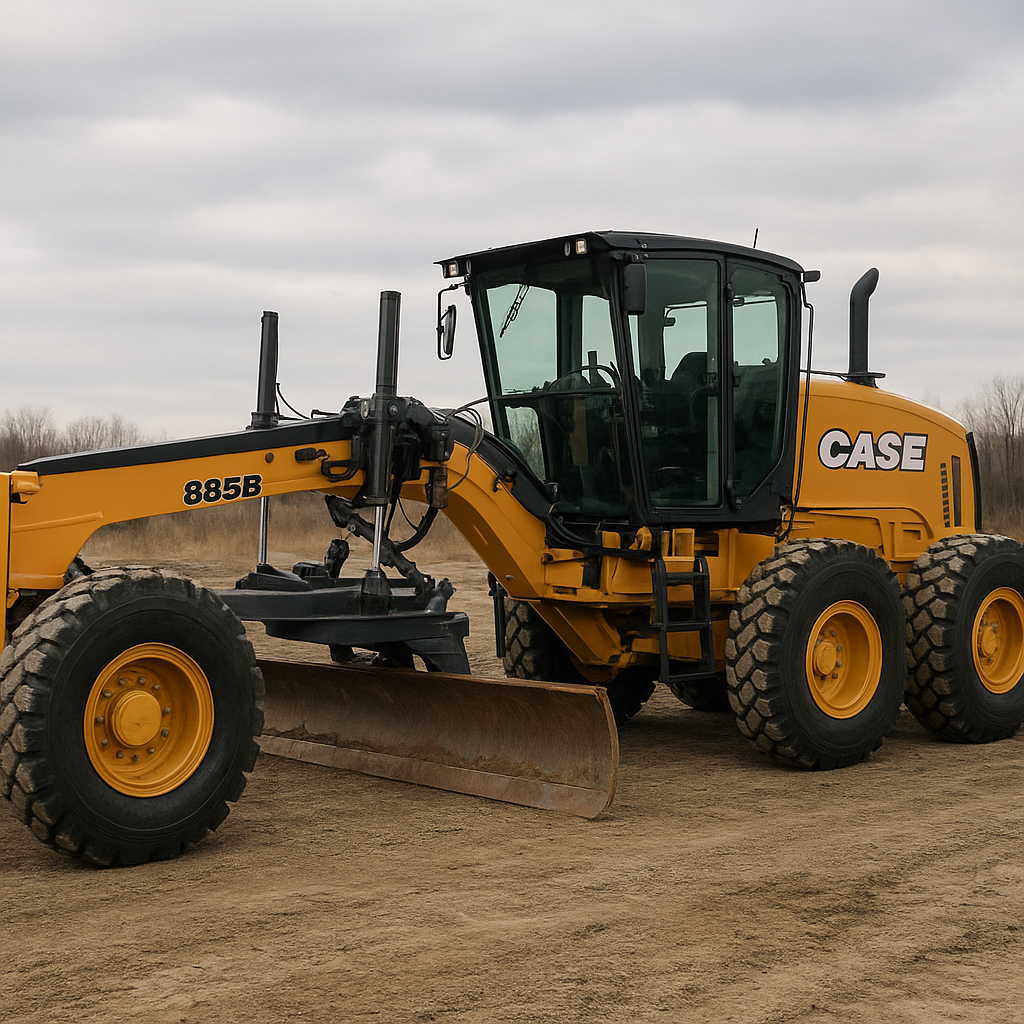
The CASE 885B motor grader is a reliable piece of heavy equipment that has served construction, road maintenance, and civil engineering projects for decades. Built with a focus on simplicity, serviceability and all-around performance, this grader offers a balance between power and maneuverability that makes it useful in a wide range of tasks. In the sections below you will find a detailed look at its technical characteristics, typical applications, operational considerations, market and maintenance information, and a selection of interesting facts about the machine.
Design and technical characteristics
The CASE 885B is a medium-class motor grader designed to perform earthmoving, grading and fine-finish tasks. Its architecture follows the classic grader layout: front axle with adjustable wheels, a mid-mounted operator station, a long frame with a centrally mounted moldboard (blade), and a rear power unit housing the engine and drive components. The machine emphasizes ruggedness and ease of repair, which contributed to its long operational life in many fleets.
Powertrain and engine
- Engine: The 885B was offered with a diesel engine tailored for continuous heavy-duty operation. Typical installed power for machines in this class is in the range of 150–200 horsepower (gross), though exact ratings vary by year and specification.
- Cooling and aspiration: Diesel engines of this era typically used turbocharging and robust cooling systems to maintain performance under sustained load, especially in hot climates or high-altitude work sites.
- Transmission: Power is transferred through a multi-speed transmission and differential arrangement, sometimes with optional torque-converter or power-shift features depending on configuration and aftermarket upgrades.
Blade and articulation
- Moldboard: The grader typically comes equipped with a center moldboard about 12 feet (approx.) wide, suitable for road grading and leveling tasks. Blade design allows for angle, pitch and tilt adjustments to shape and finish surfaces precisely.
- Articulation: Many graders employ articulated frames to enhance maneuverability and reduce turning radius; the 885B’s frame geometry and steering system enable precision work along edges and slopes.
- Cutters and attachments: The machine can be fitted with circle motors, scarifiers, rippers and other front or rear-mounted implements to increase flexibility on different soil and surface types.
Hydraulics, controls and operator station
- Hydraulic system: The hydraulics power blade positioning, steering assist and attachments. Systems are generally mechanical/hydraulic with simple circuitry for reliability and easier field repairs.
- Controls: Mechanical levers or early electro-hydraulic controls give the operator direct command over blade and articulation functions; the layout prioritizes durability over high-tech interfaces.
- Cab and ergonomics: Depending on the model year and factory options, the cab offers varying degrees of comfort and visibility. Operators benefit from a high vantage point and clear sightlines to the blade and working surface.
Weights and dimensions (typical/approximate)
Because specifications change with serial numbers and optional equipment, the following values should be treated as representative ranges rather than absolute figures:
- Operating weight: roughly 10,000–13,000 kg (22,000–29,000 lb).
- Overall length: depends on configuration but commonly in the 8–9 m range.
- Moldboard width: typically about 3.6 m (12 ft).
- Ground clearance and axle load: designed to strike a compromise between stability and flotation on soft soils.
Typical applications and working environments
The CASE 885B has been used across multiple sectors because of its versatility and straightforward mechanical design. Its most common applications include:
- Road construction and maintenance — shaping roadbeds, creating smooth profiles for base and surface layers, and maintaining gravel/dirt roads.
- Site preparation — leveling building pads, trimming slopes, and preparing areas for paving or landscaping.
- Agricultural infrastructure — maintaining farm tracks, drainage ditches and yard surfaces on larger agricultural properties.
- Mining and quarry support — maintaining haul roads, smoothing work surfaces and assisting in small-scale site grading operations.
- Snow removal — in colder regions, graders fitted with appropriate blades are used to clear snow from roads, airports and yards.
- Utility and pipeline projects — creating access roads, clearing right-of-way surfaces and restoring surfaces after trenching.
Because the 885B is not the largest grader in Case’s lineup, it often excels in medium-duty tasks where maneuverability and economy are prioritized over maximum throughput. It frequently finds a place in municipal fleets, smaller contractors, and owner-operators who value a dependable grader that is relatively simple to maintain.
Operation, maintenance and productivity
Operating a CASE 885B effectively requires an understanding of blade dynamics, weight transfer and ground interaction. Skilled operators can use the grader to produce highly accurate road surfaces and contours by combining machine geometry with careful pass planning.
Operator techniques and productivity tips
- Blade control: Use the blade pitch and angle to maintain material flow rather than forcing cuts. Slight, repeated passes often produce better surface finish and reduce fuel consumption.
- Speed and momentum: Optimal travel speeds depend on material and blade setting. Too fast leads to poor cut quality; too slow increases cycle time and fuel burn.
- Weight distribution: Use front/rear implements (rippers, scarifiers) judiciously to alter front axle load for better traction when cutting hard-packed surfaces.
Maintenance considerations
- Routine checks: Regular inspection of the blade circle, cutting edges, hydraulic lines, and articulation bearings will prevent progressive damage. Keep grease points serviced on schedule.
- Engine upkeep: Timely oil changes, filter replacement and cooling-system maintenance prolong engine life and maintain fuel efficiency.
- Undercarriage and tires: For wheel graders like the 885B, tire selection and pressure management are crucial. Monitor for uneven wear and replace tires when needed to preserve grading accuracy.
- Parts availability: Replacement parts remain available through OEM dealers and aftermarket suppliers for many years after production due to the popularity of the platform. Salvage markets also provide components for older units.
Fuel consumption and operating costs
Fuel consumption depends on engine tuning, load, terrain and operator style. In typical medium-duty grading work, hourly fuel consumption commonly ranges from approximately 15 to 30 liters per hour (4–8 gallons per hour), but this varies significantly with conditions. Routine maintenance, correct tire pressure, and skilled operation all contribute to lower life-cycle costs.
Market history, availability and resale
The CASE 885B has been sold across many regions and remains present in used-equipment markets worldwide. Its straightforward design makes it a desirable option for buyers seeking a capable grader without the complexity or cost of more modern machines.
- Production and era: The model belongs to a generation of graders produced in the late 20th century. Exact production years and serial ranges differ by factory and region.
- Availability: Used 885B units can commonly be found through auction houses, dealer lots, and private sales. Their presence in local markets depends on regional infrastructure investment cycles and fleet renewal schedules.
- Resale value: Prices for used 885B graders vary widely. Factors include hours, condition, maintenance history, attachments, and local demand. Typical price ranges on secondary markets can run from several thousand to tens of thousands of dollars — examples include lower-end units for under $20,000 and well-maintained machines asking $30,000–$70,000 or more depending on configuration and local conditions.
Safety, environmental and regulatory aspects
Operating any motor grader safely involves adherence to site rules, manufacturer guidelines and local regulations. Important considerations include:
- Roll-over protection: Ensure the cab and ROPS (rollover protective structure) are intact and certified for the machine’s model year.
- Emissions: Older diesel engines may not meet modern emissions standards. Retrofitting after-treatment systems or repowering can be options when working in regulated zones.
- Noise and dust control: Implement mufflers, sound insulation and dust-suppression practices (water trucks, windbreaks) to reduce environmental impact on sensitive worksites.
Interesting facts, upgrades and typical modifications
The CASE 885B is popular with owners who appreciate a balance of capability and mechanical simplicity. Several trends and notable adaptations have emerged in the field:
- Longevity: Many 885B graders remain in productive use decades after manufacture because of robust componentry and the relative ease of mechanical repairs.
- Upgrades: Common modernizations include electronic ignition improvements, fuel-injection retrofits, and the addition of GPS/laser grade-control systems to increase accuracy and productivity on precision jobs.
- Custom attachments: Operators often add scarifiers, front-mounted dozer blades, or specialized snow plowing equipment to expand the machine’s seasonal utility.
- Adaptation for remote regions: In areas with limited dealer support, simple machines like the 885B are favored because owners can source parts from a broad aftermarket and maintain the units locally.
Examples of productivity improvements
- Adding a blade circle motor upgrade or newer hydraulic components can reduce cycle time for blade positioning.
- Installing basic grade-control electronics or a laser receiver improves precision substantially, often reducing rework and material waste.
- Operator training focused on blade technique and machine balance can yield measurable improvements in fuel efficiency and finish quality.
Concluding overview
The CASE 885B motor grader represents a pragmatic choice for contractors and agencies requiring a medium-duty grader with dependable performance and straightforward serviceability. While newer machines offer advanced electronics, comfort and higher productivity margins, the 885B’s strengths lie in its durability, mechanical simplicity and adaptability. It remains a useful tool on many job sites, particularly where budget constraints, harsh conditions, or limited maintenance resources favor rugged, well-understood machinery. By combining careful operation, routine maintenance and sensible upgrades, a fleet manager or owner-operator can extract many years of productive service from an 885B.
)
)