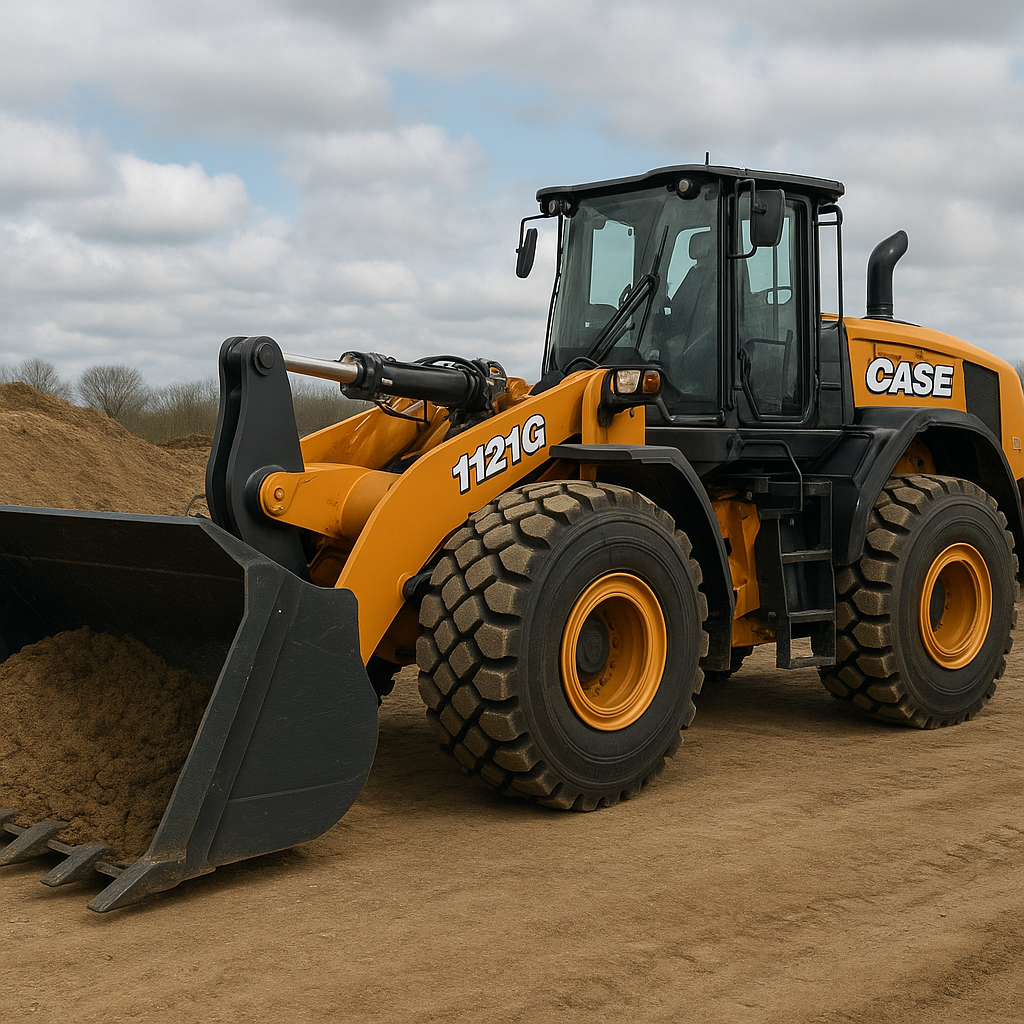
The CASE 1121G is a mid-size wheel loader designed to offer a balance of power, maneuverability and versatility for construction, agriculture, recycling and industrial applications. Built to meet the demands of daily heavy-duty tasks while providing a comfortable working environment for the operator, the 1121G is marketed as a productive and cost-conscious choice in CASE’s G-series lineup. Below you will find a comprehensive look at the machine’s design philosophy, typical specifications, operational roles, maintenance considerations and real-world advantages.
Overview and design philosophy
CASE set out with the 1121G to deliver a machine that performs reliably in demanding environments without unnecessary complexity. The model emphasizes straightforward mechanical robustness combined with modern systems for fuel management, hydraulics and operator ergonomics. The loader’s frame geometry, articulation joint, and lift arm design are optimized to provide a blend of lift height, breakout force and reach suitable for handling material loading, site cleanup, feedlot and feed handling duties, as well as road maintenance and light quarry work.
Key design priorities include:
- Durability: Reinforced critical pivot points and heavy-duty steel in high-stress areas extend component life.
- Serviceability: Ground-level daily checkpoints, grouped service points and easy-open panels reduce downtime for routine checks and repairs.
- Operator focus: An ergonomic cab with clear sightlines and intuitive controls reduces fatigue and improves productivity.
- Versatility: Compatibility with a wide range of attachments expands the loader’s use cases across industries.
Typical specifications and performance (approximate)
Note: specific numbers vary by market region, optional packages and final factory configuration. The following figures are representative ranges for the CASE 1121G class and are intended to give a realistic expectation of capability.
- Operating weight: approximately 10,500–12,500 kg (≈11–13 metric tons).
- Engine power: commonly in the range of 120–160 kW (160–215 hp) depending on emission stage and tuning.
- Rated bucket capacity: typically 2.0–4.0 m³ depending on bucket style (general purpose, high-capacity, light-material bucket).
- Breakout force: roughly 80–120 kN at the bucket edge (varies with boom geometry and hydraulic configuration).
- Dump height: lift and hinge pin heights designed to allow effective truck loading in the mid-size haul class — usually in the range 2.8–3.6 m.
- Hydraulic system: high-flow gear/variable-displacement pump options enable fast cycle times and strong lift/tilt forces; auxiliary hydraulic flow often provided for powered attachments.
- Fuel capacity: typically around 200–290 liters, balancing long shift operation with weight and footprint considerations.
- Travel speed: top speeds around 30–40 km/h for road transfers depending on tire choice and gearing.
In practical terms the 1121G delivers the type of productivity expected from a mid-sized loader: rapid bucket cycles, high breakout for loading compacted materials, and the ability to keep pace with medium-sized articulated trucks. The emission stage of the engine (Tier 3/Tier 4 Final/Stage IIIA/IV etc.) changes the aftertreatment hardware and can affect fuel economy slightly, so exact consumption figures depend heavily on regional spec and duty cycle.
Applications and typical use cases
The CASE 1121G’s combination of power and agility makes it suitable across a broad spectrum of tasks. Below are the primary areas where the machine commonly proves its value:
Construction and site preparation
- Loading dump trucks with earth, gravel and aggregate.
- Moving stockpiles and feeding crushers or screening plants.
- Backfilling and site cleanup where mobility and visibility matter.
Agriculture and feed handling
- Managing silage, feed bunkers and manure handling with special purpose buckets and grapple attachments.
- Transporting bales, palletized goods and material within large farming operations.
Quarry, mining and recycling
- Sorting, loading and reclaiming material at recycling facilities — the loader’s hydraulics and optional high-dump configurations help with specialized workflows.
- Light quarry duties, pit face support and trucking station loading.
Municipal and utility work
- Road maintenance, snow clearing (with snow plows and blowers), and seasonal tasks.
- Utility trench cleanups, landfill cell maintenance and daily waste transfer operations.
The machine’s ability to accept a variety of attachments — bucket types, hydraulic breakers, grapples, forks and sweepers — makes it a multi-use asset on any fleet.
Operator environment, controls and safety
CASE places a strong emphasis on the cab environment to maximize operator efficiency and reduce fatigue. Typical features for the 1121G class include:
- Spacious cab with COF/ROPS certification and laminated glass for visibility and protection.
- User-friendly controls: ergonomically positioned joystick or lever controls, easy-to-read digital displays outlining engine parameters, hydraulic temps and service intervals.
- Climate control options: heater and air conditioning integrated into the cab to maintain comfort for long shifts.
- Audio and telematics mounting points for communication and fleet management systems.
From a safety standpoint, the loader often includes backup alarms, optional rear-view cameras, LED work lights for low-light operation, and easy-to-access engine shutoff switches. The machine’s stable linkage geometry and counterweight design are engineered to maintain balance during heavy lifting, which reduces overturn risk when operated correctly.
Hydraulics, drivetrain and fuel efficiency
Modern CASE G-series loaders like the 1121G typically incorporate efficient hydraulic and drivetrain systems to achieve smooth power delivery and reduced fuel consumption. Examples of design elements contributing to efficiency include:
- Load-sensing hydraulics or electronically controlled variable displacement pumps, which deliver oil only as needed and minimize parasitic losses.
- Automatic transmission pairing with lock-up torque converters or powershift transmissions designed to keep the engine in optimal rpm ranges for fuel economy.
- Eco modes and engine management software that reduce engine speed during light-duty cycles while preserving responsiveness for high-demand moments.
These features combine to lower operating costs. Typical fuel consumption in medium-heavy duty cycles can range widely — from single-digit liters per hour in light work to 15–25 L/h in continuous heavy loading — but the 1121G is tuned to give competitive economy for its class.
Attachments and versatility
One of the 1121G’s strengths is its ability to be fitted with a broad selection of attachments, turning a single machine into a multi-role tool. Common attachments include:
- General purpose buckets and high-capacity buckets for light materials.
- Multi-purpose buckets with dozer cutting edges for grading and material handling.
- Hydraulic grapples for logs, scrap and demolition debris.
- Pallet forks for loading and transport of palletized items.
- Snowplows, blowers and rotary brooms for municipal tasks.
- Hydraulic breakers for light demolition and rock breaking (with appropriate carrier and hydraulic flow).
Quick-coupler systems speed attachment changes and minimize downtime, allowing fleets to use the 1121G across seasons and projects, increasing overall utilization.
Maintenance, serviceability and total cost of ownership
Serviceability is an important factor for contractors who can’t afford long equipment downtime. CASE engineers accessible service points into the machine package:
- Side-opening service panels and ground-level access to key filters, fluid fill points and routine inspection items.
- Extended service intervals using high-quality filters and oils where permitted by application and operating conditions.
- OEM support networks and parts availability vary by region but CASE often provides dealer network programs for preventive maintenance scheduling.
Total cost of ownership (TCO) is influenced by initial purchase price, fuel consumption, routine maintenance and resale value. The 1121G competes in its segment by offering reasonable initial pricing, good fuel efficiency for its power band and robust build quality which helps preserve resale value when properly maintained. Telemetry and fleet management options optionally included or retrofitted allow fleet managers to monitor fuel usage, idle time and service intervals to optimize costs.
Market position and statistical context
The CASE 1121G sits in the competitive mid-size wheel loader market where several manufacturers offer comparable machines. Statistical trends in the industry show increasing demand for:
- Machines with improved fuel economy due to rising fuel costs and environmental regulations.
- Telematics and fleet management integration to drive machine utilization and preventative maintenance.
- Flexibility through attachments so one machine can fulfill multiple roles.
While precise global sales figures for a single model like the 1121G are not typically published by manufacturers, CASE and its parent company regularly report that the wheel loader segment remains a backbone product line with steady year-on-year demand in emerging markets and in refurbishment/replacement cycles in mature markets. Resale valuations for well-maintained G-series loaders remain comparatively strong, particularly where service history and telematics records exist.
Real-world performance examples and productivity
On typical loading cycles involving mixed aggregates, operators report that mid-size CASE loaders such as the 1121G can load standard 10–16 tonne trucks in fewer cycles than smaller machines, while consuming less fuel per tonne moved compared with oversized machines. In agricultural settings, the loader’s ability to handle silage, loose feed and pallet handling without frequent attachment swaps saves time and labor. In recycling yards, the combination of visibility and hydraulic responsiveness helps sort and move material faster with fewer accidental payload spills.
Productivity gains are most apparent when:
- Operators take advantage of matched bucket sizing to avoid overloading and to achieve optimal fill factors.
- Hydraulic options are selected to match the primary attachment (for example, higher flow for grapple work).
- Telematics are used to minimize idle time and schedule servicing before failures occur.
Buying considerations and practical tips
When evaluating a CASE 1121G for purchase or lease, consider the following points to ensure you get the best match for your needs:
- Define your primary tasks: Choose bucket size and hydraulic options based on the material densities you will work with most often.
- Assess transport logistics: Operating weight and machine dimensions affect transport permits and costs.
- Service network: Ensure local CASE dealer support provides timely parts and trained service technicians.
- Consider telematics: Built-in or aftermarket fleet management systems can reduce TCO by improving maintenance scheduling and utilization.
- Attachment inventory: A proper set of attachments increases utilization—factor in quick couplers and hydraulic plumbing for powered tools.
- Operator training: Proper operator techniques cut fuel use and wear, increasing the lifetime of tires, hydraulic components and drivetrain parts.
Environmental and regulatory aspects
The 1121G is available in engine configurations that comply with diverse emissions regulations worldwide. Advanced aftertreatment systems and electronic engine control provide reduced particulate and NOx outputs in regions that require them. Operators and fleet managers should verify which emission stage is installed in machines sold in their area and consider the long-term implications of retrofits, fuel quality and service needs associated with aftertreatment systems (for example, diesel particulate filters and selective catalytic reduction units).
Additionally, the push toward electrification and hybrid solutions in the off-highway sector may influence future versions of CASE loaders. For now, conventional diesel powerplants with smart controls remain the backbone of performance for customers requiring long operating hours and remote operation without extensive charging infrastructure.
Summary
The CASE 1121G is a practical, mid-sized wheel loader engineered for a wide range of duties where reliability, versatility and operator comfort are required. With a balanced mix of power, hydraulic capability and serviceability, it serves construction, agricultural, recycling and municipal markets effectively. While exact specifications vary with region and configuration, typical machines in this class offer operating weights around 11–13 tonnes, bucket capacities that range from 2.0–4.0 m³ and engine power appropriate to deliver strong breakout forces and efficient cycle times.
For fleets seeking a dependable loader that can be configured for multi-season use and a range of attachments, the 1121G represents a solid choice. Prospective buyers should match machine configuration to their primary applications, verify service and parts support locally and take advantage of telematics to optimize uptime and reduce lifecycle costs.
Note: The figures and ranges provided in this article are indicative and may vary by region, option packages and production year. For exact technical data and availability, consult a local CASE dealer or the manufacturer’s official documentation.
)
)