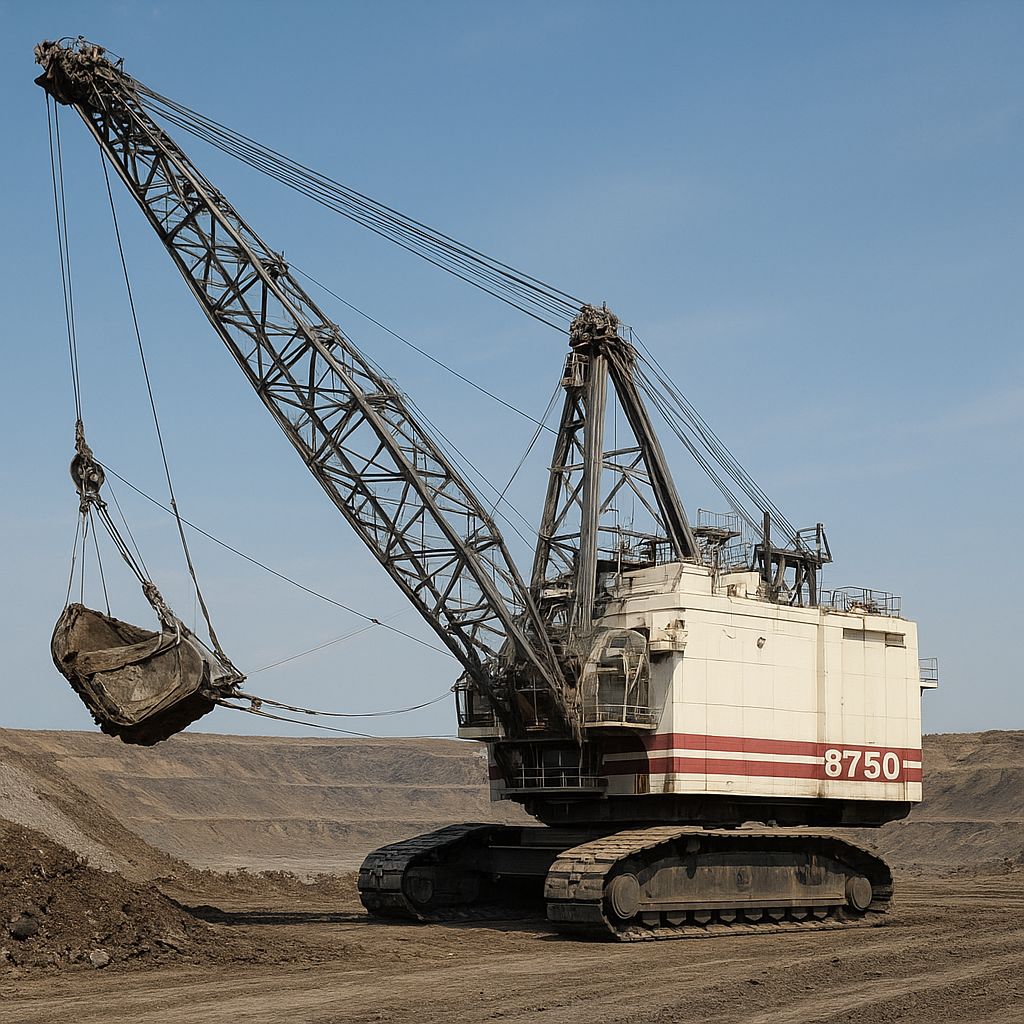
The Bucyrus 8750 is a remarkable example of heavy earthmoving equipment known primarily as a dragline. Built for large-scale surface mining and major civil engineering projects, this machine represents decades of engineering focused on maximizing the removal of overburden with minimal human labor. In this article we will examine its design and technical characteristics, typical applications and performance, operational and maintenance aspects, environmental and social implications, and some historical context and notable installations. Where precise figures are quoted, they are given as representative ranges because configurations and reported data can vary by build and source.
Design and technical characteristics
The Bucyrus 8750 belongs to the family of large-scale walking draglines — excavators that use a suspended bucket pulled by ropes to strip large volumes of material with each cycle. The machine is characterized by a long lattice boom that supports the digging radius, a massive suspended bucket connected via a system of hoist and drag ropes, and a base that may be a slewing platform or a walking chassis. The design purpose is simple in concept but complex in engineering: to move the largest possible quantity of material per scoop while maintaining safe and reliable operation.
Structure and boom
The structural frame is built around a heavy-duty turntable and base that must carry extreme loads transmitted from the boom and bucket. The lattice boom is constructed from high-strength steel and is often hundreds of feet long to achieve deep or wide excavating reach. The combination of boom length and bucket size determines the machine’s effective working envelope and productivity.
Bucket, ropes and digging system
The bucket is the heart of the machine. Dragline buckets used on machines in the size class of the Bucyrus 8750 can range widely in volume depending on configuration; many reports place large dragline bucket sizes anywhere from tens to a few hundred cubic yards (dozens to hundreds of cubic meters) for the largest models. Buckets are connected to the boom tip via a complex arrangement of pre-stretched hoist, drag and suspension ropes, drum winches, and a system of fairleads. The dragline operates by lowering the bucket, dragging material toward the machine by pulling on the drag rope, and hoisting the bucket closed with the hoist rope before swinging out and dumping the load.
Power and control systems
Power for the winches and walking mechanism is typically supplied by large diesel engines coupled with electric generators in many modern builds; some older machines were directly diesel-mechanically driven. The electrical control systems regulate winch speeds, coordinate hoist and drag operations, and manage the walking or slewing functions. Typical power plants on machines of this class produce thousands of kilowatts of installed power, distributed to multiple motors and winches. Redundancy and heavy-duty braking systems are critical for safe handling of the bucket and for controlled walking cycles.
Walking mechanism and mobility
Large draglines like the Bucyrus 8750 are often equipped with a slow but robust walking mechanism that allows them to reposition without needing to be disassembled. The walking mechanism typically uses massive shoes or pistons that lift and shift the machine in incremental steps. Walking is slow — usually only a few meters per hour when in reposition mode — but it provides the ability to relocate the machine across a mining bench or move to a new pit area over time without heavy transporters.
Representative technical ranges
- Bucket capacity: variable; many large draglines use buckets from several dozen up to a few hundred cubic yards (tens to a few hundred m3), depending on the configuration.
- Boom length: typically tens to hundreds of feet (dozens of meters to nearly 100 meters) for machines in the largest classes.
- Installed power: often measured in the low thousands of kilowatts (multiple megawatts), depending on winch and walking requirements.
- Operational crew: usually small — often one to a few operators supported by maintenance personnel and remote control/automation systems in modern retrofits.
Because individual Bucyrus 8750 units may have been customized for the owner, reported technical specifications should be checked against manufacturer or owner manuals for exact numbers. Nevertheless, the overall engineering principles and subsystems described above are standard across the largest draglines.
Applications and performance in mining and construction
Draglines such as the Bucyrus 8750 are primarily associated with large-scale surface mining, particularly open-pit coal mining and tar-sands or oil sands operations where continuous removal of large volumes of loose or semi-loose material is required. They are also used in large civil earthmoving projects — for example, canal and harbor construction, river training works, and dam excavation — wherever a long reach and high-volume scoop cycle provide economic advantage.
Surface coal mining and overburden removal
In the coal mining context, draglines are typically tasked with removing the overburden — the layer of soil and rock that lies above coal seams. The economics are straightforward: the larger the bucket and the longer the boom, the more overburden a machine can remove per cycle, reducing the number of passes and the time required to expose coal seams. Draglines excel at continuous, repetitive material movement over wide areas and can operate effectively in bench mining scenarios where the geometry favors long reach.
Comparative performance
Compared to shovels and hydraulic excavators, draglines often have higher cycle output per scoop but slower swing and reposition times. Their operating costs per ton moved can be very competitive for large volumes of relatively uniform material because they reduce the need for truck-and-shovel fleets for initial stripping. The trade-off is lower versatility: draglines are less nimble and have limited capability to dig below the base of their tracks or to handle tightly confined operations.
Cycle times and productivity
Cycle times for a machine like the Bucyrus 8750 will vary by depth of cut, bench layout, and operator skill, but a well-run dragline can move thousands of cubic meters of material per hour under ideal conditions. Productivity is influenced by bucket fill factor, swing time, hoist and drag speeds, and the percentage of effective digging time versus repositioning and maintenance.
Operation, maintenance and lifecycle
Large draglines are capital-intensive machines requiring disciplined operation and long-term maintenance regimes. A properly maintained Bucyrus 8750 can operate for several decades, with major overhauls and component replacements extending life further. The lifecycle approach considers periodic refurbishment of the ropes, drums, motors, and structural members as well as potential upgrades to control electronics and safety systems.
Routine maintenance
- Daily inspection of ropes, sheaves and bucket teeth.
- Lubrication of boom pins, bearings and slewing surfaces.
- Checking hydraulic and pneumatic systems (where fitted) and cooling systems for prime movers.
- Electrical inspections for generators, motors and control panels.
- Scheduled replacement of high-wear parts such as ropes and bucket liners.
Maintenance planning is essential because unscheduled downtime can be hugely expensive in lost production. Major components such as the boom, gearbox assemblies and drums are designed to be serviceable but may require specialized cranes or onsite fabrication facilities for replacement.
Mobility, assembly and transport
These machines are typically delivered in large sub-assemblies and assembled on-site using heavy lift cranes. The walking capability reduces the need for long-distance over-land transport once installed, but initial relocation between sites is complex. Decommissioning or moving a dragline between distant mines often requires partial disassembly, shipment by heavy-transport carriers, and reassembly, which can be a significant logistical expense.
Automation and modern upgrades
In recent decades, control systems for draglines have been progressively modernized. Upgrades may include digital operator consoles, remote monitoring, preventive maintenance diagnostic systems, and partial automation of repeating cycle motions to improve consistency and safety. Some operators use GPS and fleet-management software to integrate dragline productivity data into mine planning systems.
Environmental, social and economic impacts
The use of a large dragline such as the Bucyrus 8750 has far-reaching implications beyond its immediate production statistics. Because draglines are designed to remove overburden on a massive scale, their deployment is tied to environmental footprint, reclamation obligations, and socio-economic considerations in mining regions.
Environmental footprint and reclamation
Draglines help concentrate the environmental disturbance into predictable corridors and benches, which can simplify reclamation planning if done responsibly. However, the sheer scale of earth moved often results in substantial alteration of landscapes, water tables and habitats. Modern regulations in many jurisdictions require progressive reclamation, water management, and monitoring to mitigate impacts. Because draglines work efficiently in removing material, they can also reduce the duration of some disturbance activities compared with smaller, less efficient methods — potentially reducing total time of active disturbance if reclamation is started early.
Noise, dust and community
Hearing and dust control measures are necessary around large draglines. While they are not as noisy as fleet truck traffic in some modes, their winches, diesel generators and walking operations contribute to site noise. Dust suppression practices, buffer zones, and community engagement are standard components of responsible operation.
Economic context
From an economic viewpoint, a dragline like the Bucyrus 8750 is typically justified where long-term, high-volume stripping is required. The initial capital cost is large, but operating costs per cubic meter can be low compared with alternatives for removing very large amounts of overburden. Ownership models vary: some mining firms own and operate their draglines; others contract heavy equipment providers for dedicated machines.
History, notable machines and legacy
The company behind the name, Bucyrus, traces its roots to the late 19th century and specializes in large-scale mining equipment. Bucyrus-Erie and later Bucyrus International were responsible for some of the most iconic machines in mining history. In 2011, Bucyrus International was acquired by Caterpillar, integrating many legacy technologies into broader product lines.
Notable installations and records
Over the decades, large draglines have been deployed worldwide, from the coalfields of the United States to the open-pit operations of Australia, Canada and South America. Some individual draglines have become famous for scale and longevity. While specific model-to-model comparisons can be complex, machines in the class of the Bucyrus 8750 are recognized for exceptionally large buckets, long booms and the capacity to operate continuously for decades with proper maintenance.
Legacy and future prospects
The legacy of machines like the Bucyrus 8750 is twofold: they demonstrate the potential of mechanical scale to dramatically alter landscapes in service of energy and infrastructure needs, and they embody a body of engineering knowledge about heavy lifting, wear-resistant materials and large-scale electrical-mechanical integration. In the future, draglines will likely see further integration with automation, remote operation and predictive maintenance technologies. As mining and energy landscapes evolve — including shifts toward lower-carbon energy and changing demand profiles — the role of very large draglines will adapt accordingly, influenced by economic, environmental and regulatory trends.
Practical considerations for owners and operators
For companies considering a machine like the Bucyrus 8750, several practical matters should be assessed:
- Matching machine capacity to long-term mine plan to ensure cost-effectiveness.
- Planning for heavy lifting and assembly infrastructure for initial setup.
- Developing comprehensive spare-parts strategies for ropes, bearings, gears and structural components.
- Investing in skilled maintenance staff and in training for safe walking and hoist procedures.
- Incorporating environmental management plans and stakeholder engagement from the outset.
Strong project management and lifecycle cost modeling are essential because the economics of such machines are realized across years and even decades of operation.
Conclusion
The Bucyrus 8750 represents a class of extremely capable heavy earthmoving equipment optimized for high-volume excavation tasks in mining and major civil works. Its defining features — a long boom, large bucket, powerful hoist and drag systems, and a robust walking mechanism — enable efficient removal of overburden and other materials at scale. While the specific technical parameters can vary between units and owners, the overarching trade-offs are consistent: very high production per cycle in exchange for heavy capital investment, specialized maintenance, and significant logistical and environmental planning. For large, long-life operations such as open-pit coal mining and major infrastructure projects, the dragline remains an iconic and practical choice.
)
)