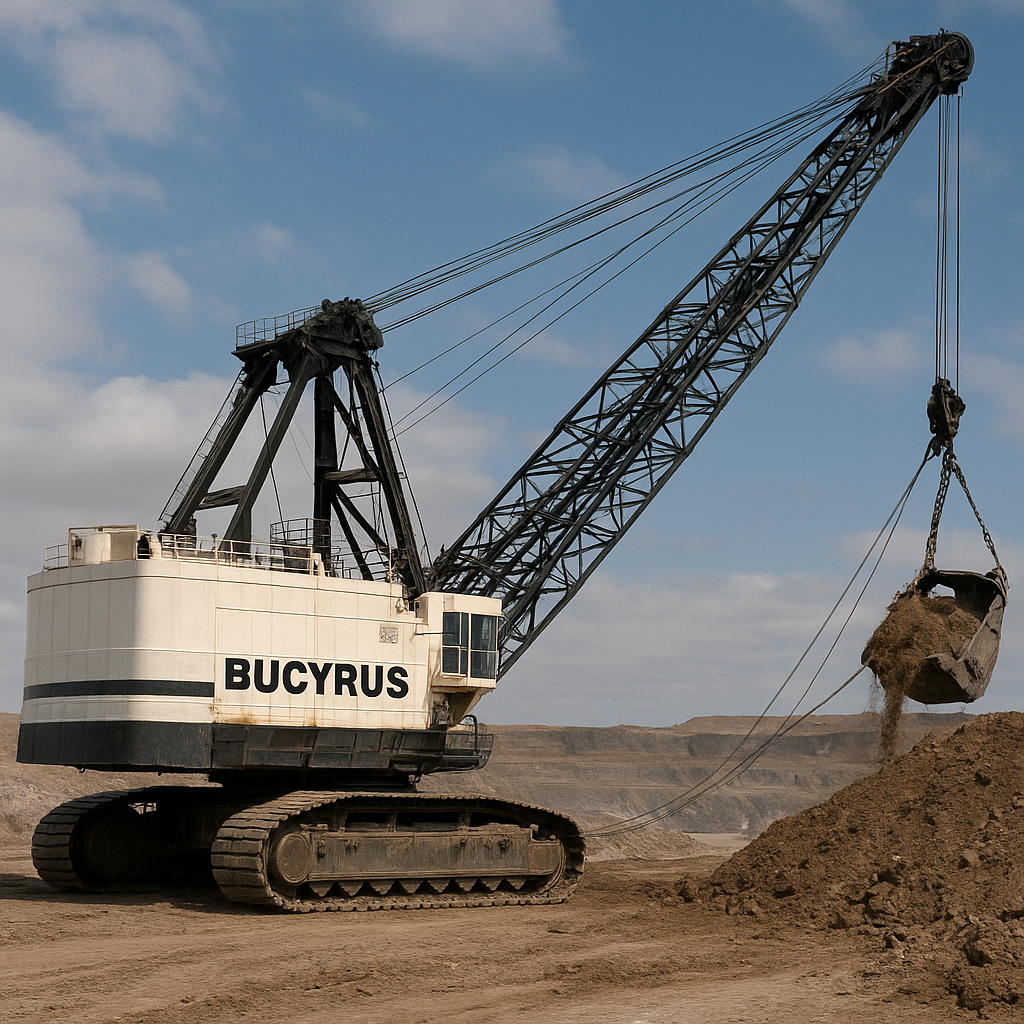
The Bucyrus 1300W dragline is one of the heavy-equipment workhorses designed for large-scale surface mining and earthmoving. Combining a long boom, a large bucket, and electrically driven winches, this machine is engineered to move massive amounts of overburden or bulk material efficiently. In this article we explore the machine’s background, design and technical features, typical applications, operational considerations, maintenance and safety aspects, and its place in the history and future of large-scale excavation.
Overview and historical context
The name Bucyrus evokes a long legacy in excavation and heavy machinery. The original company, Bucyrus-Erie, was a leader in excavators, draglines and mining equipment throughout the 20th century. The Bucyrus 1300W is part of a family of draglines produced to meet the needs of large surface operations—primarily coal, lignite, and other bulk-mineral surface mining. Later corporate changes saw Bucyrus become Bucyrus International, and the company was subsequently acquired by Caterpillar in 2011, a move that consolidated a significant portion of the world’s heavy mining-equipment design and manufacturing expertise.
Draglines like the 1300W were developed to maximize productivity in open-pit operations by removing overburden in large continuous scoops. Over decades, refinements in electrical drive systems, materials, and structural design made these machines more reliable and efficient. The 1300W occupies a class of mid-to-large draglines—smaller than some of the monumental super-draglines, but large enough to be central to many major mining operations worldwide.
Design and technical specifications
At its heart, a dragline is a simple concept: a large bucket suspended from a boom, controlled by hoist and drag ropes to dig, lift, swing and dump material. The Bucyrus 1300W follows this architecture but with engineering designed for heavy, continuous duty.
Core components
- Boom: A long lattice boom provides reach and height. Typical busts of this class feature booms from approximately 200 ft (61 m) up to around 300 ft (91 m) in length, depending on configuration and application.
- Bucket: The bucket capacity for 1300-class machines commonly ranges widely by configuration, but a representative capacity is in the order of 60–120 cubic yards (≈46–91 cubic meters). The bucket is designed to resist abrasion and to shed material efficiently during the dump cycle.
- Hoist and drag systems: Multiple electrically driven winches manage the hoist, drag, and crowd functions. These winches are designed for high duty cycles, with large-diameter drums, multi-part cables and heavy-duty brakes.
- Electrical power: Most large draglines, including the 1300W, use electric motors powered via trailing cable from plant substations or local power grids. Total installed power can range considerably; for machines in this class, installed electrical power is often in the range of several megawatts—typical figures might be 2–8 MW depending on motor sizing and auxiliary loads.
- Superstructure and undercarriage: The rotating house (superstructure) supports the boom and winches and sits on a heavy-turning bearing system. Travel may be on crawlers or on a rotary base; some machines are intended to remain in a fixed operating position for long periods.
Performance parameters
Key performance indicators for a Bucyrus 1300W configuration include:
- Cyclic digging rate: Measured in passes per hour and cubic yards per hour, depending on bench height and material. A well-configured 1300-class dragline can move tens of thousands of cubic yards per week under continuous operation.
- Maximum cut depth and reach: With a long boom and deep dig geometry, draglines of this class can cast the bucket outwards and excavate depths in the tens of meters; reach and depth are functions of boom length and rope geometry.
- Operating weight: While exact weight depends on configuration, counterweights and supported structures, a mid-to-large dragline like the 1300W typically has a gross mass measured in multiple hundreds to a few thousand tons when including its undercarriage and ballast. The largest draglines worldwide can weigh tens of thousands of tons, but 1300-class machines are substantially lighter than those extremes.
Applications and typical use cases
The primary role of the Bucyrus 1300W is large-scale surface excavation. Its design makes it particularly well-suited for several specific industries and tasks.
Surface coal and lignite mining
Surface coal operations often require the removal of thick layers of overburden to expose coal seams. The 1300W is ideal for:
- High-volume overburden removal on long benches
- Creating spoil piles and spreading overburden for reclamation
- Working in periodic cycles that align with shovel-truck systems and conveyor feeds
Bulk material excavation for infrastructure
Beyond mining, large draglines are used in civil projects that demand the bulk movement of earth, such as:
- Major earthworks for dams, reservoirs and large civil earthmoving projects
- Harbor and port construction where large dredging or reclamation cuts are required (in some cases modified for soft sediments)
- Large-scale site preparation where continuous, repetitive cuts are efficient
Strip mining and overburden management
Draglines excel in strip-mining configurations where they can swing long distances to place spoil directly onto spoil heaps, greatly reducing intermediate hauling costs. The combination of long boom reach and large bucket reduces the number of repositioning moves required compared with shovels and truck fleets.
Operation, logistics and assembly
Despite their relative mechanical simplicity, operating and deploying a dragline such as the Bucyrus 1300W is a complex logistical undertaking. These are not road-transportable machines in one piece; they are assembled on site from major components.
Transport and assembly
- Major components—boom sections, house, counterweights, crawler frames and dipper/bucket—are transported by heavy-haul vehicles and cranes.
- Assembly may take weeks to months, requiring specialist rigging teams, precise alignment of the slew bearing, and careful installation of electrical systems.
- Once assembled, moving a dragline to a new site is typically done by partial disassembly or by crawling short distances; long-distance moves almost always require disassembly and reassembly at the destination.
Operational efficiency
Efficiency depends on bench design, material characteristics, and operator skill. Draglines minimize load/unload cycles by using longer swings and placing spoil directly into final positions when feasible. They are typically used in combination with other equipment (dozers, graders, conveyors) that handle fine grading or material compaction.
Maintenance, safety and environmental considerations
Maintaining a Bucyrus 1300W requires rigorous planning, skilled technicians and an ongoing parts supply. These machines are subject to large mechanical stresses and harsh environments.
Maintenance practices
- Regular inspection of wire ropes, drums and sheaves is critical; rope replacement is a major maintenance item and safety factor.
- Wear components on the bucket lip, teeth and shell must be monitored and replaced to maintain digging performance and prevent structural damage.
- Electrical systems require careful upkeep: traction motors, winch motors, switchgear and cabling must be maintained to avoid downtime.
- Scheduled major overhauls—bearing replacement, slew system work and structural inspections—are part of multi-year maintenance cycles.
Safety
Safety is a paramount concern. Key safety considerations include:
- Strict access control to the operating envelope to avoid ground personnel being caught in swing paths or under the bucket.
- Fall protection for crews working on booms or elevated structures during assembly and maintenance.
- Electrical safety procedures for working around high-voltage power systems and trailing cables.
- Rigorous lifting and rigging protocols during assembly/disassembly to manage massive structural components.
Environmental impact
Draglines are highly efficient at moving overburden, which can reduce truck traffic and associated emissions in some scenarios. However, impacts include:
- Large-scale landscape alteration and habitat displacement inherent to surface mining.
- Noise and dust during excavation—mitigation includes water sprays, dust suppression and careful staging of spoil.
- Potential benefits in reclamation: because draglines can place spoil in controlled layers, some operators use them to facilitate progressive rehabilitation and improved post-mining landform reconstruction.
Notable examples and statistical observations
While the Bucyrus 1300W is not among the absolute largest historical draglines, it sits in an important class for heavy surface-mining operations. Some general statistics and observations about machines in this class include:
- Bucket capacity: Typical ranges for machines in the 1300-series family are approximately 60–120 cubic yards (≈46–91 m3), depending on bucket type and configuration.
- Boom length: Common boom lengths for such machines fall roughly in the 200–300 ft (61–91 m) range; longer booms improve reach but increase structural and rigging complexity.
- Power: Installed electrical power for a machine of this size commonly measures in the low megawatts—often between 2 and 8 MW—allocated among hoist, drag, swing and auxiliary systems.
- Material moved per cycle: Cycle volumes depend on bench height and bucket fill factor. Under optimum conditions, a 1300-class dragline can achieve very high hourly throughputs compared with single-shovel and truck systems for specific repeatable tasks.
- Service life: With proper maintenance, large draglines often remain productive for multiple decades. Many legacy machines built in the mid- to late 20th century continued to operate into the 21st century after refurbishments.
These figures are approximate and vary by the specific machine variant, custom client options, and the particular operating environment. Mine engineers frequently tailor bucket geometry, rope configurations, and motor sizes to optimize performance for the deposit profile at hand.
Economic implications and comparative advantages
Choosing a dragline like the Bucyrus 1300W involves weighing capital cost, operating cost and productivity. Advantages that often favor draglines in specific scenarios include:
- Low operating labor per unit of material moved: One operator and a comparatively small maintenance crew can move very large volumes, especially when the dragline’s reach reduces the need for haul vehicles.
- Energy efficiency in continuous cycles: Electrically driven winches can be more energy-efficient than diesel trucks and shovels for moving large quantities over short horizontal distances.
- Reduced hauling infrastructure: Where spoil can be placed directly by the dragline, expensive conveyor or truck systems can be minimized.
Trade-offs include high initial capital and mobilization costs, less flexibility when bench geometry or mining methods change rapidly, and slower relocation compared to truck-shovel fleets.
Technological trends and the future of draglines
Modern mining practices and technology have influenced the role of draglines like the Bucyrus 1300W.
- Automation and remote operation: Recent decades have seen increased adoption of remote monitoring, operator-assist systems and semi-automated control systems. These advances improve safety and can increase digging consistency and productivity.
- Condition-based maintenance: Sensor networks, vibration monitoring and predictive analytics reduce downtime by allowing maintenance to be scheduled before catastrophic failure.
- Electrification and grid integration: As mines seek decarbonization pathways, electrically powered draglines can integrate with renewable energy and energy-storage systems to lower their carbon footprint relative to diesel-powered fleets.
- Lifecycle refurbishment: Given their durability, many draglines are rebuilt or retrofitted with modern components to extend life and add capabilities without the full expense of replacement.
Practical considerations for operators and mine planners
Deploying a Bucyrus 1300W successfully requires coordination between engineering, operations and maintenance teams. Practical tips include:
- Detailed site planning: Bench heights, spoil placement strategy and power availability should be established well before assembly to maximize productivity and minimize rework.
- Spare-part strategy: Stocking critical spares—wire rope, relay modules, bucket wear parts—reduces extended downtime.
- Skilled workforce: Training for electricians, riggers and operators is essential. Cross-training improves flexibility in addressing unscheduled issues.
- Environmental and social engagement: Because dragline operations can be visually and physically disruptive, proactive community engagement and reclamation planning are necessary components of responsible deployment.
Legacy and concluding perspective
The Bucyrus 1300W dragline represents a balance between raw excavation power and practical deployability. While not the largest dragline ever built, it embodies the engineering principles that made draglines a hallmark of efficient large-scale surface mining. Over decades, machines of this class have demonstrated robust service lives, adaptability to refurbishment and upgrades, and clear niche advantages in specific mining geometries.
As the mining industry evolves—embracing automation, electrification and stricter environmental standards—the fundamental strengths of dragline technology remain relevant. The 1300W and its peers continue to be a compelling choice where large, repetitive overburden removal tasks can be mapped to the dragline’s long reach and high-volume scooping capability. With appropriate investment in maintenance, power infrastructure and operator skill, a Bucyrus 1300W can deliver reliable, high-throughput performance for many years.
)
)