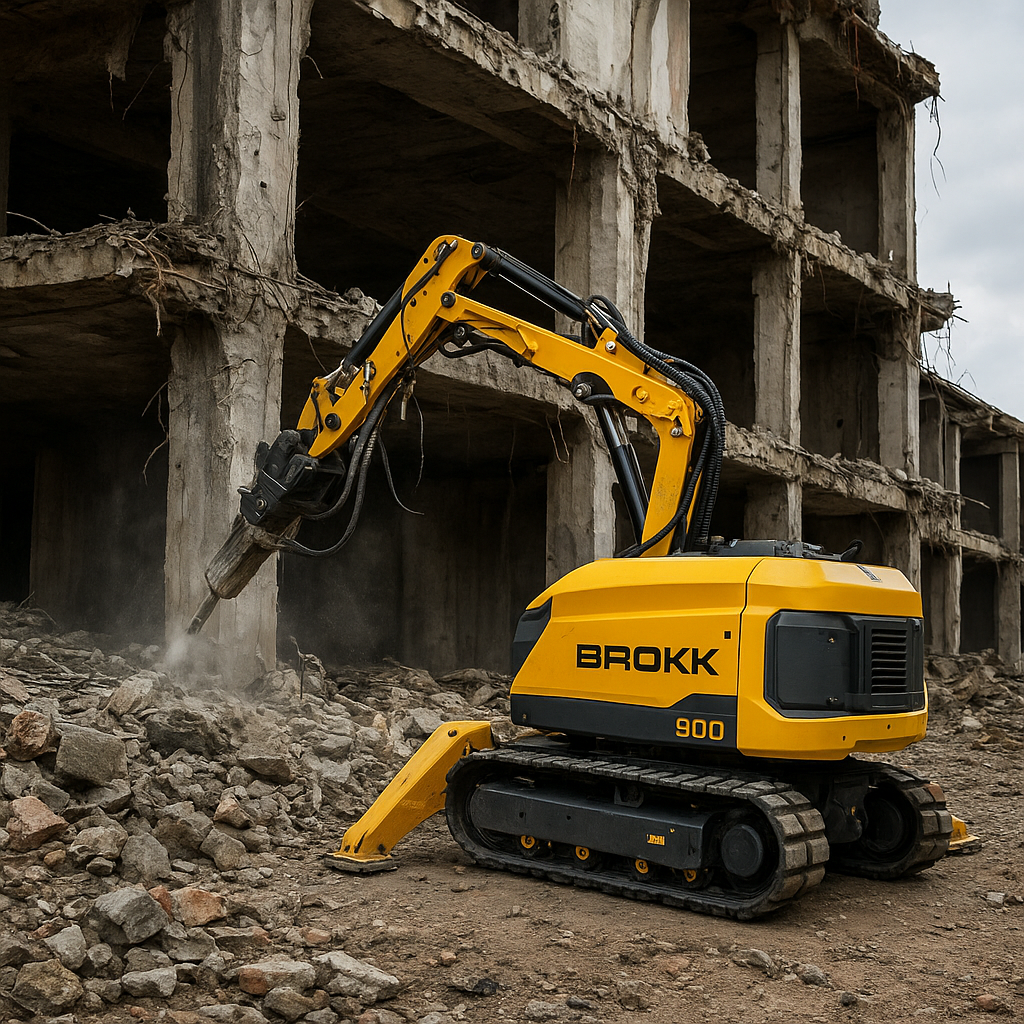
The Brokk 900 is a heavy-duty, remote-controlled demolition machine produced by the Swedish manufacturer Brokk AB. Designed to bring power and precision into confined and hazardous work zones, this type of robot fundamentally changes how contractors approach demolition, tunneling and decommissioning projects. In the sections below you will find an in-depth look at the machine’s features, typical applications, operational benefits, safety and maintenance considerations, and guidance to help decide when a Brokk 900-style unit is the right choice for a job.
Overview and design philosophy
The Brokk product family was created to replace manual labor in dangerous and physically demanding demolition tasks using compact, remote-controlled machines. The Brokk 900 is aimed at heavier demolition tasks where a balance between mobility and raw breaking power is required. Unlike traditional crawler excavators that require human operators in direct proximity, the Brokk 900 is controlled remotely, bringing the operator out of harm’s way while delivering high-impact performance through hydraulic attachments.
The design emphasizes several central goals: maximize power in a compact footprint, provide modularity for a wide range of attachments, and offer reliable remote operation under adverse conditions (dust, confined spaces, high temperatures). The machine is typically electrically powered (with flexible power options for construction sites), giving it advantages in indoor or enclosed environments where emissions and fuel fumes are a concern.
Key technical characteristics and typical specifications
Manufacturers usually publish exact specifications for each model and production year; these data are essential for safe and efficient operation. Below are commonly reported characteristics for a machine in the weight and performance class of the Brokk 900. Note that specific numbers may vary with model year, optional equipment and regional configurations, so always consult the factory data sheet for precise figures.
Typical technical highlights
- Operating weight: approximately 6–9 tonnes (varies with attachments and optional counterweights)
- Power source: electric motor, often in the 50–110 kW range; some variants can be powered via generators on-site
- Hydraulic system: high-pressure hydraulics designed for powerful breakers, crushers and shears
- Maximum reach: boom and arm combinations can reach several meters (typical working radii in the 4–7 m range depending on configuration)
- Attachments: hydraulic hammer/breaker, concrete crusher/jaw, shear, grinding/drum cutter, bucket, hydraulic tilt rotator and wire saw interfaces
- Mobility: crawler undercarriage for stable operation on uneven terrain and confined spaces
- Remote control: robust radio control with fail-safe features, proportional controls and emergency stop
These machines are engineered to provide exceptional power-to-weight ratios: a relatively compact chassis houses a hydraulics package and boom system capable of delivering force comparable to much larger, manned equipment in certain tasks. The balance is achieved by optimizing hydraulic cylinder positioning, counterweighting and the design of the tool mounting interface.
Attachments and tool versatility
A major strength of the Brokk 900 concept is its tool interchangeability. The same base unit can be fitted with a wide variety of implements to match the demands of a job, which increases machine utilization and reduces the need for multiple dedicated machines on-site.
- Hydraulic breaker (pneumatic-style chisels for concrete and rock breaking)
- Concrete crusher / jaw for selective dismantling and recycling-friendly separation of concrete and rebar
- Hydraulic shear for cutting structural steel and rebar
- Drum cutter for milling concrete and rock in tunnels and shafts
- Diamond wire saw interface for controlled cutting of thick concrete sections
- Buckets and grapples for material handling and sorting
- Rotating tilt heads for precise orientation of tools in awkward positions
Attachment exchange is engineered to be efficient, often enabling crews to switch tools on-site with minimal downtime. The availability of different tools makes the Brokk 900 suitable not only for demolition but for detailed deconstruction, concrete profiling, and even some mining and tunneling applications.
Primary applications and sectors using Brokk 900-style machines
The Brokk 900 finds use in many sectors where remote operation, compactness and power matter. Some of the most common application areas include:
- Building demolition — both selective interior demolition and full structural takedowns where access is limited.
- Tunneling and underground works — for rock and concrete breaking inside tunnels, metro systems and utility corridors.
- Nuclear and hazardous facility decommissioning — where radiation, contamination or toxic environments make human presence risky.
- Industrial shutdowns and refurbishment — steel mills, petrochemical plants and shipyards where hot-work or manual cutting is hazardous.
- Disaster response and search-and-rescue — controlled demolition and debris removal in unstable structures.
- Mining and quarrying — limited-scale rock excavation and face cleaning in constrained zones.
In particular, the machine’s adoption in decommissioning projects (nuclear and chemical) has grown because remote control reduces worker exposure to dangerous conditions. The electric drive and compact footprint also make it ideal for structural interiors where ventilation is limited and emissions need to be minimized.
Performance benchmarks and statistical indicators
Exact performance metrics vary by model and configuration, but general performance indicators used by contractors and fleet managers include:
- Break rate and throughput — how many cubic meters of concrete or tonnes of material can be processed per shift using a given attachment
- Downtime and reliability — mean time between failures, which tends to be favorable for electrically driven, well-maintained units
- Fuel / energy consumption per job — electric machines often show lower direct energy costs and near-zero on-site emissions compared to diesel alternatives
- Operator productivity — measured in reduced crew size and time to complete specified demolition tasks
Published case studies of Brokk-class machines typically report reductions in labor exposure and significant time savings on complex demolition tasks. For example, reports from demolition contractors have noted up to 50% reductions in man-hours for certain confined-space dismantling tasks when using remote demolition robots versus traditional manual methods. Energy-wise, operators frequently note that electric Brokk machines cut site ventilation needs and associated costs when working indoors.
Safety, controls and ergonomics
Safety is a primary driver behind the adoption of remote demolition robots. The operator controls the Brokk 900 from a distance through a radio control console that provides proportional control of boom, arm and tool functions. Modern control systems include:
- Redundant emergency stop and fail-safe modes
- Signal strength and interference protection to maintain control in complex industrial environments
- Telematics options for remote monitoring, diagnostics and programming
- Positioning aids and cameras (where fitted) to improve visibility in confined or obstructed areas
Removing the operator from the immediate hazard zone reduces risk from falling debris, dust, toxic fumes and heat exposure. The machine’s low center of gravity and tracked undercarriage improve stability on uneven surfaces, and counterweight options help when heavy attachments are used at extended reach.
Operation, maintenance and serviceability
Routine operation requires trained technicians familiar with remote control systems, hydraulics and the electrical powertrain. Key maintenance tasks include hydraulic oil and filter changes, inspection of boom pins and hoses, track and undercarriage checks, and electrical system diagnostics.
Typical service considerations:
- Hydraulic system maintenance: scheduled replacements and leak checks to ensure consistent breaker performance.
- Electrical systems: inspection of connectors, motor cooling and control electronics for robust long-term operation.
- Attachment wear parts: chisels, crusher jaws, shear blades and cutter teeth require periodic replacement depending on material abrasiveness.
- Transport and setup: quick-disconnect fittings and foldable booms on some models reduce preparation time between jobs.
Because these machines are often used in high-value, time-sensitive projects, manufacturers and local dealers commonly provide rapid-response service contracts, spare parts kits and operator training. Inclusion of telematics can substantially shorten diagnostic times, enabling remote troubleshooting or preemptive maintenance actions.
Economic and environmental considerations
Investing in a Brokk 900 or similar remote demolition robot should be evaluated against direct and indirect costs. The machine’s purchase price and operating costs must be weighed against labor savings, reduced downtime, improved safety record (and associated insurance benefits), and faster project completion times.
- Return on investment (ROI): High for contractors working regularly in confined or hazardous conditions, because the machine reduces crew size and speeds complex dismantling tasks.
- Recycling and waste sorting: Precision demolition allows for better separation of concrete and rebar, increasing the value recovered from demolition waste.
- Emissions and indoor air quality: Electric operation reduces on-site diesel particulate and NOx, often reducing ventilation costs in enclosed operations.
From an environmental perspective, minimizing human exposure to hazardous materials and improving recycling through selective deconstruction are significant advantages. Additionally, lower noise and vibration compared with large, manned breakers can reduce community disruption when working in urban contexts.
Case studies and real-world examples
Brokk-class robots have been used worldwide in high-profile decommissioning and demolition projects. Typical success stories include:
- Nuclear power plant segment dismantling — robots perform cutting and remote handling of contaminated concrete and metal components.
- Subway and tunnel refurbishments — drum cutters and breakers remove concrete linings in confined tunnel sections while workers remain in safer zones.
- Industrial plant turnarounds — shears and crushers allow for rapid removal of process equipment in hazardous atmospheres.
In many of these projects, contractors reported safer and faster operations, with measurable improvements in site logistic costs and reduced personnel exposure. Telemetry and post-job reports commonly highlight how a single skilled remote operator with a Brokk-class machine can replace multi-person teams using smaller tools or more dangerous manual methods.
How to choose the right machine and configuration
Selecting the correct model and attachments depends on the type of material, access constraints, and production targets. Consider the following checklist when evaluating a Brokk 900-style machine:
- What is the primary material to be processed (reinforced concrete, plain concrete, structural steel, rock)?
- Is the working environment indoors, underground, or outdoors? Are emissions and noise restricted?
- What are the transport and access restrictions—will the machine need to pass through narrow doors or elevators?
- What toolset is required (breaker, crusher, shear, cutter)? Are quick-change adapters needed?
- What power supply is available on site (direct electric connection, generator power, battery-assisted solutions)?
Answering these questions helps determine whether a Brokk 900 or another model in the Brokk range is the most cost-effective solution. For example, projects dominated by heavy structural steel cutting may favor shear-optimized configurations, while tunnel projects may prioritize drum cutters and dust suppression systems.
Future developments and trends
The remote demolition sector continues to evolve. Key trends shaping the next generation of Brokk-class machines include:
- Advanced telematics and remote diagnostics for predictive maintenance.
- Improved human-machine interfaces, including augmented-reality (AR) overlays to help operators visualize hidden structures and tool orientation.
- Battery-electric or hybrid power options to increase site flexibility and reduce reliance on grid or generator power.
- Autonomy and semi-autonomous functions for repetitive tasks, improving consistency and reducing operator fatigue.
These developments aim to increase safety, productivity and the range of tasks these machines can perform without compromising ease of use. The combination of improved sensors, data connectivity and smarter control systems will make future models more efficient and simpler to integrate in complex demolition and decommissioning workflows.
Summary
The Brokk 900-class machine represents a powerful and versatile tool for modern demolition and decommissioning projects. Its remote operation, modular attachments and compact footprint make it particularly valuable in confined, hazardous or emission-sensitive environments. When selected and operated correctly, such a machine increases productivity, enhances worker safety and supports better recycling and environmental performance on demolition sites. For precise performance figures and to match a machine to a specific project, always consult the manufacturer’s technical datasheets and speak with authorized dealers and service partners.
)
)