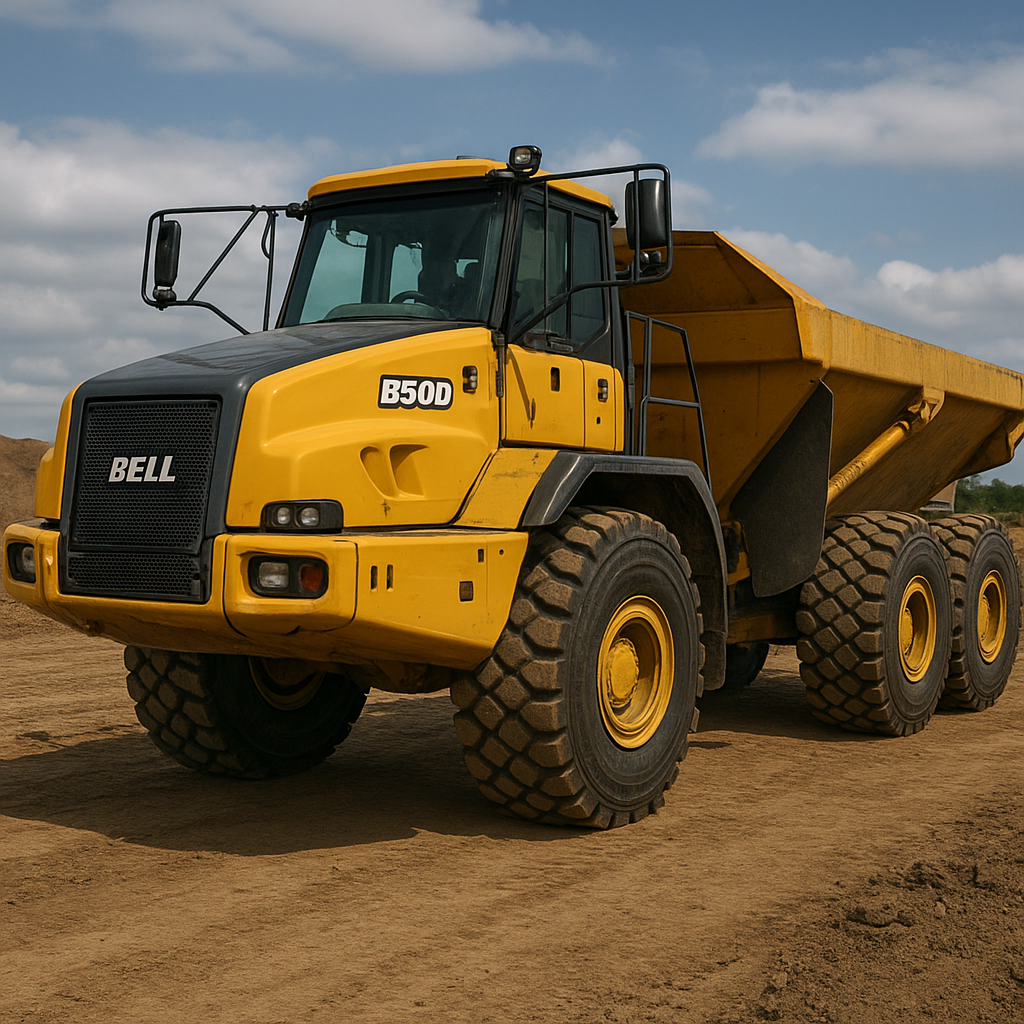
The Bell B50D is a heavy-duty articulated hauler designed for demanding earthmoving, quarrying and mining operations. Combining robust construction with flexibility for varied working environments, this class of machine addresses the need to move large volumes of material reliably across rough terrain. The following article explores the machine’s design, typical applications, operational performance, maintenance considerations and market context, while highlighting practical information that helps owners, operators and fleet managers make informed choices.
Overview and key characteristics
The Bell B50D belongs to the family of large articulated hauler models intended for off-road transport of heavy bulk materials. Its designation “B50” indicates the machine’s place in the 50-tonne payload category. Articulated haulers are distinct from rigid dump trucks because of their hinged frame between the front and rear sections, which allows superior manoeuvrability and traction in soft or uneven ground conditions.
- 50-ton payload class – the B50D is built to carry nominal loads in the region of fifty tonnes, making it suitable for large-scale earthworks and quarry tasks.
- Articulated chassis configuration for improved ground contact and steering in rough terrain.
- Heavy-duty driveline and axles designed to tolerate high torque and shock loads typical in mining and quarrying.
- High-capacity body options (various capacities and materials) to suit different materials such as rock, sand, or overburden.
The B50D’s basic strengths are mobility over difficult ground, a high material throughput per cycle, and a design that emphasizes durability and serviceability. While the specific features and trims vary between production years and market regions, the overall purpose remains constant: to move large volumes efficiently and reliably across challenging sites.
Design and technical features
At the heart of the B50D is a package designed to balance performance, longevity and operator usability. Key design elements typically found on this type of machine include:
- Articulation joint — allows independent movement of the front and rear sections, enabling tight turning radii and excellent traction on uneven surfaces. The articulation concept reduces stress on the chassis and tires when compared to rigid-frame trucks in similar conditions.
- Robust suspension and axle layout — heavy-duty bogies and large-capacity axles handle the cyclic loads of full-payload transport and minimize downtime caused by component failure.
- Powertrain — a purpose-built diesel engine tuned for high torque at low engine speeds, mated to multi-speed automatic transmissions and retardation systems to control descent speeds on grades.
- Hydraulics and body mechanism — electro-hydraulic or direct-hydraulic tipping controls provide safe and controlled discharge of material. Bodies can be steel, wear-resistant AR steel, or have bolt-on wear liners depending on abrasion levels from the carried material.
- Operator environment — ergonomics, visibility, and controls are optimized for long shifts. Modern cabs include climate control, suspension seats, noise insulation, and telematics-ready instrument panels.
Manufacturers often offer multiple body configurations (standard, long, high-capacity, and rock bodies) and optional equipment such as tyre pressure monitoring systems (TPMS), cab air filtration for dusty conditions, and heavy-duty front and rear stone guards. The B50D’s electrical and control architecture usually supports diagnostic tools and remote monitoring systems, which improve uptime and simplify preventive maintenance planning.
Applications and use cases
The B50D is engineered to operate where large, frequent material moves are needed and where ground conditions make rigid trucks inefficient. Typical applications include:
- Quarrying and mining — transporting blasted rock, overburden and run-of-mine material between faces, crushers and stockpiles.
- Major civil engineering projects — highway and dam construction where large earth volumes are relocated.
- Heavy infrastructure works — port developments, large-scale utility corridors and airport earthworks.
- Bulk site clearance — removal of spoil or contaminated soil in remediation projects where high payloads reduce cycle counts.
Because of their articulation and traction, machines like the B50D are particularly valuable in soft or seasonally wet sites where rigid-frame trucks would struggle or need additional support (such as improved access roads). They are also useful in operations with constrained space for turning or where frequent manoeuvring around loading equipment is required.
Performance, capacities and operational statistics
While exact numerical specifications differ by build year, market and selected options, the following outlines typical performance characteristics for a B50-class articulated hauler:
- Nominal payload: approximately 50 tonnes (metric) — the figure used for matching with loaders and excavators when planning cycle times and production targets.
- Body volume: depending on material and body style, common volumes range from the high 20s to low 30s cubic metres heaped. Rock bodies have lower volume but greater mass-handling durability.
- Engine power: modern machines in this class usually have engines producing in the mid-hundreds of kilowatts; a common operational range is approximately 350–410 kW (roughly 470–550 hp), with torque curves optimized for low-speed pulling power.
- Top speed: articulated haulers are tuned for site transport rather than highway travel; maximum travelling speeds typically are in the 40–55 km/h range depending on gearing and regulatory limits.
- Fuel consumption: highly variable with duty cycle, terrain and operator style. Typical working consumption can range from approximately 20–45 litres per hour under load; fuel economy improves with careful cycle planning and modern engine management systems.
- Cycle efficiency: matched with loading equipment, a B50-class machine can significantly reduce the number of cycles needed compared with smaller payload classes, improving site throughput and lowering cost per tonne moved.
Production planning uses these metrics to estimate tonnes moved per hour, fuel cost per tonne and hourly operating costs. Telematics and onboard diagnostics now allow managers to refine these figures for specific sites, improving productivity predictions and maintenance scheduling.
Operator comfort, safety and controls
Operator well-being and safety are core to continuous high performance. The B50D series emphasizes:
- Operator comfort — comfortable, adjustable seating, low-vibration cab mounting, and noise reduction help reduce fatigue during long shifts. Visibility improvements and camera systems support safer operations in congested sites.
- Safety systems — ROPS/FOPS certified cabs, advanced braking systems, gear and slope-hold features, as well as integrated alarm systems, protect both personnel and machine. Many units include automated retarder control to maintain safe travel speeds downhill.
- Control ergonomics — intuitive joystick and pedal layouts, as well as digital displays that show fuel, operating hours, payload measuring and fault codes, make it easier to monitor machine health and performance.
- Telematics integration — remote monitoring allows supervisors to view machine location, hours, fuel usage and diagnostic alerts, enabling faster responses to abnormal conditions and improved fleet coordination.
Safety procedures remain a human responsibility: daily checks, safe loading/discharging practices, and proper use of personal protective equipment are indispensable complements to machine design.
Maintenance, durability and lifecycle considerations
The economics of owning a B50D hinge on uptime, parts availability and lifecycle costs. Best practices and design features that influence total cost of ownership include:
- Maintenance accessibility — service-friendly design (tilting cabs, accessible filters, centralized grease points) reduces downtime for routine servicing.
- Heavy-duty components — reinforced frames, wear liners for bodies, and durable driveline elements decrease frequency of major repairs in high-abrasion environments.
- Predictive maintenance — condition monitoring via telematics and vibration or oil analysis helps plan interventions before failures occur, lowering unplanned downtime.
- Spare parts and dealer networks — strong manufacturer or dealer support shortens repair lead times; availability of bolt-on wear parts is particularly important in quarry environments.
- Resale and residual value — machines kept up with service history and refitted with new wear parts tend to retain value better at trade-in or resale.
Operators should budget for tyres as one of the largest recurring costs, together with fuel and routine engine/transmission service. Over the life of the asset, major components such as axles, transmissions, and bodies will need attention; how these are managed through rebuilds or component replacements shapes long-term economics.
Fleet integration and matching with loading equipment
To maximize productivity, the B50D must be matched with compatible loading equipment and site logistics:
- Loader or excavator bucket capacity should be chosen to match the truck’s payload to avoid underloading (wasting capacity) or overloading (safety and legal concerns).
- Site haul distances influence whether a B50-class hauler is the most cost-effective choice—longer hauls favour larger payloads, but tighter, shorter-cycle sites may benefit from smaller machines with faster cycle times.
- Road grades and surfacing determine whether optional retarder systems, enhanced braking packages or tyre choices are required to maintain safety and cycle efficiency.
- Scheduling and fleet management systems optimize truck assignments, reduce idle time, and help align fuel and maintenance planning with actual site conditions.
Environmental and regulatory considerations
Modern articulated haulers are designed to meet increasingly strict emissions and noise regulations. Engines are commonly compliant with regional standards through selective catalytic reduction (SCR), diesel particulate filters (DPF) and optimized combustion systems. Operators should be aware of:
- Emissions stages applicable in their region (for example, EU Stage, EPA Tier classifications) and select machines or retrofit options accordingly.
- Noise restrictions for sites near residential areas — additional muffling and reduced operating hours may be required.
- Fuel alternatives and electrification trends — while full electrification of 50-tonne haulers is in development, hybrid systems and biodiesel-compatible engines can reduce carbon intensity today.
Purchasing considerations and resale
When evaluating a B50D or similar articulated hauler for purchase, consider:
- Application fit — ensure the payload class and body type match the site’s material characteristics and cycle requirements.
- Operating cost analysis — total cost of ownership (TCO) including fuel, tyres, parts, labour and downtime should be modelled over expected ownership duration.
- Warranty and service agreements — extended warranties and preventive maintenance contracts can provide cost predictability and reduced administrative burden.
- Used market — older B50 models may be available at lower capital costs but require careful inspection for frame fatigue, axle wear and engine hours; verified service history is essential.
- Telematics and fleet compatibility — integration with existing fleet management tools simplifies reporting and predictive maintenance.
Market positioning and alternatives
The B50D competes in a market segment where operators balance the need for high payload against site flexibility. Alternatives and complementary machines include:
- Smaller articulated haulers (30–40 tonne class) for sites with tighter manoeuvring or shorter haul distances.
- Rigid dump trucks for high-production open-pit mining over prepared haul roads, where higher speeds and larger capacities are possible.
- Off-highway trucks from other manufacturers in the 50-tonne class, which can be compared on fuel efficiency, uptime, dealer network and resale value.
Choosing the right machine often depends less on brand and more on local dealer support, machine configuration for the intended material, and the fleet’s operational model.
Conclusion
The Bell B50D exemplifies the capabilities expected of a high-capacity articulated hauler: dependable hauling of heavy loads across challenging terrain, combined with ergonomics and serviceability that support sustained site productivity. For operations involving large-scale earthmoving, quarrying or infrastructure projects, a well-maintained B50-class unit can be a pivotal asset, reducing cycle counts and improving throughput per shift.
Decisions about specifying, operating and maintaining such a machine should be guided by a clear understanding of site conditions, duty cycles, and long-term cost implications. Emphasizing traction, durability, operator safety and effective maintenance planning will maximize the value derived from a B50D over its service life. When chosen and managed correctly, it offers a robust solution for moving large volumes efficiently and reliably.
)
)