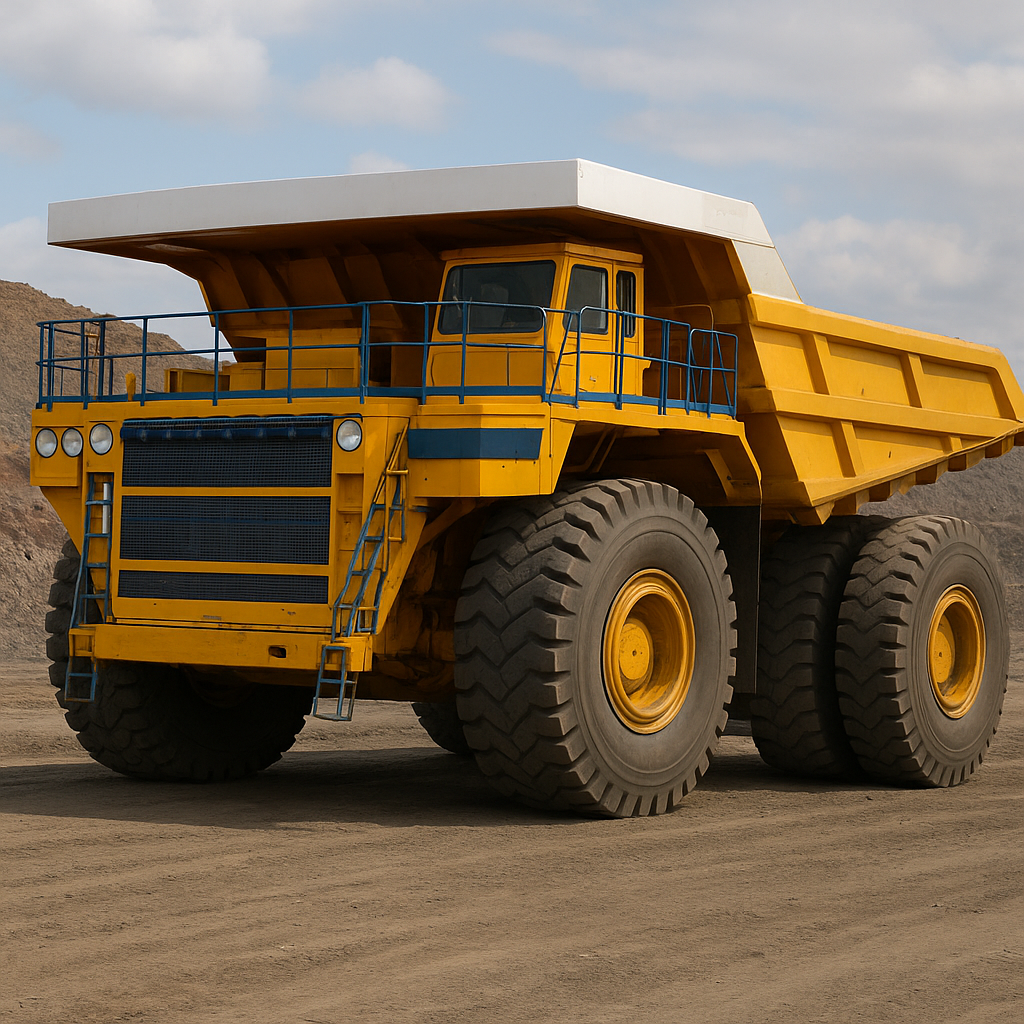
The BelAZ 75710 is one of the most remarkable examples of heavy mining equipment developed in the 21st century. Built by the Belarusian manufacturer BelAZ, this ultra-class haul truck redefined what is possible in surface mining with its unprecedented payload capacity and distinctive engineering solutions. This article examines the truck’s design, technical characteristics, real-world applications, economic and operational implications, and some practical considerations operators face when integrating such a machine into large-scale mining operations. Throughout the text you will find technical data and contextual information to understand why the BelAZ 75710 remains a headline-making vehicle for bulk haulage.
Overview and historical context
The BelAZ 75710 emerged as a response to the mining industry’s constant drive for increased productivity and lower cost per tonne hauled. Introduced to the public in the early 2010s, the model was developed to compete at the very top of the haul truck market. Its creation reflected a global trend: mining companies seeking to move ever-larger volumes of overburden and ore with fewer machines, lowering operating and labor costs while maximizing hourly throughput.
The machine is notable for its use of a diesel-electric powertrain with twin engines, an eight-wheel configuration, and a payload capacity that positioned it as the world’s largest mining dump truck by capacity at the time of its introduction. The development and limited production of the 75710 also underlined BelAZ’s ambitions to supply specialized equipment to major mining operations in Eurasia and beyond.
Key technical specifications and design features
The BelAZ 75710’s dimensions and components illustrate why it requires special infrastructure and logistical planning. Some of the most commonly cited values and design highlights include:
- Payload capacity: 450 tonnes — a benchmark figure that defines the model’s class and primary selling point.
- Dimensions: overall length approximately 20.6 m, width about 9.87 m, height near 8.16 m (figures vary slightly by source).
- Empty weight and gross vehicle weight: empty mass reported around 360 tonnes, giving a loaded gross weight near 810 tonnes.
- Axles and wheels: four axles and eight wheels, each wheel driven via electric traction motors; typical tire size used on ultra-class trucks of this scale is 59/80R63.
- Powertrain: twin diesel engines driving AC generators that supply electric traction motors — a configuration that combines the advantages of diesel power with the controllability and torque characteristics of electric traction.
- Top speed: site top speeds are commonly reported in the range of tens of km/h, with an empty top speed often quoted around 60–64 km/h; loaded speeds are significantly lower depending on haul road grade and conditions.
- Body and framing: a very large, reinforced dump body designed for repeated cycle loading and high-impact ore types, integrated with robust structural elements to handle bending moments and fatigue loads associated with heavy carry cycles.
Drive and traction: The diesel-electric scheme provides high starting torque and efficient traction control, critical for hauling heavy loads up pit ramps. Electric motors on each wheel allow precise torque distribution and effective braking performance through electric retarding in addition to mechanical brakes.
Engineering trade-offs
Designing the BelAZ 75710 involved trade-offs concerning weight distribution, structural strength, and compatibility with existing loading and pit infrastructure. The truck’s enormous mass demands reinforced haul roads, larger turning radii, and heavy-duty loading equipment. Its size is advantageous in reducing the number of haul cycles needed to move a given volume of material, but requires mines to invest in appropriately scaled ecosystem elements.
Operational applications and matching equipment
The primary application of the BelAZ 75710 is in large open-pit mines where high-volume, long-haul cycles are common. Typical uses include transporting:
- bulk ore in large-scale metal mining (e.g., copper, iron ore);
- overburden and waste rock in large surface coal and metallurgical coal operations;
- aggregates and other raw materials where economies of scale justify the truck’s capital and operating costs.
To fully leverage a truck of this capacity, mines must align several elements:
- loading equipment capable of matching the truck’s payload in a single pass — hydraulic shovels or electric rope shovels with bucket capacities large enough to fill the body in few passes (often in the 40–100+ m³ range depending on material density);
- haul roads constructed and maintained for the enormous axle loads, including pavement, substrate, drainage, and bench widths;
- maintenance facilities and cranes large enough for component replacement, along with storage for large tyres and other critical spares;
- logistics for transporting components to remote sites — these trucks are typically assembled or finalized on-site due to size constraints on public roads.
Real-world operational advantages
Deploying a 450-tonne truck can reduce the number of machines required in a fleet, lower the number of drivers per tonne moved, and reduce the number of truck shovel interactions per unit of ore hauled. The result is often a lower operating cost per tonne when utilization, uptime, and matching equipment are optimized. For very large deposits with consistent high-rate haulage needs, the BelAZ 75710 can be an attractive investment.
Economic, logistical and environmental considerations
Purchasing an ultra-class haul truck is a complex capital decision. With the BelAZ 75710, operators weigh several economic and logistical factors:
- Capital cost: initial purchase price and the cost of site modifications (widening pits and ramps, strengthening bridges and roads) are significant.
- Operating cost per tonne: while absolute fuel and tire costs per truck are high, the cost spread per tonne can be favorable because each cycle carries more material.
- Maintenance logistics: servicing ultra-class trucks requires specialized tooling, larger parts inventory, and trained heavy-equipment technicians. Downtime for an ultra-class truck can be extremely costly given its single-cycle throughput.
- Supply chain and spares: tyres, drivetrain components, and replacement parts for such large vehicles are specialized and expensive; logistics for delivery to remote sites add to stocking strategies and lead times.
- Environmental factors: modern heavy equipment designers aim to improve fuel efficiency and reduce emissions. Diesel-electric drives can yield efficiency gains in certain cycles and offer options for future hybridization or integration with alternative energy sources.
From an environmental perspective, fewer larger trucks can mean fewer emissions per tonne moved if the trucks operate near optimal load factors and maintain efficient cycle times. Conversely, the sheer size of the BelAZ 75710 means fuel use per hour is high; only when that is offset by higher payload per cycle does per-tonne efficiency improve.
Maintenance, safety and operational best practices
Safety and maintenance protocols for the 75710 mirror those of other ultra-class equipment but at escalated scales. Key practices include:
- rigorous pre-shift and post-shift inspections focused on tyres, brakes, steering mechanisms, and electric drive components;
- planned preventive maintenance intervals tied to hours and cycles rather than calendar time to manage fatigue-related failures;
- operator training emphasizing the particular handling characteristics of a long wheelbase and very heavy loaded mass — braking distances and turning characteristics differ markedly from smaller trucks;
- use of remote monitoring and telematics to watch critical systems (drive motors, generator sets, brake temperatures, and tyre pressures) to anticipate failures and optimize dispatching;
- contingency plans for component failures that require heavy lifting equipment or off-site repairs, since moving or repairing a truck of this scale mid-pit is non-trivial.
Because the vehicle is so large, tire management programs are essential: tyres for the 75710 are expensive and have long lead times, so tyre-flipping schedules, condition monitoring, and repair vs. replace decisions have a major impact on fleet economics.
Production, operators and market presence
BelAZ produced the 75710 in limited numbers relative to more mainstream haul trucks. The model was designed for major mining customers with specific requirements for very high payload haulage. Production was concentrated in Belarus at BelAZ’s manufacturing facilities, and final delivery typically involved on-site assembly or modular transport due to the truck’s dimensions.
Operators tend to be the largest mining companies, often in regions with large open-pit operations such as parts of Russia, Kazakhstan, and other resource-rich countries. Because of the specialized nature of the machine, its adoption is selective: mines that can justify the necessary infrastructure investments and have loading equipment capable of efficiently filling the truck will consider it. Across the industry, the BelAZ 75710 remains one of a small number of ultra-class trucks worldwide; its peers include models from other major original equipment manufacturers that aim at similar payload bands.
Case studies and comparative context
When viewed in context, the BelAZ 75710’s main competitor advantage is its payload capacity. Comparative considerations include:
- fleet simplification: a single 450-tonne truck can replace several smaller 200–300 tonne trucks, reducing fleet complexity;
- synergy with large shovels: pairing the truck with high-capacity shovels reduces idle time and maximizes material movement rates;
- pit geometry constraints: larger trucks need larger switchbacks, bench widths and turning circles, sometimes forcing pits to be redesigned;
- transport and assembly: some mines transport the truck in modules and assemble it on site due to restrictions on public-road movements; planning for delivery and assembly is part of the procurement process.
Examples reported in industry literature often highlight the increased productivity per truck and the consequent reductions in unit costs when the 75710 is employed in suitably large operations. However, mines with narrower benches, steeper ramp grades, or limited loading capacity will not see the same benefits and may focus on a mixed-fleet approach instead.
Challenges and limitations
Notable challenges associated with the BelAZ 75710 include:
- infrastructure investments required for haul roads and pit geometry;
- high absolute fuel consumption and maintenance load per machine;
- specialized parts and long lead-times for critical components (e.g., tyres, electric motors, large hydraulic parts);
- logistical complexity when moving the truck between sites or provinces, often requiring disassembly or dedicated heavy-transit arrangements;
- limited resale market relative to smaller, more ubiquitous models, potentially affecting lifecycle asset strategies.
Future directions and technological prospects
The development of ultra-class haul trucks such as the BelAZ 75710 points to broader trends that will shape mining haulage technology in coming decades, including:
- increased electrification and possible hybridization — diesel-electric drives are a step toward fully electric haulage when site power and battery or tethering solutions become more feasible;
- autonomous operation — large haul trucks are high-value candidates for autonomous or semi-autonomous operation, which can increase utilization and reduce labor costs while improving safety on repetitive cycles;
- digital integration — advanced telematics, predictive maintenance using machine learning, and fleet optimization software will continue to improve the per-tonne economics of large trucks;
- materials science improvements — lighter, stronger structural materials and improved tyre technology may enable even greater payloads or better efficiency for existing designs.
Summary and practical takeaway
The BelAZ 75710 represents a pinnacle of haul truck engineering by combining a very large payload capacity with a robust diesel-electric drive and engineering features that enable efficient bulk haulage in very large open-pit operations. Its principal advantages are high productivity and potential reductions in unit haulage cost where operational conditions — large deposits, compatible shovels, and appropriately engineered infrastructure — align with the truck’s requirements.
At the same time, the 75710 imposes significant demands on mine planning, maintenance logistics, and capital budgeting. The machine is best understood not as a general-purpose truck but as a specialized strategic asset for very large, high-throughput mines that can justify the accompanying investments. For those operations, the BelAZ 75710 can deliver meaningful gains in efficiency and throughput, making it a noteworthy option in the ultra-class haulage segment.
Selected quick facts (commonly cited):
- Payload capacity: 450 tonnes
- Configuration: eight wheels (four axles)
- Typical dimensions: length ~20.6 m, width ~9.87 m, height ~8.16 m
- Empty weight: ~360 tonnes; loaded gross weight near ~810 tonnes
- Drive: twin diesel engines with diesel-electric transmission and electric traction motors
- Tire spec commonly used for ultra-class machines: 59/80R63
)
)