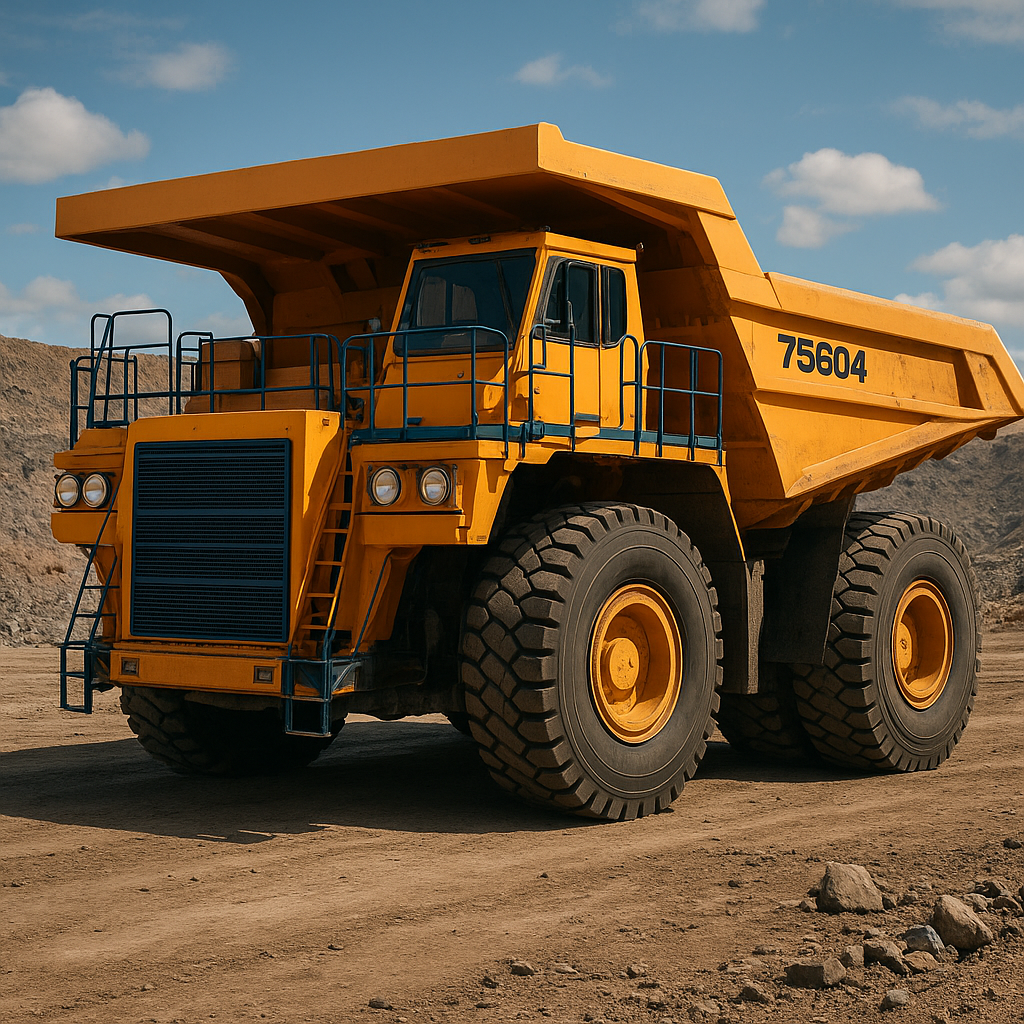
The BelAZ 75604 is a heavy-duty mining haul truck produced by the Belarusian manufacturer BelAZ. Built to work in the most demanding open-pit mining and large-scale earthmoving operations, this machine combines robust structural design with powertrain options tailored for high payloads and continuous operation. In this article I will describe its design principles, typical applications, operational considerations, maintenance and safety aspects, and supply a collection of technical and statistical information where available. The text highlights key features and real-world uses of the BelAZ 75604 and places the vehicle in the broader context of the mining equipment market.
Technical design and core components
The BelAZ 75604 is engineered around a heavy-duty frame and a large dump body designed to carry enormous weights of ore, overburden or construction material. Several design elements define the truck’s performance and reliability in harsh conditions:
- Chassis and frame: The frame is reinforced with high-strength steel and designed to distribute loads evenly across axles and suspension. This increases service life in abrasive, rocky environments.
- Dump body: Typically constructed from wear-resistant alloys or with replaceable liners to extend life against abrasive loads. The body geometry is optimized for fast unloading and stability when raised.
- Powertrain: Available in diesel or diesel-electric configurations in large haul trucks. The BelAZ 75604 is commonly offered with heavy-duty diesel engines rated for continuous high-load operation, paired with robust transmissions or electric drive systems depending on customer specification.
- Axles and suspension: Rigid axles with planetary final drives are common, together with heavy-duty torsion or multi-leaf suspension systems adapted to carry the rated payload while maintaining traction and ride stability.
- Braking and retarding systems: Large multi-disc service brakes, often oil-cooled, supported by engine braking and retarder systems to control descent on grades in mines.
- Cab and control systems: Ergonomically designed operator cabs with climate control, air-ride seating, and modern instrument panels. Many units include telematics for fleet management and diagnostic monitoring.
Engine and drivetrain options
Exact engine models and power outputs vary by configuration and year of manufacture. Heavy haul trucks in the same class commonly feature engines delivering anywhere from 1,000 to 2,500 kW (roughly 1,340 to 3,350 horsepower) depending on payload rating and operating profile. Some customers opt for diesel-electric drive systems to improve traction control and reduce transmission wear in severe duty cycles. Powertrain choice affects fuel consumption, maintenance intervals and operating cost per tonne moved.
Applications and where the BelAZ 75604 is used
The BelAZ 75604 is purpose-built for large-scale surface mining and heavy construction uses. Typical applications include:
- Open-pit mining: Transporting ore, coal, and waste rock from benches to crushers, stockpiles or waste dumps. The truck’s high payload capacity makes it efficient for high-volume sites.
- Quarrying operations: Moving blasted rock and aggregates to processing plants.
- Major earthworks and infrastructure projects: Moving large amounts of material on projects such as dam building, large civil works, and port construction.
- Heavy logistics at mining complexes: Supporting integrated operations including hauling intermediate products between plants and stockyards.
Operators choose machines like the BelAZ 75604 when the economics favor fewer, larger trucks over many smaller units — reduced fleet complexity, lower labour requirements, and optimized productive cycles per shift.
Operational environments
BelAZ haul trucks are used in a range of climates and site conditions. They are commonly found in:
- Cold, subarctic mines (adapted with pre-heating systems and cold-start features)
- Hot, arid quarries (with enhanced cooling systems)
- High-dust and abrasive environments (with sealed cabins and particulate filtration)
Performance metrics and statistical data (typical and indicative)
Manufacturers publish figures for payload capacity, operating mass, peak engine output, and fuel consumption as guidelines; actual site figures vary with duty cycle and operator technique. For the BelAZ 75604 and trucks in its class, commonly quoted metrics include:
- Payload capacity: Typical mid-to-large-size models in the BelAZ 75×00 series are rated anywhere from approximately 90 to over 200 tonnes, depending on configuration. The 75604 is positioned within the medium-to-large segment for heavy mining haul trucks.
- Gross vehicle weight (GVW): Including payload and vehicle tare, GVW for trucks in this class often ranges between 150 and 400 tonnes.
- Engine power: Depending on customer choice, engines delivering in the range of several hundred to a few thousand kW are used. This ensures adequate acceleration and hill-climbing capacity under full loads.
- Top speed: Empty and loaded speeds vary. Maximum design speeds for large haul trucks are typically in the 40–70 km/h range empty, and 20–40 km/h when loaded, constrained by grade and safety systems.
- Fuel consumption: Fuel burn depends strongly on duty cycle; typical values might be several dozen to over a hundred liters per hour under heavy load. Fuel efficiency is often expressed as liters per tonne-kilometer or liters per operating hour.
- Cycle time and productivity: Productivity is measured as tonnes moved per hour. With high payloads, a single truck can move thousands of tonnes per shift; precise figures depend on shovel size, loading time, haul distance and road grades.
Note: Specific numbers for an individual unit depend on its build specification. Customers typically work with the factory to match engine, transmission and body options to site conditions. For precise technical data on the BelAZ 75604, consult manufacturer datasheets or the dealer network for configuration-specific numbers.
Economics, fuel use and lifecycle costs
The total cost of ownership (TCO) for haul trucks like the BelAZ 75604 includes initial capital cost, fuel, tyres, scheduled maintenance, unscheduled repairs, and operator and fleet management expenses. Several factors affect the economics:
- Payload optimization: Larger payloads reduce the number of cycles needed to move a given volume of material, lowering cost per tonne.
- Fuel efficiency: Fuel is typically a major operating cost. Selection of engine type and operating practices can significantly alter fuel burn per tonne moved.
- Tyre life: Tyres for large haul trucks are expensive; terrain, operating speed, and loading practices drive replacement rates.
- Maintenance strategy: Preventive and predictive maintenance (using telematics) can lower downtime and repair costs compared with reactive maintenance.
- Residual value and refurbishment: Major mining companies often refurbish trucks for a second life, which affects long-term economics.
In many operations, fleet managers calculate cost per tonne moved as the primary metric, balancing higher upfront cost of larger trucks like the BelAZ 75604 against reduced labor and cycle inefficiencies.
Maintenance, reliability and lifecycle management
For continuous productivity, maintenance planning and reliability engineering are critical. Common practices include:
- Planned preventive maintenance: Scheduled inspections, oil changes, filter replacements and component rebuilds at defined operating hours.
- Condition monitoring: Telematics and onboard diagnostics report engine hours, fuel consumption, fault codes and component wear indicators to fleet managers.
- Wear part management: Wear liners for the dump body, brake components, and tyres are consumables that require careful stocking and management.
- Major overhauls and rebuilds: Engine and transmission rebuilds are planned events to extend truck life over many years.
Reliability is improved by correct operator training, strict loading discipline (avoiding overloading or uneven loading), and careful site road maintenance. Modern BelAZ trucks are built to be serviceable onsite, with modular assemblies to reduce downtime during component replacement.
Safety systems and operator ergonomics
Large haul trucks must protect operators and other site personnel. Typical safety features and best practices include:
- Operator visibility: High-mounted cabs, camera systems and mirrors reduce blind spots. Many trucks include 360-degree cameras and proximity detection.
- Collision avoidance and object detection: Radar, lidar or ultrasonic systems integrated with speed control can warn operators or bring a vehicle to a stop.
- Brake redundancy and retarders: Multi-system braking ensures safe descent on grades without overheating.
- Cab ergonomics: Climate control, vibration isolation and adjustable seating reduce operator fatigue and enhance concentration during long shifts.
- Emergency systems: Fire suppression systems in engine compartments and fuel-safe designs are common in mining trucks to reduce the risk from fuel- or oil-fed fires.
Environmental aspects and emission control
Environmental pressure and regulation are encouraging lower-emission equipment in mining. Strategies used with trucks like the BelAZ 75604 include:
- Engine emission controls: Use of engines meeting Tier/Stage emission standards with selective catalytic reduction (SCR) and particulate filtration.
- Fuel alternatives: Trials with biodiesel blends, hydrogenated vegetable oil, and in some cases experimental use of hydrogen or battery-electric powertrains in the broader haul truck market.
- Idle reduction: Automatic shut-down systems and generator management reduce unnecessary fuel consumption during long idle periods.
- Operational optimization: Route planning, speed management and reduced empty haul distances cut fuel burn per tonne moved.
Manufacturers and users also look at lifecycle environmental impacts: manufacturing, component replacement cycles, and end-of-life recycling are increasingly part of procurement decisions.
Innovations, automation and future trends
The heavy haul truck sector is evolving rapidly. Key trends relevant to the BelAZ 75604 class include:
- Automation and autonomous operation: Many mines are deploying driverless haulage systems (DHS) to improve safety and efficiency. Trucks can be retrofitted or factory-equipped for semi- or fully-autonomous operation.
- Telematics and digital twins: Continuous data streams enable predictive maintenance, performance optimization and simulation-based planning.
- Hybridization: Diesel-electric and other hybrid drivetrains can improve fuel efficiency and lower peak loads on mechanical components.
- Materials and wear-resistant technologies: Advances in metallurgy and composite linings increase service life and reduce downtime for bodies and critical components.
BelAZ and other manufacturers are active in R&D to integrate these technologies into new models and retrofit programs, giving operators choices to modernize older fleets economically.
Choosing the BelAZ 75604: procurement and fleet integration
Purchasing a truck like the BelAZ 75604 involves more than price comparison. Key procurement considerations:
- Match truck size to site constraints: Road geometry, haul distance, loading system (shovel or loader size) and pit gradients determine the optimal payload class.
- Availability of parts and service: Local dealer support and parts supply chains are essential to keep trucks running.
- Financing and lifecycle planning: Total cost of ownership models help compare alternatives and determine refurbishment cycles.
- Operator training and safety culture: Training programs for safe and efficient use of large trucks reduce accidents and extend component life.
For many operations, a mix of truck sizes is optimal: very large machines for the highest-volume circuits and smaller trucks for tighter pits or secondary duties. Integrating the BelAZ 75604 into a fleet requires simulation of cycles, payback analysis for fuel-saving options and alignment with maintenance capabilities.
Real-world considerations and case notes
In practice, the performance of a haul truck is determined by site-specific factors:
- Loading equipment compatibility: Bucket size of the loading excavator should ideally match the truck’s payload to minimize shovel dwell time and reduce operator stress.
- Road maintenance: Poor roads increase tyre and suspension wear and lower average payload productivity.
- Operator skill: Trained operators can substantially reduce fuel burn, tyre wear and unscheduled maintenance through optimal shifting, braking and loading techniques.
- Climate adaptation: Cold-start kits, dust control and enhanced cooling packages are site-specific options that materially affect uptime.
Successful deployments emphasize the connection between equipment specification and site process design: a technically capable truck must be embedded within a well-managed haulage strategy to deliver optimum value.
Summary and final remarks
The BelAZ 75604 is a heavyweight performer in the realm of surface mining haulage, offering high payload potential, rugged construction and the option to be fitted with a range of powertrains and technology packages. Its value lies not only in raw capacity but in the ability to be configured and integrated into a larger mine-system to optimize tonne-miles moved per hour. Key strengths include structural robustness, serviceability and adaptability to harsh environments, while the main operational challenges revolve around fuel consumption, tyre costs and the need for disciplined maintenance and operator training.
When considering a truck like the BelAZ 75604, it is important to align model configuration with site-specific needs, ensure strong local support and invest in digital and maintenance systems to maximize uptime. With the continuing trends toward automation, emissions reduction and telematics, operators who modernize fleets thoughtfully can realize improvements in safety, efficiency and lifecycle cost that make such large haul trucks central to modern mining operations.
)
)