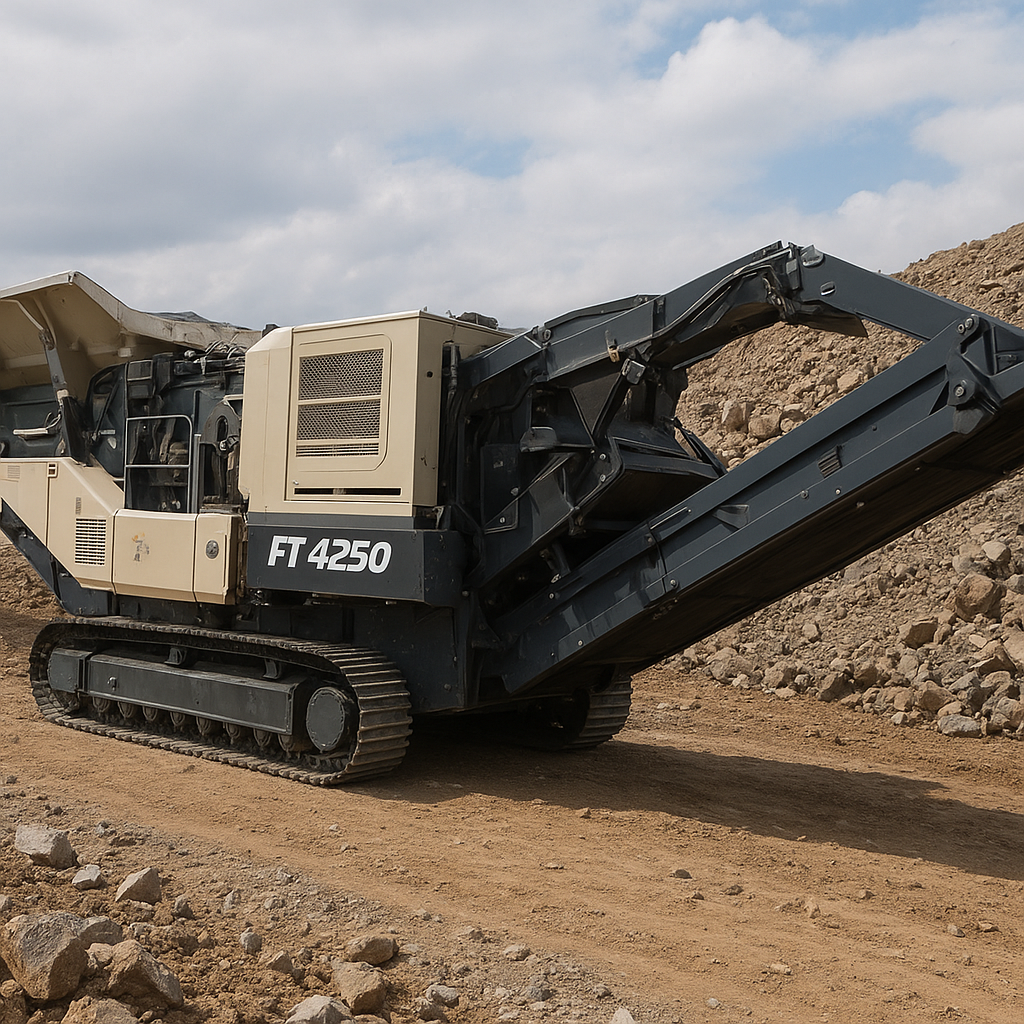
The Astec FT4250 is a robust mobile crushing solution designed for demanding aggregate, mining, and recycling operations. Combining on-site flexibility with heavy-duty crushing capabilities, this machine aims to provide contractors and plant operators with a practical balance of performance, serviceability, and cost-efficiency. In the following sections we examine the FT4250’s design features, typical applications, operational considerations, and its role in modern materials processing. The article highlights both technical aspects and practical guidance for maximising the value of this type of equipment.
Overview and key design philosophy
The Astec FT4250 is conceived as a track-mounted impact crusher intended to operate where mobility and rapid deployment are essential. Built to be transported between sites and to function in varied environments—quarries, construction and demolition locations, road building projects, and remote mine sites—the FT4250 embodies a design focus on mobility, rapid setup, and flexible product output. Its modular layout permits easy access to wear components and routine service items, reducing downtime and improving overall equipment availability.
At its core, the FT4250 typically uses an impact-style crushing mechanism, which makes it particularly well-suited to producing cubical, well-graded aggregates and for recycling operations that process concrete and asphalt. Impact crushers excel where the requirement is to shape material rather than simply reduce size, and the FT4250 leverages that ability while integrating features that support quick changeovers and on-the-go adjustments.
Technical features and configurable elements
The FT4250’s architecture usually includes a heavy-duty feed hopper, a feed conveyor, the impact crushing unit, an adjustable crusher chamber, and disposables such as conveyors for finished product. While exact specifications vary with production years and optional packages, the following are common elements found in machines of this class:
- Feed system: Hydraulic folding hopper with grizzly or vibratory feeder options for pre-screening and to remove fines prior to crushing.
- Impact crusher unit: Robust rotor assembly with replaceable blowbars and adjustable apron settings to control product gradation and reduction ratios.
- Conveyors: Main discharge and side conveyors that fold hydraulically for transport; fitted with dust suppression ports and easy belt access points.
- Powertrain: A diesel engine package sized to the crushing unit, often combined with a direct drive or hydrostatic drive to optimise fuel consumption and responsiveness.
- On-board controls: Operator panels with diagnostic readouts, automatic overload protection, and hydraulic settings for chamber regulation.
- Wear parts and materials: Interchangeable liners, reversible blowbars, and heavy-wear components made from high-chrome or manganese alloys for extended life.
These features collectively deliver a balance between crushing productivity and service simplicity. Optional extras frequently include remote monitoring, additional screening or wash units, and specialized rotor configurations for sticky materials.
Applications and industry use cases
The Astec FT4250 finds a place across a wide spectrum of industries because of its ability to operate close to the source of material and produce saleable products on-site. Typical applications include:
- Quarry and aggregate production — producing graded aggregates for construction, asphalt, and concrete.
- Construction and demolition recycling — processing concrete, brick, and asphalt into reusable materials, lowering disposal costs and generating on-site aggregate.
- Road building and infrastructure projects — producing ballast and sub-base materials directly at project sites, minimizing haul costs.
- Small- to medium-scale mining operations — for secondary or tertiary reduction where mobility is prioritized.
- Environmental and landscaping projects — creating screened material for erosion control, drainage, or decorative stone.
One of the standout advantages in these contexts is the FT4250’s ability to reduce the need for multiple handling stages. By crushing material at the point of origin, users can cut transport, double-handling, and stockpile requirements—key factors that affect project timelines and budgets. This also enhances the machine’s role in closed-loop recycling operations, where on-site re-use of aggregates supports sustainability goals and reduces landfill dependence.
Performance, capacity, and statistics (typical figures and considerations)
Exact performance numbers for an FT4250 will depend on feed size, material hardness, moisture content, rotor speed, blowbar profile, and screening arrangements. However, machines in this class commonly exhibit the following typical ranges and operational statistics:
- Throughput: Many mobile impact crushers similar to the FT4250 achieve nominal throughputs in the range of 100–400 tph (tonnes per hour), depending on the configuration and material. Lower figures are typical in recycling or very abrasive rock; higher figures are achievable with softer quarry rock and optimized feed conditions.
- Feed size: Designed to accept large feed sizes in a single stage, these crushers often handle rocks and demolition debris with maximum input dimensions substantially larger than finished sizes—commonly in the range of several hundred millimetres (e.g., up to 500–800 mm), though exact limits vary by setup.
- Reduction ratio: Impact crushers typically provide reduction ratios of about 10:1 down to 3:1 for shaping duties; the FT4250 series machines are optimized for both reduction and shape control.
- Engine power: Onboard diesel engines for comparable machines tend to be sized between approximately 200–600 kW, depending on whether the unit is optimized for high throughput or more fuel-efficient operation at moderate weights.
- Operational weight and transport: Track-mounted units of this type usually weigh several tens of tonnes; transport dimensions when folded comply with road regulations in most territories but may require permits for oversize loads in some regions.
For project planning it is essential to perform a material test to determine expected throughput under the specific hardness and moisture conditions on site. Many operators track productivity metrics such as tonnes per engine hour, fuel consumption per tonne, and average wear part life to derive accurate life-cycle costs and to justify capital expenditure.
Operation, setup and best practices
To maximize the benefit of a mobile crusher like the FT4250, operators and site managers should adhere to several best practices that influence throughput, product quality, and equipment life:
- Feed control and pre-screening: Installing a pre-screen or grizzly can remove fines and segregate feed size, reducing blockages and increasing the efficiency of the impact chamber.
- Consistent feed rate: Using a regulated feed conveyor or feeder prevents surges that could overload the rotor and minimize sudden wear on blowbars.
- Optimized rotor and blowbar selection: Different materials require specific blowbar profiles. Reversible blowbars can extend wear life and preserve output shape.
- Regular monitoring: Use vibration and thermal sensors where available to detect early signs of component distress. Periodic inspection of liners, bearings, and drive components prevents catastrophic failures.
- Dust and water management: Employ water sprays and dust suppression systems to control airborne particulates in compliance with regulations and to reduce wear from abrasive dust.
Training and operator skill are critical factors. An experienced operator can significantly increase machine efficiency by adjusting chamber settings, rotor speed (if variable), and feed strategies to match changing material characteristics during a job.
Maintenance, wear parts and lifecycle costs
Maintenance philosophy for the FT4250 focuses on downtime reduction and ease of parts replacement. Typical maintenance considerations include:
- Wear parts: Blowbars, impact aprons, and liners are designed for relatively quick replacement. Keeping an inventory of high-wear components on site reduces idle time.
- Wear monitoring: Visual and measurement-based checks for liner thickness and blowbar wear patterns allow scheduled interventions rather than reactive maintenance.
- Access and serviceability: Hydraulic access panels, quick-release guards, and accessible lubrication points simplify routine tasks and inspections.
- Consumables tracking: Tracking wear part replacement intervals per tonne processed helps estimate cost per tonne and supports budgeting for long-term ownership costs.
Lifecycle cost is influenced more by operational discipline than by the initial purchase price. Fuel consumption per tonne, wear part expenditure, and unscheduled downtime often account for the majority of total ownership costs over the machine’s service life. A proactive maintenance regime and operator training program will reduce the total cost of ownership and increase return on investment.
Safety, environmental impact and regulatory compliance
Mobile crushers provide operational advantages but also bring specific safety and environmental challenges. The FT4250 and similar machines incorporate safety features such as emergency stops, guard interlocks, and controlled access to moving parts. Modern units often include remote shutdown and lockout capabilities to protect maintenance personnel.
Environmental considerations:
- Noise management: Impact crushers can be loud, so acoustic enclosures, barriers, and planned operating hours help mitigate community noise concerns.
- Dust control: Integrated water sprays, dust extraction, and enclosed transfer points lower airborne particulate emission. On projects near sensitive receptors, additional dust management plans should be implemented.
- Emissions and fuel use: Engines compliant with current emission standards (Tier/Stage levels) are crucial for regulatory compliance. Operators increasingly consider hybrid or electric power options where available to reduce emissions and improve fuel-efficiency.
- Waste reduction and recyclability: By enabling on-site processing of demolition materials, mobile crushers cut landfill volumes and support circular construction resource models.
Regulatory compliance is ultimately site-specific. Operators must ensure air quality, water discharge, and noise regulatory requirements are met for each jurisdiction and project. Routine environmental monitoring and documented mitigation plans will support compliance and community relations.
Accessories, upgrades and technological trends
To expand the capabilities and ROI of units like the FT4250, many owners invest in accessories and upgrades:
- Onboard screening modules to produce multiple product sizes without additional plants.
- Wash systems for aggregate cleaning, particularly useful in producing high-specification concrete or asphalt aggregates.
- Telematics and remote diagnostics to monitor fuel use, operating hours, load cycles, and location—enabling predictive maintenance and asset management.
- Hybrid power packs or electric drive conversions to lower operating costs and emissions in the long run.
Technological trends shaping mobile crushers include improved automation for process control, increased use of sensors for predictive maintenance, and advances in wear materials that extend service intervals. As the industry continues to emphasize sustainability, features that reduce energy use and increase recycled content in construction materials will gain in importance.
Economic considerations and return on investment
Key economic drivers when evaluating a machine such as the FT4250 include initial capital cost, expected throughput, fuel and maintenance costs per tonne, and the value of on-site processing (saved transport and disposal fees). Typical considerations for ROI calculations are:
- Estimated tonnes processed per year multiplied by expected margin per tonne when producing final product on site.
- Cost avoidance in haulage and landfill fees when recycling demolition materials on-site.
- Resale value and lifespan—heavy-duty mobile crushers can retain significant value if well-maintained.
- Downtime risk: access to parts and service networks in the region of operation affects operational continuity.
Project planners should conduct material-specific test crushes, factor in site logistics (space for stockpiles, feed equipment, and plant positioning), and calculate comprehensive operating costs for an accurate business case.
Comparative strengths and limitations
The FT4250 and impact-style mobile crushers excel in applications requiring product shape and material cleanliness. They are particularly strong at:
- Producing cubical aggregates suitable for asphalt and concrete.
- Processing mixed demolition waste where contaminant removal and shape control are important.
- Providing rapid site mobility and quick setup for short-term projects.
Limitations to be aware of:
- High abrasivity materials can accelerate wear on impact elements compared with jaw or cone crushing for very hard rock.
- Wet, sticky materials require good feed control and possibly pre-washing to avoid plugging and reduced throughput.
- For ultra-high-capacity fixed-plant duties, stationary primary crushers may outperform mobile impact units on pure throughput metrics.
Practical tips for procurement and deployment
When selecting an FT4250 or equivalent mobile crusher, consider the following procurement criteria:
- Match the machine’s rated capability to the intended material and required product sizes. Underestimating feed hardness or moisture can severely curtail output.
- Evaluate the supplier’s Parts and Service network. Proximity to authorised dealers reduces downtime during critical projects.
- Inspect wear parts packages and warranty terms—availability of reversible blowbars and quick-change liners is a plus.
- Request site trials or references from operators who have used the same model on similar materials and in similar climates.
Deployment planning should address transport permits, site layout, feedstock routing, and environmental controls. Early coordination with contractors, haulage operators, and permitting authorities accelerates project start-up and reduces regulatory risk.
Conclusion
The Astec FT4250 represents a class of mobile impact crushers that deliver flexible on-site crushing with an emphasis on versatility, product quality, and rapid redeployment. For contractors and recyclers seeking to reduce logistics costs and process material at the point of generation, such machines can provide compelling economic and environmental advantages. Success depends on matching machine capability to material characteristics, adopting disciplined maintenance practices, and leveraging technologies—such as telematics and improved wear materials—that extend productive uptime and lower life-cycle costs. With appropriate operation and support, a well-specified FT4250 can be a cornerstone asset for modern, resource-efficient aggregate and recycling operations.
)
)