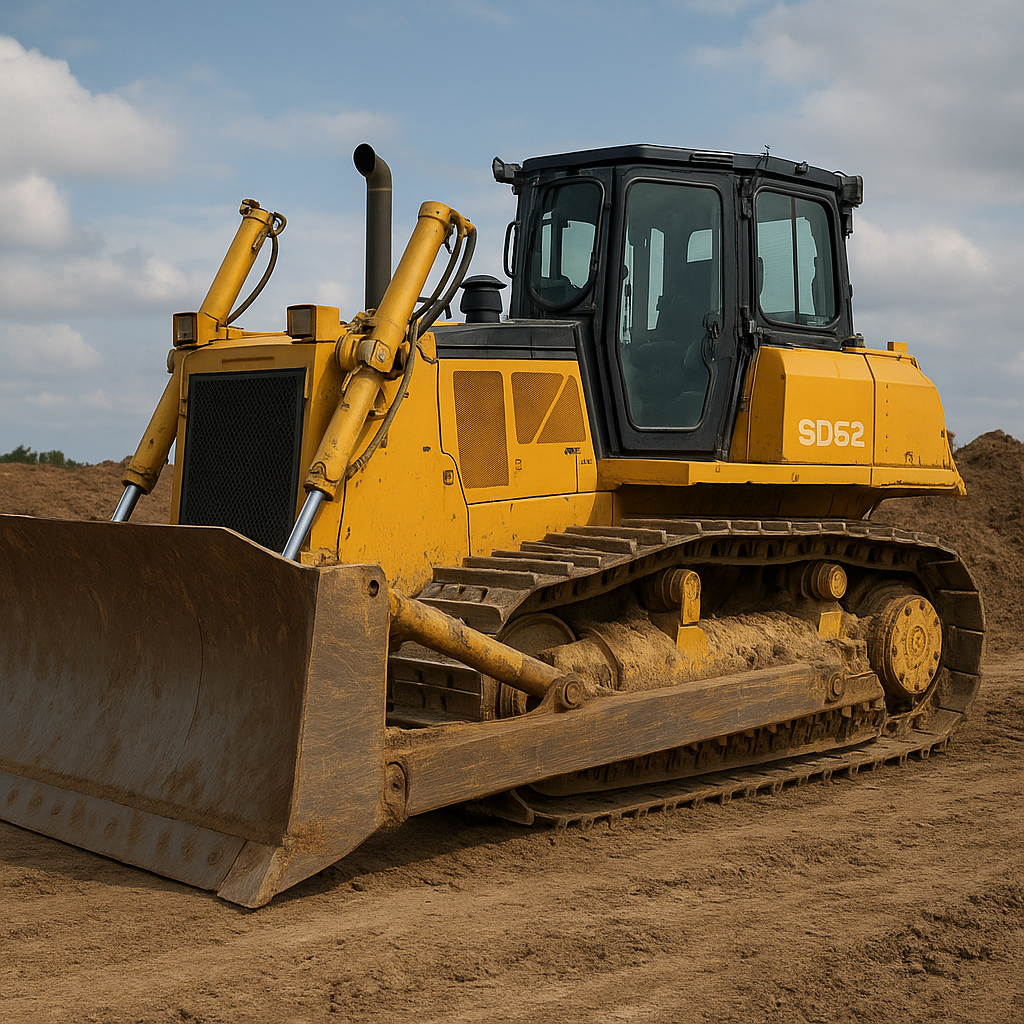
The SANY SD52 is a heavy-duty track-type tractor designed for large-scale earthmoving tasks. Combining robust mechanical systems with modern controls and optional automation, this machine targets contractors and mining operators who need reliable, high-output equipment. Below you will find a comprehensive description of its design, typical specifications, fields of application, operational guidance, maintenance considerations, and market context. The article highlights practical facts, performance indicators and useful insights relevant to engineers, fleet managers and equipment buyers.
Overview and design philosophy
The SANY SD52 represents the brand’s approach to delivering powerful, efficient and serviceable heavy equipment. As a large-capacity dozer, it is built for demanding environments — from open-pit mining and large earthworks to preparation of critical civil infrastructure. The machine integrates a high-output drivetrain, reinforced undercarriage and a choice of blade and ripper configurations that allow it to tackle a wide variety of tasks.
Key design priorities for the SD52 include chassis durability, operator ergonomics and fuel-efficient performance. SANY’s platform engineering emphasizes modular components that simplify repair and replacement, reducing downtime in remote or harsh operating environments. Also notable is the SD52’s compatibility with modern control systems: many units are delivered ready for integration with GPS grade-control or fleet-telematics systems, improving accuracy and fleet management.
Technical characteristics and approximate specifications
Exact specifications can vary by market, optional packages and final configuration. The following figures are representative of large, 50+ tonne-class crawler dozers like the SANY SD52 and are provided to give a realistic picture of capabilities and scale.
- Operating weight: approximately 45,000–55,000 kg (about 45–55 tonnes), depending on blade and ripper configuration.
- Engine: a turbocharged diesel engine with emission control meeting regional standards (Tier 3/Stage IIIA to Tier 4 Final/Stage IV in some regions). Rated power commonly ranges from 300–450 kW (approx. 400–600 hp) depending on tuning and emissions package.
- Blade types: available in straight (S), universal (U), and combination (S-U) blades; capacities frequently in the 7–12 m³ range for primary blades on this class.
- Transmission: planetary final drives paired with a robust gearbox and a torque converter or direct-drive configuration optimized for pushing power and consistent track torque.
- Undercarriage: heavy-duty sealed-and-lubricated track links, optional triple-shim track shoes with widths typically between 560–915 mm, and long-track frame variants for lower ground pressure.
- Ripper: multi-shank parallelogram ripper options offer deep penetration capability with hydraulic or mechanical depth control.
- Travel speed: low range for pushing (typically under 10 km/h) and higher travel settings up to roughly 12–15 km/h depending on the drivetrain configuration.
- Fuel capacity: large fuel tanks in the 700–1,200 liter range to support long shifts in remote operations.
- Hydraulics: load-sensing or priority-control systems to balance blade, ripper and auxiliary functions, with emphasis on efficiency and operator response.
- Operator station: climate-controlled cab with air suspension seat, clear sightlines, digital displays for engine and hydraulic status, and ergonomic controls for reduced operator fatigue.
These technical attributes make the SD52 a competitive choice for applications demanding continuous heavy push force, large blade volumes and reliable long-term operation. For precise numbers tailored to a specific region or equipment package, consult SANY’s published specification sheets or an authorized dealer.
Primary applications and work environments
The SD52 is most commonly found where scale and sustained power are essential. Typical applications include:
- Mining and quarrying — bulk push, reclaiming stockpiles, road maintenance within pits and clearing overburden.
- Large civil earthworks — grading and mass excavation for dam construction, airport runways, major highways and reclamation projects.
- Landfill construction and maintenance — spreading cover material, compacting waste layers and building containment berms.
- Aggregate and heavy construction — final and rough grading of large surfaces, creating borrow pits, and staging material for loading.
- Forestry and land clearing — where heavy root systems and dense material require high drawbar pull and robust undercarriage solutions (often with protective modifications).
Due to their mass and footprint, machines like the SD52 are not ideal for tight urban sites or sensitive landscaping tasks where smaller, more maneuverable equipment is preferred. Their strength is in volume work and applications that reward fuel efficiency per tonne moved.
Productivity, fuel economy and performance trade-offs
Productivity for an SD52-class dozer is measured in cubic meters moved per hour and operating cost per tonne. Several factors govern real-world performance:
- Blade capacity and fill factor — the right blade (U, S, or SU) can significantly affect how much material is moved per pass.
- Engine tuning and transmission configuration — affect drawbar pull, torque curve and fuel burn.
- Operator skill and site conditions — slope, moisture content, and material cohesion influence cycle times and fuel use.
- Undercarriage condition and track shoe width — wider shoes lower ground pressure and can improve traction in soft soils but may slightly reduce transport speed.
Typical fuel consumption in heavy push duty for machines of this class can range from 30 to 60 liters per hour depending on load, engine management systems and duty cycle. Efficiency gains are realized with modern electronic engine controls, staged idle systems, optimal gear selection and regular maintenance.
Operator comfort, controls and automation
The SD52 cabins are designed to reduce fatigue and improve situational awareness during long shifts. Features often include heated and cooled seating options, low-noise cabs, and panoramic windows. Electronic displays provide real-time machine diagnostics, fuel usage, hydraulic pressures and maintenance alerts.
On the automation side, many operators integrate machine guidance and management systems: GPS-based grade-control, on-board weighing, and telematics. These systems enhance accuracy, reduce rework and enable remote monitoring for preventative maintenance. When fitted with compatible hardware, the SD52 can be part of a semi-automated fleet where operator inputs are augmented by automated blade control and optimized travel routes.
Maintenance, serviceability and lifecycle costs
For large dozers like the SD52, maintenance strategy is a critical determinant of lifecycle cost. SANY designs these machines with accessibility in mind: wide-open service doors, grouped service points for fuel/water/filters, and modular components that reduce repair time. Recommended maintenance practices include:
- Daily inspection of tracks, rollers and tensioning systems to prevent accelerated wear.
- Frequent checks of hydraulic oil condition and filters, with replacements on manufacturer-recommended schedules.
- Engine oil and coolant checks at regular intervals, and use of recommended lubricants and parts.
- Undercarriage monitoring — track shoe bolts, sprocket wear, idler and roller condition, with scheduled rebuilds based on hours or kilometres.
- Using telematics data to predict failures and schedule downtime efficiently.
By investing in structured maintenance and operator training, fleet managers can extend component life and reduce unplanned downtime. Availability of local parts and dealer support for SANY is improving in many regions, which also affects total cost of ownership.
Attachments, customization and variants
The SD52 is often offered with several factory or aftermarket attachments that expand its utility:
- Multi-shank ripper assemblies for breaking hard or compacted strata.
- Winches for recovery, logging operations or specialized applications.
- Specialized blades — heavy-duty U-blades for high capacity, angle blades for finishing, and low-ground-pressure blades for soft soils.
- Protective packages for mining use — rock guards, reinforced undercarriage and cab FOPS/ROPS upgrades.
- Custom paint, lighting and telematics for corporate fleet integration.
Contractors often modify machines in coordination with manufacturers to match local requirements, such as additional cooling packages for hot climates or cold-weather kits for arctic operations.
Safety and environmental considerations
Modern dozer design balances productivity with operator safety and environmental compliance. Safety features for the SD52-class machines may include:
- ROPS/FOPS-protected cabs, seatbelts and fall-prevention handrails.
- Emergency shutdown systems, fire suppression options and auxiliary alarms for reverse travel.
- Visibility aids — rear cameras, proximity sensors and improved lighting for night operations.
On the environmental side, engine emission control technologies (such as SCR, EGR or DOC systems depending on the region) reduce NOx and particulate output. Fuel-efficient engine calibration and automatic idle-reduction features lower greenhouse gas emissions per unit of material moved. Additionally, correct machine selection and site planning minimize fuel burn and soil disturbance.
Market position, competition and total cost considerations
SANY’s SD52 competes in a market with established brands offering comparable capacity machines. Buyers evaluate not only purchase price but also service network, parts availability, resale value and reliability history. Factors influencing purchase decisions:
- Initial capital cost versus expected operating costs and throughput.
- Dealership support and availability of trained technicians.
- Financing terms, warranty coverage and regional parts pricing.
- Compatibility with existing fleet systems and telematics.
For large contractors and mining operations, the SD52 can make economic sense when its higher productivity reduces cycle times and total man-hours. However, comparing lifecycle cost metrics (cost per tonne moved, maintenance cost per 1,000 hours) across multiple brands is essential before procurement.
Case studies and practical examples
Real-world use cases of SD52-class machines typically emphasize mass earthmoving and continuous push work. Examples include:
- Bulk overburden removal in an open-pit mine, where a fleet of large dozers works in tandem with haul trucks to maintain a steady material feed. In such operations, a single heavy dozer can move thousands of cubic meters in a shift depending on site layout and blade configuration.
- Construction of dam embankments — precise layering and compaction of fill material benefit from the predictable push force and blade control offered by heavy dozers.
- Highway corridor clearing — initial clearing and mass grading across long alignments where consistent progress and low per-meter cost are needed.
In each scenario, operator training, scheduled maintenance and proper machine-matching to the task are essential to achieve the expected productivity gains.
Buying tips and fleet integration
When considering acquisition of an SD52 or comparable machine, buyers should:
- Request detailed machine specification sheets that list power curve, drawbar pull, blade capacity and standard options.
- Inspect similar units in operation to evaluate real-world fuel use, reliability and servicing needs.
- Ask about telematics packages and whether software subscriptions are included or optional.
- Factor transport and mobilization costs — heavy dozers often require special trailers and permits.
- Negotiate warranty terms and consider extended coverage for critical components like the final drives and hydraulic pumps.
Conclusion and final observations
The SANY SD52 is positioned as a heavy-duty, high-capacity crawler dozer suited for demanding operations in mining, large civil works and heavy construction. With robust structural elements, configurable blade and ripper options, and the possibility to integrate modern control and telematics systems, it aims to deliver strong power and sustained productivity at competitive lifecycle costs.
While exact technical figures depend on the chosen configuration and regional variants, the SD52-class machines typically feature large displacement turbocharged engines, heavy undercarriages and advanced hydraulic systems designed to meet a variety of site demands. Prospective buyers should analyze total cost of ownership, local dealer support and compatibility with fleet processes to ensure the machine delivers the expected return on investment.
)
)