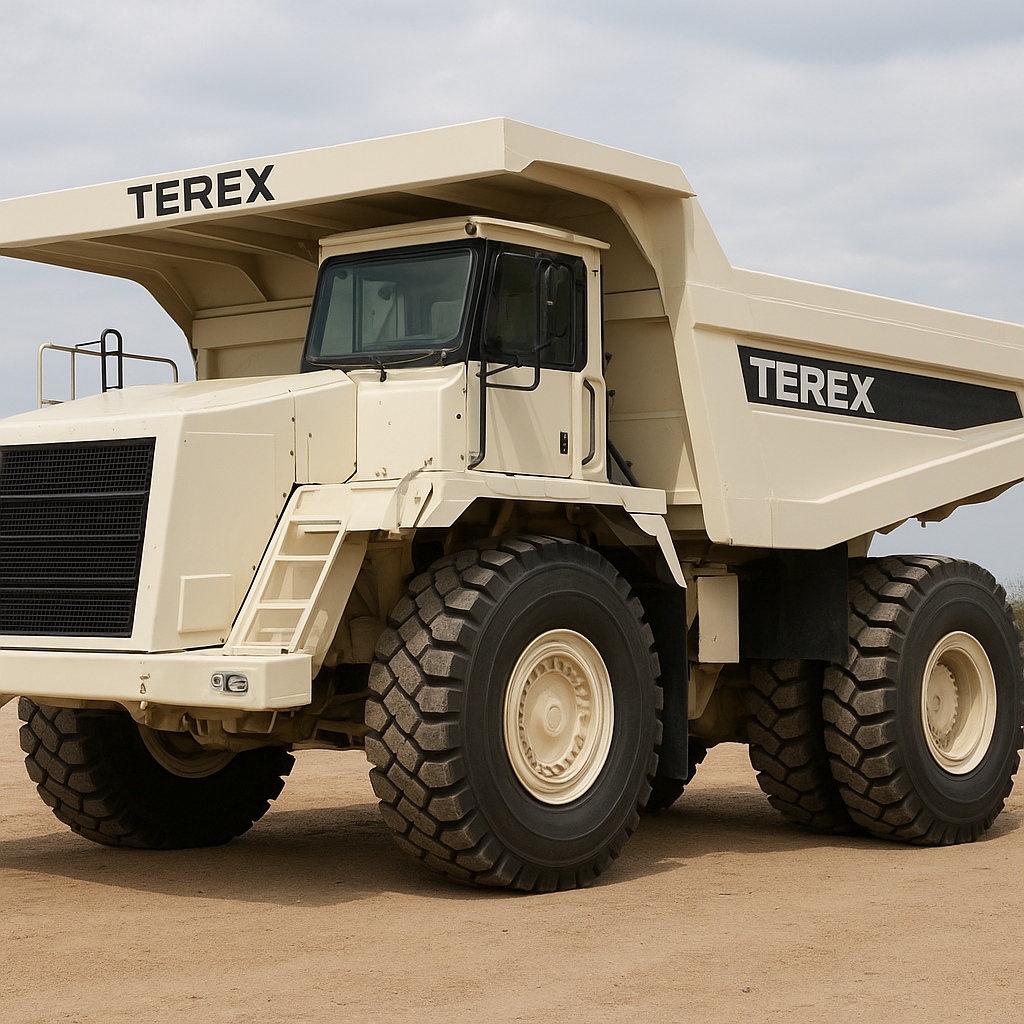
The Terex TR100 is a heavy-duty rigid-frame off-highway truck designed to move large volumes of material in demanding environments. Built to perform in **mining**, quarrying and large earthmoving projects, the TR100 blends robust construction with features intended to maximize **productivity** and reduce operating costs. This article examines the truck’s design, common applications, technical characteristics, operational performance and lifecycle considerations, offering a comprehensive picture for fleet managers, engineers and industry enthusiasts.
Overview and purpose
The Terex TR100 occupies a place among the medium-to-large class haul trucks used primarily in surface mining and quarry operations. As a purpose-built **haul truck**, it solves the fundamental challenge of transporting heavy loads of ore, overburden or aggregate between excavation and processing or waste dumps. Its design emphasizes load-carrying capacity, ruggedness, and ease of service in remote and harsh environments.
Role in modern operations
- Material movement: The TR100 is engineered for repetitive short-haul cycles typical of open-pit mining and large-scale construction projects.
- Fleet flexibility: Its payload and chassis class make it suitable as a backbone vehicle in mixed fleets where both productivity and maneuverability are required.
- Heavy duty environments: Built to operate in dusty, abrasive and elevated-temperature conditions, it supports continuous multi-shift use with appropriate maintenance.
Target users
- Open-pit mining companies (metallic and coal mines)
- Large quarries and aggregates operations
- Major civil construction projects and earthmoving contractors
- Equipment rental providers for heavy mining needs
Design and technical characteristics
The TR100 is formed around a robust, rigid-frame chassis with heavy axles and purpose-designed suspension to handle extreme loads and uneven terrain. Terex engineered the truck to balance durability with serviceability, placing emphasis on accessible service points and modular components.
Chassis and structure
- Rigid frame: Heavy-duty box-section frame and reinforced body mounting points minimize stress concentrations under full-load conditions.
- Axles and drivelines: High-capacity planetary axles and heavy-duty differentials are typical for this class of truck, designed for high torque and long life under cyclic loading.
- Bodies and payload handling: The dump body (box) is formed from abrasion-resistant steel with optimized geometry for efficient material ejection and extended wear life. Options often include heel plates, wear liners and tailored body volumes for specific materials.
Powertrain and propulsion
The TR100 uses a high-output diesel powerplant coupled to either an electric drive or a mechanical/hydraulic drivetrain, depending on configuration and market. Typical engines for haul trucks in this class deliver substantial torque at low RPM to move fully loaded bodies over gradients and rough terrain.
- Engine power: Configurations usually fall into a broad power band that supports the truck’s rated payload; modern units are optimized for fuel efficiency and emissions compliance.
- Transmission: Options include automatic power-shift transmissions or diesel-electric drive systems; both approaches aim to maximize tractive effort while reducing operator workload.
- Cooling and filtration: Heavy-duty cooling systems and advanced filtration are standard to ensure reliable operation in dusty and hot environments.
Operator environment and controls
Terex designs cab and control layouts to enhance comfort and operator productivity. Key features typically include ergonomic seating, climate control, clear instrumentation and visibility enhancements.
- Visibility: Large glazed areas and carefully positioned mirrors/cameras improve sightlines for safe loading and dumping.
- Ergonomics: Adjustable seats, multi-function joysticks and vibration-damping mounts reduce operator fatigue during long shifts.
- Telematics and diagnostics: Integrated fleet management systems allow remote monitoring of machine health, fuel use and location, assisting in predictive maintenance and uptime optimization.
Applications, performance and productivity
The TR100 is versatile in application but excels where bulk material handling, short cycle times and reliability are priorities. Fleet planners consider several operational metrics when assessing the TR100 for a site: payload capacity, fuel consumption, cycle time, availability, and total cost of ownership (TCO).
Common applications
- Open-pit mining: Hauling ore and waste from benches to crushers, stockpiles or dumps—often in multi-shift operations.
- Quarrying: Transporting blasted rock to primary crushers or processing plants.
- Infrastructure projects: Mass earthmoving for dams, highways and large excavations where reliable high-capacity trucks speed project delivery.
Performance metrics and typical figures
Performance depends on configuration, terrain and operating practices. The following figures are representative ranges for haul trucks in the TR100’s class and are useful for planning and benchmarking.
- Nominal payload capacity: Around 80–110 metric tonnes (this class is often called the “100-tonne class”; actual rated payload varies by configuration and regional model).
- Engine power range: Typical installed engine power is in the order of 900–1,600 kW (approximately 1,200–2,150 hp), depending on driveline and market specifications.
- Empty and loaded speed: Empty top speeds are commonly in the 50–60 km/h range, with loaded speeds typically limited to 40–50 km/h for safety and braking considerations.
- Fuel consumption: In heavy duty cyclical operation fuel burn can vary widely; typical ranges are roughly 50–120 liters per hour depending on load, terrain, duty cycle and engine tuning.
- Cycle time and productivity: Productivity is directly related to payload, cycle distance and loading efficiency; on short-haul routes the truck can achieve high tonne-km per hour outputs when matched to hydraulic shovels or large wheel loaders.
Operational considerations
To realize the TR100’s potential, operators focus on matching truck size to loader capacity, optimizing haul-road profiles, and implementing effective maintenance and training programs.
- Loader-truck matching: Proper matching minimizes partial loads and reduces cycle time—boosting overall fleet productivity.
- Haul road design: Gradients, bench width and road geometry influence fuel use, tyre wear and cycle time.
- Tyres and wear items: Tyre selection, wheel alignments and body wear liners are high-impact cost items; proper management extends service life and controls operating costs.
Maintenance, safety and lifecycle economics
Long-term value of a haul truck depends as much on maintenance strategy and safety systems as on the original equipment specification. The TR100’s architecture supports modular replacement and in-field servicing—important for remote mining operations.
Maintenance strategies
- Preventive and predictive maintenance: Scheduled inspections plus telematics-based predictive alerts help prevent catastrophic failures and reduce unscheduled downtime.
- Modular components: Swappable modules for powertrain, axles and hydraulic components shorten repair times and simplify logistics for spare parts.
- Workshop and OEM support: Availability of trained technicians and access to genuine parts are essential—especially in remote mining locations where downtime is costly.
Safety features and regulatory compliance
Safety is a core requirement for all modern haul trucks. The TR100 and its class typically include multiple systems to protect personnel and equipment.
- Braking systems: Redundant service and emergency brakes, plus retarders, ensure controlled descent and stopping under load.
- Collision avoidance: Proximity detection, radar, and camera systems are increasingly standard or available as options to reduce runovers and collisions.
- Operator protection: ROPS/FOPS-certified cabs, seat belts and ergonomic controls protect operators in the event of incidents.
Total cost of ownership (TCO)
When evaluating the TR100, fleet managers examine acquisition cost, fuel consumption, tyre and wear item expenses, maintenance hours, and residual value. The TCO approach often reveals that a higher-capacity truck with better fuel efficiency or lower maintenance requirements can be more economical over its service life despite higher capital cost.
- Depreciation and resale: Resale values vary by market and overall demand for used mining trucks; regular maintenance and documented service histories support stronger residuals.
- Fuel and consumables: Fuel typically represents the largest single operating expense; enhancing fuel efficiency through engine tuning and haul-cycle optimization delivers immediate cost benefits.
- Availability: Maximizing fleet availability through effective maintenance and remote diagnostics drives up productivity and reduces per-tonne hauling costs.
Comparisons, alternatives and fleet integration
Operators choosing a truck for a specific operation will compare the TR100 against competing models in the 80–110 tonne class. Key comparison points include payload, fuel efficiency, service network, and compatibility with existing fleet equipment (loaders, shovels, roads).
Competitors and alternatives
- Global manufacturers: Major competitors in the 100-tonne class include trucks from manufacturers such as Caterpillar, Komatsu, Hitachi, and Volvo—each offering different strengths in powertrain options, dealer networks and total lifecycle support.
- Electric and hybrid trends: The industry is seeing gradual adoption of hybrid drivetrains and electrified haulage solutions; while these are more common in larger ultra-class trucks or trolley-assist systems, electric-drive and hybrid options are part of the technological horizon for all truck classes.
Integrating into a fleet
Successful integration of the TR100 requires attention to several practical aspects:
- Maintenance capability: Ensuring spare parts and trained personnel are available prevents prolonged downtime.
- Operator training: Specialized training on engine management, braking and safety systems improves fuel economy and reduces incident rates.
- Data integration: Feeding TR100 telematics into site-level fleet management systems allows route optimization, predictive maintenance scheduling and performance benchmarking.
Environmental and future perspectives
Environmental regulations and corporate sustainability goals are shaping the development and operation of heavy haul trucks. While the haul truck market traditionally centered on diesel propulsion, manufacturers and operators are exploring low-emission engines, fuel additives, and electrification strategies.
Emissions and fuel reduction
- Engine tuning and aftertreatment: Modern diesel engines incorporate advanced aftertreatment systems (e.g., SCR, DPF) to meet emissions standards while maintaining power and efficiency.
- Operational measures: Smoother operator inputs, optimized haul routes, and reduced idling times can deliver measurable reductions in fuel use and emissions.
Electrification and alternative fuels
While full battery-electric haul trucks at this size are still emerging, options such as trolley-assist, diesel-electric hybridization and the use of lower-carbon fuels (HVO, biodiesel blends) provide viable pathways to reduce carbon footprints while leveraging existing truck platforms.
Summary and practical takeaways
The Terex TR100 is a substantial and capable machine aimed at heavy-duty material transport in mining and quarry operations. Its strengths lie in robust construction, scalable powertrain options and design features that facilitate field maintenance and operator comfort. When evaluating the TR100 for a fleet, stakeholders should focus on matching truck capacity to site requirements, ensuring strong maintenance support, and leveraging telematics to optimize uptime and fuel use.
Key points
- Payload and class: Suited for the roughly 80–110 tonne payload class, providing a balance of capacity and maneuverability.
- Operational efficiency: Productivity depends heavily on matching to loaders and optimizing haul roads; telematics improves operational decisions.
- Lifecycle costs: Fuel and maintenance are primary cost drivers—predictive maintenance and operator training reduce TCO.
- Safety and environment: Modern safety systems and emissions technologies are integral to current configurations, with electrification trends influencing future developments.
Overall, the TR100 remains a competitive choice for operations that require reliable, high-capacity hauling with reasonable flexibility for maintenance and fleet management. Attention to matching, upkeep and operational practices will determine whether it delivers its potential in terms of throughput, cost-effectiveness and longevity.


)
)