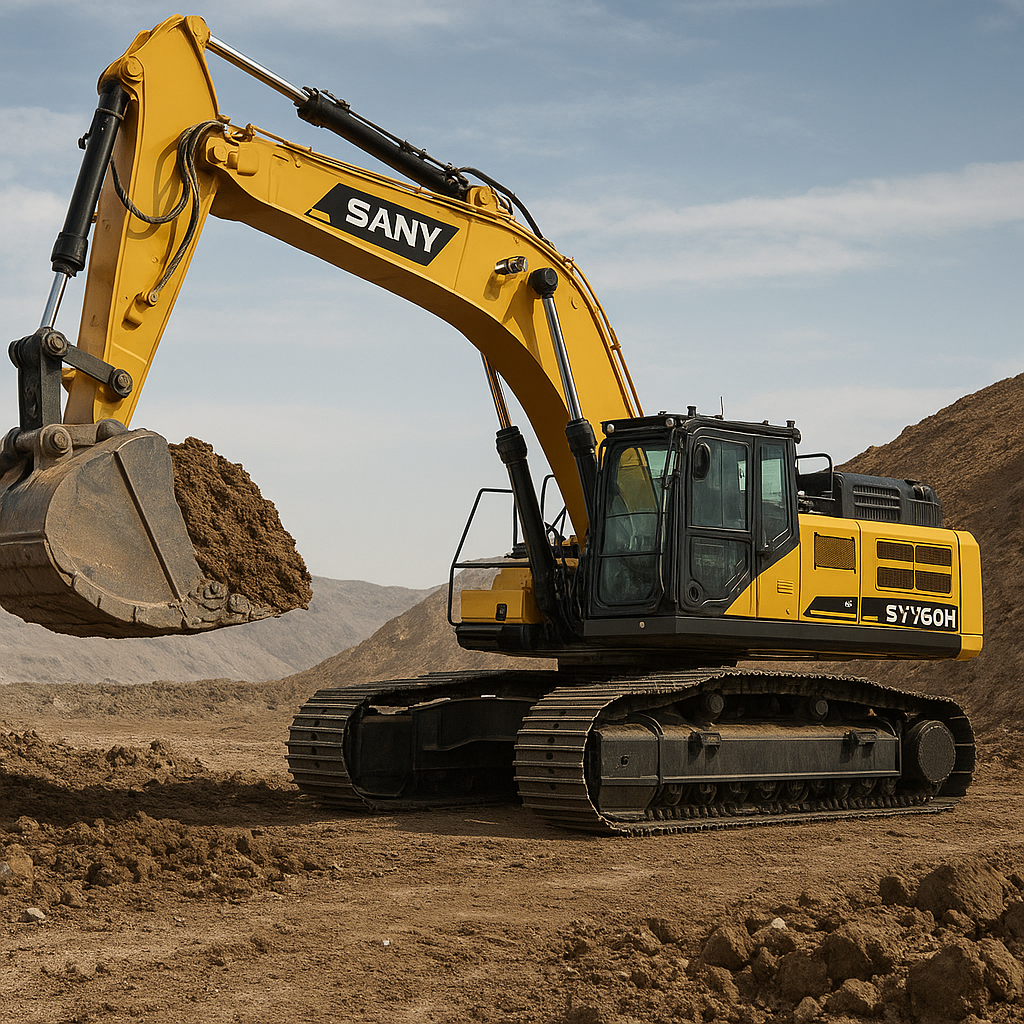
The SANY SY750H is a heavy-duty hydraulic excavator designed for the most demanding tasks in large-scale earthmoving and surface mining. Combining robust mechanical design with modern hydraulic control and operator-focused ergonomics, this machine is aimed at maximizing uptime and productivity in harsh environments. In the sections that follow, you will find a detailed overview of its design, typical applications, operational performance, safety and maintenance features, market context and some indicative statistics that illustrate where the SY750H fits in the global fleet of mining equipment.
Design and technical overview
The SANY SY750H represents a class of large excavators engineered specifically for heavy mining and quarrying work. At its core, this machine emphasizes structural strength, hydraulic efficiency and serviceability to achieve long-term reliability in continuous-duty applications.
Basic configuration and structure
- Operating class: large-class mining excavator optimized for open-pit operations and large-quarry work.
- Chassis and undercarriage: heavy-duty tracks with reinforced rollers and track frames designed to resist wear and damage from abrasive rock and frequent travel over uneven surfaces.
- Boom, arm and bucket: high-strength steel construction with reinforced welds and gussets; buckets available in a range of capacities and tooth patterns to match material types.
Key components are designed to be serviceable in the field: modular hydraulic pumps, replaceable wear parts on the boom and stick, and externally accessible grease points. The SY750H platform typically supports a variety of attachments beyond the standard digging bucket, such as rock breakers, ripper teeth and specialized material-handling grapples.
Powertrain and hydraulics
The machine uses a diesel engine paired with a high-capacity hydraulic system. The combination aims to deliver consistent digging power, quick cycle times and controlled movement when handling heavy loads.
- Engine: heavy-duty diesel unit tuned for torque and longevity under continuous operation. Engine calibration often prioritizes reliability and service intervals over maximum peak power, making it suitable for mining environments.
- Hydraulic system: an advanced load-sensing or variable-displacement pump configuration is often used to allocate power where it is most needed, improving responsiveness and reducing fuel consumption compared with older fixed-flow systems.
- Cooling and filtration: oversized radiators and multi-stage filtration help ensure the machine remains operational in dusty, high-temperature mining conditions.
Cab and controls
Operator comfort and control precision are important for safety and productivity. The SY750H is typically fitted with a spacious operator station featuring:
- Ergonomic joystick controls and multi-function switches.
- Climate control to maintain comfort in extreme temperature ranges.
- Instrument cluster with diagnostic readouts and, in many configurations, an LCD display for real-time machine data and camera feeds.
- ROPS/FOPS-certified structures and vibration-damped mounting to reduce operator fatigue.
Operator cabin improvements, such as adjustable seating and noise insulation, contribute to longer productive shifts and fewer operator errors under stress.
Applications and typical use cases
The SANY SY750H is tailored for large-scale operations where high-volume digging, loading and material transport are essential. Below are the primary areas of employment for machines of this class.
Open-pit mining
- Primary digging of overburden and ore in surface mines.
- Loading large haul trucks—machines like the SY750H are often matched to haul trucks in the 50–150 tonne class depending on bucket size and cycle time.
- High-production shoveling where duty cycles are continuous across multiple shifts.
In open-pit environments, stability, reach and bucket size are key factors. The SY750H’s heavy undercarriage and reinforced front-end components make it suitable for frequent deep-cut digging and loading at significant heights.
Quarrying and aggregate handling
- Extraction and loading of aggregate, crushed rock and other quarried materials.
- Feeding primary crushers and doing stockpile management.
For quarries, machine uptime and predictable maintenance intervals directly affect throughput. The SY750H’s service-friendly layout and robust wear components help minimize downtime in these settings.
Bulk materials handling and port terminals
- Loading/unloading bulk materials such as coal, ore, limestone and salt.
- Working alongside conveyor systems, stackers and reclaimers to keep material flows moving.
When configured with appropriate attachments, the SY750H can be effective in handling diverse bulk products and working in confined loading bays or open stockyards.
Specialized applications
- Task-specific attachments for demolition, trenching, river dredging (with specialized booms) and ripper work.
- Road construction and heavy civil earthworks where large cut-and-fill volumes are required.
Its modular design allows owners to adapt the excavator to a range of tasks, increasing the return on investment by enabling multi-role deployment across projects.
Performance, productivity and fuel economy
Performance metrics for large mining excavators like the SY750H are influenced by machine configuration, bucket selection, material properties and operator skill. The following are typical performance considerations and indicative statistics to help understand operational potential.
Bucket capacity and cycle productivity
Bucket sizes for machines in this class are commonly offered in a range of sizes to match production goals and truck payloads. Typical bucket volumes might range from medium large to very large capacities depending on site needs.
- Bucket capacity: configured to balance load per scoop with desirable cycle times and truck compatibility.
- Payload per cycle: depends on bucket fill factor and material density; higher bucket capacities increase weight per pass but can also lengthen cycle times.
Hourly production estimates vary widely. For example, in favorable conditions with optimized sequencing and matched trucks, a large excavator of this class can load several thousand tonnes per shift. Exact hourly throughput will depend on haul road layouts, truck availability and cycle efficiency.
Engine power and fuel consumption
Diesel engine output and hydraulic efficiency largely determine digging force and swing capabilities. Fuel consumption is influenced by load, duty cycle and how aggressively the operator commands the machine.
- Engine power: tuned to provide continuous torque for heavy digging; typical figures for excavators in this weight class are in the high hundreds of kilowatts, but exact values depend on regional configurations and emissions packages.
- Fuel efficiency: modern models improve efficiency with electronically controlled engines and smart hydraulic management; expected fuel burn under load may be reported as a range to accommodate varying site conditions.
Estimating fuel use per hour without a site-specific profile is challenging, but fleet managers commonly track liters per tonne moved as a practical productivity metric rather than raw liters per hour.
Hydraulic performance and cycle time
High-flow hydraulics provide quick bucket filling and fast swing speeds. Load-sensing controls and proportional valves help maintain steady performance when handling large loads or operating at height.
- Cycle time: improvement in pump control and valve response shortens the time for each excavation cycle, boosting hourly throughput.
- Attachment power: the hydraulic capacity also affects the performance of auxiliary tools such as breakers and grapples.
Hydraulic system design is therefore central to achieving both high productivity and controllability in bulk loading operations.
Safety, maintenance and operator considerations
Safety and maintenance regimes are critical in mining environments where machine failures can be costly and hazardous. The SY750H integrates features to protect personnel and facilitate serviceability.
Safety systems
- Structural protections like ROPS/FOPS-certified cab and reinforced engine enclosures.
- Operator aids such as rear and side cameras, proximity alarms and audible warnings for swing and travel operations.
- Emergency shut-offs and fail-safe hydraulic locks to prevent uncontrolled movements.
Worksite procedures typically include daily pre-start checks and scheduled inspections to monitor wear parts, hydraulic hoses and undercarriage components.
Maintenance accessibility and intervals
The SY750H is designed to reduce the time mechanics spend on routine tasks:
- Centralized service points and grouped filters reduce inspection and replacement time.
- Long-life components and robust filtration systems extend intervals between major services in dusty conditions.
- Onboard diagnostics and fault codes speed troubleshooting and parts ordering.
Preventive maintenance schedules are tailored to operating hours and duty cycles. Typical service plans for heavy mining excavators include daily checks, 250–500 hour minor services, and more comprehensive overhauls at multi-thousand-hour intervals depending on usage intensity.
Operator training and productivity
Operator competence significantly affects both machine longevity and output. Training programs that cover efficient digging techniques, proper bucket filling, and coordinated truck loading sequences increase productivity while reducing wear and fuel use.
- Telematics and monitoring systems can provide feedback on operator behavior and machine usage, enabling targeted coaching.
- Operator-friendly controls and clear displays contribute to safer, more precise operation.
Market presence, support and indicative statistics
SANY Heavy Industry has grown to be a major global supplier of construction and mining equipment, competing with established brands. The SY750H is an example of SANY’s push into larger equipment classes that are commonly used in mining operations worldwide.
Global footprint and dealer network
SANY’s global dealer network supplies parts, service and technical support. For large mining contracts, SANY teams often provide site-acceptance support and extended maintenance packages to ensure machines meet expected uptime targets.
- Regional presence: strong in Asia, Africa and parts of Latin America, with increasing sales and service in Australia and Europe.
- Aftermarket support: parts distribution centers and authorized service groups help reduce downtime for critical components.
Indicative production and ownership statistics
Specific sales and production figures for individual models vary by year and region. Broad trends for large excavators and heavy mining machinery include steady demand tied to commodity cycles, with increased interest in machines that offer fuel-saving technologies and remote monitoring.
- Fleet managers typically evaluate cost-per-tonne and availability; machines like the SY750H are compared on metrics such as fuel consumption per tonne, mean time between failures (MTBF) and parts lead time.
- Average resale values and lifecycle costs depend heavily on maintenance history and operating hours; heavy excavators maintained with OEM parts and proper service records preserve higher residual values.
While exact numerical sales figures for the SY750H are not publicly standardized across markets, SANY’s broader heavy-equipment shipments have shown consistent growth year over year in many regions, driven by infrastructure and mining investments.
Sustainability, technology trends and future outlook
Mining equipment is increasingly subject to pressures for lower emissions, reduced fuel consumption and smarter fleet management. The development trajectory for machines like the SY750H aligns with these industry trends.
Emissions and fuel-saving technologies
- Engine tuning and aftertreatment systems are adapted to meet regional emissions standards (Tier/Stage regulations), which can affect engine power output and maintenance needs.
- Fuel-saving measures such as auto-idle, pump flow optimization and hybrid-assist concepts are becoming more common in large excavators to reduce lifecycle operating costs.
Telematics and digital integration
Remote monitoring, predictive maintenance and fleet optimization software allow operators to track fuel use, location, cycle times and health diagnostics in near-real time. These tools help mining companies make data-driven decisions about machine deployment.
- Predictive alerts can flag components approaching wear limits, enabling maintenance planning that minimizes disruption.
- Integration with mine planning systems improves truck-excavator matching and reduces queue times at loading faces.
Future developments
Looking forward, evolution in hydraulic hybridization, electrification of drivetrain components and improved automation will likely reach large excavators. These developments aim to reduce fuel costs, lower emissions and potentially increase precision in repetitive loading tasks. Manufacturers that successfully introduce scalable solutions for the heavy end of the market will gain competitive advantage.
For owners and operators, the choice of a machine such as the SANY SY750H is guided by a balance of initial acquisition cost, expected productivity, availability of local service and parts, and alignment with site-specific requirements. When matched properly to application and supported by solid maintenance and operator programs, machines in this class deliver the heavy-duty performance required by modern surface mining and large-scale earthmoving projects.
Key terms: SANY SY750H, excavator, mining, bucket capacity, engine power, hydraulic system, productivity, operator cabin, fuel efficiency, maintenance.


)
)