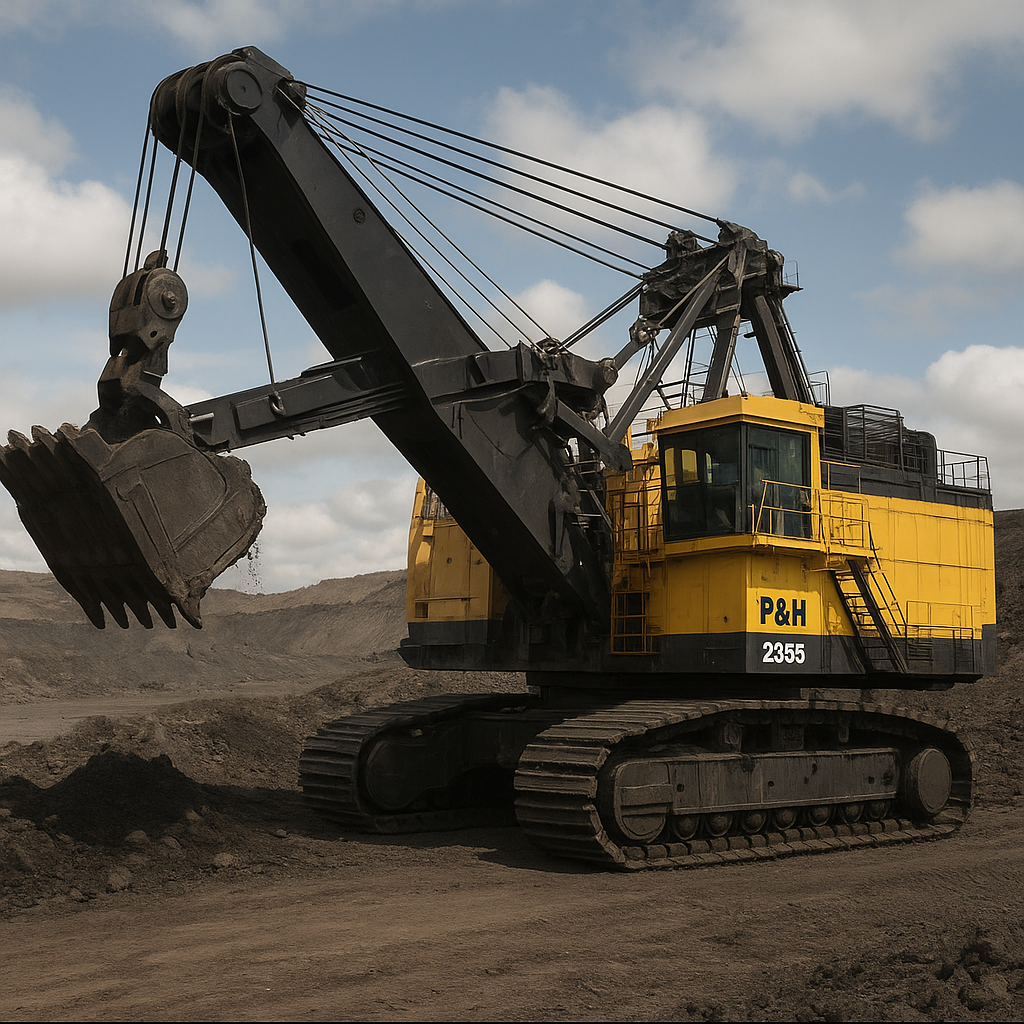
The P&H 2355 is a heavy-duty mining electric shovel that has been used worldwide in open-pit operations for digging, loading and material handling. This article examines the machine’s design, typical applications, operational performance, maintenance needs and its place in modern mining fleets. Where possible, illustrative numerical examples and approximate statistics are included to help understand the machine’s capabilities and practical impact on production. The text highlights key technologies and considerations for operators, engineers and fleet managers who deal with large excavating equipment.
Overview and role in mining operations
The P&H 2355 belongs to a family of large, rope-driven electric shovels originally developed by P&H Mining Equipment (later Joy Global and subsequently part of Komatsu Mining). These machines are purpose-built for high-volume surface mining tasks: removing overburden, loading haul trucks, and handling blasted rock in large open pits. The P&H 2355 is valued for its combination of robustness, continuous electric power architecture and capacity to sustain long duty cycles in harsh environments.
Typical material types handled by the P&H 2355 include coal, iron ore, copper ore, and various bulk rock types. Operators appreciate the shovel for strategic tasks such as shovel-and-truck mining benches where high per-pass payloads reduce truck cycles and lower overall hauling costs.
Design and key technical characteristics
General layout
The P&H 2355 is a rope shovel featuring a house-mounted electric powertrain, a lattice boom and a dipper/bucket that is raised and lowered via wire ropes. The machine’s core subsystems include the electric motors for hoist and swing, the crowd mechanism that controls dipper penetration, the structural boom and stick, and the operator cab with modern control and monitoring systems.
Power and drive systems
As an electric rope shovel, the 2355 uses high-powered electric motors supplied from mine-site medium-voltage distribution or onboard transformers. This electrical architecture delivers high torque and efficient energy conversion for repeated hoist and swing cycles over long shifts. The electrical system often includes:
- medium-voltage supply and step-down transformers,
- multiple AC or DC hoist motors (depending on age and configuration),
- variable-frequency drives or modern motor controllers in retrofit units,
- redundant systems for reliability and smoother load sharing.
Bucket/dipper and payload
The shovel’s digging implement is a dipper or bucket designed for repeated fill-dump cycles. The P&H 2355 can be fitted with a range of bucket sizes and shapes to match material characteristics. Typical dipper capacities for machines in this class vary by configuration; mines often select a bucket that optimizes the match with the assigned haul truck fleet. Because configurations vary, exact bucket volumes are site-dependent, but common considerations include bucket fill factor, material density and truck bed dimensions.
Structure, boom and mobility
The 2355’s superstructure sits on crawler tracks, providing mobility around the bench. The lattice boom and stick are engineered for high bending strength and fatigue life. Structural design prioritizes easy maintenance access to wear parts such as rope guides, boom pins and bucket teeth.
Operational performance and productivity
Quantifying the P&H 2355’s productivity depends on three interrelated parameters: dipper capacity, cycle time, and material density. Below is an illustrative calculation to show how these elements translate to hourly production.
Illustrative productivity example
- Assumed dipper payload: 40 tonnes (this depends on bucket size and material density)
- Assumed average cycle time: 30–40 seconds (digging, swing, dump, return)
- Cycles per hour (at 30 s cycle): 120; at 40 s cycle: 90
Thus, hourly throughput = payload × cycles per hour. For 40 t payload: 40 × 120 = 4,800 t/hr (at 30 s cycle) or 40 × 90 = 3,600 t/hr (at 40 s cycle). These figures are illustrative and actual performance can be higher or lower depending on conditions such as bench geometry, operator skill, material hardness and the match with haul trucks. Larger-bucket configurations or more aggressive cycle planning can significantly increase hourly tonnages.
Typical operating weight and scale
Machines in the P&H mid-to-large class typically have operating weights measured in the low to mid hundreds of tonnes. The exact operating mass of a 2355 will depend on attachments, counterweight packages and optional equipment. The machine’s scale and duty profile are designed to operate continuously for 12–24 hour shifts in many mines.
Applications and fleet integration
P&H 2355 shovels are most often assigned to roles that require steady, high-volume material removal. Typical applications include:
- Primary loading of 30–300 tonne haul trucks in conventional truck-and-shovel operations,
- Stockpile reclaim and loading,
- Overburden removal in multi-bench open pits,
- Heap-leach feed operations and concentrate handling in mineral processing contexts.
Fleet planners evaluate shovel and truck match to avoid under- or over-loading trucks. The optimal shovel size minimizes truck idle time while maximizing shovel utilization. The P&H 2355 is often paired with medium-to-large haul trucks depending on its selected bucket size, enabling balanced cycles and high truck payload utilization.
Maintenance, reliability and lifecycle management
Long-term reliability is one of the P&H shovel family’s strong points, but achieving expected availability requires rigorous maintenance programs. Key maintenance domains include:
- wire rope inspection and replacement schedules,
- hoist brake and motor servicing,
- hydraulic and pneumatic systems checks (for auxiliaries),
- undercarriage and track tensioning,
- wear parts replacement (bucket teeth, adapter, dipper lip),
- electrical systems diagnostics and transformer maintenance.
Condition-based maintenance using vibration monitoring, thermography and oil analysis has become standard for fleets using older rope shovels. Many operations retrofit telemetry and predictive analytics to schedule interventions before failures, increasing availability and reducing unplanned downtime.
Typical life expectancy and rebuilds
With proper maintenance, a rope shovel like the P&H 2355 can provide decades of service. Major component rebuilds—house gearboxes, motors, booms—are commonly performed during a shovel’s lifecycle. Rebuilds extend service life and can include modern control and drive upgrades that improve energy efficiency and operator ergonomics.
Safety, ergonomics and operator environment
Operator safety and comfort have become central design considerations. Modernized 2355 units commonly feature:
- improved cabs with HVAC and enhanced visibility,
- ergonomic controls and joystick operation,
- integrated cameras and proximity detection systems,
- Rollover Protective Structures (ROPS) and Falling Object Protective Structures (FOPS) where required,
- interlocks and automated safe-limit controls for swing and hoist operations.
Training for operators and maintenance crews emphasizes rope-handling safety, lockout/tagout procedures for electrical systems and safe practices for working around moving buckets and swinging booms.
Modernization trends and technological upgrades
Many mining companies pursue modernization programs for proven shovel platforms to gain efficiency improvements without the capital expense of a new machine. Common upgrades for P&H 2355 machines include:
- installation of AC electric drives and variable-frequency drives for finer control and lower maintenance than legacy DC systems,
- advanced operator assistance systems and semi-automation for repeatable, safer digging cycles,
- telemetry integration for fleet optimization and remote diagnostics,
- wear-resistant materials and improved metallurgy for bucket and dipper components,
- energy-recovery strategies where possible (regenerative hoisting concepts).
Such upgrades can improve fuel/electricity efficiency, reduce mean time to repair (MTTR), and increase effective availability.
Environmental and economic considerations
Electric rope shovels such as the P&H 2355 have an environmental profile that is largely determined by the power source. When grid or mine-site electricity is generated from low-carbon sources, the shovel’s carbon footprint per tonne moved can be lower than that of diesel-powered hydraulic excavators performing similar tasks. Energy-efficient motors and modern drive systems can further reduce electricity consumption.
Economically, the shovel model is evaluated on cost-per-tonne moved, availability, spare-part lead times and lifecycle maintenance costs. A well-maintained P&H 2355 can deliver attractive unit costs in large-volume production contexts where continuous loading of haul trucks reduces cycle inefficiencies.
Notable operational data and statistics (illustrative)
Exact performance statistics for a given P&H 2355 depend on site-specific factors, but the following illustrative figures can help set expectations:
- Typical dipper payload range: 25–50 tonnes (site- and bucket-dependent).
- Representative cycle times: 25–45 seconds in efficient bench conditions.
- Hourly throughput example: 3,000–6,000 tonnes per hour depending on payload and cycle time.
- Availability targets for well-managed fleets: 85–92% annual availability (subject to maintenance strategy).
- Operational life with rebuilds: 20+ years with major component overhauls and modernization.
These numbers are indicative and should be validated against manufacturer specifications and actual site performance data. Mines typically run trials and field tests to determine the most productive bucket size and cycle strategy for their materials and truck match.
Comparisons and fleet selection considerations
When selecting a shovel for a particular duty, engineers weigh factors such as bucket size options, electrical infrastructure, expected production, haul-truck fleet sizes and bench geometry. Compared with hydraulic excavators, rope shovels like the 2355 often provide higher per-pass payloads and greater durability for hard-rock face conditions, while hydraulic machines can offer more precise control in selective loading tasks.
Key selection criteria include:
- match between dipper volume and truck payload to avoid underloading or multi-pass inefficiency,
- site electrical capacity and whether medium-voltage distribution is available or feasible,
- spare parts logistics and local service capability,
- total cost of ownership over expected service life, including energy costs and rebuild intervals.
Examples of operational practices and tips
To maximize the 2355’s performance, operators and maintenance teams typically focus on:
- optimizing bench face angle and approach paths to reduce unnecessary swing and repositioning,
- using cycle sequencing to coordinate with truck arrival and minimize truck waiting times,
- implementing condition-monitoring systems for early detection of component wear,
- training crews on best-practice rope handling and safe maintenance procedures,
- tracking fuel/electricity consumption per tonne as a KPI to drive efficiency improvements.
Conclusion
The P&H 2355 is a capable electric rope shovel designed for sustained, high-volume surface mining duties. Its advantages include strong payload capability, resilient structural design and the potential for modernization with modern drives and control systems. Productivity outcomes depend heavily on the match of bucket size with haul trucks, bench layout, operator technique and preventive maintenance regimes. For operations seeking reliable, long-lived equipment for primary loading tasks, a well-maintained P&H 2355—especially one upgraded with contemporary controls—remains a competitive choice in many open-pit mining environments.


)
)