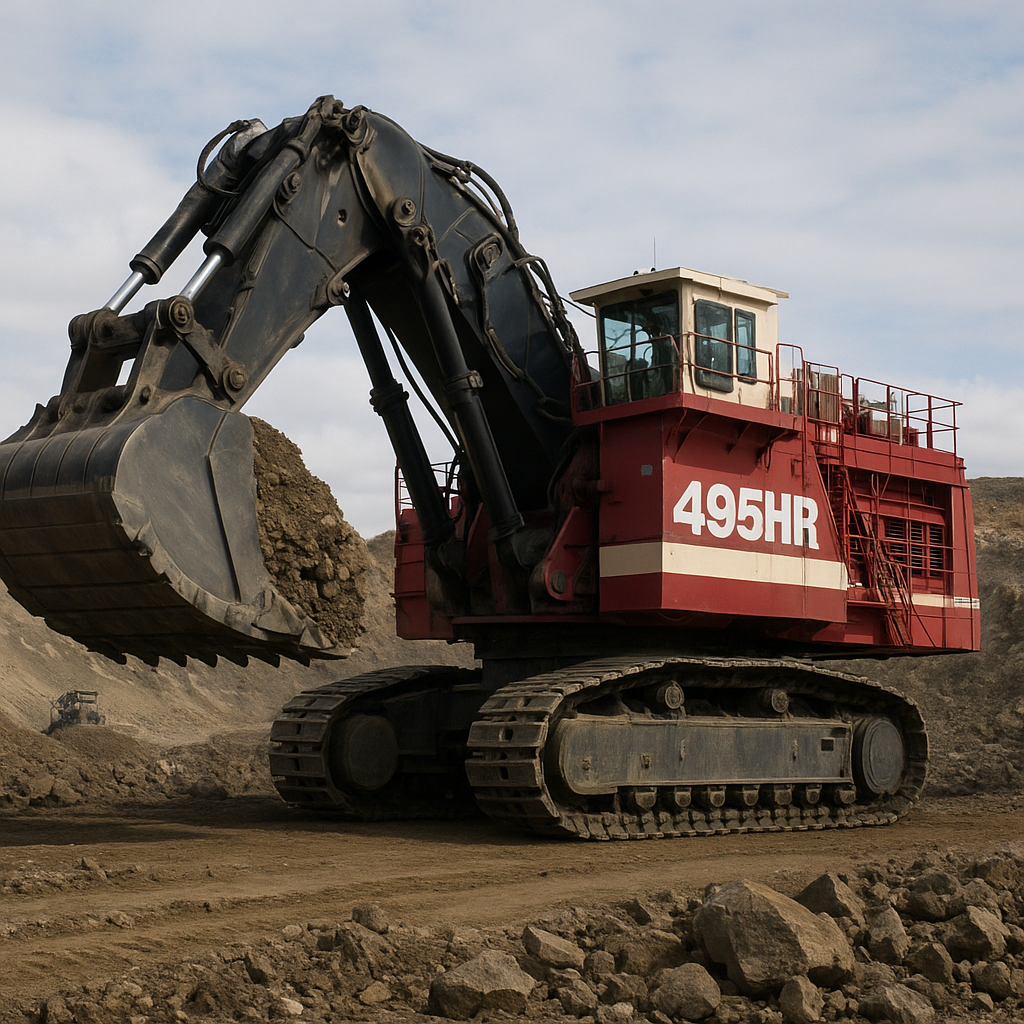
The Bucyrus 495HR is a heavy-duty hydraulic mining shovel that has played a significant role in large-scale surface mining operations worldwide. Designed to move vast amounts of overburden and ore, this machine combines robust mechanical engineering with operational flexibility to serve mines extracting coal, iron ore, copper, and other commodities. In the following sections we will explore the 495HR’s design, typical applications, performance characteristics, maintenance and safety considerations, and its place in modern mining fleets. The article includes practical statistics where generally available and highlights aspects that make the 495HR a valuable asset on major open-pit sites.
Design and technical characteristics
The Bucyrus 495HR is a member of the family of large hydraulic shovels developed for continuous, high-volume loading tasks. As a hydraulic shovel, it uses hydraulic cylinders and motors to control boom, stick and bucket motion rather than the classic cable-and-dragline arrangement. This configuration gives precise control, high digging forces and faster cycle times in appropriate conditions.
Key components
- Engine and powertrain – The machine is powered by large diesel engines or a diesel-electric powertrain depending on the build and customer requirements. Engines in machines of this class typically deliver power in the range of several hundred to a few thousand kilowatts in total installed power when auxiliary systems are included.
- Boom and linkage – A reinforced box-section boom and robust stick provide the reach and digging geometry necessary for heavy-duty excavation. Hydraulic cylinders control lift, crowd and dump operations.
- Bucket – The 495HR is commonly equipped with large-capacity buckets designed to match target haul truck sizes. Bucket sizes vary by application but are engineered for heavy materials and abrasive conditions.
- Undercarriage and slewing system – Heavy-duty crawlers support the machine’s weight and allow repositioning on the pit bench. A high-capacity slewing bearing and drive permit rotation with loaded buckets.
- Operator cab and systems – Modern configurations include ergonomically designed cabs with climate control, vibration damping, extensive instrumentation, and increasingly, operator assistance systems or semi-automation packages.
Typical specifications (approximate ranges)
Actual figures depend on configuration and year of manufacture. The following figures are representative ranges for a machine in the 495HR class:
- Operating weight: approximately 500–800 metric tons (varies with counterweight and equipment).
- Bucket capacity: typically 30–45 cubic meters (or more in high-capacity variants) — often matched to truck bodies in the 90–150 tonne payload class.
- Payload per bite: commonly in the order of 50–120 tonnes loose material depending on material density and bucket size.
- Engine power: aggregate installed power (main engines plus hydraulics) often ranges from 1,000 to 3,000 kW equivalent.
- Reach and digging depth: boom and dipper combinations allow digging depths and reach that handle typical high-bench operations; digging depth may exceed 10–15 meters in many setups.
- Cycle time: loaded cycle times vary widely with operator skill and bucket size but can be on the order of 30–60 seconds in optimized conditions.
Applications and operational roles
The primary mission of the Bucyrus 495HR is in open-pit mining, where it performs both overburden removal and ore loading. Its size and hydraulic control make it particularly useful in a number of scenarios:
- High-capacity ore loading – Loading large haul trucks efficiently requires consistent bite volumes and fast, repeatable cycles. The 495HR is tailored to match the larger rigid trucks common at modern mines.
- Overburden stripping – In many surface mines, removing waste rock rapidly is crucial to exposing ore bodies. The 495HR’s power and bucket capacity make it effective for bulk earthmoving tasks.
- Selective mining – Hydraulic shovels offer precision control that can be important for selective digging in ore zones with interbedded waste.
- Stockpile reclaim and rehandle – Where stockpiles must be reshaped or re-handled, the shovel’s reach and controlled digging are advantageous.
- Support roles – In addition to primary loading, machines like the 495HR assist in constructing benches, creating haul-road berms, and supporting drilling and blasting cycles by clearing muck.
Compatibility with haul fleets
Matching shovel bucket capacity to haul truck payload is essential to maximize fleet productivity. A well-matched 495HR will typically be paired with haul trucks in the 90–150 tonne payload class. This pairing reduces under- or over-loading, optimizes cycle times, and improves overall mine throughput.
Performance, productivity and economic considerations
Productivity of a Bucyrus 495HR depends on several interrelated factors: bucket size, material characteristics (density and abrasiveness), bench height, operator skill, and supporting fleet logistics. When optimized, a single hydraulic shovel can load thousands of tonnes per hour, contributing directly to a mine’s revenue-generating rate.
Key productivity drivers
- Bucket fill factor – Achieving consistent, full bites is essential. Fill factors depend on material fragmentation and digging technique.
- Cycle time and reliability – Minimizing delays between bites and ensuring high availability through maintenance reduce unit operating costs.
- Haul truck matching – Properly sized truck fleets and well-managed dispatching prevent truck-shovel conflicts and idle time.
- Operator training and automation – Skilled operators and automated assistance (such as shovel guidance or semi-autonomous systems) consistently improve per-shift throughput.
Operational economics
The cost-effectiveness of deploying a 495HR is evaluated against capital expenditure (CAPEX) for purchase or lease, operating expenditures (OPEX) including fuel, hydraulic oil and wear parts, and the productivity gained. Typical economic considerations include:
- Fuel consumption per hour and per tonne of material moved
- Wear parts costs: bucket teeth, adapters, side cutters, and linkages
- Hydraulic system maintenance and oil change cycles
- Component refurbishments: pumps, cylinders and swing gear over major life intervals
Because of its size and throughput, the 495HR can deliver low unit costs of material movement compared to smaller machines when operated in appropriate environments with a matching haul fleet.
Maintenance, reliability and lifecycle management
Maintaining a large hydraulic shovel such as the Bucyrus 495HR is a complex, year-round task that significantly influences availability and total cost of ownership. Sound maintenance strategies extend service life and ensure safe operation.
Preventive and predictive maintenance
- Scheduled inspections – Daily and weekly inspections focus on hydraulic hoses, cylinders, pivot pins, tracks, and the bucket and teeth. Early detection prevents catastrophic failures.
- Condition monitoring – Vibration monitoring, oil analysis, and thermal imaging provide predictive insight into component health.
- Component lifecycles – Items like bucket teeth and wear plates have short lifecycles; larger components such as hydraulic pumps and undercarriage elements have longer scheduled lifecycles often measured in thousands of operating hours.
- Refurbishment and rebuilds – Major rebuilds of the crawler, swing systems and engines are common mid-life investments that extend the shovel’s useful life by many years.
Typical availability targets
Mines commonly target availability figures in the range of 85–95% for primary loading equipment; achieving these rates requires rigorous maintenance planning and rapid response to breakdowns. Reliability is also enhanced by stocking critical spares and employing trained technicians on site.
Safety and operator ergonomics
Safety features and operator comfort are central to shovel design. The 495HR’s cab and control layouts aim to reduce operator fatigue and increase awareness of hazards on the bench.
- Visibility and cameras – Large windows, mirrors and camera systems provide good sight lines for operators to see the bucket, truck bed and bench edges.
- Control ergonomics – Joystick controls, adjustable seats, and climate control reduce operator strain and improve precision.
- Access and egress – Safe ladders, platforms and handrails reduce slip and fall risks during climbs and maintenance.
- Emergency systems – Fire suppression, emergency shutdowns, and fall-protection anchorage are standard safety inclusions on modern builds.
Environmental impact and fuel efficiency
The environmental footprint of large hydraulic shovels includes fuel consumption, hydraulic fluid use, noise and dust generation. Manufacturers and mine operators increasingly pursue strategies to reduce emissions and improve efficiency.
Fuel and emissions
Large shovels are diesel-intensive. Fuel consumption varies with work rate and load but is a major contributor to onsite greenhouse gas emissions. Measures to reduce emissions include:
- Engine upgrades to meet stricter emission standards
- Hybridization or electrification where feasible (e.g., electrified shovels drawing power from stationary sources or mine power grids)
- Idle reduction strategies and operator training to avoid unnecessary fuel use
Dust and noise control
Operational controls such as water spraying, windbreaks, and timing of activities can limit dust. Noise attenuation is addressed through mufflers, cab insulation and operational planning that reduces noise exposure to personnel.
Automation, telematics and modern enhancements
Recent years have seen growing integration of automation, telematics and operator-assistance technologies into large shovels. These advances increase safety, improve precision and enable remote operation in hazardous conditions.
- Remote operation – Some mining operations use remote-control centers to operate shovels from a safe distance, decreasing risk in unstable benches or high-seam coal operations.
- Guidance and payload control – Systems that monitor bucket fill and adjust swing and crowd motion help maximize consistent payloads and reduce overloading or spillage.
- Fleet telematics – Real-time data on fuel consumption, cycle times and machine health support better fleet-wide decision-making and predictive maintenance.
Global deployment and case examples
The Bucyrus 495HR and similar shovels have been used across continents in large open-pit mines. Typical deployments include coal operations in Australia, North America and Russia; metal mines extracting copper and iron ore in South America, Australia and Africa; and large aggregate and specialty mining sites worldwide.
Operational scenarios
- In coal surface mines the 495HR is often used along continuous benches where high tonnages per shift are required; in these settings, shotcreting and ground-support are less of an issue than achieving rapid loading cycles.
- At copper and gold mines with complex geological layering, the shovel’s precision helps selectively load ore zones while minimizing dilution.
- In iron ore pits with high-density materials, bucket design and wear packages are customized to extend service life and maintain high fill factors.
Historical context and market position
Bucyrus, a historic name in mining equipment, developed a lineage of large excavators and shovels over many decades. After consolidation in the industry, platforms and technologies from Bucyrus influenced subsequent designs under larger corporate brands. The 495HR represents an evolutionary point where hydraulic shovels combined increasing power, improved hydraulics and operator comforts suited for modern, heavy-haul operations.
Comparative advantages
Compared to smaller hydraulic shovels or older cable excavators, machines in the 495HR class bring:
- Higher single-bite payloads – Reducing the number of truck passes required per tonne moved.
- Superior control – Hydraulic actuation enables precise material handling and selective digging.
- Flexibility – Hydraulic shovels can be configured with different buckets or booms to suit changing mine plans.
Procurement, lifecycle costs and resale
When considering acquisition of a 495HR-class shovel, mining companies evaluate total lifecycle costs, not just initial purchase price. Major factors include:
- Availability of local service and spare parts
- Fuel efficiency and expected fuel price exposure
- Expected maintenance intervals and the cost of wear items
- Resale market and long-term demand for large hydraulic shovels
Used machines of this size frequently change hands between operators and contractors; refurbishment programs and remanufacturing can return a shovel to near-new condition, often at lower cost than buying new.
Conclusion
The Bucyrus 495HR is a robust, heavy-capacity hydraulic shovel designed to meet the demanding requirements of modern open-pit mining. Its strengths lie in high-volume loading, precise hydraulic control, and adaptability to multiple minerals and bench conditions. Real-world performance depends on correct matching to haul trucks, diligent maintenance, skilled operators, and increasingly, the integration of automation and telematics.
When deployed effectively, the 495HR can be a central element of a mine’s production system, enabling high tonnage movement with competitive unit costs. Ongoing trends toward electrification, automation and improved predictive maintenance continue to shape how machines in this class will perform and be managed in the coming decades.
Selected highlighted concepts: Bucyrus 495HR, hydraulic shovel, open-pit mining, bucket capacity, payload, productivity, maintenance, operator cab, fuel efficiency, automation.


)
)