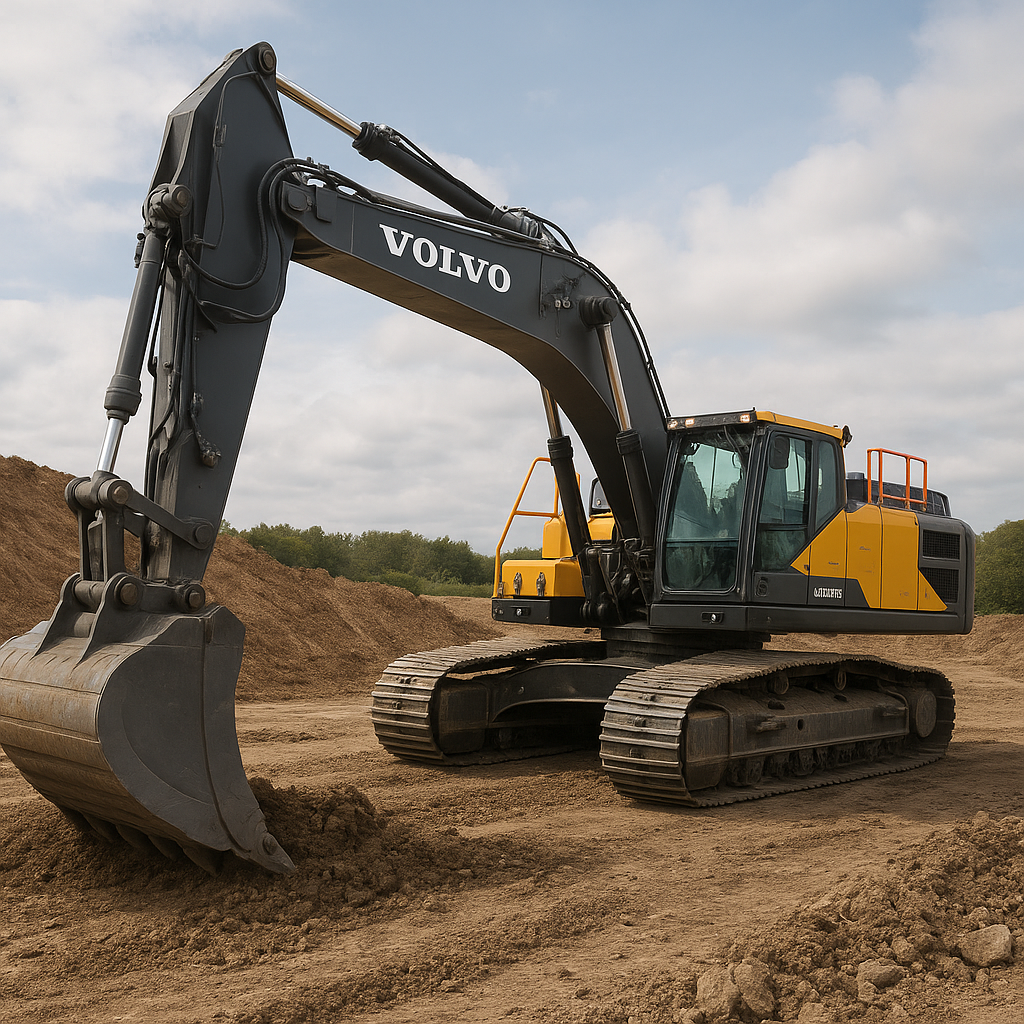
The Volvo EC750E is a flagship in the heavy crawler excavator category, designed for the most demanding earthmoving, quarrying, and mining operations. Combining robust structural design, advanced hydraulics and powertrain technology, and operator-focused ergonomics, this machine aims to deliver high uptime and consistent performance in severe working conditions. The following article explores its technical characteristics, typical applications, maintenance considerations, and the business case for deploying such a large machine on modern job sites.
General overview and key specifications
The Volvo EC750E sits in the upper tier of excavators offered by Volvo Construction Equipment, aimed at heavy-duty tasks where capacity and endurance matter most. It is commonly used where high production rates, deep digging reach, and heavy bucket loads are required. Below are typical characteristics and a compact technical summary — note that exact figures can vary with configuration, attachment choice and region.
- Volvo EC750E class: large / ultra-large crawler excavator
- Operating weight: approximately 75,000–79,000 kg (165,000–174,000 lb) depending on configuration and counterweights
- Engine: Volvo diesel engine (Tier 4 Final / Stage IV / Stage V compliant where applicable); net power roughly 400–410 kW (approx. 535–550 hp)
- Bucket capacity: commonly 3.0–6.5 m3 depending on bucket type (general purpose, rock, heavy-duty)
- Hydraulic system: load-sensing or electronically controlled variable flow system with large pump capacity to supply multiple simultaneous functions
- Maximum digging depth: commonly in the 11–13 m range depending on boom/arm configuration
- Swing torque and breakout forces: designed to move heavy loads with high breakout forces; specific numbers depend on arm/boom and bucket options
- Undercarriage: heavy-duty track frames and links with optional XL/XXL track shoes for ground-bearing requirements
These large excavators are engineered for a balance between structural durability and hydraulic performance. The heavy-duty boom and arm, reinforced linkages, and robust pins and bushings are critical for the long service life expected in quarrying and mining work.
Primary applications and typical use cases
The EC750E is built to be versatile within heavy operations. Its most common arenas include:
- Mining: loading haul trucks, trimming benches, and secondary digging where deep reach and heavy bucket payloads increase cycle productivity.
- Quarrying and aggregates: high-volume rock removal, loading crushers and hoppers, and supporting continuous production operations.
- Civil mega-projects: excavation for dams, ports, bridges and other large earthworks where mass removal and lift capacity are essential.
- Bulk material handling: when fitted with grapples or clamshells, the excavator can be used for stockpile management, scrap handling, or bulk terminal work.
- Specialized demolition and deconstruction: using breakers, shears and other heavy attachments for selective dismantling of large structures.
In mining and quarry operations the EC750E is often matched with haul trucks in the 90–240 ton class depending on fleet strategy; the excavator’s bucket size and swing/loader cycle are selected to maximize truck fill factors and minimize truck idle time.
Powertrain, hydraulics and performance features
At the heart of the EC750E is its powertrain and hydraulic system, engineered to provide steady, controllable power and efficient energy use. Key aspects include:
- Engine management: a high-displacement Volvo diesel with modern emissions control (aftertreatment systems such as SCR and diesel particulate filters as required by region). Different engine maps allow operators to select high-power or economy modes for job-specific needs.
- Hydraulic efficiency: an electronically controlled hydraulic system with large-capacity pumps that deliver high flow at variable pressure. This enables simultaneous heavy functions (boom lift, arm curl and swing) with minimal loss in responsiveness.
- Hydraulic regeneration: some movements can recover energy and reduce fuel use, especially in boom-lift cycles.
- Automatic work modes and load-adaptive control: improves cycle times and reduces operator fatigue while maintaining fuel economy.
Typical performance indicators for this machine in operational practice focus on cycle time, bucket fill factor and truck matching. When optimally configured, an EC750E can achieve high tonnage per hour in face loading and bench operations, significantly lowering unit cost per tonne.
Operator environment and safety features
Volvo places emphasis on operator comfort and safety because a well-rested and informed operator drives better productivity and longer machine life. Notable cabin and control features include:
- Spacious ROPS/FOPS certified cab with excellent all-around visibility and sound-dampening for reduced fatigue.
- Ergonomic controls with adjustable seats, armrests and joystick positions to suit long shifts.
- Integrated displays for machine diagnostics, viewable parameters, camera feeds and operating modes.
- Advanced camera packages and sensors: rear, side and optional top-view cameras enhance situational awareness around this large machine.
- Safety steps, handrails and anti-slip surfaces to reduce risk during servicing and daily checks.
For heavy excavators, visibility and easy access to service points are safety-critical given the scale of components and the potential hazards in mining environments.
Attachments and customization
One of the EC750E’s strengths is adaptability through a wide range of attachments tailored to job demands:
- Heavy-duty rock buckets and large-capacity GP buckets for maximum cycle payloads
- Hydraulic breakers for primary and secondary rock breaking
- Grapples and clamshells for material handling and sorting
- Rippers and multi-shank rippers for tough ground preparation
- Specialized handling booms and rotators for log or scrap handling
- Quick couplers for fast changeover between tasks
Selection of the correct attachment is essential for maximizing the machine’s productivity while avoiding overloading the hydraulic system or compromising stability.
Maintenance, uptime and lifecycle costs
For heavy machines like the EC750E, lifecycle cost and uptime are often more important to owners than the initial purchase price. Volvo and many global dealers emphasize services that reduce downtime and extend component life:
- Planned maintenance intervals with easy access to filters, fluids and inspection points reduce service time.
- Heavy-duty wear components: reinforced pins, bushes and undercarriage designs extend intervals between rebuilds in abrasive environments.
- Modular components and standardized parts reduce lead times for replacement parts across a fleet.
- Volvo telematics and remote monitoring: systems like CareTrack and ActiveCare (or regional equivalents) enable remote diagnostics, predictive maintenance alerts and optimized service planning.
Operators often measure total cost of ownership through uptime percentage, maintenance cost per operating hour, and resale value. Large excavators that maintain high uptime and controlled maintenance costs can significantly improve profitability in large-scale projects.
Performance metrics and productivity examples
Performance on the job is measured by output (tonnes per hour), fuel consumption (litres per hour), cycle time (seconds), and truck fill factor. Example ranges observed in heavy-duty applications:
- Average fuel consumption: typically 20–45 L/hour depending on duty cycle, attachment and mode selection; peak conditions produce higher burn rates.
- Cycle time for a full loading swing and dump: can range from 20–40 seconds depending on bucket size and operator proficiency.
- Typical productivity: when matched with appropriately sized haul trucks, an EC750E may move several thousand tonnes per shift in high-production quarry and mining situations.
Actual field numbers depend heavily on geology, bucket fill factor, operator skill and the equipment synergy in a fleet. Using telematics to monitor and refine duty cycles and match truck sizes is a proven way to increase effective productivity.
Environmental compliance and fuel economy initiatives
Modern heavy excavators are required to meet strict emissions regulations in many markets. Volvo equips machines like the EC750E with aftertreatment systems that comply with Tier 4 Final, Stage IV or Stage V standards where they apply. In addition to emissions control, Volvo’s design philosophy includes:
- Engine mapping and work modes to reduce unnecessary high-RPM operation
- Hydraulic systems tuned for energy efficiency and reduced heat generation
- Cooling systems designed to prevent excessive fuel use while maintaining optimal component temperatures
Operators can further reduce fuel use and emissions with best practices: idling minimization, selecting economy mode for lighter tasks, and ensuring hydraulics and engine systems are properly serviced.
Transport, site requirements and logistics
Due to its mass and size, moving an EC750E between sites is a logistical undertaking. Considerations include:
- Heavy transport trailers and local permitting for oversized loads
- On-site ground-bearing capacity for assembly/disassembly and machine operations
- Crane lifting capacity for modular parts if required during assembly
- Storage and security for spare parts and specialized attachments
Site planning must account for turning radius, swing clearance and approach angles to ensure safe and productive operation without risk to surroundings or traffic flow.
Economic rationale for selecting a machine like the EC750E
Investing in a large excavator is ultimately a business decision that hinges on matching machine capability to project scale. Benefits generally include:
- Lower unit cost per tonne moved versus smaller machines due to larger bucket payloads
- Fewer cycle repetitions for the same mass of material moved—reducing wear and improving throughput
- Ability to perform a wider variety of tasks (digging, loading, handling) with attachments that increase fleet flexibility
- Potential for improved worksite productivity when combined with truck-tramming optimization and telematics
Owners should weigh acquisition cost, financing, expected uptime, maintenance strategy and resale potential. Contractual work requiring high continuous output may quickly justify investment in a machine of this scale.
Summary and final notes
The Volvo EC750E is a purpose-built solution for the toughest excavation and material handling tasks. It blends robust mechanical engineering, advanced hydraulics and a focus on operator efficiency and safety. Whether applied in mining benches, aggregate quarries, heavy civil works or bulk handling yards, its size and capability make it a central asset in high-production operations. When evaluating the machine for purchase or rental, consider operational matching (bucket size to truck fleet), maintenance infrastructure, and telematics-enabled monitoring to ensure real-world productivity aligns with site needs.
Highlighted capabilities
- Hydraulic performance tuned for simultaneous heavy operations
- Engine and emissions systems meeting modern regulatory standards
- Telematics integration for proactive maintenance and uptime
- Wide range of bucket and specialty attachments for job flexibility
- Operating weight and structural design tailored to heavy-duty applications
For exact, model-specific data (e.g., precise engine family code, breakout forces in kN, hydraulic flow rates, and OEM-configured bucket volumes), consult an authorized Volvo Construction Equipment dealer or the official product specification sheet. Configurations, optional packages and regional regulations can affect final machine specification and performance.
)
)