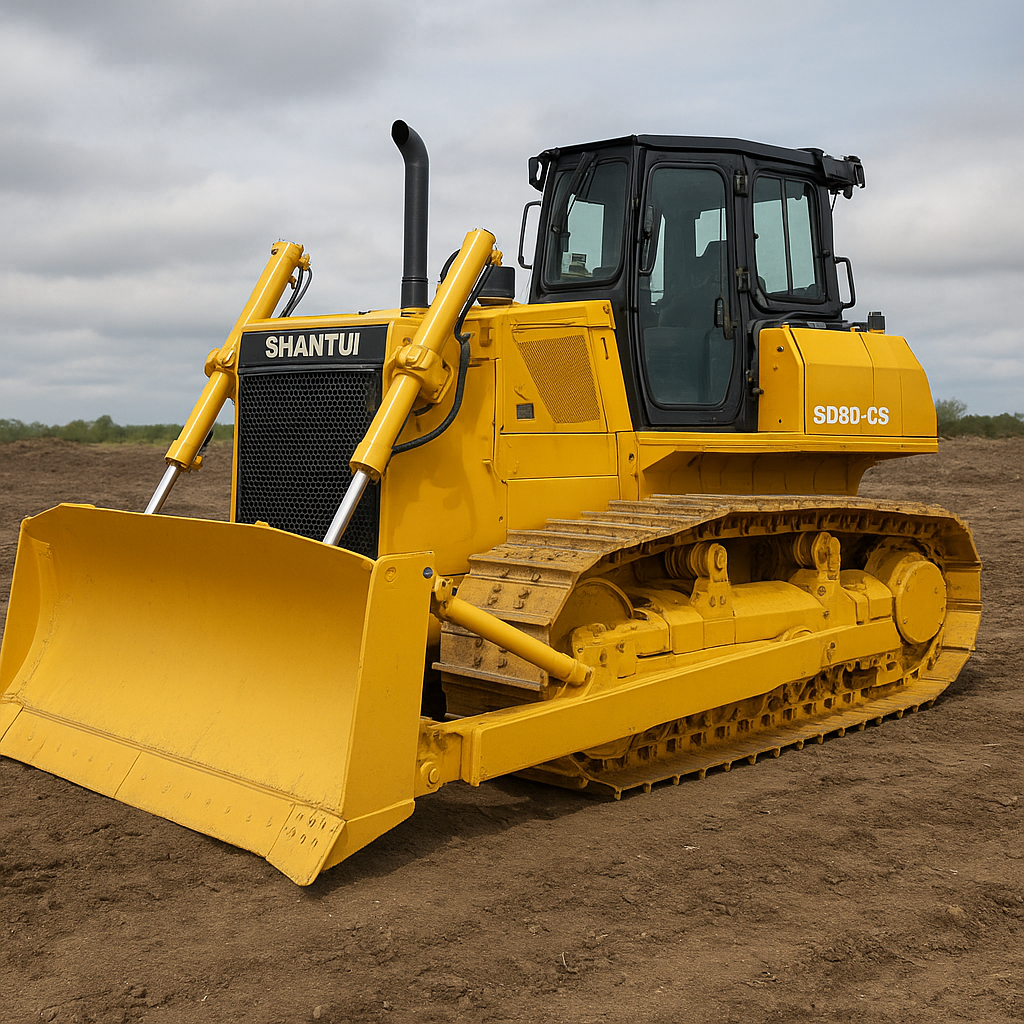
The Shantui SD90-C5 crawler dozer represents a compact but capable machine in the global earthmoving market. Built by Shantui Construction Machinery Co., Ltd., this model is designed for tasks that require a balance of mobility, pushing power and operational economy. In this article we examine the SD90-C5’s design, typical applications, technical characteristics, operational strengths and practical considerations for owners and operators. Emphasis is placed on real-world uses, maintenance, safety and how this machine compares with alternatives in its class.
Design and technical overview
The SD90-C5 is a crawler dozer that combines a robust undercarriage with a hydraulically actuated blade and a compact frame. Shantui’s product line is known for offering machines that deliver good value for money, and the SD90-C5 is positioned for customers who require a reliable machine for medium-duty earthmoving.
Key components and layout
- Engine and powertrain: The SD90-C5 typically features a turbocharged diesel engine married to a hydrostatic or power-shift transmission, chosen to provide smooth torque delivery and straightforward serviceability. The engine and drivetrain are tuned to balance fuel efficiency and steady pushing power.
- Undercarriage: Tracks, rollers and idlers are engineered to offer high traction and stability on varied ground conditions. The undercarriage design emphasizes ease of replacement for wear parts and resilience to abrasive soils.
- Blade and attachments: The machine usually comes with a straight (S) blade or an optional universal (U) or semi-U blade. Quick-attach options and ripper attachments are often available to expand versatility.
- Hydraulic system: A proportional hydraulic system controls blade lift, tilt and angle with sufficient responsiveness for grading and leveling tasks.
Typical specifications (approximate)
Specifications vary by configuration, market and optional equipment. The figures below are representative of the SD90-C5 class and should be confirmed with a dealer for exact configurations.
- Operating weight: approximately 9,000–11,000 kg
- Engine power: roughly 66–90 kW (approx. 88–120 HP)
- Blade capacity: 2.0–3.0 m³ depending on type and configuration
- Ground pressure: typically in the range of 40–55 kPa (low ground pressure options may be available)
- Track gauge and shoe width: common track shoe widths of 450–600 mm to balance flotation and maneuverability
- Travel speed: typically up to 10–12 km/h forward, with lower reverse speed
- Fuel tank capacity: usually between 120–200 liters
- Ripper options: single or multi-shank rippers available for breaking compacted material
These numbers place the SD90-C5 in a segment suitable for contractors, municipal departments and agricultural operations that need a medium-weight dozer with versatile utility.
Applications and typical work environments
The SD90-C5 shines in scenarios that require a reliable dozer capable of both fine grading and heavier pushing tasks. Its relatively compact footprint and maneuverability make it suitable for confined sites while still providing enough mass for effective earthmoving.
- Road construction and maintenance — Used for subgrade preparation, spreading aggregate and shoulder work on secondary roads. The machine’s blade control and traction permit efficient surfacing and grading in tighter road corridors.
- Land clearing and site preparation — Effective for clearing scrub, leveling pads and distributing topsoil. Optional rippers and brush-cutting attachments increase capability on overgrown or compacted sites.
- Landscaping and utility trench backfill — Contractors use this class of dozer for shaping landscapes, preparing terraces and backfilling trenches where a larger machine would be impractical.
- Agriculture and forestry — On farms and in forestry yards, the SD90-C5 can move silage, clear land for planting, and maintain farm roads.
- Mining and quarry support — While not a primary production machine for heavy mining, it performs support roles such as road maintenance inside quarries and moving stockpiles.
- Disaster recovery and civil works — Its role in emergency response operations (flood mitigation bunds, debris clearance) is valued for its combination of power and transportability.
Operational features and operator experience
Shantui designs the operator station to prioritize basic ergonomics, visibility and service access. In a competitive market segment, the SD90-C5 focuses on delivering practical comforts that reduce operator fatigue and support productivity.
- Cab and controls: Options range from open-station ROPS frames to enclosed cabs with climate control. Enclosed cabs provide better operator comfort for long shifts and cold climates.
- Visibility: Large windows and elevated seating positions help with blade and trackline visibility, improving grading accuracy and safety on site.
- Controls layout: Intuitive joystick or lever controls are typical, offering proportional blade control for fine grading. Mechanical linkages or electro-hydraulic controls are both possible depending on build specification.
- Noise and vibration: The SD90-C5 is engineered to keep in-cab noise and vibration within acceptable ranges for medium-duty machines, but aftermarket damping or active maintenance may further reduce levels.
- Serviceability: Ground-level service points, accessible filters and modular components are used to reduce downtime and simplify routine maintenance tasks.
Maintenance and lifecycle considerations
For owners and fleet managers, total cost of ownership and machine availability are critical. The SD90-C5 emphasizes ease of maintenance, spare-part availability and straightforward diagnostics.
Routine maintenance aspects
- Scheduled servicing: Regular oil and filter changes, track tensioning and hydraulic system checks are the backbone of long service life.
- Undercarriage wear: The tracks and rollers are wear items; regular inspections and timely replacement of worn shoes, idlers and sprockets can extend life and reduce repair costs.
- Hydraulic system care: Clean filtration and monitoring of hydraulic temperatures prevent premature component wear and maintain consistent blade performance.
- Parts logistics: Shantui’s international dealer network and third-party suppliers often provide a steady supply of consumables and wear parts, influencing machine uptime positively.
Lifespan and rebuilds
With proper maintenance, machines in this class commonly reach 10,000–20,000 operating hours before major overhaul is economically justified, depending on intensity of use and environment. Rebuild kits and remanufactured engines are widely available in many markets, allowing cost-effective life extension.
Economic and market considerations
When evaluating the SD90-C5, potential buyers consider acquisition cost, operating expenses and the machine’s resale value. Shantui generally aims to achieve competitive pricing versus established Western brands, creating a cost-benefit scenario where lower capital expenditure can offset slightly higher operating or perceived quality differentials.
- Acquisition cost: The SD90-C5 is typically offered at a lower list price than equivalent models from premium brands, making it attractive for budget-sensitive buyers and fleets expanding quickly.
- Operating costs: Fuel consumption for machines in this power band often ranges from 8 to 18 liters per hour depending on load cycles and engine tuning. Maintenance and parts costs are a significant factor that can vary by region and dealer support.
- Depreciation and resale: Used-market demand depends strongly on local familiarity with the brand and the availability of parts and service. In regions with established Shantui support, resale values can be competitive.
Safety and environmental factors
Modern expectations for construction equipment include safety features and emissions controls. The SD90-C5 can be configured to meet various regional standards and includes features to protect operators and nearby workers.
- Operator protection: ROPS and FOPS-certified structures are available, along with seat belts and clear sightlines to reduce collision risk.
- Emissions: Engines can be supplied to meet local emissions standards; options may include electronic engine management and after-treatment in markets with strict regulations.
- Noise and dust control: Enclosed cabs, improved engine insulation and site practices (water spraying, windbreaks) reduce environmental impact.
- Safety systems: Backup alarms, mirrors, and optional cameras increase site safety, particularly in congested or low-visibility conditions.
Comparisons with competitors and alternatives
Buyers choosing a dozer in the SD90-C5’s class typically compare it with similarly powered machines from both multinational brands and other Chinese manufacturers. Key differentiators are service network, total cost of ownership, parts availability and perceived reliability.
- Versus larger brands: Western manufacturers often supply more advanced electronics and deeper global dealer networks, which can translate to higher resale values and predictable support. The SD90-C5 competes on initial cost and straightforward mechanical design.
- Versus other Chinese brands: Within its domestic origin market, Shantui competes with established peers by offering a broad model range and economies of scale in production and parts distribution.
- Role-based choice: If a fleet requires rugged simplicity and a lower purchase price, an SD90-C5 is attractive; if advanced telematics, brand prestige or specialized attachments are prioritized, a different choice may fit better.
Real-world use cases and operational tips
Operators and fleet managers can optimize the SD90-C5 for longevity and performance with a few practical measures. These practices reflect field experience across multiple markets.
- Match the machine to the task: Use the SD90-C5 for medium-duty pushing, grading and clearing. Avoid continuous heavy dozing against immovable objects, which can overstrain the drivetrain.
- Track management: Adjust track tension to manufacturer recommendations—too tight increases wear, too loose reduces traction and can cause derailment.
- Attachment selection: Fit the correct blade and optional ripper for the job; a semi-U blade is preferable for high-capacity pushing, while an S-blade offers better precision grading.
- Operator training: Skilled operators who understand blade angles, momentum control and machine balancing will increase productivity and reduce fuel use and wear.
- Site staging: Plan tasks to minimize nonproductive travel and use smaller dozers for finish grading where fine control is needed.
Statistical context and market presence
Exact production and sales figures for a single model like the SD90-C5 are not always publicly disclosed in detail. However, Shantui as a group is one of the world’s largest producers of bulldozers, with annual production numbers in the tens of thousands for dozers across all models in recent years. Several observable trends are relevant to anyone considering an SD90-C5:
- Global reach: Shantui exports to dozens of countries; market penetration is strongest in Asia, Africa, Eastern Europe and parts of Latin America.
- Fleet composition: Medium-class dozers such as the SD90-C5 make up a significant portion of municipal and contractor fleets, due to their balance of capability and transportability.
- Service footprint: Markets with established Shantui dealerships report shorter lead times for parts and higher used-equipment turnover rates.
For precise numbers on production, regional sales, or lifecycle cost modelling for the SD90-C5, consult official Shantui publications or authorized dealers who can provide up-to-date and region-specific data.
Purchasing advice and lifecycle planning
If you are considering purchasing an SD90-C5, follow a structured evaluation that includes both technical checks and commercial due diligence.
- Define mission profile: Determine average daily hours, typical soil types and required attachments. This clarifies whether the SD90-C5’s capacities match your use case.
- Inspection checklist: For new or used units, inspect undercarriage wear, hydraulic hoses, cylinder seals, frame integrity and the engine compartment for leaks or excessive corrosion.
- Warranty and support: Compare dealer warranty terms and availability of extended service plans. Access to trained technicians and diagnostic tools is a major value-add.
- Financing and total cost: Consider lease versus buy scenarios and model expected fuel, service and parts expenses over a 5–10 year horizon.
- Resale strategy: Keep thorough maintenance records, use OEM parts where practical and manage cosmetic condition to improve future resale value.
Conclusion
The Shantui SD90-C5 crawler dozer is a practical choice for organizations that require a mid-weight, versatile earthmoving machine with an emphasis on cost-effectiveness and reliable basic performance. Its strengths include a sturdy undercarriage, adaptable blade options and a straightforward mechanical design that supports ease of maintenance. While precise specifications and support will vary by market, the SD90-C5 appeals to contractors, municipalities and agricultural users who need a machine that can perform a wide range of tasks without the capital outlay associated with larger, more complex dozers.
When evaluating this model, prioritize long-term service access, operator training and matching the machine to the intended tasks. With thoughtful lifecycle management and the right attachments, the SD90-C5 can deliver strong returns in productivity for many medium-duty earthmoving applications.


)
)